Thursday, July 12, 2012
Mary Cassatt – Graphic Artist
Over the course of her career impressionist painter Mary Cassatt created over 200 graphic works, the majority of which were not printed for general sale. Her most important graphic art is a set of twelve drypoints that she created in 1889 and 1890, and printed in an edition of 25 impressions. Distinguished by their free flowing line, compositional economy, and emphasis on contour, the set is evenly divided between studies of young women and the theme of mother and child. This outstanding group of prints was given to the Academy in 1903 by the artist, printmaker and decorator Samuel Colman, who became closely aware of Cassatt’s work through his association with her great patrons Louisine and Henry Osborne Havemeyer.
These prints are on exhibit at the National Academy Museum & School, New York May 23 - August 26, 2012.
Baby's Back, 1890
Drypoint.
Sheet size: 12 _ x 10 in
Plate size: 9 _ x 6 _
Helene of Septeuil, c. 1890
Drypoint.
Sheet size: 12 _ x 10 in
Plate size: 9 _ x 6 5/16
Nursing, c. 1890
Drypoint
Sheet size: 12 7/8 x 9 7/8 in.
Plate size: 9 3/8 x 7 1/8 in
Reflection, c. 1890
Drypoint in brown ink
Sheet size: 12 _ x 10 in.
Plate size: 10 _ x 6 7/8 in.
Repose (Resting), c. 1890
Drypoint.
Sheet size: 12 _ x 10 in.
Plate size: 9 _ x 6 _ in.
Tea, c. 1890
Drypoint,
Sheet size: 12 _ x 9 7/8 in.
The Map (or The Lesson), 1890
Drypoint in brown ink.
Image size: 6 1/14 x 9 1/4 in.
Sheet size: 10 x 10 3/4 in
NOT PICTURED:
The Bonnet, c. 1891
Drypoint,
Sheet size: 12 5/8 x 9 7/8 in.
Plate size: 7 3/8 x 5 _ in.
The Mandolin Player, c. 1889
Drypoint,
Sheet size: 12 _ x 9 7/8 in.
Plate size: 9 3/8 x 6 3/8 in.
The Mirror, c. 1891
Drypoint,
Sheet size: 12 3/4 x 10 in.
The Parrott, c. 1891
Drypoint in brown ink
Sheet size: 12 3/4 x 10 in.
Plate size: 6 3/8 x 4 3/4 in.
The Stocking, c. 1890
Drypoint in brown ink
Sheet size: 12 7/8 x 9 7/8 in.
Plate size: 10 1/4 x 7 1/2 in.
Claude Monet, Pierre-Auguste Renoir, Vincent van Gogh and Jean-Baptiste Camille Corot
Celebrating one hundred years as one of America's oldest and largest art and antique dealers, M.S. Rau Antiques will mark the end of its centennial with a specially curated exhibit of significant Impressionist paintings, presented alongside the masters who paved the way to the revolutionary movement as well as the innovators who carried the Impressionist ideals into the 20th century. This remarkable collection includes paintings spanning the pre-Impressionist and Impressionist movements with works by Claude Monet, Pierre-Auguste Renoir, Vincent van Gogh and Jean-Baptiste Camille Corot, works owned by M.S. Rau as well as works on loan. The paintings will be on display in M.S. Rau's exhibition gallery from November 16th this year to January 4t, 2013, in the historic French Quarter in New Orleans at 630 Royal Street. The gallery is open to the public Monday to Saturday, 9:15am to 5:00pm. Admission to the exhibition is free.
Claude Monet's L'Enfant a la Tasse, Portrait de Jean Monet, is an oil painting that was completed in 1868 as a tribute to his son, Jean Monet. In impeccable condition, the subject matter reveals the intense love bond between father and son and was painted during a time of extreme financial turmoil in Monet's life before he received recognition in the art world. He had just been ousted from his family and its fortune because he chose to live with his mistress and the son they had together. The same year, this anguish caused Monet to throw himself in the Seine River in Paris to try and drown himself.
Pierre-Auguste Renoir's Paysage, Arbres et Lande au Fonde in 1892. This landscape with trees and a moor is a brilliant example of Renoir's iconic style. The development of his lush brushstroke, carefully conjured atmosphere and scintillating palette of color was a result of his early landscapes such as this one. Renoir, like other painters of his era, was inspired by the lush, scenic peninsula in northwestern France where this was painted.
Vincent van Gogh's Still Life with Two Sacks and a Bottle (1884) is canvas on a panel. It is one of a series he painted in his somber still life phase. As a post impressionist, van Gogh used intensely contrasting colors against a dark background, transforming the technical exercise of still life painting into a dynamic study of form and color characteristic of the Post Impressionist movement. Such drama emphasized his emotional turmoil at the time over the recent loss of his father and potentially foreshadows mental instability that would plague him so severely later in life.
Jean Baptiste Camille Corot painted L'Entrée de Chemin Creux between the years of 1870-1875. Claude Monet referred to Corot as a master of Impressionism. His techniques of painting landscapes "en plein air" (outside of a studio) were significant in the transition between classical and Impressionist styles, capturing light, natural beauty and classical elements with great ease on canvas. This particular canvas illustrates an exceptional depth of realism. Among his contemporary admirers were Courbet and Berte Morisot.
In addition to the significant works of art which will be part of this exhibition, MS Rau Antiques has an inventory of museum-quality antiques and estate jewelry for sale and for viewing at its gallery. Visitors and collectors are welcome to browse and ask questions of the knowledgeable staff.
Wednesday, July 11, 2012
Brushed with Light: American Landscape Watercolors
Brushed with Light: American Landscape Watercolors from the Collection showcased a selection of eighty works from the Brooklyn Museum’s extensive and highly regarded holdings of American landscape watercolors. The exhibition, on view September 14, 2007, through January 13, 2008 at the Brooklyn Museum of Art, explored the joint evolution of landscape and watercolor painting in the United States over the course of two centuries.
Included were paintings by America’s foremost practitioners of the medium, including William Trost Richards, Winslow Homer, Thomas Eakins, Childe Hassam, Maurice Prendergast, John Marin, and Edward Hopper. Ranging in date from 1777 to 1945, the works on view are arranged chronologically around the major movements in American landscape art: late-eighteenth-century topographical and Picturesque view painting; the Hudson River School and Pre-Raphaelitism; post-Civil War realism; American Impressionism; modernist abstraction; and American Scene painting. In addition to these sections, there wasan introduction to watercolor materials and techniques with illustrative examples.
In the colonial period, the American landscape was depicted by the trained draftsmen and watercolorists who recorded sites and terrain for the English and French governments. For such artists as Captain William Pierie (active late eighteenth century) landscape work was an extension of mapping.
While stationed in North America as an officer in the British royal artillery, Pierie produced topographical views such as Narrows at Lake George (1777). With its easy portability, watercolor was an ideal medium for this type of documentation.
By 1800, American landscape imagery gradually began to transition away from panoramic, topographical views to scenes based on British theories of the Picturesque.
This impulse to both document the landscape and to imbue it with Romantic sensibility was evident in George W. Beck’s (1748–1812) Stone Bridge over the Wissahickon (ca. 1800). Many of these works were reproduced and circulated in prints and books that, along with the Hudson River School of landscape painting, helped to foster widespread interest in American scenery.
A dramatic change in attitude toward the practice of watercolor came about in the United States beginning in the late 1850s with the Exhibition of English Art in 1857, which heightened the visibility of watercolor as fine art. It featured the work of the British Pre-Raphaelites, among them watercolor theorist John Ruskin. Ruskin’s espousal of absolute truth to nature inspired a group of American followers including William Trost Richards. Trained in the Hudson River School idiom and a founding member of the American Pre-Raphaelites, Richards began using watercolor in the 1870s to create naturalistic, highly detailed landscapes based on plein-air studies, as in Rhode Island Coast: Conanicut Island (ca. 1880) and
As more American artists began experimenting with watercolor, the so-called American Watercolor Movement was underway with professional societies, regular exhibitions, and supportive patrons. Winslow Homer (1836–1910), already established for his realistic illustrations and oil paintings, emerged as one of the leading figures in the movement.
In Fresh Air (1878), one of his early forays on the medium, Homer’s working method parallels that found in his oil paintings: he sketched this composition in pencil, then built up the volume of the figure with careful modeling of light and shade. By the end of his career, he was widely acknowledged as one of the greatest masters of the medium.
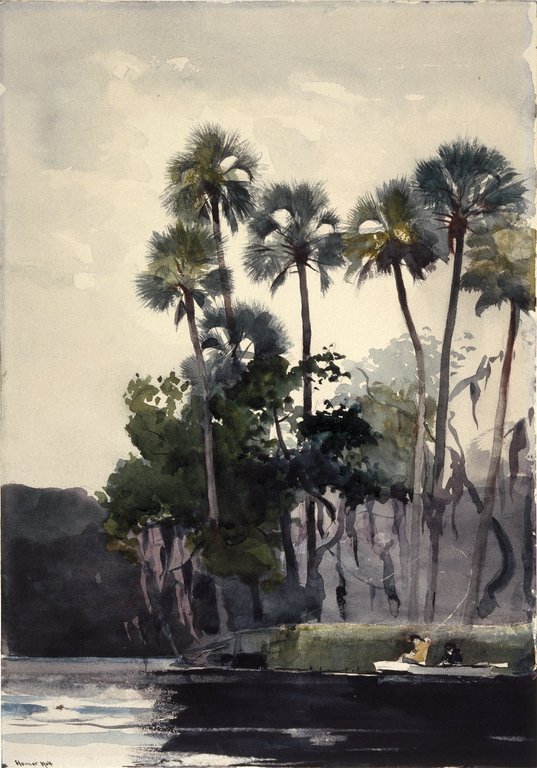
His late watercolors such as Homosassa River (1904) demonstrate both his intuitive approach and technical facility with the medium.
Led by innovators like Homer and the American Impressionists, American watercolorists broke new ground in the 1880s and began to explore the potential of the liquid medium. As never before, the play of natural light on landscape forms became the primary subject of their work. Inspired by the progressive realistic styles they saw in Europe, many artists adopted a freer approach to watercolor in order to convey their immediate impressions of nature with lively strokes of pure, bright color.
In The Gorge, Appledore (1912), Childe Hassam (1859–1935) captures the fleeting effects of light and color along the rugged coastline of the island off the coast of New Hampshire where he spent his summers.
During the same period, modernists began to experiment with abstract pictorial modes that referred to the formal structures or essences of their landscape subjects.
In paintings like John Marin’s (1870–1953) Pine Tree (1917), the bare white paper plays as vital a role as the dynamic components of the composition. Watercolor came to be associated with progressive art in the United States and it was considered a medium in which American artists equaled if not surpassed their European counterparts.
The American Scene Painting movement of the late 1920s–30s rejected most nineteenth-century ideas and devices in favor of unvarnished, typical American subjects, recording them with a new informality and sense of simplicity. Notable twentieth-century works in this vein include
Edward Hopper’s (1882–1967) House at Riverdale (1928)
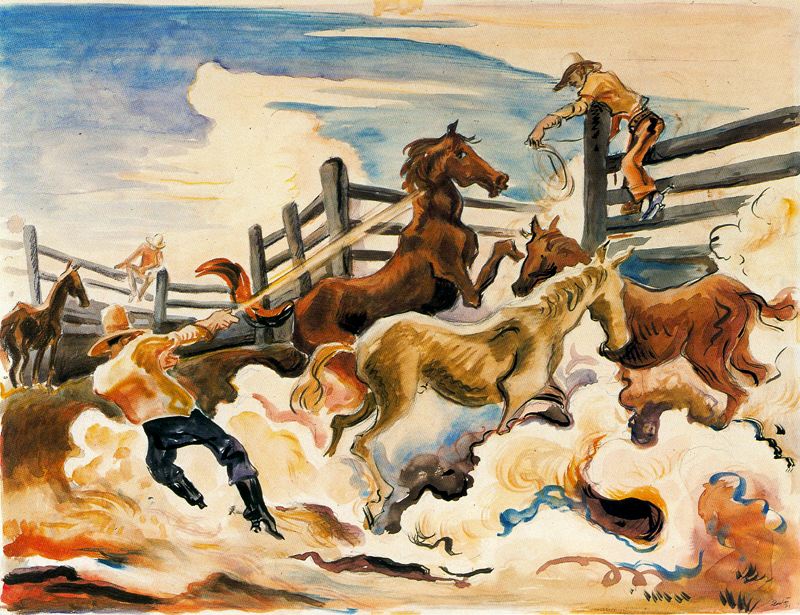
and Thomas Hart Benton’s (1889–1975) Lassoing Horses (1931).
American Waters: Celebrating the 400th Anniversary of Hudson, Fulton and Champlain
American Waters: Celebrating the 400th Anniversary of Hudson, Fulton and Champlain brings to light many works that have rarely been viewed by the public. American Waters features more than 50 works drawn from the National Academy’s wide-ranging collection of American art. This exhibition was on view at the National Academy Museum February 4 - April 5, 2009. Spanning the period 1850-2000, American Waters explores the myriad ways American artists have represented American aquatic environs, especially in the northeastern regions.
in 2009 New York State and its many communities celebrated a yearlong series of events to commemorate the 400th anniversary of New York State and the dual anniversaries of the voyages of English Captain Henry Hudson and Frenchman Samuel de Champlain. Within a century of their discoveries, the waterways that now bear the names Hudson and Champlain merged into one vital corridor at the epicenter of global commerce, politics and ideas. To celebrate these simultaneous Quadricentennials – as well as the 200th anniversary of Robert Fulton’s successful maiden steamboat journey up the Hudson River– the National Academy’s exhibition, American Waters revealed a unique historical perspective through select paintings of rural and urban American landscapes captured by generations of American artists.
Among the eastern sites pictured were the Hudson River and Niagara Falls of New York, the Saco River of New Hampshire, and Blubber Island in Maine. Some highlights of the exhibition were paintings by members of the second generation of the Hudson River School, which included
John Frederick Kensett’s dramatic painting of Bash-Bish Falls, one of Massachusetts’ highest and most dramatic waterfalls.
A section devoted to the landscape and marine painter William Trost Richards offered eight works given to the Academy by his daughter in 1952 and included a suite of five masterful watercolors of the sea that have not been seen by the public in many years. In contrast,
Junius Allens,
Guy Carleton Wiggens and
Ernest Lawson
describe the cityscapes along Manhattan’s ever changing waters’ edge.
American Waters provided a distinctive view of a variety of areas all across the continental United States. The exhibition featured the Academy’s superb, but little known group of paintings by leading Pennsylvania Impressionists Daniel Garber, and Edward Willis Redfield who painted in and around New Hope.
Western waterways were represented by Albert Bierstadt’s sparkling view of Devil’s Gate, a gorge on the Sweetwater River in Wyoming, which was a major landmark along the Oregon Trail,
Gregory Kondos’ 1993 view of a lonely strip of modern homes bordered by the Sacramento River, and Susan Shatter’s 1990 Alluvial Fantasy, based on observations and studies of natural erosion the artist made while working on the west coast. The imagery in Gregory Amenoff’s Dusk and Dim 1, 1996, developed as the result of spending time observing the role of water in the desert of the American Southwest. .
Among the 53 artists featured were Gregory Amenoff, Robert Berlind, Albert Bierstadt, George H. Boughton, Howard Russell Butler, Jasper Francis Cropsey, Asher B. Durand, Yasu Eguchi, Robert Gwathmey, Daniel P. Huntington, William Hart, George Inness, Yvonne Jacquette, John F. Kensett, Paul Resika, William Trost Richards, George Gardner Symons, Charles H. Woodbury and Newell Convers Wyeth.
American Waters: Celebrating the 400th Anniversary of Hudson, Fulton and Champlain was organized by Bruce Weber, Senior Curator, 19th Century Art, and has received the generous support of the F. Donald Kenney Memorial Fund, the New York City Department of Cultural Affairs, the New York State Council on the Arts.
The National Academy Museum & School of Fine Arts is an honorary association of professional American artists with a museum and an art school, modeled on London’s Royal Academy. The institution was founded in 1825 to promote contemporary painting, sculpture, drawing, printmaking and architecture in the United States. The Academy’s Museum organizes traveling shows accompanied by scholarly catalogues and hosts exhibitions from other museums. The Academy’s School features classes and master workshops in all styles and fine arts media. Public programs including lectures, symposia, panel discussions, and events for seniors and families are offered to the public.
Works on Display
1. Junius Allen, (1898-1962)
East River Waterfront, 1940
Oil on canvas, 25 x 30 inches
National Academy Museum & School of Fine Arts
2. Gregory Amenoff, b. 1948
Dusk and Dim I, 1996
Oil on canvas, 52 x 62 inches
National Academy Museum & School of Fine Arts
3. Robert Berlind, b. 1938
Pond’s Edge, 1994
Oil on linen, 54 x 48 _ inches
National Academy Museum & School of Fine Arts
4. Albert Bierstadt, (1830-1902)
On the Sweetwater, Near Devil’s Gate, 1860
Oil on millboard, 12 _ x 18 inches
National Academy Museum & School of Fine Arts
5. George H. Boughton, (1833-1905)
Winter Scene II, 1860
Oil on canvas, 15 1/8 x 12 _ inches
National Academy Museum & School of Fine Arts
6. Howard Russell Butler, (1856-1934)
Surf and Rocks, 1944
Oil on canvas, 40 _ x 50 inches
National Academy Museum & School of Fine Arts
7. John Fabian Carlson, (1874-1945)
Woodland Idyl, 1926
Oil on canvas, 25 x 30 3/8 inches
National Academy Museum & School of Fine Arts
8. John Costigan, (1888-1972)
The Sun’s Reflection, c. 1925
Oil on canvas, 45 1/8 x 45 1/8 inches
National Academy Museum & School of Fine Arts
9. Jasper Cropsey, (1823-1900)
Coast Scene, 1855
Oil on canvas, 17 x 26 1/8 inches
National Academy Museum & School of Fine Arts
10. Charles Temple Dix, (1838-1873)
Marblehead Rocks, 1868
Oil on canvas, 38 x 60 _ inches
National Academy Museum & School of Fine Arts
11. Asher B. Durand, (1796–1886)
Landscape, 1850
Oil on canvas, 27 _ x 38 _ inches
National Academy Museum & School of Fine Arts
12. Yasu Eguchi, b. 1938
Near the Spring, 1980
Watercolor, 43 x 79 inches
National Academy Museum & School of Fine Arts
13. Daniel Garber, (1880-1958)
By Addingham, 1911
Oil on canvas, 25 _ x 30 1/8 inches
National Academy Museum & School of Fine Arts
14. Marie Francois Regis Gignoux, (1814-1882)
Niagara Falls
Oil on canvas, 16 x 32 inches
National Academy Museum & School of Fine Arts
15. Robert Gwathmey, (1903-1988)
Soft Crabbing, 1976
Oil on canvas, 20 x 15 inches
National Academy Museum & School of Fine Arts
16. William Hart, (1823-1894)
Landscape, c. 1859
Oil on canvas, 7 _ x 10 _ inches
National Academy Museum & School of Fine Arts
17. William Hart, (1823-1894)
Twilight
Oil on canvas, 12 x 22 inches
National Academy Museum & School of Fine Arts
18. Daniel Huntington, (1816-1906)
Glimpses From the Forest, c. 1862
Oil on canvas, 17 _ x 21 inches
National Academy Museum & School of Fine Arts
19. George Inness, (1825-1894)
Landscape, 1860
Oil on paper mounted on panel, 16 _ x 24 inches
National Academy Museum & School of Fine Arts
20. Yvonne Jacquette, b. 1934
Embarcadero II, 1984
Monoprint and pastel hand coloring on white paper, 61 _ x 38 _ inches
National Academy Museum & School of Fine Arts
21. Wolf Kahn, b. 1927
Pond in November, 1977
Oil on canvas, 29 x 36 inches
National Academy Museum & School of Fine Arts
22. John F. Kensett, (1816-1872)
Glimpse Through the Wood, c. 1850
Oil on canvas, 12 x 10 inches
National Academy Museum & School of Fine Arts
23. John F. Kensett, (1816-1872)
The Bash-Bish, 1855
Oil on canvas, 36 1/8 x 29 inches
National Academy Museum & School of Fine Arts
24. John F. Kensett, (1816-1872)
On the Narragansett Coast, 1864
Oil on canvas, 9 _ x 20 _ inches
National Academy Museum & School of Fine Arts
25. Gregory Kondos, b. 1923
Courtland, Sacramento River, 1993
Oil on canvas, 24 x 32 inches
National Academy Museum & School of Fine Arts
26. Ernest Lawson, (1873-1939)
Road Down the Palisades
Oil on canvas, 25 x 30 inches
National Academy Museum & School of Fine Arts
27. Emma Fordyce MacRae, (1887-1974)
Pigeon Cove, c. 1951
Oil on cardboard, 24 _ x 29 _ inches
National Academy Museum & School of Fine Arts
28. Louis R. Mignot, (1831-1870)
Sources of the Susquehanna, 1857
Oil on canvas, 24 x 36 inches
National Academy Museum & School of Fine Arts
29. Anne Poor, (1918-2002)
Derricks on the Horizon, Haverstraw, c. 1974
Oil on canvas, 30 x 45 inches
National Academy Museum & School of Fine Arts
30. Marjorie Portnow, b. 1943
The Cut in the Marsh: Cape Cod Regatta, 1995
Oil on Masonite, 11 _ x 19 _ inches
National Academy Museum & School of Fine Arts
31. Edward Redfield, (1869-1965)
River in Winter, c. 1906
Oil on canvas, 22 7/8 x 31 _ inches
National Academy Museum & School of Fine Arts
32. Paul Resika, b. 1928
The End of the Hurricane, 1979
Oil on canvas, 24 x 29 inches
National Academy Museum & School of Fine Arts
33. Paul Resika, b. 1928
Calypso, 1999-2000
Oil on canvas 28 x 35 _ inches
National Academy Museum & School of Fine Arts
34. William Trost Richards, (1833-1905)
Coastal Scene, 1862
Oil on cardboard, 8 1/16 x 12 1/8 inches
National Academy Museum & School of Fine Arts
35. William Trost Richards, (1833-1905)
Marine with Yachts, c. 1870
Watercolor and gouache on green-grey wove paper, 8 3/16 x 13 7/8 inches
National Academy Museum & School of Fine Arts
36. William Trost Richards, (1833-1905)
Seascape, 1875
Watercolor and gouache on cream wove paper, 8 13/16 x 13 7/8 inches
National Academy Museum & School of Fine Arts
37. William Trost Richards, (1833-1905)
The Coming Rain, Narragansett Bay, c. 1890
Watercolor on off-white wove paper, 10 1/16 x 14 _ inches
National Academy Museum & School of Fine Arts
38. William Trost Richards, (1833-1905)
Shoreline with Bird, 1897
Watercolor and graphite on cream wove paper
National Academy Museum & School of Fine Arts
39. William Trost Richards, (1833-1905)
Coastal Sunset
Watercolor and gouache on cream wove paper, 9 13/16 x 15 11/16 inches
National Academy Museum & School of Fine Arts
40. William Trost Richards, (1833-1905)
Connanicut Shore with Breaking Wave
Oil on composition board, 12 _ x 23 7/8 inches
National Academy Museum & School of Fine Arts
41. Clare Romano, b. 1922
Big Falls, 1986
Color collagraph and woodcut on cream paper
29 _ x 22 _ inches
National Academy Museum & School of Fine Arts
42. Edward Francis Rook, (1870-1960)
Flume in Snow (Flume in Winter), c. 1920
Oil on canvas, 30 x 36 _ inches
National Academy Museum & School of Fine Arts
43. Susan Shatter, b. 1943
Alluvial Fantasy, 1990
Watercolor and graphite on white wove paper, 20 5/16 x 46 _ inches
National Academy Museum & School of Fine Arts
44. Aaron Draper Shattuck, (1832-1928)
The Ford, 1856
Oil on canvas, 16 x 24 inches
National Academy Museum & School of Fine Arts
45. Aaron Draper Shattuck, (1832-1928)
Along the Saco, 1857
Oil on canvas, 5 x8 inches
National Academy Museum & School of Fine Arts
46. George Gardner Symons, (1861-1930)
Swift Flowing River in Winter, 1912
Oil on canvas, 29 x 38 5/8 inches
National Academy Museum & School of Fine Arts
47. Reuben Tam (1916-1991)
Monhegan Night, 1956
Oil on canvas, 34 x 46 inches
National Academy Museum & School of Fine Arts
48. Thomas Worthington Whittredge (1820-1910)
Study from Nature, 1956
Oil on canvas, 19 _ x 15 _ inches
National Academy Museum & School of Fine Arts
49. Guy Wiggins, (1883-1962)
Manhattan, 1929
Oil on canvas, 30 x 60 inches
National Academy Museum & School of Fine Arts
50. Charles H. Woodbury, (1864-1940)
October, c. 1908
Oil on canvas, 27 x 27 inches
National Academy Museum & School of Fine Arts
51. Newell Convers Wyeth, (1882-1945)
Blubber Island, Maine, 1940
Oil on gesso ground, 25 x 40 inches
National Academy Museum & School of Fine Arts
Andy Warhol: The Last Decade
Andy Warhol: The Last Decade, at the Brooklyn Museum of Art June 18–September 12, 2010, was the first United States museum exhibition of the late works of American artist Andy Warhol (1928–1987) and the first major Warhol survey in New York since the 1989 exhibition at the Museum of Modern Art.
Created amid the frenetic activity of Warhol’s celebrity, the nearly fifty paintings on view revealed the artist’s vitality, energy, and spirit of experimentation. During this time Warhol produced more works, in a considerable number of series and on a vastly larger scale, than at any other point in his forty-year career. It was a decade of great artistic development for him, characterized by a dramatic transformation of his style and the introduction of new techniques. Warhol’s active social life, continuing business ventures, print projects, television productions, fashion engagements, and renewed interest in painting combined to make the artist’s final decade one of the busiest in his career.
Beginning with the Oxidation series of 1977–78 and the screened Shadows initiated in 1978, he began exploring abstract art, a conceptual and stylistic break from his Pop imagery of the 1960s. Over the next ten years, his prolific output of paintings included a return to the figurative inspired by his collaborations with Jean-Michel Basquiat, Francesco Clemente, and Keith Haring; black-and-white paintings based on magazine advertisements; psychologically revealing fright-wig self-portraits; the Camouflage works; and explorations of religious themes, including the Last Supper paintings, which infused Leonardo da Vinci’s iconic Italian fresco with a pop sensibility and constituted the largest series that Warhol produced throughout his career.
Together, these works demonstrated how Warhol simultaneously incorporated the screened image and pursued a reinvention of painting. Created alongside his commissioned portraits and print series, many of these late paintings were personal projects that were not exhibited until after the artist’s death on February 22, 1987.
The works in the exhibition were on loan from private and public collections. Included are examples of the Oxidation series, in which urine is a component;
the mysteriously evocative Shadows, some with diamond dust;
a late example of Warhol’s iconic Campbell Soup (Tomato) from his Retrospectives and Reversals series;
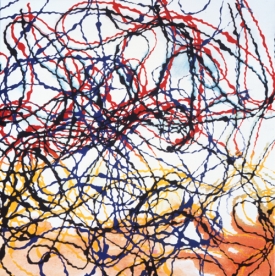
the Yarn paintings, a direct reference to Jackson Pollock’s drip paintings;
monumental Rorschach paintings;
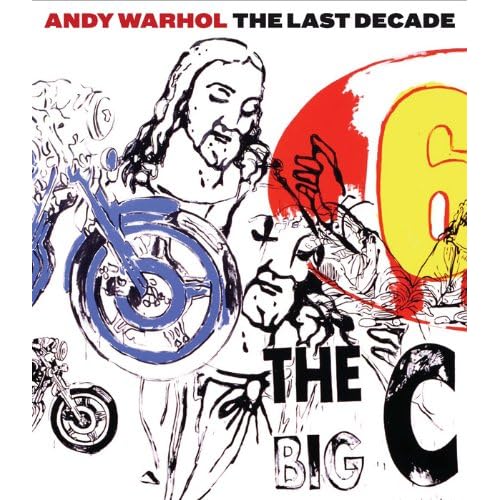
and a version of The Last Supper, featuring images of Christ juxtaposed with a price tag and Mineola motorcycles, that was included in the Fort Worth and Brooklyn presentations only.
Andy Warhol: The Last Decade was organized by the Milwaukee Art Museum.
The exhibition was curated by Joseph D. Ketner II, Henry and Lois Foster Chair of Contemporary Art, Emerson College, Boston. The Brooklyn Museum presentation is organized by Sharon Matt Atkins, Associate Curator of Exhibitions, Brooklyn Museum.
An exhibition catalogue, published by the Milwaukee Art Museum and DelMonico Books, an imprint of Prestel Publishing, includes essays by Joseph D. Ketner II, Keith Hartley, and Gregory Volk, along with a contribution by Bruno Bischofberger and out-of-print essays by Keith Haring and Julian Schnabel.
Tour Schedule:
Milwaukee Art Museum September 26, 2009–January 3, 2010 Museum of Modern Art, Fort Worth February 14–May 16, 2010 Brooklyn Museum June 18–September 12, 2010 Baltimore Museum of Art October 17, 2010–January 9, 2011
Norman Rockwell: Behind the Camera
To create many of his iconic, quintessentially American paintings, most of which served as magazine covers, Norman Rockwell worked from carefully staged study photographs that are on view for the first time, alongside his paintings, drawings, and related tear sheets, in Norman Rockwell: Behind the Camera. The exhibition, on view at the Brooklyn Museum of Art from November 19, 2010, through April 10, 2011, was organized by the Norman Rockwell Museum in Stockbridge, Massachusetts, following a two-year project that preserved and digitized almost 20,000 negatives.
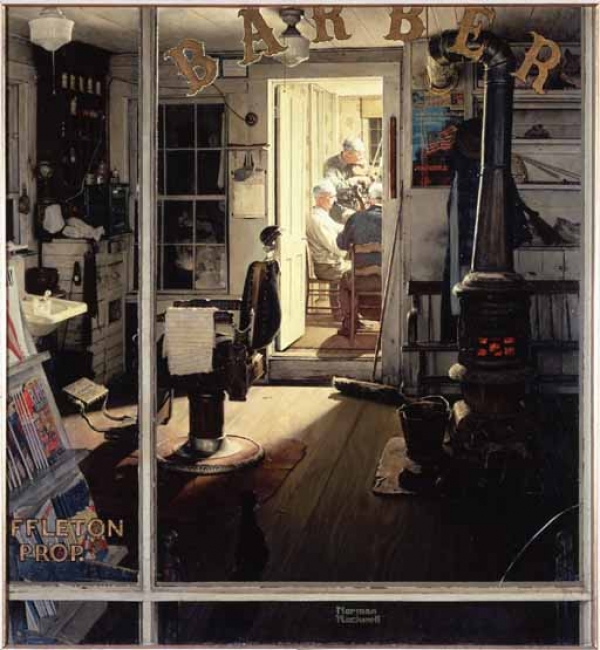
Beginning in the late 1930s, Norman Rockwell (1894–1978) adopted photography as a tool to bring his illustration ideas to life in studio sessions. Working as a director, he carefully staged his photographs, selecting props, locations, and models and orchestrating every detail. He began by collecting authentic props and costumes, and what he did not have readily available he purchased, borrowed, or rented—from a dime-store hairbrush or coffee cup to a roomful of chairs and tables from a New York City Automat.
He created numerous photographs for each new subject, sometimes capturing complete compositions and, in other instances, combining separate pictures of individual elements. Over the forty years that he used photographs as his painting guide, he worked with many skilled photographers, particularly Gene Pelham, Bill Scovill, and Louis Lamone.
Early in his career Norman Rockwell used professional models, but he eventually found that this method inhibited his evolving naturalistic style. When he turned to photography, he turned to friends and neighbors instead of professional models to create his many detailed study photographs, which he found liberating. Working from black-and-white study photographs also allowed Rockwell more freedom in developing his final work.
“If a model has worn a red sweater, I have painted it red—I couldn’t possibly make it green.… But when working with photographs I seem able to recompose in many ways: as to form, tone, and color,” Rockwell once commented.
Included in the exhibition were more than one hundred framed digital prints alongside paintings, drawings, magazine tear sheets, photographic equipment, and archival letters, as well as an introductory film.
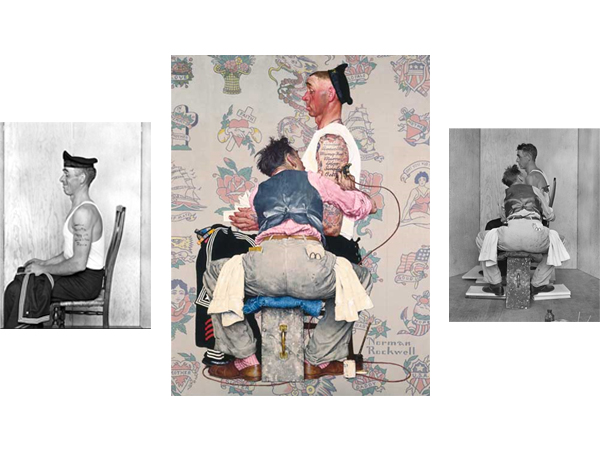
Among the paintings on view was the Brooklyn Museum’s painting The Tattoo Artist — one of many that Rockwell created during World War II — depicting a young sailor stoically having his arm tattooed, shown alongside working photographs by Gene Pelham,
and the watercolor Dugout, also from the Museum’s collection, portraying the Chicago Cubs baseball team being jeered by fans of the Boston Braves.
This work was displayed along with the September 4, 1948, Saturday Evening Post cover on which it appeared and study photographs by Gene Pelham.
Among the magazine covers included in the exhibition were several from The Saturday Evening Post, for which Rockwell worked for nearly fifty years before turning his attentions to more socially relevant subjects for Look magazine, with which he had a decade-long relationship.
Included was The Art Critic, showing an aspiring artist scrutinizing paintings in a gallery, which appeared in the April 16, 1955, issue.
The exhibition also included several series of photographs and the final paintings and magazine tear sheets, among them the July 13, 1946, Saturday Evening Post illustration Maternity Waiting Room, shown along with a series of images by an unidentified photographer that served as details of the final work, which portrays ten anxious soon-to-be fathers.
Norman Rockwell became one of the most famous illustrators of his generation through his naturalistic, narrative paintings done in a readily recognizable style, which appeared in national magazines that reached millions of readers. Born in 1894 on Manhattan’s Upper West Side, he left high school to study at the National Academy of Design and later the Art Students League of New York. By the age of eighteen he was already a published artist specializing in children’s illustration and had become a regular contributor to magazines such as Boys’ Life, the monthly magazine of the Boy Scouts of America, where he was soon named art director. In 1916 he painted his first cover for The Saturday Evening Post, beginning a forty-seven year relationship that resulted in 323 covers and was the centerpiece of his career.
Early in his career Rockwell had a studio in New Rochelle, New York. He later moved with his wife and three sons to Arlington, Vermont, where many of his family and neighbors served as models in working photographs for his illustrations, which began to focus on small-town American life. In 1943 a fire destroyed his Vermont studio, along with numerous paintings and many of the photographic studies. A decade later the family relocated to Stockbridge, Massachusetts.
In 1963 he severed his forty-seven- year association with The Saturday Evening Post and began to work for Look magazine, where, during his ten-year association, he produced work that reflected his personal concerns, including civil rights, America’s war on poverty, and space exploration.
Norman Rockwell: Behind the Camerawas organized by the Norman Rockwell Museum, where it was presented from November 7, 2009, through May 31, 2010. Conceived in collaboration with Ron Schick, guest curator for the Norman Rockwell Museum and author of
the accompanying publication, the exhibition revealed a rarely seen yet fundamental aspect of Rockwell’s creative process and unveils a significant new body of Rockwell imagery through the medium of photography. The Brooklyn Museum presentation was organized by Sharon Matt Atkins, Acting Head of Exhibitions and Managing Curator.
Subscribe to:
Posts (Atom)