Monday, October 5, 2026

Photography’s First Century: Masterworks from the Bibliothèque nationale de France

Kimbell Art Museum 

October 4, 2026, through January 17, 2027


The Kimbell Art Museum will present the special exhibition Photography’s First Century: Masterworks from the Bibliothèque nationale de France from October 4, 2026, through January 17, 2027, in the Renzo Piano Pavilion. The Kimbell’s first-ever photography exhibition, it will trace the history of photography’s first one hundred years of exploration and discovery, from the rise of the daguerreotype and the calotype in the 1840s to the age of modernism between the World Wars. Organized in conjunction with France’s national library in Paris in celebration of the bicentennial of photography’s invention, this survey of more than 150 images includes work by Henri Le Secq, Gustave le Gray, Félix Tournachon (Nadar), Édouard Baldus, Louis-Émile Durandelle, Eugène Atget, André Kertesz, Rogi André, Man Ray, and Brassaï.   

“The Kimbell’s first photography exhibition is drawn entirely from what is arguably the world’s most important collection of photographs, one that dates back to the birth of the medium in France in the nineteenth century,” said Eric Lee, director of the Kimbell Art Museum. “We are fortunate to partner with the Bibliothèque nationale—one of the world’s greatest libraries, where centuries of human thought and creative output are preserved—and to be part of the international celebration of photography’s bicentennial.” 

The exhibition is organized along roughly chronological lines, first introducing visitors to photography’s invention and earliest years, showcasing rare historical documents and images, before beginning explorations of the earliest technological innovations: the daguerreotype and the calotype. These two sections include works of historic, artistic, and technological significance, such as Charles Hugo’s daguerreotype portrait of his father, the novelist Victor Hugo; archaeologist Joseph-Philibert Girault de Prangey’s daguerreotypes, documenting Notre-Dame Cathedral in Paris and the Khayrbak Mosque (also known as the Blue Mosque) in Cairo, palms in Athens, and ancient cedars in Beirut; still lifes by Henri Le Secq, seen in rare paper negatives; and Eugène Cuvelier’s poetic calotype landscapes of the Forest of Fontainebleau. 


The exhibition also includes several sections that present concentrated explorations of individual photographers, revealing each artist’s particular contribution to the medium in depth. 
Photography’s First Century
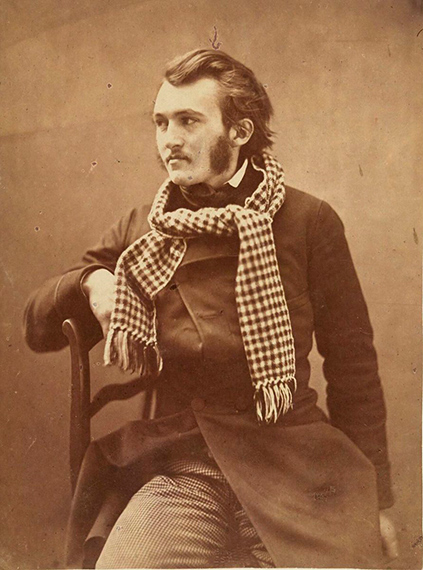
Félix Nadar,
Gustave Doré jeune, assis, une écharpe à carreaux autour du cou

- Entre 1856 et 1858 - BnF, département des Estampes et de la photographie,

Portrait photographs by Félix Tournachon, known as Nadar, for example, demonstrate the artist’s pioneering achievements in the use of carefully modulated light to photograph such international notables as Cuban singer María Martínez and Italian composer Gioachino Rossini; Parisian artists Honoré Daumier, Gustave Doré, and Antoine-Augustin Préault; writers Alexandre Dumas and Henri Murger; and celebrated beauties Princess Cantacuzene and actress Marie Laurent. Believing that the photograph could rival painting, the pioneering Gustave le Gray created moody views of the Mediterranean coast that capture the dramatic light of both the sea and the sky—almost impossible to photograph simultaneously in his day—by making sumptuous prints from multiple negatives. His contemporary Édouard Baldus’s reputation was built along with the modern infrastructure of France itself, as the artist gained commissions to document architectural and engineering marvels, including the 1860s construction of the Paris–Lyon–Méditerranée railway and the picturesque sites along its length. Equally renowned for his contributions to nineteenth-century architectural photography, Louis-Émile Durandelle is represented in the exhibition through a series of photographs that document the construction of the Paris Opéra (1861–75) commissioned by its architect Charles Garnier.

The photographs of Baldus and Durandelle were bound in albums for presentation or sale. 


Seated Female Nude
(also known as Draped Model or Nude from Behind), a collaborative photographic study created around 1853–1854 by French amateur photographer Eugène Durieu alongside painter [Eugène Delacroix].

The image shows a woman with braided dark hair viewed from behind, seated with a draped fabric or cloth wrapped around her lower body against a simple curtain backdrop. Delacroix reportedly directed the staging and poses of these nude studies to use as reference for his paintings and drawings, while Durieu operated the camera. Another section of the exhibition is devoted to albums of photographs assembled for private use, beginning with a collaborative series of pictures by the painter Eugène Delacroix and photographer Eugène Durieu. Created over two days in 1854, these were staged by the famed Delacroix—who had become fascinated by photography, especially studies of the nude figure—and shot by Durieu. The prints of nude models were assembled in an album, and after Delacroix’s death came into the possession of a friend who gave them to the Bibliothèque nationale in 1899. Also on view are albums containing works by Henri Le Secq and his friends; by the family of Victor Hugo; and by Edgar Degas and his friends the writer Ludovic Halévy, his wife Louise, and their son Daniel. 

As visitors to the exhibition cross the threshold of the twentieth century, they will encounter the renowned works of Eugène Atget, whose evocative Paris street scenes together capture a poignant portrait of a city in transformation, as the remnants of vieux Paris—the Paris of old—gave way to modernization. The work of the American-born Man Ray follows, including some of his best-known works, like Sleeping Woman (Natascha) (1931); a striking Rayograph: Revolver and Serpentine, made by placing objects on a sheet of photo paper and exposing it to light; and portraits of Jacqueline Goddard, Gertrude Stein, and fellow photographer Lee Miller, some incorporating his signature solarization. Similarly iconic images by the Hungarian-born French photographer known as Brassaï include works from his famous series Paris de Nuit (1932), Madame Bijou at the Bar de la Lune, Montmartre (1932), and Sleeping Worker at the Folies Bergères (1933). 

The section Rogi André and Photography Between the Wars presents a selection of the disciplined yet nuanced portraits of early twentieth-century intellectuals and artists by the photographer, born Rosza Klein in Hungary in 1900. Among these are likenesses of Peggy Guggenheim, Alberto Giacometti, Piet Mondrian, and Dora Maar, Pablo Picasso’s lover and muse, herself a photographer. André’s images appear alongside photographs by her husband of approximately four years, André Kertész, and a selection of photographic publications from the inter-war years by artists in their circle.

The exhibition devotes two chapters to the idea of a single personality as explored by many of the most well-known photographers of the early twentieth century. First, exhibition visitors meet visual artist, fashion and textile designer, and color theorist Sonia Delaunay. Born in the Russian Empire, she arrived in France as a twenty-year-old in 1905 and emerged in the Parisian avant-garde with paintings displayed alongside works by Picasso, Georges Braque, and André Derain before marrying the painter Robert Delaunay in 1910. By the 1920s, her focus shifted to couture, which she had documented in photographs by such artists as Germaine Krull and Thérèse Bonney. In posed shots of models and portraits of the artist herself, photographers tackled the problem of representing Delaunay’s bold geometry and characteristic juxtaposition of complementary colors through the black-and-white medium of photography.

As the concluding chapter in this sweeping view of the first century of the medium of photography in the country of its birth, the exhibition brings viewers face-to-face with Pablo Picasso through a selection of photographs from the 1930s. Another exploration of a single subject seen through many lenses, the grouping includes photos by Cecil Beaton, Man Ray, Rogi André, and especially Brassaï. First introduced in 1932 when Brassaï received a commission to photograph Picasso’s studio and sculptures, the two artists became friends and continued to work together throughout their careers. As noted in the exhibition catalogue essay on the Picasso photographs, “Brassaï knew Kertész, who had introduced Rogi André to the medium; Rogi André frequented the Surrealists, whom Picasso passed through without ever submitting to them . . . All these photographers are practitioners of multiple curiosities—painters, draftsmen, filmmakers, writers—for whom photography is not a specialty but one instrument among others.”

"It has been a privilege and a pleasure to work with Sylvie Aubenas and Flora Triebel at the Bibliothèque nationale to select the most intriguing examples for the show from their collection,” said George Shackelford, deputy director of the Kimbell Art Museum and organizing curator of the exhibition. “It’s a collection unlike any other, filled with rare and surprising things, from the manuscripts documenting the invention of photography in the 1830s to celebrated photographs by the Parisian masters of the inter-war years. Around every corner in Photography’s First Century, there will be something unexpected to discover.”


ORGANIZATION AND CATALOGUE

This exhibition is organized by the Bibliothèque nationale de France and the Kimbell Art Museum in collaboration with Manifesto Expo and in conjunction with France’s celebration of the bicentennial of the invention of photography.

The exhibition’s curators are Madame Sylvie Aubenas, director of the Department of Prints and Photography emerita, and Madame Flora Triebel, curator of the nineteenth-century photography collection at the Bibliothèque nationale de France, Paris. Its presentation at the Kimbell is organized by George T. M. Shackelford, deputy director.


The 336-page catalogue reproduces each exhibited work as well as a rich variety of comparative images. It includes a preface by Gilles Pécout, president of the Bibliothèque nationale de France, and a foreword by Kimbell director Eric M. Lee, followed by essays by Aubenas and Triebel, who also contributed discussions of each of the sections of plates. An illustrated chronology of the first one hundred years of photography in France is accompanied by a selection of evocative texts written by the artists themselves and later critics; a rich bibliography will be useful for further research.  

Sunday, October 4, 2026

The Surrealist Book: Tomorrow Lives in Mirror

The Museum of Modern Art 

October 4, 2026, through January 23, 2027

The Museum of Modern Art presents The Surrealist Book: Tomorrow Lives in Mirrors, an exhibition showcasing the propulsive impact of artists’ books—books made as works of art—within the Surrealist movement. For the artists and writers associated with Surrealism, the book was an ideal vehicle for subversive experimentation and the promotion of their revolutionary tenets. Working collaboratively to unlock the unconscious, they transformed the bound volume into a provocative new art form, an enchanted portal to the unexpected, the irrational, and, what they called, the “marvelous.” 

On view at MoMA from October 4, 2026, through January 23, 2027, The Surrealist Book features a selection of rare volumes produced by Surrealism’s most imaginative artists and writers, including André Breton, Claude Cahun, Salvador Dalí, Paul Éluard, Max Ernst, and Toyen. The exhibition is organized by Jodi Hauptman, The Robert Lehman Foundation Chief Curator of Drawings and Prints, and Starr Figura, Senior Curator, with Kolleen Ku, Curatorial Assistant, and Emma Kang, Brooke Alexander Fellow, Department of Drawings and Prints. 

The exhibition presents—for the first time at MoMA—a transformative gift of artists’ books from Helen and Sam Zell, which came to the Museum in 2022. The Zell Collection is one of the most significant collections of artists’ books formerly in private hands. Comprising approximately 100 works, it spans the period from 1857 to 2014, with an extensive and unparalleled concentration of editions and unique book works made in the context of Surrealism and its legacy. What unites these volumes is a sensibility that extends from the Surrealists’ profound sensitivity to all facets of the book, from the intellectual and poetic to the formal and tactile, from the intimate and personal to the subversive and revolutionary. 

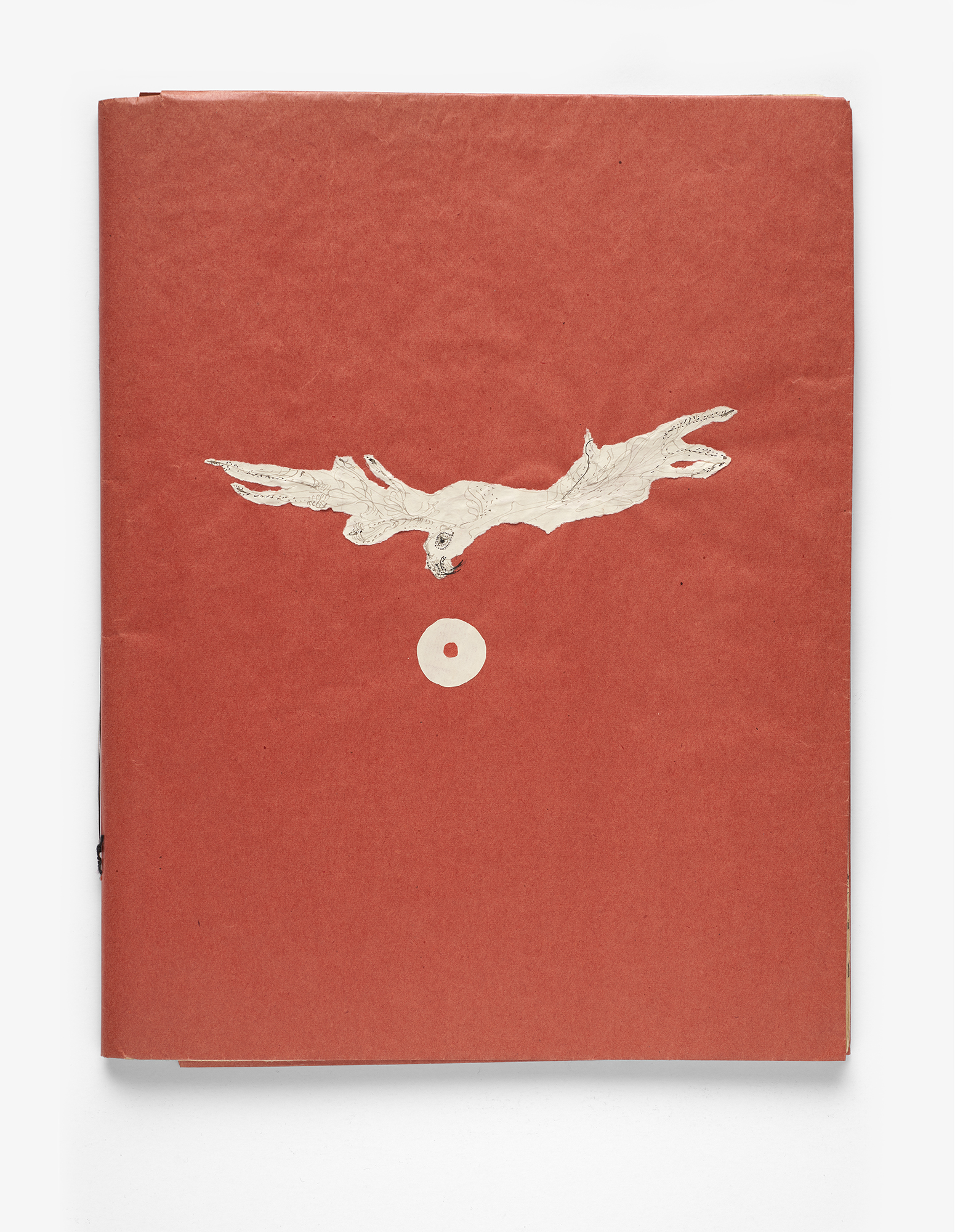
Anchored by this singular collection, the exhibition will display special editions printed on unusual papers or enhanced with supplementary materials, unique maquettes and singular sketchbooks filled with collages and fantastical drawings, sculptural bindings that turn books into hybrid, interactive artworks, and much more. Among the extraordinary rarities in the Zell Collection are original manuscripts for some of Surrealism’s iconic texts, including Breton’s Manifeste du surréalisme; Poisson soluble (Surrealist Manifesto; Soluble Fish) (1924); outstanding books by such women artists as Unica Zürn, who filled a private notebook with intricate drawings of hybrid animal-human creatures; and one-of-a- kind bindings by Georges Hugnet that incorporate unexpected materials like liquid mercury or shattered glass. 

The Surrealist Book foregrounds intimate partnerships between artists and poets, such as that of Dalí, Breton, and Éluard in L’Immaculée conception (The Immaculate Conception) (1930); radical explorations of materiality, including the frottage rubbings Ernst made for Mr. Knife, Miss Fork (1931) and Je Sublime (I Sublime) (1936); photographic experiments, such as the kaleidoscopic photomontages in Cahun and Marcel Moore’s Aveux non Avenus (Cancelled Confessions) (1930), the solarized nudes by Man Ray that merge with Éluard’s love poems in Facile (Easy) (1935), and the transformation of succulent plants into mutating forms in Yoshio Shimozato’s Mesemu zoku; Chōgenjitsushugi shashinshū (Genus Mesemb; 20 Surrealist Photographs) (1940); and dynamic typography, as exemplified by Hugnet and Marcel Duchamp’s La septième face du dé: Poèmes-découpages (The Seventh Face of the Die: Collage Poems) (1936). Through these and other works, the exhibition demonstrates the centrality of bookmaking within Surrealism and the artist’s book’s place among the most compelling achievements of avant-garde art in the 20th century. 

The exhibition begins in the 1920s, when collaborations between writers and artists became a driving force in Surrealist practice and the Surrealist book emerged as one of the movement’s most prevalent, expressive, and significant art forms. Works made in the 1930s capture the expansive ambition of the movement’s members, as Surrealist artists and poets lavished attention on the book’s aesthetic and material possibilities and sought to spread their ideas across the globe. Ever more intricately conceived and elaborately housed, with texts and images increasingly transgressive and unfettered—and distribution networks expanding internationally—the book evolved into a quintessential Surrealist object of desire and a key emissary in the field. 

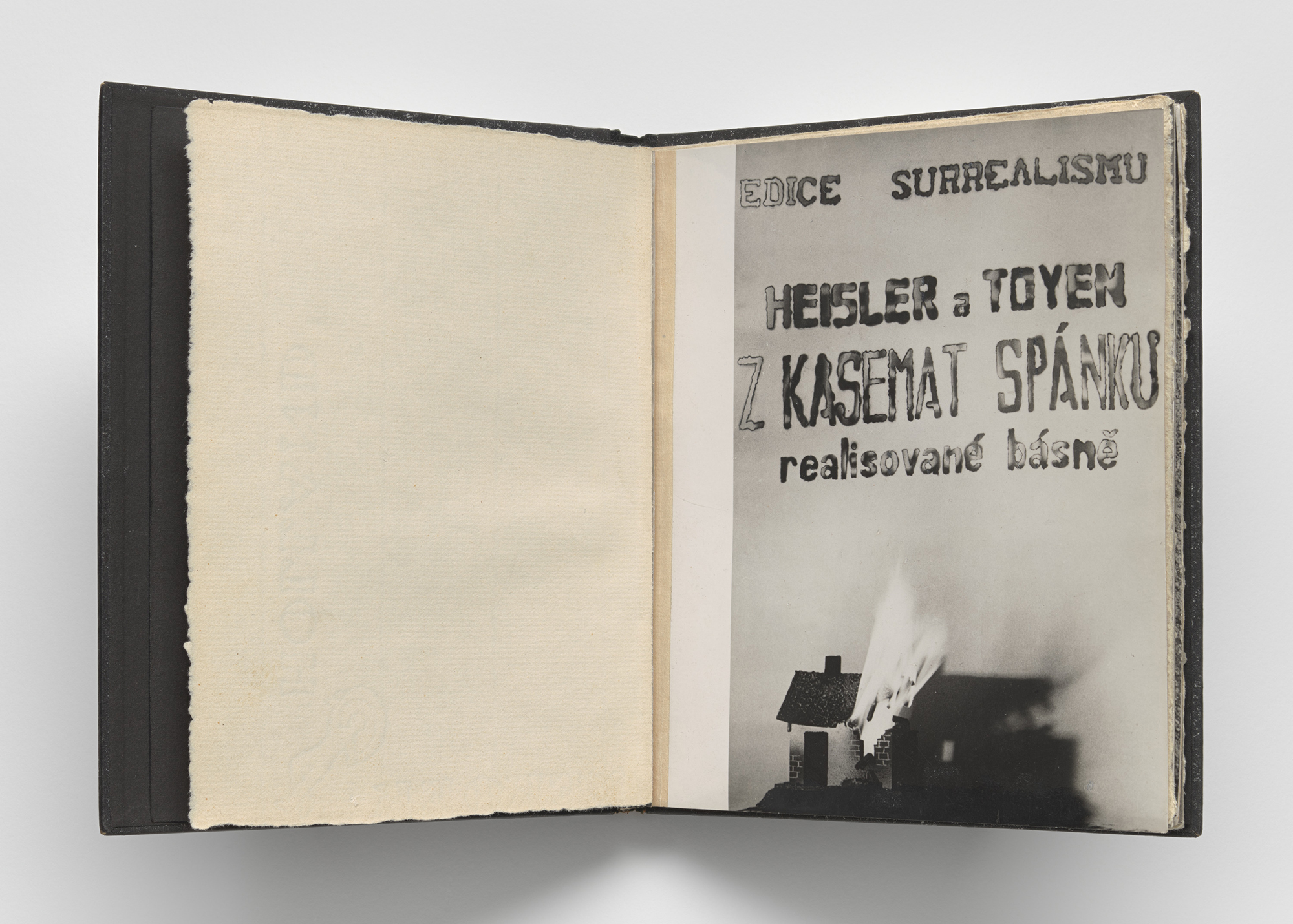
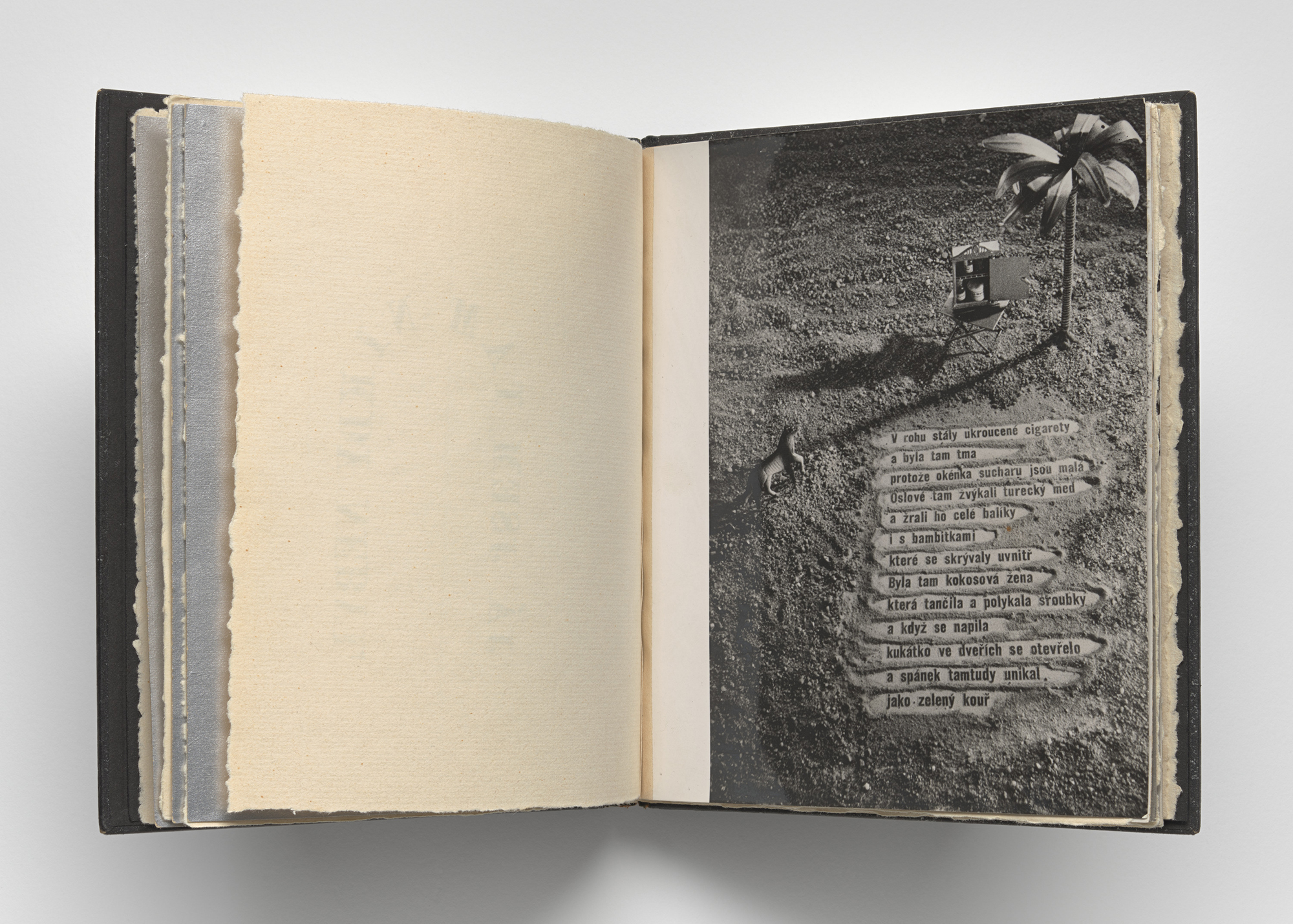
With the rise of fascism and war in the late 1930s and ’40s, books became stealth agents of resistance, as publishers searched for covert ways to distribute their antiwar books and private homes served as clandestine printshops for volumes such as Toyen and Jindřich Heisler’s Z kasemat spánku: Realisované básně (From the Strongholds of Sleep: Realized Poems) (1940). 

Well into the postwar period, the Surrealists continued to deploy published editions and unique volumes to explore and communicate their ideas. In the landmark A Toute Épreuve (Proof Against All) (1958), for example, Joan Miró’s colorful biomorphic woodcuts float playfully around Éluard’s lyrical poems. Meanwhile, a new generation of artists and writers, including Charles Henri Ford, William S. Burroughs, and Brion Gysin, took up Surrealist strategies of collaboration, collage, and chance within the pages of their own inventive books, using them to create new ways to bypass the conscious mind. 

“A sense of the marvelous, the pursuit of new forms of expression via collaborative means, an invitation to expand consciousness; these aspects of Surrealism are fully activated in the Surrealist book,” says Hauptman. “At its most quintessential and exquisite, the Surrealist book combined the literary, artistic, and political in a way that no other object could, and enabled the spread of Surrealist thought in a way that no other vehicle would.” Figura adds, “For the Surrealists, a book was like a door, a portal to a higher realm, where untold surprises and liberatory revelations await. The Surrealist Book demonstrates how and why books were so meaningful, evocative, and inspiring for the Surrealists, and it offers a rare opportunity to see their experiments with this medium at their most dazzling and creative.” 


The Surrealist Book will be accompanied by a richly illustrated catalogue exploring the Zell Collection’s rare and unique artists’ books, highlighting experimentation with unconventional materials and innovative formats, and discussing the contexts in which these special volumes were created. The catalogue is edited by Jodi Hauptman and Starr Figura, with contributions by leading scholars, curators, and conservators, including Barbora Bartunkova, Chang Yuchen, Lee Ann Daffner, Leah Dickerman, Hal Foster, Hannah Freed-Thall, Samantha Friedman, Johanna Gosse, Caitlin Gozo Richeson, Sofia Kofodimos, Kolleen Ku, Alyce Mahon, Sean O’Hanlan, Abigail Susik, Whitney Trettien, Anne Umland, and Annie Wilker with Sonya Barron. Hardcover, $75. ISBN: 978-1-63345-181-0. Published by The Museum of Modern Art, New York, and available at MoMA stores and online at store.moma.org. 

Giorgio de Chirico, artist. Paul Éluard, author. Georges Hugnet and Louis Christy, binders. Défense de savoir (Knowledge Forbidden). Published 1928; rebound 1936. Book with one collotype reproduction of a drawing by de Chirico (frontispiece); letterpress text. Bespoke rebinding by Hugnet and Christy for Hugnet, with leather, blind tooling, blind stamping, and paint, front and back covers each holding a sheet of shattered lead glass between two additional sheets of lead glass; metallic-paper flyleaves and decalcomania (gouache transfer) endpapers. Pages (dimensions vary), largest: 10 1/2 × 8 1/8 in. (26.6 × 20.7 cm). Publisher: Éditions Surréalistes, Paris. Edition: no. 14 of 100. The Museum of Modern Art, New York. Gift of Helen and Sam Zell

Photo by Martin Parsekian
© 2026 Artists Rights Society (ARS), New York / SIAE, Rome; © 2026 Artists Rights Society (ARS), New York; © 2026 Artists Rights Society (ARS), New York / ADAGP, Paris

André Breton, author. Paul Bonet, binder. Manifeste du surréalisme; Poisson soluble (Surrealist Manifesto; Soluble Fish). Published 1924; additional documents c. 1920–29; rebound 1931. Book with letterpress text, annotated by Breton. Rebound with additional manuscripts and one collage poem by Breton, folded to fit, and bespoke nickel silver binding by Bonet for René Gaffé. Pages (dimensions vary): from 7 1⁄16 × 4 ⁵⁄16 in. (18 × 11 cm) to 13 ⅞ × 9 13⁄16 in. (35.2 × 25 cm). Publisher: Éditions du Sagittaire, Paris. Edition: no. 1 of 19. The Museum of Modern Art, New York. Gift of Helen and Sam Zell

Photo by Ben Blackwell
© 2026 Artists Rights Society (ARS), New York / ADAGP, Paris

Salvador Dalí, artist. André Breton, author. Paul Éluard, author. Paul Bonet, binder. L’immaculée Conception (The Immaculate Conception). Published 1930; additional documents c. 1935; rebound 1942. Book with one gravure and etching by Dalí (frontispiece); letterpress text; line-block vignette by Dalí on title page and on publisher’s original paper cover. Rebound with an original pencil drawing by Dalí, manuscript materials by Paul and Nusch Éluard, Breton, and Dalí, and other documents. Bespoke black leather rebinding by Bonet for Éluard, front and back covers each with a gelatin silver print, colored leather onlays, blind tooling, and foil stamping. Pages (dimensions vary): from 9 1/16 × 7 1/16 in. (23 × 18 cm) to 9 13/16 × 8 ¼ in. (25 × 21 cm). Publisher: Éditions Surréalistes/Librairie José Corti, Paris. Edition: Éluard’s author’s copy, no. 6 of 116 and one of 13 on Japon blanc nacré paper (plus 2,000 without the gravure and etching). The Museum of Modern Art, New York. Gift of Helen and Sam Zell

Photo by Martin Parsekian
© 2026 Salvador Dalí, Fundació Gala-Salvador Dalí, Artists Rights Society; © 2026 Artists Rights Society (ARS), New York / ADAGP, Paris; © 2026 Artists Rights Society (ARS), New York

Salvador Dalí, artist. Georges Hugnet, author and binder. Louis Christy, binder. Onan. Published 1934; rebound 1936. Book with one gravure, aquatint, and drypoint by Dalí (frontispiece); letterpress text. Bespoke rebinding by Hugnet and Christy for Hugnet, with leather, blind tooling, and foil stamping, front cover with dye-colored sand between two sheets of lead glass with rayon-covered board elements on top, back cover with dried seahorse between two sheets of lead glass; printed-paper flyleaves, front flyleaf with collage by Hugnet in cut-and-pasted printed paper and pencil. Pages (dimensions vary, approx.): 11 × 9 in. (27.9 × 22.9 cm). Publisher: Éditions Surréalistes, Paris. Edition: Hugnet’s author’s copy, unnumbered, from the edition of 77, (plus 200 without the gravure). The Museum of Modern Art, New York. Gift of Helen and Sam Zell

Photo by Martin Parsekian
© 2026 Salvador Dalí, Fundació Gala-Salvador Dalí, Artists Rights Society; © 2026 Artists Rights Society (ARS), New York / ADAGP, Paris

Claude Cahun, artist and author. Marcel Moore, artist. Aveux non avenus (Canceled Confessions). Published 1930 (texts 1919-28). Book with ten gravure reproductions of photomontages and one gravure reproduction of a photograph; letterpress text. Pages: 8 1/4 × 6 5/16 in. (21 × 16 cm). Publisher: Éditions du Carrefour, Paris. Edition: one of 25 press copies, this one lettered J (total edition 500). The Museum of Modern Art, New York. Gift of Helen and Sam Zell

Photo by Ben Blackwell

Toyen, artist. Jindřich Heisler, artist and author. Z kasemat spánku: Realisované básně (From the Strongholds of Sleep: Realized Poems). Published 1940. Book with eight gelatin silver prints, including title page (staged environments by Toyen and Heisler, photographed by Miro Bernat and Viktor Radnitzer), each mounted on metallic paper; printed text. Pages: 6 1/8 × 5 1/16 in. (15.5 × 12.9 cm). Publisher: Edice Surrealismu, Prague. Edition: no. 2 of 17. The Museum of Modern Art, New York. Gift of Helen and Sam Zell

Photo by Martin Parsekian
© 2026 Artists Rights Society (ARS), New York / ADAGP, Paris

Unica Zürn, artist and author. Orakel und Spektakel, IV. Buch: Anagramme und Zeichnungen (Oracle and Spectacle, Book IV: Anagrams and Drawings). 1960. Book with ink, colored ink, pencil, torn-and-pasted paper, dried plant material, feathers, envelopes, playing card, and embroidery-thread winder with thread; pamphlet binding with red paper wrapper with cut-and-pasted paper and drawing in ink on torn-and-pasted papers. Pages: 12 13/16 × 9 13/16 in. (32.5 × 25 cm). The Museum of Modern Art, New York. Gift of Helen and Sam Zell

Photo by Ben Blackwell
© Verlag Brinkmann & Bose, Berlin, Germany

Ray Johnson, artist and author. Th Thee for and Lai Book. c. 1955. Book with cut-and-pasted printed, colored, and metallic paper and hand-lettered text in ink on irregularly shaped paper leaves, some with cutout holes, foldout flaps, synthetic leather, and partially erased handwritten text in pencil; cover with cut-and-pasted printed, colored, and metallic paper on paper over boards. Pages (approx., irreg.): 7 5/16 × 5 13/16 in. (18.5 × 14.8 cm). The Museum of Modern Art, New York. Gift of Helen and Sam Zell

Photo by Ben Blackwell
© 2026 Ray Johnson Estate / Artists Rights Society (ARS), New York