On 3 July, Sotheby’s will bring to auction
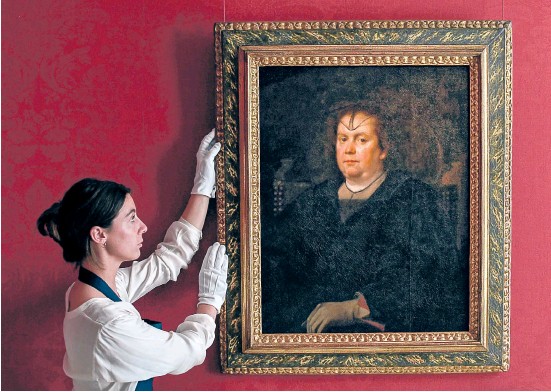
a newly-discovered
painting of Olimpia Pamphilj by Spanish master, Diego Velázquez. Lost for
almost three centuries, this captivating portrait once formed part of the
illustrious collection of Don Gaspar Mendez de Haro y Guzman, 7th Marques del
Carpio - one of the greatest patrons
and collectors of arts in 17th-century Italy. Last recorded in 1724, it subsequently
disappeared without trace. The
whereabouts of the painting remained completely unknown
until one day, an
unattributed work, sold in the 1980s as
‘anonymous Dutch school’, was brought into Sotheby’s Amsterdam office. An
intriguing old cypher hidden on the back of the painting
prompted Sotheby’s specialists to begin a
process of research and
discovery – all of which ultimately lead to the realisation that this striking portrait
was the long-lost original by Velázquez:
a painting much revered in
its day and executed during the artist’s ‘golden period’.
James Macdonald,
Sotheby’s Senior Specialist of Old
Master Paintings, said: ‘The
search for Velázquez’s portrait of Donna Olimpia is finally over. Painted in Rome in 1650 by perhaps
the greatest portrait painter of all time, this depiction of one of the most powerful and
domineering woman of her
time has long been recorded through early documents and engravings but was lost
for nearly 300 years. Its recent rediscovery represents
a highly significant addition
to the great Spanish master’s oeuvre and the painting can be counted amongst
only a handful of works by the artist remaining in private hands today.’
Painted
in 1649-50 during Velázquez’s second trip to Rome, the Portrait of Olimpia Maidalchini Pamphilj (est. £2 - 3 million) will be offered at Sotheby’s
London on July 3rd in the context of one of the strongest
Old Master sales ever
staged. On view to the public from 28th June till 3rd July, it will hang alongside major works by the titans of British Art – Thomas Gainsborough, John Constable, J.M.W. Turner –
as well as leading Renaissance and
Baroque painters Botticelli, Pieter Brueghel the Younger and Sir Peter Paul Rubens. A
newly discovered drawing by 16th century Mannerist
artist Rosso Fiorentino
will also be unveiled to the public for the first time. The portrait
of Olimpia belongs to a moment during
which Velázquez produced some of his most celebrated masterpieces, including
the Portrait of Pope
Innocent X –
a work that was to have a profound
influence on subsequent generations
of artists, culminating most
famously in Francis Bacon’s seminal Pope
series. One of a few, and the only lady, to be selected to be painted by Velázquez
during his visit, the painting depicts a stout, strong-jowled woman, and exudes the artist’s unique
ability to capture and convey the personalities of his sitters.
Commissioned either by, or for Olimpia
herself, the painting is documented as having been in the collections of
numerous notable figures of 17th and 18th
century Rome, including the sitter’s grandson Cardinal
Camillo Massimi, a famous connoisseur and art patron, and Don
Gaspar Mendez de Haro y Guzman, 7th Marques del Carpio, who by his death had amassed over 1,800 paintings for his collection, including
no fewer than six paintings
by Velázquez. Well documented in a number of collections thereafter, the
painting was last recorded
as being in the
collection of Cardinal Pompeo Aldrovandi
of Bologna and Rome in 1724, after which traces of the work are lost.
Olimpia
Maidalchini Pamphilj
Born into a
noble family in Viterbo in 1591, Olimpia married and was
widowed twice, latterly by Pamphilio
Pamphilj, the elder brother of Cardinal Giambattista Pamphilj, later elected
Pope Innocent X in 1644. The Pope’s sister-in-law and his reputed lover,
Olimpia Pamphilj was one of the most influential figures at the papal court
during her brother-in-law’s tenure. Her
influence over the pontiff was well-known with one
Cardinal, Alessandro
Bichi, on the election
of Innocent in October 1644,
supposedly angrily declaring, “Gentlemen, we have just elected a female pope.”
Eleanor Herman, New York Times best-selling
author and writer of a captivating biography
of Olimpia Pamphilj,
‘Mistress of the Vatican’ comments: ‘The most powerful and notorious woman of her time, Olimpia
Maidalchini was a
baroque rock star. Women from all over the Catholic world came to Rome to station themselves
outside her palace to cheer as her carriage rolled out. They could not
believe that a
female from modest beginnings
had risen to such
heights – running the nation of the Papal States and the Catholic Church, an institution where
women were not allowed any
power.’ Nicknamed ‘Papessa’ – the ‘lady Pope’, Olimpia effectively controlled appointments
at Papal Court with
candidates for vacant episcopal
roles applying directly to her, and the office
typically going to the
highest bidder.
In 1645 she received the title Princess of San Martino, a position she used in court to bring
considerable wealth to the house of Pamphilj.
Her influence subsided somewhat following the recalling by Innocent X of Fabio
Chigi from Germany, who subsequently became Pope Alexander VII, however, in the
last years of Innocent’s life, she guarded access to him and used her position
for her own financial gain.
Having
constantly feared being condemned
to a convent as a young woman – the fate of many a
dowerless young lady of the time – Olimpia was empathetic to the plight of her own sex. Contemporary accounts
describe how she gave money to women to save them from this fate, delivering
provisions to convents and building hundreds of homes as dowries
for girls who would otherwise
not be able to marry and would be forced into a convent or prostitution. She
was also said to have allowed prostitutes
in Rome to ride in carriages bearing
her coat of
arms to indicate that they were
under her protection.
Olimpia was
also a patron of Roman culture sponsoring numerous artists, musicians,
playwrights and sculptors and was responsible
for Gian Lorenzo Bernini’s
Fontana dei Quattro Fiumi in
the Piazza Navona in Rome designed and created for
Pope Innocent X in 1651.
The Discovery
ThePortrait of Olimpia Maidalchini
Pamphilj was last documented alongside Velázquez’s celebrated portrait of her
grandson, Cardinal Camillo Massimi, in the collection of Cardinal Pompeo
Aldrovandi (1668 – 1752) of Bologna and Rome, in 1724. While the subsequent
ownership of Camillo’s portrait is well-documented through to its current
location in Kingston Lacy, Dorset, records of the portrait of Olimpia end with Aldrovandi.
The only clue to its whereabouts for almost 300 years
before it re-appearance at a Dutch auction house
in 1986, is an old custom stamp on the reverse of the former stretcher, indicating
that the painting had left Italy in 1911. Brought to the attention of Sotheby’s specialists in
Amsterdam who immediately recognised
the mysterious cypher on
the back of the painting as that of Don Gaspar Mendez de Haro y Guzman, 7th Marques del Carpio,
the process of establishing
the true creator of the work began in earnest.
Viewing the painting and
tracking down various inventories
from the 17th and 18th centuries, Sotheby’s Senior Specialist,
James Macdonald, soon suspected that this striking portrait could be the hitherto missing original by
Velázquez. Showing the painting to key experts in the field, the attribution
of the work was confirmed, making the portrait one of only a handful of
paintings by the great Spanish artist left in private hands.
Another great
discovery: a rare, long-lost drawing by Rosso Fiorentino.
Scrolling through a batch of images
sent through from around the world via Sotheby's online valuation tool Cristiana Romalli,
Senior Director and Italian
specialist in Sotheby’s Old Master Drawings Department,
paused at an intriguingly
accomplished sketch. It looked to her like an accomplished
work by major Mannerist artist, Rosso Fiorentino, whose drawings are extremely
rare.
Cristiana retired home to read Giorgio Vasari’s
‘Lives of the Artists’, chronicling the lives of the leading Italian artists of the early 16th-century. And there
she found a reference to this work, since then unrecorded – lost from the canon
of art history.
Vasari describes how, in 1524, Rosso set out from Florence to
Rome, in search of work. He stopped en route in his home town of Arezzo, where
he caught up with his old friend Antonio Lappoli (1492-1552). Lappoli – a less successful
artist than Rosso – had just been asked to complete a major commission
in Arrezzo: a
rendering of the Visitation,
for the family chapel of a
wealthy Aretine citizen. Lappoli
turned to his friend
Rosso for help and
inspiration, and Rosso, forever
generous, worked up this beautifully accomplished composition,
which Lappoli then used as the basis for his painting.
The beautiful drawing by Rosso – described by
Vasari asmolto bello – was believed by scholars to be lost. Its re-emergence
now adds significantly to our understanding of the working methods of an artist
known for his eccentricity,
and expressive, unconventional style. Only the second drawing by Rosso to have appeared on the market in over half a century,
its survival and fine state of preservation is nothing short of miraculous.
That it has
clearly been handled with care over the last 500 years is perhaps largely thanks
to an old attribution to Michelangelo, penned on the back of the drawing in a
17th-century hand; partly too because it has enjoyed the lucky fate of having,
since the 18th century, just one careful family of owners. Watch Cristiana Romalli
talk about the process of discovery here. The drawing will be offered as a
highlight of Sotheby’s Old Master and British Works on Paper sale on 3
July.