Tuesday, July 10, 2012
Urban Views: Realist Prints and Drawings by Robert Henri and His Circle
Urban Views: Realist Prints and Drawings by Robert Henri and His Circle, an exhibition of nineteen works on paper, will opened on January 13, 2006 at the Brooklyn Museum of Art.
Sometimes popularly known as the Ashcan School, Henri and the the artists of the circle were leaders of a new movement in early twentieth-century American art. Departing from an aesthetic that focused on the wealthy and beautiful as subjects, these artists instead document some of the more mundane activities of everyday city life. The exhibition focuses on the graphic work of Henri and his followers, most of whom were successful commercial illustrators, cartoonists, and newspaper sketch artists. Three of the works included are illustrations for books or magazines. Despite their beginnings as commercial artists, they were persuaded, under Henri’s influence, to pursue art more seriously as a calling.
George W. Bellows (American, 1882–1925). Business Men's Class, 1916. Lithograph on wove
paper. Brooklyn Museum, Gift of the estate of Chester Dale, 63.155.10 Among the prints and drawings on view was a George Bellows lithograph that takes a comic look at a group of ungainly businessmen trying to improve their physiques at a YMCA; an unusual, unfinished watercolor by Maurice Prendergast of a seaside scene; a John Sloan etching from memory of a quiet evening spent together with Robert Henri and their wives; and an ink sketch by Henri of a party scene.
Urban Views was organized by Margaret Stenz, Ph.D., Andrew W. Mellon Research Associate in the Department of American Art at the Brooklyn Museum.
William J. Glackens (American, 1870–1938). Merry Christmas (Yuletide Revels), 1910. Illustration for Collier's, The National Weekly, December 10, 1910. Black conté crayon, ink, watercolor, graphite, and paper attachment on pulp board. Brooklyn Museum, Gift of Ira Glackens, 63.
John Sloan (American, 1871–1951). Swinging in the Square, 1912. Etching on laid paper. Brooklyn Museum, Gift of the Louis E. Stern Foundation, Inc., 64.101.322
George Benjamin Luks (American, 1867–1933). Pony Ride, undated. Black conté crayon on wove paper. Brooklyn Museum, Dick S. Ramsay Fund, 58.43.5
American Identities: A Reinterpretation of American Art
American Identities: A Reinterpretation of American Art at the Brooklyn Museum of Art, went on long-term view on September 7, 2001. American Identities included nearly two hundred paintings, sculptures, and works on paper ranging from colonial portraits to distinguished works by artists such as John Singleton Copley, Thomas Cole, Albert Bierstadt, Thomas Eakins, Childe Hassam, and John Singer Sargent, to twentieth-century paintings by Stuart Davis, Ad Reinhardt, Richard Diebenkorn, Barbara Kruger, and others. These works will be complemented by more than 125 related holdings representing the depth and quality of the Museum’s Decorative Arts collections, among them furniture, ceramics, silver, Tiffany objects, textiles, Spanish colonial material, and Native American objects.
The presentation began with an Orientation Section that included
Asher B. Durand’s The First Harvest in the Wilderness;
Francis Guy’s Winter Scene in Brooklyn,which illustrates Brooklyn’s racial diversity in the early 19th century and was one of the first works to enter the collection;
Georgia O’Keeffe’s rendering of the Brooklyn Bridge;
and a basket made by the last living Brooklyn Canarsie Indian.
From Colony to Nation explored the transformation of colonial societies into an emerging nation in search of a symbolic and stylistic identity.
Works on view included portraits by painters such John Singleton Copley, Gilbert Stuart, and Charles Willson Peale, along with objects including an 18th-century silver tankard made in New York; a pair of early 19th-century Sevres vases adorned with portraits of John Adams and Thomas Jefferson, and a door and doorframe from a Brooklyn house, as well as Spanish colonial material.
Inventing American Landscape dealt with the development of the American tradition of landscape painting in the 19th century and its continuing role in expressing the national identity.
Among the works in this section were Albert Bierstadt’s monumental A Storm in the Rocky Mountains-Mount Rosalie
and Thomas Cole’s A View of the Two Lakes Mountain House, Catskill Mountains Morning,
along with such 20th-century works as Arthur B. Dove’s Flat Surfaces; Richard Diebenkorn’s non-objective Ocean Park No. 27; and Pat Steir’s Everlasting Waterfall.
American Art Home Life, which explored how Americans have defined their daily customs from the early Republic to the present, included works such as George Caleb Bingham’s genre frontier landscape Shooting for the Beef;
Eastman Johnson’s urban interior Not At Home;
Larry Rivers’s July; and Florine Stettheimer’s evocation of ennui, Heat; a Herter Brothers Mantel from the Sloan Griswold House that has not been on view for a quarter century; along with 19th- and 20th century still-life paintings; household objects and furniture; and works by women of the Arts and Crafts movement.
The visual culture of the Civil War was examined in A Nation Divided.
Included were Alexander Pope ’s Emblems of the Civil War
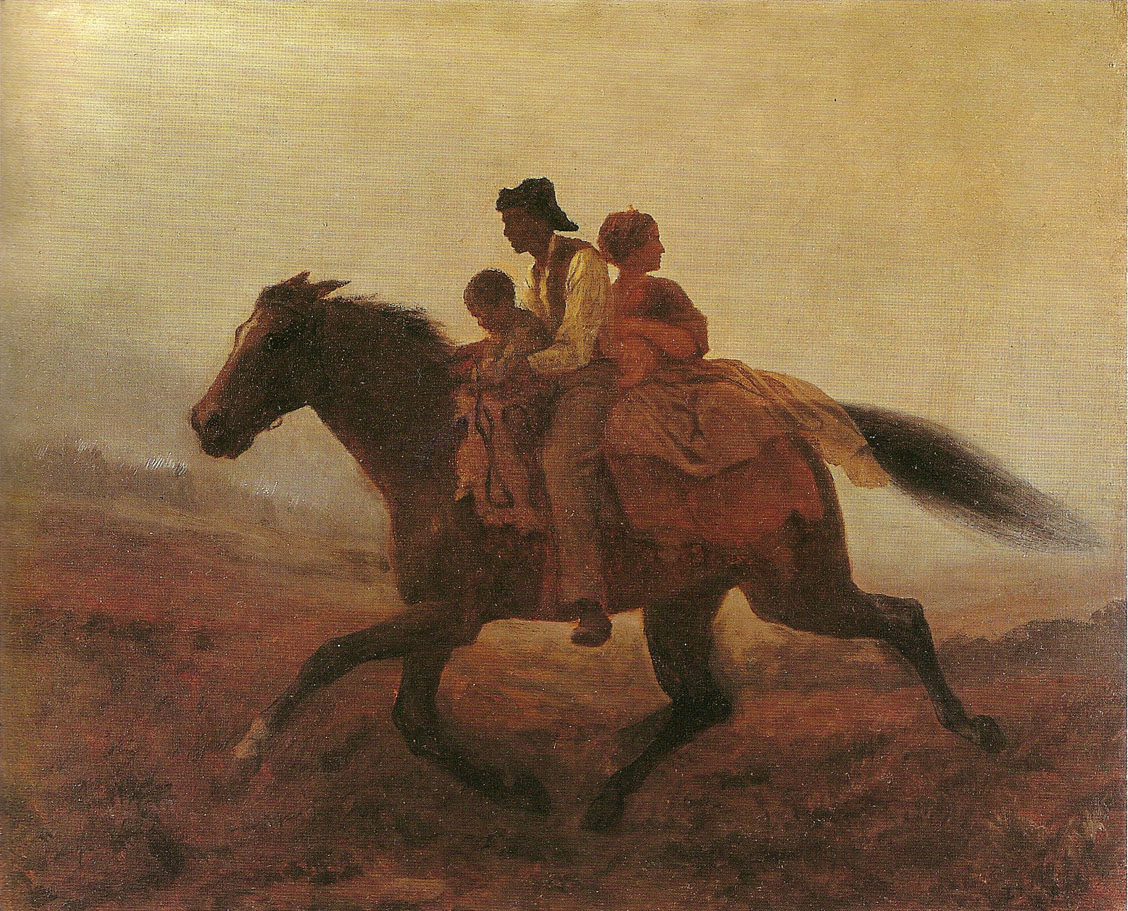
and Eastman Johnson’s Ride for Liberty.
Post Civil War expansion of American worldliness and the fascination with the exotic were dealt with in the section Crossing Borders.
The new and energetic eclecticism in artistic styles and subjects were represented by works such as Frederic Church’s Tropical Scenery;
William Merritt Chase’s The Moorish Warrior;
and Edwin Lord Weeks’s The Old Blue-Tiled Mosque Outside of Delhi, India; as well as by objects such as a chest of drawers in the Japanese style made of woven cane, bamboo, and brass, which was sold on Fulton Street in Brooklyn,
Art Making is an examination of the artistic process from folk art to academic figure styles and included material as diverse as Edward Hicks’s The Peaceable Kingdom; the African American folk art sculptor William Edmondson’s Angel; Louise Bourgeois’s Decontractée; Gaston Lachaise’s monumental Standing Woman; Alex Katz’s Ann; the folk art Giraffe Head ; a Kwakiutl male potlatch figure; and a side chair decorated with gold stenciled swans.
The Centennial Era, examining visual culture from the 1876 Centennial Exhibition in Philadelphia through the 1893 World’s Columbian Exposition in Chicago, included
George Inness’s Sunrise
and Winslow Homer’s In the Mountains.
Also included: Augustus Saint-Gaudens' "Victory," a figure from the Robert Gould Shaw Memorial (1884-97).
Monday, July 9, 2012
Kirchner and the Berlin Street
Kirchner and the Berlin Street on view from from August 3 to November 10, 2008, at the Museum of Modern Art, New York City, was a focused investigation of Ernst Ludwig Kirchner’s (German, 1880-1938) renowned Berlin Street Scenes of 1913-1915, bringing together seven major paintings of the series, the first time these paintings were ever been shown together. With the unusual motif of the prostitute, and a visual language of jagged forms, agitated brushwork, acute perspectives, and strident color, the Street Scene paintings evoke the striking contradictions of modern city life, from nighttime glamor and excitement to loneliness, decadence, and danger. In addition, 60 works on paper examine the artist’s subject matter in the Street Scene series, as well as his working process as it evolved.
Kirchner and the Berlin Street drew from public and private collections in Germany, Switzerland, Italy, and the United States, providing the most comprehensive examination of the series to date. The exhibition was organized by Deborah Wye, The Abby Aldrich Rockefeller Chief Curator of Prints and Illustrated Books, The Museum of Modern Art. MoMA was the only venue for the exhibition.
The Street Scene series is considered not only the high point of Kirchner’s career, but also a milestone in German Expressionism. Earlier, as a member of the Brücke (Bridge) artists’ group, Kirchner rejected traditional art as it was taught in the academy, seeking instead a more natural and spontaneous freedom of expression. By late 1911, the principal artists of Brücke had moved from the relatively genteel city of Dresden to the teeming metropolis of Berlin, by then the third largest city in Europe, following London and Paris. In May 1913, after finding only moderate success there, and with the individual artists developing along their own paths, the Brücke group disbanded, after eight years of working closely together. In the fall of that same year, at a time of relative loneliness and discouragement, Kirchner began the Street Scene series with unusual resolve and ambition, moving away from the bright colors and curving lines captured in earlier works, and toward a strident palette with angular forms that conjure up the high-pitched energy and lurid atmosphere of Berlin in those years. The fact that this mood was captured on the eve of World War I contributes to the tensions embodied in these paintings.
Later, when speaking of the Street Scenes, Kirchner said: “They originated…in one of the loneliest times of my life, during which an agonizing restlessness drove me out onto the streets day and night, which were filled with people and cars.”
To contextualize the Street Scene series, the exhibition was divided into two sections, with the seven paintings forming the centerpiece. In one area, Kirchner’s working process is revealed through drawings, pastels, and prints that demonstrate Kirchner’s commitment to this theme and also reveal the investigatory method he used to refine his subject and establish his artistic means. Another section focuses on Kirchner’s unusual choice of the prostitute motif as his symbol for the city, through contrasting examples of his more typical cityscapes and studies of the eroticized female figure.
The seven paintings in the Berlin Street Scene Series are Five Women on the Street (1913), Berlin Street Scene (1913), Street, Berlin (1913), Street Scene (Friedrichstraße in Berlin) (1914), Two Women on the Street (1914), Potsdamer Platz (1914), and Women on the Street (1915).
Street, Berlin has long been part of MoMA’s collection. At first glance, it appears to simply depict elegantly dressed figures on the way to a fancy event. But the strident color and knowing glances of the female figures, with their swaying hips and syncopated steps, suggest a more illicit role. The crowds of men also add a menacing note.
In Berlin Street Scene (1913), two prostitutes make up the painting’s center, while two men before them are seemingly about to be preyed upon. The bright red lips of the male figure on the right forge a direct link to the heavily made-up women. If the male face is indeed a self-portrait of the artist—as some have argued—the figure’s identification with the prostitutes is especially provocative.
With Five Women on the Street (1913), Kirchner has placed the prostitutes in a space that resembles a stage, relating them to dancers in a revue. Lined up rhythmically, these figures, in their proliferation, also reference the abundance of streetwalkers in Berlin at that time.
Unlike the other Street Scene paintings, where usual signs of city life are kept at the periphery, the monumental Potsdamer Platz (1914) is set in a recognizable spot in early twentieth-century Berlin—specifically Potsdamer Platz, as identified by the red train station and rounded building housing a café seen in the background. The primary figures of Potsdamer Platz, standing on a traffic island, call to mind mannequins in store windows set on revolving platforms.
Considering the large number of works on paper related to the Street Scene paintings, it is clear that Kirchner held high ambitions for this series. In the section of the exhibition devoted to these works, one finds drawings in ink, pastel, and charcoal, along with prints and sketchbook studies that demonstrate Kirchner’s probing creative process. However, none of these works are strictly preparatory; some exhibit specific references to the paintings, while others share generalized movements or moods. Included in the exhibition are three of Kirchner’s sketchbooks (seen also in electronic versions that allow for pages to be viewed), revealing how Kirchner observed the world around him, always striving to capture his reactions with an immediacy and authenticity of feeling before returning to the studio. As he later said: “It seems as though the goal of my work has always been to dissolve myself completely into the sensations of the surroundings in order to then integrate this into a coherent painterly form.” As part of his working process, Kirchner experimented with patterns of light and dark, combinations of colors, and various surface rhythms achieved through hatching pen strokes, gouges in woodblock, and scratches on etching plates.
In Five Cocottes (1914) and Women on Potsdamer Platz (1914), two woodcuts in the exhibition, Kirchner seems to closely follow the compositions of the related paintings. But in fact there are significant differences, indicating that printmaking, like drawing, could play an experimental role in Kirchner’s evolving imagery. Kirchner also explored thematic concerns in these works on paper.
In one pastel and charcoal, Berlin Street Scene (1914), the central female figure is accompanied by a male, while in the painting of the same scene, the male figure is almost fully obscured behind what looks like a lamppost. Instead, the woman has been joined by companions, all striding forward and implying a kind of solidarity among those who prowled the streets of nighttime Berlin.
Throughout Kirchner’s career, female figures with erotic overtones were among his primary motifs, and vistas of cities also appear frequently. One section of the exhibition explored these subjects, in works from the years leading up to and including the period of the Street Scenes, in an effort to highlight the contrasting approach he used in the paintings. Kirchner’s representations of the city usually depicted buildings, bridges, and monuments, with people barely noted. Many hint at his prior architectural training.
One exception is the painting in MoMA’s collection entitled, Street, Dresden (1908/19), created during Kirchner’s early years as part of the Brücke artists’ group. Its bright colors and spontaneous strokes capture the spirit of shoppers at midday, in contrast to the lurid atmosphere of nighttime Berlin found in the street scenes.
Three Bathers For Kirchner, and the artists of the Brücke group, the female nude was considered a fundamental building block of art. However, they rebelled against the traditional, idealized conception of the body, fostering instead a more open and intimate relationship to nudity.
In Bather with Hat (1913),(left image) for example, the way in which Kirchner pictures the torque of the body and sway of the hips in the central figure expresses an unrestrained sexuality. When the artists turned their attention to cabaret dancers in the nightspots of the city, it was also in search of an authentic vitality. Kirchner captured a raw and energized emotion through the movements of the dancers’ bodies and their exotic costumes. The vivid eroticism revealed in such work differs from Kirchner’s interpretation of the prostitute in his Berlin Street Scenes, where allure is coupled with alienation, and the “women of the night” come to symbolize life in the modern city.
More Images II
PUBLICATION:
Kirchner and the Berlin Street is the most extensive consideration of Kirchner’s Street Scene paintings in English. It is a richly illustrated volume with an essay by Ms. Wye that examines the series through contrasting motifs in the artist’s oeuvre, as well as his creative process. Clothbound. 9 x 10 3/4 in.; 138 pages; 135 color illustrations.
The Jewish Journey: Frédéric Brenner’s Photographic Odyssey
Contemporary French photographer Frédéric Brenner spent twenty-five years traveling the world documenting the lives of Jews in over forty countries on five continents. More than 140 of his most compelling photographs drawn from approximately 80,000 negatives was presented in The Jewish Journey: Frédéric Brenner’s Photographic Odyssey at the Brooklyn Museum of Art from October 3, 2003 through January 11, 2004.
Born in Paris in 1959 and trained in social anthropology, Brenner also draws upon history and philosophy for his project to capture images of the Jewish Diaspora in such places as India, Italy, China, Ethiopia, Yemen, Mexico, Russia, Canada, America, and Israel.
By establishing visual histories of Jewish communities in flux, Brenner records the evolution of Jewish civilization, debunking stereotypes and illuminating the concept of cultural diversity while exploring the myriad reinventions of the Jewish people.
Brenner made his first photograph—a child dressed as an angel running down a back alley in the Mea Shearim quarter of Jerusalem—when he was 18 years old. Since then, tens of thousands of Brenner’s contrasting and contradictory photographs have challenged society’s stereotypical images of what it means to be Jewish.
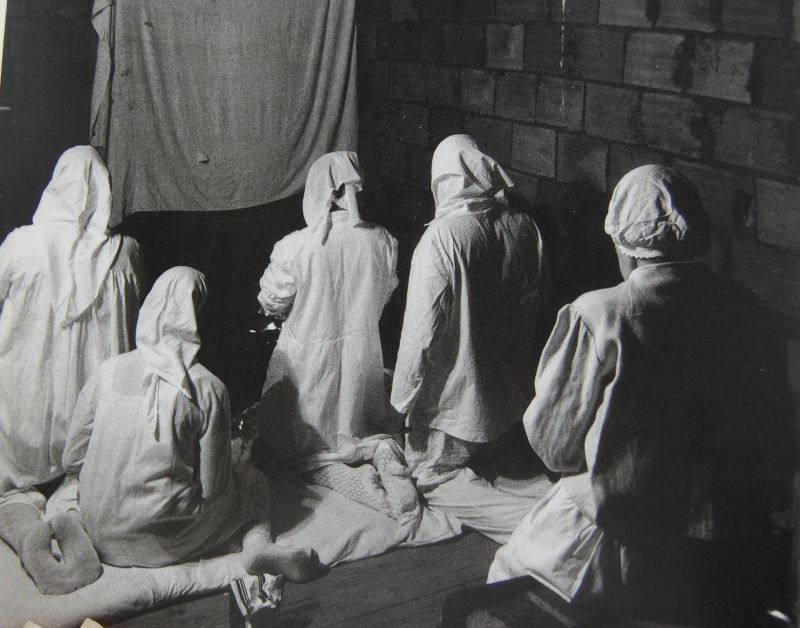
Minyan
Marranos in Portugal
By photographing Jewish subjects such as a village woman in Ethiopia, a man of Iraqi origin in Calcutta,
leather-clad bikers in Florida ("Hogs")
and barbers with Muslim customers in Tajikistan, he has created a new vision of Jewish life in far-flung corners of the world.
Frédéric Brenner. Citizens Protesting Anti-Semitic Acts Billings, Montana, 1994. Panoramic photograph, gelatin silver print. Prints and Photographs Division, Library of Congress. © Frédéric Brenner, Courtesy Howard Greenberg Gallery, New York (141A)
On December 2, 1993, someone in Billings, Montana, tossed a brick through the window of a Jewish home. On December 11, the Billings Gazette wrote: "Today, members of religious faiths throughout Billings are joining together to ask residents to display the menorah as a symbol of something else: our determination to live together in harmony, and our dedication to the principle of religious liberty embodied in the First Amendment." A year later, photographer Frédéric Brenner staged this photograph of residents of Billings--from all walks of life, ethnicities, and religions--holding menorahs to mark the city's singular response to an act of religious intolerance.
His visually stunning, exquisitely crafted black-and-white photographs—many of which were taken with wide-angle lenses—act as a metaphor for the scope and dynamism of one of the world’s oldest, most diverse cultures. Unlike more conventional photographic depictions of Jewish life, which tend to focus on specific moments or high points, Brenner’s portraits capture both ordinary and extraordinary individuals and groups set up for the camera.
Additional Resources
Lots of excellent commentary and images I
Lots of excellent commentary and images II
Lots of excellent commentary and images III
fredericbrenner.com
The Jewish Journey: Frédéric Brenner’s Photographic Odyssey at the Brooklyn Museum of Art was organized by guest curator Dara Meyers-Kingsley. It was made possible by the Righteous Persons Foundation and other generous friends of the Brooklyn Museum of Art.
Coinciding with the exhibition’s opening was the two-volume book Diaspora: Homelands in Exile, published by Harper Collins.
George Tooker: A Retrospective
George Tooker: A Retrospective was the first museum retrospective in three decades of the work of George Tooker (b. 1920), providing a comprehensive examination of his place in American art and revealing the full scope of his achievement as a painter. Jointly organized by the National Academy Museum, the Pennsylvania Academy of the Fine Arts, and the Columbus Museum of Art, the exhibition brings together sixty-six paintings and drawings made since 1945. The National Academy Museum was the first of the three museum venues to host this exhibition, on view October 2, 2008 – January 4, 2009.
See also: George Tooker Obituary
George Tooker’s work became widely known in America during the late 1940’s and early fifties. During the post World War II era in America, the development of Abstract Expressionism soon pushed representational art into the background of the contemporary art scene. A more popular avant-garde’s sensibility pursued and cherished the new, often at the expense of art produced within more established traditions. George Tooker: A Retrospective built upon recent scholarship in order to re-examine the abstract/representational dichotomy by exploring the multiple meanings of postwar realist painting.
In 1944, Tooker met artist Paul Cadmus (1904–1999) at the Art Student’s League. Through Cadmus, Tooker became acquainted with the American Magic Realist Painters, Jared French (1905–1988) and his wife, Margaret Hoening (1889–1973), as well as with the dynamic gay community, which included arts philanthropist Lincoln Kirstein (1907–1996), photographer George Platt Lynes (1907–1955), and other prominent figures in the city’s artistic world. Tooker and his colleagues integrated lessons learned from Cubism, Surrealism, Abstract Expressionism,and Minimalism as readily as they did those of Piero della Francesca (circa 1420–1492).
Self-Portrait, 1947
This circle was clearly interested in a broad stylistic and intellectual position that drew upon abstraction and new approaches to form, while constructing narrative and figurative paintings. This retrospective presented an opportunity to re-examine Tooker’s oeuvre from a fresh and contemporary perspective.
From the beginning of his career George Tooker has examined human experiences of love, death, aging, isolation, alienation, and grief as seen in many seminal works of the 1950’s and 1960’s. His instantly recognizable, enigmatic imagery ranges from complex works of protest of the human condition and often engage with some of the most important societal issues of our time. Much of his subsequent work has evinced humanistic notions of optimism and hope. Since the 1970s and Tooker’s conversion to Catholicism, his paintings have been imbued with a greater sense of spirituality and include more overtly religious and meditative subjects.
Embrace of Peace, 1986
Father and Child, 2000
This exhibition featured every period of Tooker’s long career including his ambitious multi-figure scenes of the 1950s such as
Subway (1950),
Government Bureau, 1956
The Waiting Room, 1959
Lunch 1964
which have often been considered visual analogies to existentialist writings of the period.
Additionally, the exhibition contained a substantial selection of Tooker’s working drawings, rarely exhibited and largely concentrated in the collection of the Addison Gallery of American Art, allowing viewers a fascinating glimpse into the artist’s working methods.
The exhibition was accompanied by a fully-illustrated catalogue featuring essays exploring several aspects of Tooker’s work. The exhibition was co-curated by Robert Cozzolino, Curator at the Pennsylvania Academy of the Fine Arts, Marshall Price, Associate Curator of Modern and Contemporary Art at the National Academy Museum, and Associate Curator of American Art at the Columbus Museum of Art, Melissa Wolfe. Cozzolino, Price, and Wolfe each contributed essays to the catalogue; with three additional essays by Thomas Garver, Anna C. Chave, and Jonathan Weinberg. The catalogue includes new scholarship on Tooker, comprehensive documentation of his career and previously unpublished works.
More Images I
More Images II
EXHIBITION CHECKLIST
1. Children and Spastics, 1946
egg tempera on gesso panel
24 1/2 x 181/2 in. (62.2 x 47 cm)
Collection Museum of Contemporary Art, Chicago, gift of Mary and Earle Ludgin Collection
2. study for Dance, circa 1946
graphite, chalk, wash and ink on paper
13 x 20 7/16 in. (33 x 51.9 cm)
Gift of the artist (PA 1936) in memory of his parents, George Clair and Angela Montejo Roura Tooker, Addison Gallery of American Art, Phillips Academy, Andover, MA
3. Dance, 1946
egg tempera on gesso panel
13 1/4 x 20 1/2 in. (33.6 x 52 cm)
Collection of Andrew Nelson
4. study for A Game of Chess, 1946
graphite on paper
29 15/16 x 15 in. (76 x 38.1 cm)
Gift of the artist (PA 1936) in memory of his parents, George Clair and Angela Montejo Roura Tooker, Addison Gallery of American Art, Phillips Academy, Andover, MA
5. A Game of Chess, 1946-47
egg tempera on gesso panel
30 x 15 in. (76.2 x 38.1 cm)
Collection of Barney A. Ebsworth
6. study for How Do You Do?, circa 1947
colored pencil, graphite and wash on paper
26 1/6 x 19 in. (66.2 x 48.3 cm)
Gift of the artist (PA 1936) in memory of his parents, George Clair and Angela Montejo Roura Tooker, Addison Gallery of American Art, Phillips Academy, Andover, MA
7. The Groping Hand, circa 1947
egg tempera on watercolor paper
3 1/2 x 2 3/4 in. (8.9 x 7 cm)
Nicholas Miles Pentacost, courtesy DC Moore Gallery, NY
8. Self-Portrait, 1947
egg tempera on gesso panel
18 3/4 in. (47.6 cm) diameter
Curtis Galleries, Minneapolis, MN
9. study for Coney Island, 1947
graphite on paper
22 1/2 x 30 7/8 in. (57.1 x 78.4 cm)
Gift of the artist (PA 1936) in memory of his parents, George Clair and Angela Montejo Roura Tooker, Addison Gallery of American Art, Phillips Academy, Andover, MA
10. Coney Island, 1947-48
egg tempera on gesso panel
19 x 26 in. (48.3 x 66 cm)
Curtis Galleries, Minneapolis, MN
11. Bird Watchers, 1948
egg tempera on gesso panel
26 3/4 x 32 3/4 in, (67.9 x 83.2 cm)
New Britain Museum of American Art
Gift of Olga H. Knoepke
12. study for Cornice, 1949
graphite and wash on paper
27 11/16 x 18 x 1/8 in. (70.4 x 46 cm)
Gift of the artist (PA 1936) in memory of his parents, George Clair and Angela Montejo Roura Tooker, Addison Gallery of American Art, Phillips Academy, Andover, MA
13. Cornice, circa 1949
egg tempera on gesso panel
24 x 15 1/2 in. (61 x 39.4 cm)
Columbus Museum of Art, Ohio: Museum Purchase, Howald Fund II
14. study for Subway, 1949
graphite on paper
24 x 39 3/8 in. (61 x 100 cm)
Gift of the artist (PA 1936) in memory of his parents, George Clair and Angela Montejo Roura Tooker, Addison Gallery of American Art, Phillips Academy, Andover, MA
15. Bathhouses, 1950
egg tempera on gesso panel
20 1/4 x 15 1/4 in. (51.4 x 38.7 cm)
Private Collection
16. Subway, 1950
egg tempera on composition board
18 1/8 x 36 1/8 in. (46 x 91.8 cm)
Whitney Museum of American Art, NY
Purchase, with funds from the Juliana Force Purchase Award
17. study for Laundress, 1952
graphite and chalk on paper
26 1/16 x 26 in. (67.6 x 66 cm)
Gift of the artist (PA 1936) in memory of his parents, George Clair and Angela Montejo Roura Tooker, Addison Gallery of American Art, Phillips Academy, Andover, MA
18. Builders, 1952
egg tempera on gesso panel
16 x 16 in. (40.6 x 40.6 cm)
Wayne Co. Public Library, Inc.
19. Garden Party, 1952
egg tempera on gesso panel
18 x 11 3/4 in. (45.7 x 29.8 cm)
Private Collection, courtesy Debra Force Fine Art, New York
20. Letterbox, 1953
egg tempera on fiberboard
18 1/8 x 24 in. (46 x 61 cm)
Hirshhorn Museum and Sculpture Garden, Smithsonian Institution, Washington DC, Museum Purchase, 1993
21. Jukebox, 1953
egg tempera on gesso panel
21 x 14 in. (58.1 x 45.4 cm)
Mr. and Mrs. James C. Biddle
22. Highway, 1953
tempera on panel
22 7/8 x 17 7/8 in. (58.1 x 45.4 cm)
Terra Foundation for American Art, Daniel J. Terra Collection, Chicago, IL, 1992.134
23. Red Carpet, 1953 or 1954
egg tempera on gesso panel
16 x 20 1/4 in. (40.6 x 51.4 cm)
Reis Private Collection
24. The Artist’s Daughter, 1955
egg tempera on gesso panel
24 x 12 1/2 in. (61 x 31.7 cm)
Private Collection
25. Fig Tree, 1955
egg tempera on gesso panel
18 x 24 in. (45.7 x 61 cm)
Private Collection
26. Window II, 1956
egg tempera on gesso panel
24 x 18 in. (61 x 45.7 cm)
Collection of James and Barbara Palmer
27. study for Government Bureau, 1956
graphite, chalk and wash on paper
25 3/4 x 32 13/16 in. (65.4 x 83.4 cm)
Gift of the artist (PA 1936) in memory of his parents, George Clair and Angela Montejo Roura Tooker, Addison Gallery of American Art, Phillips Academy, Andover, MA
28. Government Bureau, 1956
egg tempera on gesso panel
19 5/8 x 29 5/8 in. (49.8 x 75.3 cm)
Metropolitan Museum of Art, New York, George A. Hearn Fund, 1956
29. Guitar, 1957
egg tempera on gesso panel
18 x 24 in. (45.7 x 61 cm)
Private Collection
30. study for Waiting Room, 1957
graphite on paper
27 3/8 x 35 7/8 in. (69.5 x 91.1 cm)
Gift of the artist (PA 1936) in memory of his parents, George Clair and Angela Montejo Roura Tooker, Addison Gallery of American Art, Phillips Academy, Andover, MA
31. Waiting Room, 1957
egg tempera on wood
24 x 30 in. (61 x 78.4 cm)
Smithsonian American Art Museum, Washington, D.C., Gift of S.C. Johnson & Son, Inc.
32. In the Summer House, 1958
egg tempera on fiberboard
24 x 24 in. (61 x 61 cm)
Smithsonian American Art Museum, Washington, D.C., Gift of the Sara Roby Foundation
33. Sleepers II, 1959
tempera on wood panel
16 1/8 x 28 in. (41.2 x 71.1 cm)
The Museum of Modern Art, New York. Larry Aldrich Foundation Fund
34. Lovers I, 1959
egg tempera on gesso panel
18 x 24 in. (45.7 x 61 cm)
Private Collection
35. Meadow I, 1960-61
egg tempera on gesso panel
20 x 28 in. (50 x 71.1 cm)
Toledo Museum of Art: Gift of the Woodward Foundation and purchased with funds from the Libbey Endowment, gift of Edward Drummond Libbey, by exchange, 2007.47
36. Toilette, 1962
egg tempera on gesso panel
20 1/2 x 17 1/2 in. (52.1 x 44.4 cm)
Linda Lichtenberg Kaplan
37. Supper, 1963
tempera on board
20 x 24 in. (50.8 x 61 cm)
Memorial Art Gallery of the University of Rochester; Marion Stratton Gould Fund
38. Window VII, 1963
egg tempera on gesso panel
24 1/8 x 21 1/8 in (61.3 x 53.7 cm)
Terra Foundation for American Art, Daniel J. Terra Collection 1992.168
39. study for Lunch, 1964
graphite, chalk and wash on paper
20 7/8 x 26 13/16 in. (53 x 68.1 cm)
Gift of the artist (PA 1936) in memory of his parents, George Clair and Angela Montejo Roura Tooker, Addison Gallery of American Art, Phillips Academy, Andover, MA
40. Lunch, 1964
egg tempera on gesso panel
20 x 26 in. (50.8 x 66 cm)
Columbus Museum of Art, Ohio: museum Purchase, Derby Fund, from the Philip J. and Suzanne Schiller Collection of American Social Commentary Art 1930-1970
41. Landscape with Figures, 1965-66
egg tempera on gesso panel
26 x 30 in. (77 x 76.2 cm)
Barbara B. Millhouse
42. Window VIII, 1966
egg tempera on gesso panel
24 x 20 in. (61 x 50.8 cm)
Private Collection
43. Teller, 1967
egg tempera on gesso panel
23 1/2 x 15 1/2 in. (59.7 x 39.4 cm)
Private Collection, courtesy of EKG Art Advisory, NY
44. Self-Portrait, 1969
egg tempera on gesso panel
24 x 19 1/2 in. (61 x 49.5 cm)
National Academy Museum, NY
45. Mirror III, circa 1970-71
egg tempera on panel
22 x 19 3/4 in. (55.9 x 50. cm)
Indianapolis Museum of Art: Gift of Edwin F. Koch, Jr., M.D., 2006.66
46. Ward, 1970-71
egg tempera on gesso panel
20 x 30 in. (50.8 x 76.2 cm)
Private Collection
47. Voice II, 1972
egg tempera on gesso panel
17 1/2 x 11 1/2 in. (44.5 x 29 cm)
National Academy Museum, NY, 1858-P
48. Supermarket, 1973
egg tempera on gesso panel
23 x 17 _ in. (58.4 x 43.8 cm)
Curtis Galleries, Minneapolis, MN
49. Standing Figures, 1973
egg tempera on gesso panel
18 x 24 in. (45.7 x 61 cm)
Private Collection
50. Pot of Aloes, 1974
egg tempera on gesso panel
24 x 18 in. (61 x 45.7 cm)
Private Lender
51. Woman with Oranges, 1977
egg tempera on gesso panel
23 1/2 x 17 1/2 in. (59.7 x 39.3 cm)
Courtesy D.C. Moore Gallery, NY
52. Orant, 1977
egg tempera on gesso panel
23 1/2 x 15 1/2 in. (59.7 x 39.4 cm)
Private Collection
53. Embrace I, 1979
egg tempera on gesso panel
24 x 18 in. (61 x 45.7 cm)
Collection of Anka K. Palitic
54. Un Ballo in Maschera, 1982
egg tempera on gesso panel
22 x 30 in. (55.9 x 76.2 cm)
Collection of Mr. and Mrs. Mark L. Brock
55. Waiting Room II, 1982
egg tempera on gesso board
19 x 37 in. (48.3 x 94 cm)
Private Collection
57. Girl with a Basket, 1987-88
egg tempera on gesso panel
24 x 18 in. (61 x 45.7 cm)
Private Collection, courtesy James Francis Trezza, NY
58. Embrace of Peace II, 1988
egg tempera on gesso panel
18 x 30 in. (45.7 x 76.2 cm)
Reis Private Collection
59. Woman with a Sprig of Laurel, 1992
egg tempera on gesso panel
18 x 24 in. (45.7 x 61 cm)
Susan and Peter Tuteur
60. Self Portrait, 1992
graphite and white Conté crayon on toned tracing paper
15 x 12 _ in. (38.1 x 32.4 cm)
Philadelphia Museum of Art: purchased with the Alice Newton Osborn Fund, 2003
61. Self Portrait, 1994
egg tempera on gesso panel
14 x 12 in. (35.6 x 30.5 cm)
Private Collection, Boston, MA
62. Dark Angel, 1996
egg tempera on gesso panel
24 x 19 in. (61 x 48.3 cm)
Pennsylvania Academy of Fine Arts, Philadelphia; Henry C. Gibson Fund
63. Man in a Tree, 1998
egg tempera on gesso panel
14 x 17 in. (35.6 x 43.1 cm)
Collection of James and Barbara Palmer
64. Landscape with Figures IV, 1999
egg tempera on gesso panel
19 _ x 29 _ in. (49.5 x 74.9 cm)
Pilar and Vicente Pita, NJ
65. Father and Child, 2000
egg tempera on gesso panel
24 x 20 in (61 x 50.8 cm)
Private Collection
66. Girl Reading, 2003
egg tempera on gesso panel
15 _ x 19 _ in. (38.8 x 49.5 cm)
Courtesy of the artist and DC Moore Gallery, NY
Sunday, July 8, 2012
WILL BARNET AT 100
One-hundred years in the making, Will Barnet at 100 – the artist’s first New York museum retrospective – exhibited at the National Academy Museum, September 16 through December 31, 2011. Will Barnet has worked in virtually every main museum in the United States, and his figurative and abstract paintings and prints continue to advance the fine arts. During a career that has spanned over 80 years, Barnet has been a printer for major artists, including Louise Bourgeois, a teacher of Eva Hesse, James Rosenquist, and Tom Wesselmann. Barnet celebrated his 100th birthday on May 25, 2011.
Will Barnet at 100 consisted of 43 paintings and prints that range in date from 1935 – five years after he moved from Beverly, MA to New York City at age 19 – through 2008. The loan exhibition, which included works from numerous public and private collections, was organized by Bruce Weber, Senior Curator, Nineteenth and Early Twentieth Century Art, National Academy Museum, and was accompanied by an illustrated catalogue.
Barnet was born in Beverly, MA in 1911. He moved to New York in 1931 and embarked on an 80-year career as an artist, printmaker, and instructor. Barnet taught at the Art Students League (1941-1979) and Cooper Union (1945-1967) in New York and at the Pennsylvania Academy of the Fine Arts (1967-1992) in addition to shorter term appointments.
The works in the exhibition trace Barnet’s explorations of figuration and abstraction, including WPA-tinted realism, Hard-Edged abstraction, and Indian Space painting, with its fields of color and imagery inspired by indigenous art of North and South America. An impassioned student of the visual arts of many cultures, Barnet’s investigations have been informed by old and modern masters, Byzantine art, Hopi bowls, geometric patterns found in ancient Peruvian textiles, and American folk art. The arc of Barnet’s work runs from realism in the 1930s, when he worked primarily as a graphic artist and printer, to increasingly abstract work in the 1940s, full abstraction in the 1950s and early 1960s, and a figurative style in the 1960s through 2003, when he returned to abstraction.
Highlights of the exhibition include Idle Hands, from 1935, in which a deflated man is seated, his elbows resting on his knees and arms crossed as his torso slumps forward. With a cap covering his downcast face, the figure illuminates the Depression-era plight of millions of people unable to find work.
By 1946, when Barnet completed Soft Boiled Eggs, he had entered the realm of Modernism. In the painting, Barnet’s wife and three children surround a kitchen table. In sharp contrast to Idle Hands, all of the flatly rendered elements in the painting are brought to the foreground without any hint of depth or pictorial illusion.
Childen Drawing, also from 1946, exhibits similar characteristics.
The 1959 Singular Image is a purely abstract work “prompted by a glimpse of his shadow as it intersected cracks in a city sidewalk,” as Weber notes in the exhibition catalogue, Will Barnet at 100. Barnet has explained that the cross-like form outlined in white and floating against a dark background expresses “the idea of modern man being … pushed in by all kinds of forces.”
In the early 60s, Barnet returned to figuration in paintings of his family, friends, and associates. The 1972 painting, Woman and the Sea, was inspired by a moment when he saw the silhouetted figure of his second wife, Elena, leaning against a porch column in a summer house in Maine and looking out across the ocean. As Weber notes in his catalogue essay, “The picture alludes to New England days of the past and the countless women left behind by men who went to sea… For Barnet, the woman was a universal symbol of strength, home, and endurance in the face of life’s mysteries.”
In 2003, Barnet returned to abstraction to explore form, space, and color anew. Strolling, from 2008, has a lighter palette and freer and more open sense of composition than many of his earlier abstract works.
Subscribe to:
Posts (Atom)