Wednesday, September 2, 2020

American Art at Swann - Sept 17: Childe Hassam, Grandma Moses, Guy Wiggins & More


Swann Galleries will open the fall 2020 auction season with a sale of American Art on September 17. The sale encompasses the visions of Impressionism, Regionalism and early Modernism, with seaside portraits showcasing various coastal destinations featuring prominently throughout the sale.


A top highlight of the auction is a work by Anna Mary Robertson (Grandma) Moses. Completed at 101 years of age, Happy Days is a 1961 oil-on-masonite painting depicting a typical scene of Moses’s, a rural family working happily on their farm. The work is set to come across the block estimated at $50,000 to $80,000. The painting, with exhibition and publication history, last appeared on the market more than 40 years ago.
Works from the nineteenth century include a run of circa-1880 coastal scenes by Alfred Thompson Bricher with the oil-on-canvas works Low Tide, South Head, Grand Manan Island ($20,000-30,000), and Schooner off the Coast, Bishop’s Rock, Grand Manon Island ($15,000-20,000), as well as the watercolor A Coastal Scene($2,000-3,000). Also of note are still life scenes with fruit, including an 1850s oil-on-wood panel by Severin Roesen ($15,000-20,000), and a circa-1860 oil by William Mason Brown.


            Impressionist scenes lead the sale with coastal watercolors by Childe HassamA Shady Spot (Appledore, Isle of Shoals), 1892 ($80,000-120,000), and Sailboat off the Coast, Isle of Shoals, 1894 ($30,000-50,000). Also depicting the Isle of Shoals is John Appleton Brown’s circa-1890 color pastel Celia Thaxter’s Garden and View of the Sea, Isle of Shoals ($7,000-10,000). Further Impressionist works of note include Alice Mary (Beach) Winter’s circa-1915 oil-on-canvas View of Gloucester ($5,000-8,000), Edward Potthast’s oil-on-canvas New England Harbor Scene, circa 1900–10 ($5,000-8,000), and a small run of works by Gertrude Fiske including the oil board Boston Waterfront, circa 1919–22 ($2,000-3,000).
            Marsden Hartley’s 1922–23 color crayon and pastel drawing Seated Male Nude stands out in an offering of early Modernism ($30,000-50,000). Charles Burchfield is present with Untitled (Harmony in Nature) gouache over pencil, circa 1915–16 ($7,000-10,000), and Frozen House in Winter, watercolor and gouache, circa 1918 ($10,000-15,000). Joseph Stella’s oil-on-canvas Still Life with Chrysanthemums and Goldfish, circa 1911–12 makes an appearance ($12,000-18,000). Additional highlights include works by Walt Kuhn and Jerome Myers.
            Scenes of New York City throughout the seasons include Guy Wiggins’s circa-1940 oil-on-canvas Snow Scene, depicting a busy winter day as people make their way to their destinations in a snowstorm ($20,000-30,000). Reginald Marsh’s circa-1930 oil-on-canvas Manhattan, Waterfront, which depicts the Manhattan skyline on a clear day ($15,000-20,000), and John Marin’s 1953 watercolor View of Central Park, New York, showing a loose rendering of the park’s trees and the city skyline ($15,000-20,000), are also available.

Thursday, August 20, 2020

Natural Forces: Winslow Homer and Frederic Remington

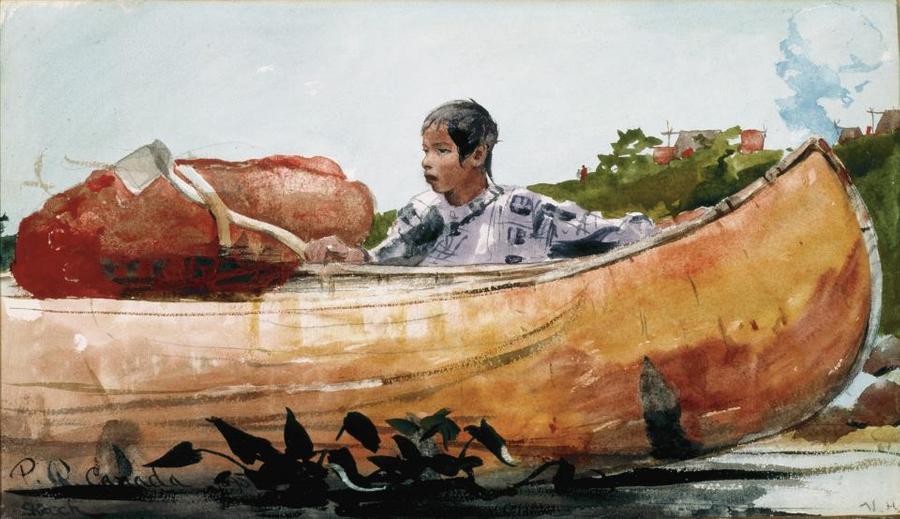
Winslow Homer, Indian Boy with Canoe, 1895. Denver Art Museum.
(The Denver Art Museum (DAM) has debuted Natural Forces: Winslow Homer and Frederic Remington (on view to Sept. 7, 2020). The traveling exhibition, featuring 60 artworks, reveals connections between artistic themes and techniques used by these two acclaimed American artists. Born a generation apart, both artists succeeded in capturing the quintessential American spirit through works of art at the turn of the late-19th and early-20th centuries, an era of growing industrialization and notions of the closing of the American western frontier.
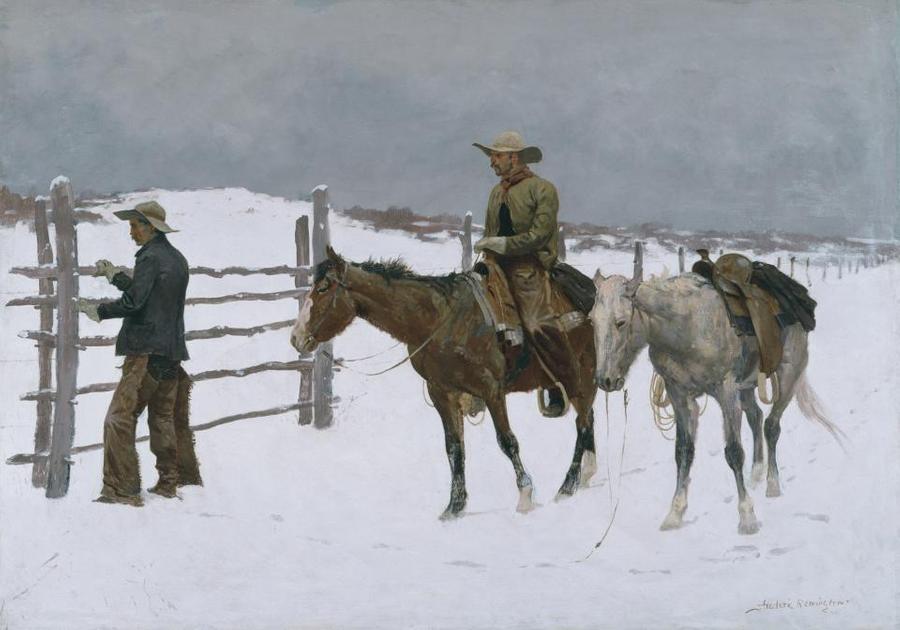
Frederic Remington, The Fall of the Cowboy, 1895. Amon Carter Museum of American Art, Fort Worth, Texas, Amon G. Carter Collection, 1961.230.
Winslow Homer (1836-1910), who was considered the most original painter of his time, prospered by creating masterful depictions of the Eastern Seaboard, while Frederic Remington (1861-1909) became famous for his iconic representations of the American West. The work of these two self-taught artists continues to be celebrated as independent, innovative and homegrown.
Natural Forces is co-organized and co-curated by a team of four curators, including the DAM’s Thomas Brent Smith, Curator of Western American Art and Director of the Petrie Institute of Western American Art, and Jennifer R. Henneman, Associate Curator of Western American Art; Diana Greenwold, Associate Curator of American Art at the Portland Museum of Art in Maine; and Maggie Adler, Curator at the Amon Carter Museum of American Art in Fort Worth, TX.
After debuting at the DAM, the exhibition will travel to the Portland Museum of Art and the Amon Carter Museum of American Art. A 225-page exhibition catalog, published in collaboration with Yale University Press, will be available in The Shop at the Denver Art Museum and online.
Take a video tour of the exhibition at DAM and see highlights here.

Texas Made Modern: The Art of Everett Spruce,


The Amon Carter Museum of American Art (the Carter) announces  the first exhibition in nearly 30 years to highlight the pioneering and inventive career of Texas artist Everett Spruce (1908–2002). Featuring nearly 50 works from private and public collections from across the country, the exhibition traces five decades of Spruce’s career, revealing how he adapted his style and subjects to the era in which he worked. On view August 18 through November 1, 2020, with three Carter member-only preview days August 14–16, Texas Made Modern reclaims the legacy of this Texas artist.

Texas Made Modern considers the exciting range of Spruce’s art from the 1920s to the 1970s. 


Everett Spruce (1908–2002), Veteran, 1932, oil on Masonite, Dallas Museum of Art, gift of Maggie Joe and Alexandre Hogue © 2019 Alice Spruce Meriwether.


Known for his inventive depictions of Texas, Spruce’s modern, visionary landscapes countered the popular narrative of the state as only a land of cattle and cowboys. From his early, surreal landscapes of West Texas to his mature figural paintings of folk culture and late abstract visions that conjure worlds beyond observation, Spruce evolved his style with the changing times, receiving national attention along the way. Texas Made Modernuncovers Spruce’s role as a key member of the Dallas Nine and a vital contributor to the narrative of modernist landscape painting in the state.


Everett Spruce (1908–2002), Twins, 1939–40, oil on canvas, Dallas Museum of Art, Dealey Prize, Eleventh Annual Dallas Allied Arts Exhibition, 1940 © 2019 Alice Spruce Meriwether.

“The Carter is committed to providing leading scholarship in American art, examining areas of focus that have often been underrepresented or overlooked,” stated Andrew J. Walker, Executive Director. “Texas Made Modern: The Art of Everett Spruce resurfaces this great Texas artist by bringing together major paintings from his oeuvre, affirming his rightful place in the history of American art, and establishing that he was not a typical regionalist painter.”
Texas Made Modern presents a chronology that recreates Spruce’s journeys in search of inspiration. His travels to West Texas, Arkansas, the Hill Country, and Gulf Coast are captured through an array of works that display his exceptional skills and diverse approaches to his subjects. Accompanying the exhibition is an extensive catalogue, featuring new scholarship that for the first time addresses Spruce’s intentions with his art, as he employed modernist techniques to impart his spiritual communion with the land.
Early works that brought him national recognition, like Arkansas Landscape (1938), selected for exhibition in the Golden Gate International Exposition of 1939 and acquired a few years later by The Phillips Collection, reveal the artist’s ability to evoke the uncanny and otherworldly aspects of nature in a landscape view of the Ozarks. Ten years later, works such as Century Plant (1948), now in the collection of the New Orleans Museum of Art, prompted a critic for the New York Times to comment that the painting, which depicts an abstracted, colorful agave, “achieves an almost epic dimension.” By late in his career, while still expressing his deeply felt responses to the land, Spruce conveyed the mystique of the Texas prairie in Near Rock Springs (1975), where earth touching sky exudes transcendental qualities.
“More than merely describing the scenery of Texas, Spruce translated his beliefs in their mystical aspects onto the canvas. He served in some ways as an art ambassador for Texas. Through his work, he helped reshape misconceptions of the state’s culture and was applauded by his better-known colleagues like Marsden Hartley for his progressive work,” stated the curator of the project, Shirley Reece-Hughes, Curator of Paintings, Sculpture, and Works on Paper at the Carter.
By the mid-twentieth century, Spruce achieved a measure of celebrity as one of the most exhibited artists from Texas. He was featured in exhibitions across the country, including the Museum of Modern Art’s Americans 1942: 18 Artists from 9 States, and his work entered the collections of prominent national museums, including the Metropolitan Museum of Art, Museum of Modern Art, Whitney Museum of American Art, Dallas Museum of Art, Pennsylvania Academy of the Fine Arts, and Walker Art Center, among others. Over time, however, with the rise of Abstract Expressionism and Pop Art, Spruce and his work fell into obscurity. Texas Made Modernresurrects the artist’s career, placing new focus on his role as a key figure in the development of modern art in Texas and a vital contributor to the narrative of modernist landscape painting in America.
Texas Made Modern: The Art of Everett Spruce is organized by the Amon Carter Museum of American Art and supported in part by The Gayden Family Foundation, Heritage Auctions, The Summerlee Foundation, and the Alice L. Walton Foundation Temporary Exhibitions Endowment. Support for the exhibition catalogue comes from the Texas Art Collectors Organization.

About Everett Spruce

Everett Franklin Spruce (1908–2002) was born near Conway, Arkansas, in the Ozark Mountain region. Influenced by the natural world around him, Spruce began drawing at a young age, and at the age of 17, he received a scholarship to study at the Dallas Art Institute (DAI). In 1931, he secured a job as a gallery assistant at the Free Public Art Gallery of Dallas, known today as the Dallas Museum of Art, where he would go on to become the Assistant Director from 1936–40 before joining the art faculty of the University of Texas at Austin, where he remained until his retirement in 1974. During the 1930s, Spruce’s association with the Dallas Artists League led to his involvement with the loosely structured artist collective known as the “Dallas Nine,” a group that openly incorporated European progressive theories and tenets into their personal idiom. In 1932, Spruce began to receive critical acclaim, which continued throughout his professional career. In 1936, his work was included in the Third Biennial Exhibition of Contemporary American Painting at the Whitney Museum of American Art, and in 1937 he exhibited his first solo show in New York. In addition to pieces held by private collectors, his work is included in the collections of many major museums, including the Metropolitan Museum of Art, Museum of Modern Art, Whitney Museum of American Art, Dallas Museum of Art, Pennsylvania Academy of the Fine Arts, Walker Art Center, The Phillips Collection, and more. He received numerous prizes throughout his career, and his work is highlighted in many publications.

Monday, August 10, 2020

Gauguin and the Impressionists: Masterpieces of the Ordrupgaard Collection.

Video:

https://www.royalacademy.org.uk/article/video-inside-the-exhibition-gauguin-and-the-impressionists

Article with images:

https://www.royalacademy.org.uk/article/manet-morisot-10-impressionist-paintings-coming-to-the-uk

Details:

https://artdaily.cc/news/127214/Royal-Academy-of-Arts-opens--Gauguin-and-the-Impressionists--Masterpieces-from-the-Ordrupgaard-Collection-#.XzFOrtXwZoE

Vida Americana: Mexican Muralists Remake American Art, 1925–1945


Vida Americana: Mexican Muralists Remake American Art, 1925–1945

We present the video on Vida Americana: Mexican Muralists Remake American Art, 1925–1945 at the Whitney Museum in New York. The exhibition questions the historiography that demonstrates the impact that the leading Mexican muralists, José Clemente Orozco, Diego Rivera, and David Alfaro Siqueiros, had on the artistic practices on American art.

Wednesday, July 29, 2020

The Monet Show Must Go On — With an Array of Online Features From MFA Boston


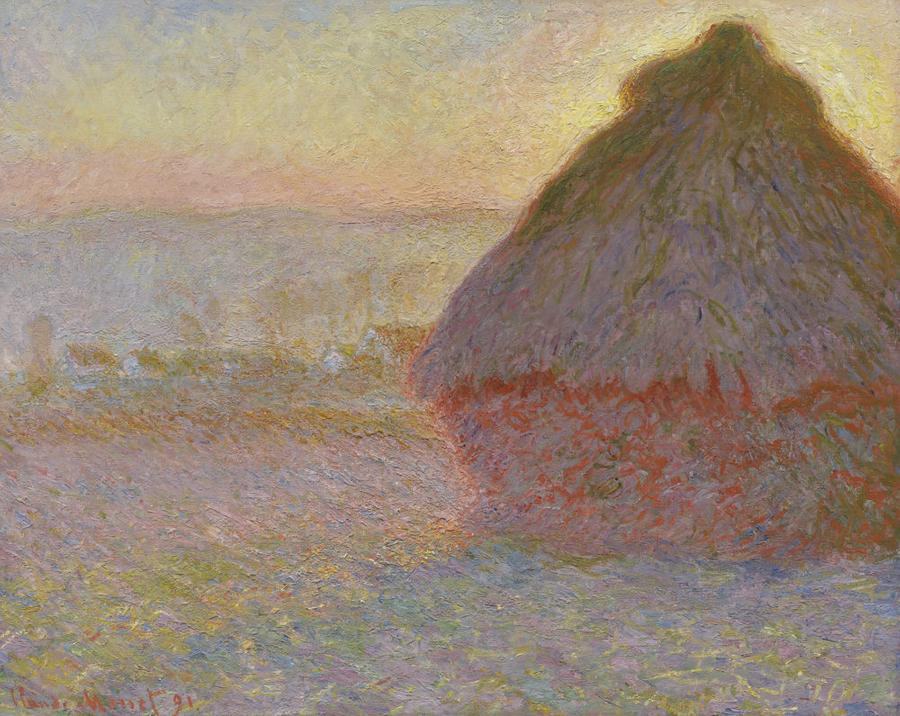
Claude Monet, “Grainstack (Sunset),” 1891. Oil on canvas. Juliana Cheney Edwards.
Museum of Fine Arts, Boston
Nineteenth-century Bostonians were on the cutting edge of collecting when the innovative works of French Impressionists burst on the scene. One of the largest holdings of Claude Monet’s (1840–1926) work outside France, the Museum of Fine Arts, Boston (MFA) acquired dozens of his Impressionist masterpieces that came to reside in the city when Monet's landscapes caught the eye of local collectors during the artist's lifetime. 
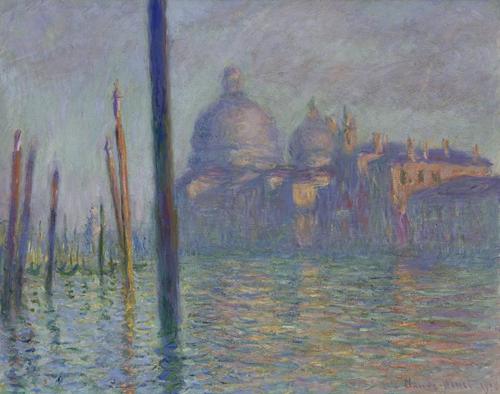
To celebrate the museum’s 150th anniversary, the MFA planned this spring to showcase its renowned collection of 35 Monet paintings for the first time all together in 25 years. When the global health crisis shuttered doors in March, the exhibition, Monet and Boston: Lasting Impression, was postponed for in-person viewing and pivoted online with enhanced features.
Claude Monet (French, 1840–1926) "Grand Canal, Venice" (1908). Oil on canvas. Bequest of Alexander Cochrane.
Museum of Fine Arts, Boston
Virtual visitors can view a video talk from associate curator of European paintings Katie Hanson or browse a slideshow previewof artworks. Take in the art online while you enjoy music both inspired by Monet and originating in his era with classical violinist Lilit Hartunian. There is also a Spotify playlist curated by songwriter and musician Barrie.
End the virtual visit by taking a Monet home: download a Zoom meeting background of Grainstack (Sunset); Antibes (Afternoon Effect); Morning on the Seine, near Giverny, and more. 
An exhibition catalogue is available.

Monday, July 6, 2020

Sotheby’s Evening Sale on 28 July,


UNSEEN WORKS OF THE EUROPEAN AVANT-GARDE

Over 40 Paintings, Sculpture & Works on Paper Led by a Rare Cubist Work by Léger & an Intimate Picasso Portrait of his Secret Lover Marie-Thérèse Pablo Picasso | Fernand Léger | Alberto Giacometti | Wassily Kandinsky | Lyonel Feininger | August Macke | Alexej von Jawlensky | Jacques Lipchitz | Marc Chagall | Henry Moore | Henri Laurens | Jean Arp | Albert Gleizes

Helena Newman, Worldwide Head of Sotheby’s Impressionist & Modern Art Department, said:
“Put together with passion and enjoyed over many years, this private collection encapsulates exactly what collectors long for – quality and rarity in works that can be, and have been, lived with and loved. Unified by the breadth and depth of art from across Europe, it offers seldom seen works from the pinnacle of the Avant-Garde, from the figurative to the abstract. At its core is an exceptionally beautiful 1931 portrait of Picasso’s lover, Marie-Thérèse, an intimate glimpse into their early days together when the love between the artist and his most important muse was still a secret from the world.” 

The first decades of the twentieth century would change the course of art history for ever. This treasure-trove from a private collection – little known and rarely seen – spans the remarkable period, telling its story through the leading protagonists, from Fernand Léger, Pablo Picasso and Alberto Giacometti to Wassily Kandinsky, Lyonel Feininger and Alexej von Jawlensky. Travelling across the continent, the works emphasise the crosscurrents and connections that united Europe, from France to Germany to Britain. Viewed together, dialogues emerge about the human form and experience, and the balance between figuration and abstraction.

Eighteen works will be offered in the cross-category Evening Sale on 28 July, in which exceptional examples of Old Masters – including one of the last self-portraits by Rembrandt in private hands – Impressionist and Modern art, Modern British and Contemporary art will be presented together for the first time.

A further twenty-four works from this collection will be offered in the Impressionist & Modern Art Online sale, open for bidding from 20 – 27 July. Prior to the sales, the works will go on public view in Sotheby’s New Bond Street galleries from 13 July.

ARTISTS IN LOVE


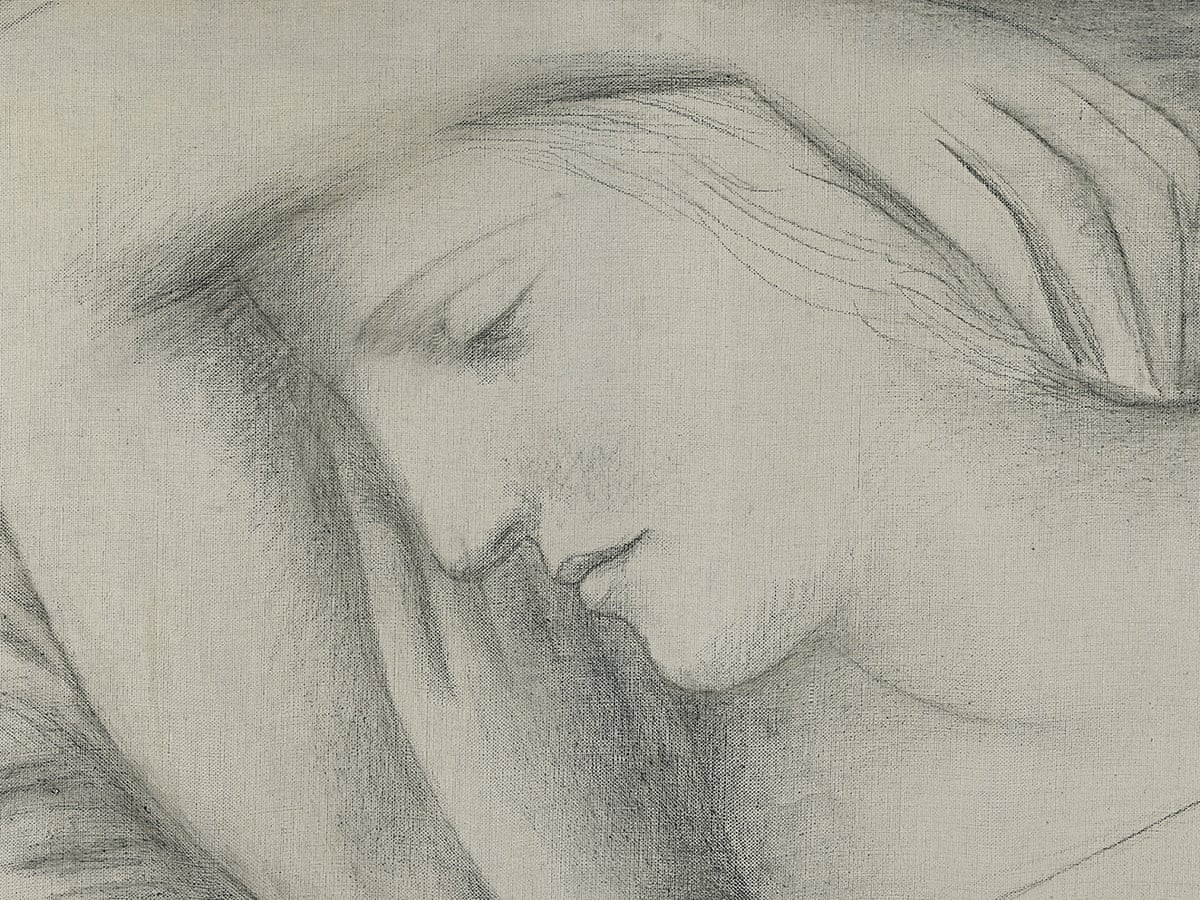
Pablo Picasso, Femme endormie, 1931, charcoal on primed canvas (est. £6,000,000 – 9,000,000)

Unseen since 1986 ‘We joked and laughed together, so happy with our secret…You know what it’s like to be truly in love…Then, love is all you need’ – Marie-Thérèse Unseen since it was acquired by the owners in 1986 from Galerie Beyeler in Basel, and appearing at auction for the very first time, this tender, intimate portrait of Picasso’s golden muse – Marie-Thérèse Walter – was kept by the artist all his life, testament to its personal nature and the intimacy of the moment captured between them. Dating to February 1931, the work depicts a private moment at the very height of their love, when their allconsuming relationship was still a secret to society. The softness of the black charcoal lines accentuates Marie-Thérèse’s sensuality, with a gentleness that is rarely seen in Picasso’s other portraits.

This fully figurative style was used only occasionally by the artist, when depicting those most important to him. Here, with her features not abstracted, we see Marie-Thérèse absolutely as Picasso did, sitting by her side while she fell asleep. Beyond this, the rare use of charcoal on canvas as opposed to paper suggests that he wanted to immortalise her and the moment. It was just a year later that Picasso revealed Marie-Thérèse’s truly pervasive presence in his art, and this famed moment was recently celebrated in an acclaimed ‘1932’ exhibition that travelled from Musée Picasso in Paris to the Tate Modern in London. Across both sales, seven works by the artist span his career from 1905 to 1969, charting Picasso’s unending exploration of the human form as he constantly experimented with different media.


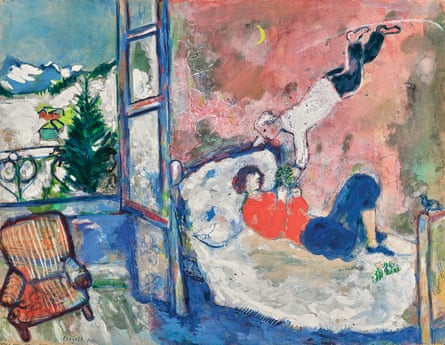
Marc Chagall, La branche de gui or Le rêve, 1928, gouache, black chalk and pencil on paper (est. £700,000 – 900,000)

Unseen since 1985 In this beautiful and tender evocation of Chagall’s most beloved subject matter, his wife Bella, the artist depicts himself presenting her with a branch of mistletoe, a symbol of long life and health. The joyous work was painted in the 1920s, a happy and peaceful time for the family, and as they travelled through France his works became increasingly brilliant and luminous. Having never previously been offered at auction, it will go on public view for the first time since it was exhibited in 1985.

A CUBIST VISION


Fernand Léger, Nature morte, 1914, oil on burlap (est. £8,000,000 – 12,000,000)

Unseen since 1983 This radical painting is from Léger’s Cubist period, in which he developed his celebrated Contrastes de formes series over the course of 1913 and 1914, the majority of which are now in major museums around the world. Working in Paris in the context of Picasso and Braque’s revolutionary development of Cubism, Léger developed his own unique style, which integrated colour and abstracted forms. Composed of boldly outlined, overlapping shapes and coloured with strong tones of reds, blues, yellows and greens, these works represent the artist’s ultimate Cubist vision. This dynamic example has never been at auction and hasremained unseen since it was last exhibited in 1983, two years after it was acquired.

GERMAN MODERNISM: DER BLAUE REITER TO BAUHAUS


Wassily Kandinsky, Murnau, Schloss und Kirche II (Murnau - Castle and Church II), oil on board, 1909 (est. £1,000,000 – 1,500,000)

Unseen since 1998 Pairing luminescent blue and white with bright yellow and orange, this key painting from Kandinsky’s highly transformative period spent in the bucolic surrounds of Southern Germany is an evocative example of the artist’s theory and work. The artist’s experiments led to the creation of a new type of painting notable for its bold expression and purity, paving the way for his ultimate venture into abstraction – one of the most important contributions to twentieth-century art. During his time in Murnau, colour became disassociated from representational form and turned into an autonomous force for the first time in his work, each shade able to invoke a certain strong emotion. The sale will also offer a watercolour by Kandinsky from circa 1914-15 (est. £600,000 – 800,000), when the outbreak of the First World War forced the artist to leave Germany and return to his native Moscow. The tumultuous political and social events led to a shift in his working methods, as he increasingly began to concentrate on works on paper to intensify the exploration of form and colour that had been trigged by his stay in Murnau.


Lyonel Feininger,  Zottelstedt II (Town Hall II), 1927, oil on canvas (est. £2,000,000 – 3,000,000)

Unseen since 1978 Unseen since 1974, Zottelstedt I pushes the boundaries of painterly exploration. The iridescent work draws on the innovations of Cubism and Italian Futurism, blending Expressionist colours with the planes of Cubo-Futurism. Marked by this powerful infusion of light and colour, it stands as an important work from a key period in Feininger’s oeuvre.

The sale will offer two further paintings by the artist, Regentag an der See (Rainy Day by the Sea) from 1914 (est. £700,000 – 900,000) and Lastträger am Meeresstrand (I) (Beachcombers by the Sea (I)) from 1920 (est. £700,000 – 900,000).

Alongside working at the Bauhaus, where he was an artist in residence, Feininger had been a member of Die Blaue Reiter, together with Kandinsky, Jawlensky and Macke, all of whom are represented in the collection. Among the highlights is a bright oil on canvas study from Macke's celebrated Schaufenster series, which depicts figures looking into the windows of fashion boutiques and hat shops.

MODERN SCULPTURE


Alberto Giacometti, Femme debout, 1958, bronze (est. £4,000,000 – 6,000,000)

Unseen since 1986 The female figure is a subject that appears throughout Giacometti’s Å“uvre. Following the war, Giacometti, like many of his contemporaries, began to explore the ideas of Existentialism, resulting in a series of highly stylised sculptures where the form is reduced to its absolute essence. Conceived in 1956-57 and cast the following year, at the height of Giacometti’s international acclaim, this piece is exactly contemporaneous with the artist’s celebrated series Femmes de Venise, which made their debut at the Venice Biennale of 1956. Belonging to an edition of 8 bronzes, others of which are in museum collections including Paris’ Centre Pompidou, this work has never previously been at auction.

Further sculptures offered from the collection include works by Jacques Lipchitz, Henry Moore, Henri Laurens and Jean Arp.