Wednesday, September 23, 2026

Christie's Post-War to Present October 1st


NEW YORK- Christie's is delighted to announce Post-War to Present taking place live on October 1st at Christie's Rockefeller Center saleroom in New York. The sale kicks off the fall season of 20/21 sales with an enviable selection of works by a diverse cross-section of post-war and contemporary artists working across mediums of all types. In total, the sale includes 236 works and is expected to achieve more than $26.9 million.

Kathryn Marber, Head of Sale, Post-War to Present, says, “This fall, Christie's Post-War to Present sale brings together a dynamic range of works spanning generations, from the pioneering figures who reshaped the course of twentieth-century art to some of the most compelling voices working today. Offering opportunities for collectors at every level, the sale reflects the remarkable breadth and continued evolution of post-war and contemporary art. We are particularly proud to build on the success of The Collection of Henry S. McNeil, Jr. and The Collection of Barbara Jakobson, with both collections represented by exceptional works by Minimalist master Donald Judd.”


Temple of Style: The Barbara Jakobson Collection | DONALD JUDD (1928-1994) Untitled, red lacquer on galvanized iron, 5 x 69 x 8½ in. (12.7 x 175.3 x 21.6 cm.), Conceived in 1965 and fabricated in 1969. This work is one of eight unique examples fabricated between 1965 and 1970. Estimate: $1,000,000-1,500,000

The top lot of the sale is a red anodized Donald Judd sculpture, a rare bullnose progression dating from the late 1960s that hails from the collection of Barbara Jakobson. Other top lots include a jewel-toned, large-scale beveled edge painting by 


Sam Gilliam, Region and Mind, which has been held in a private Washington, D.C. collection since it was purchased from the artist's studio in 1971,


Big Agnes
, a seminal portrait by Lisa Yuskavage from the 1990s and 


Coastal Farms,
a masterful landscape painting by legendary Bay Area painter Wayne Thiebaud from his River Delta series.

The sale is further highlighted by Property from the Esteemed Collection of Dr. John T. O'Neal, Boston and an exquisite selection of works on paper from private collection Everything Becomes Abstract: Works from an Esteemed Private Collection, which includes early works by Ellsworth Kelly, Agnes Martin, Annie Albers and more. Other highlights include portraits and still lifes by the celebrated Colombian artist Fernando Botero, a sublime portrait by Elizabeth Peyton and paintings and works on paper by George Condo.


FERNANDO BOTERO (1932-2023)

Tango Dancers


FERNANDO BOTERO (1932-2023)

Man with a Book


ELIZABETH PEYTON (B. 1965)

Liam


THIS IS THE MODERN WORLD: Breakthroughs in Art, 1900–1960

Hamburger Kunsthalle

4 September 2026 to 30 May 2027 

THIS IS THE MODERN WORLD: Breakthroughs in Art, 1900–1960 takes a fresh look at the Hamburger Kunsthalle’s Modern Art Collection, one of the premier collections of its kind in Germany. A selection of some 150 paintings, sculptures, prints and drawings – including both well-known highlights and special new acquisitions – illustrates the profusion of new ideas and techniques that emerged as artists broke with traditions during six decades marked by extraordinary upheavals in culture and society. A great diversity of approaches becomes apparent within the various modernist trends. Expressionism is embodied by iconic works produced by members of artist groups such as Die Brücke and Der Blaue Reiter, among them Ernst Ludwig Kirchner and Wassily Kandinsky, while the École de Paris is represented by painters such as Georges Braque and Pablo Picasso. Also featured are pioneers of early modernism such as Edvard Munch, Paula Modersohn-Becker, Lovis Corinth, Max Beckmann and Anita Rée. Joining them are artists who took up an abstract style between the wars, for example Sophie Tauber-Arp, Surrealists such as René Magritte, exponents of the New Objectivity including Christian Schad, and artists who embraced post-war Art Informel such as Wols. 

The modernist works have been rearranged in ten redesigned galleries along the museum’s circuit through eight centuries of art. The chronological presentation is now enriched by thematic groupings transcending time and place, offering new perspectives on this revolutionary era. Novel styles of abstraction and representation come to light in works that convey a changing understanding of nature and technology and also of society and human existence under the influence of the latest developments in psychology, philosophy and politics – including Nazi ideology. A gallery of works by Hamburg artists supplements the panorama of international modernism with some regional perspectives – for example harbour and city scenes. Over the course of the show, a changing selection of works from the museum’s Prints and Drawings Collection will offer further insights into artists’ working methods. 

As a highlight, recent donations and significant new acquisitions are presented, including 


René Magritte’s key Surrealist work Le palais de rideaux (The Palace of Curtains) from 1928, which the Kunsthalle acquired in 2025. (Öl auf Leinwand, 81 x 116 cm Erworben 2025, gemeinsames Ei- gentum Stiftung Hamburger Kunst- sammlungen, Hamburger Kunsthalle und Heinz H. O. Schröder Stiftung. Die Erwerbung wurde zudem unter- stützt von der Campe’schen Histo- rischen Kunststiftung sowie Sabine und Michael R. Neumann.© VG Bild-Kunst, Bonn 2026 © SHK / Hamburger Kunsthalle / ARTOTHEK Foto: Christoph Irrgang)

Max Beckmann (1884–1950) and Anita Rée (1885–1933) serve as the exhibition’s guiding lights, with a combined total of around 20 works on display. With their continual formal innovations and provocative ideas, these two contemporaries are considered para- gons of modernism. Among the works on view by Beckmann is the Hamburger Kunsthalle’s most expensive acquisition to date: 


Selbstbildnis Florenz (Selfportrait in Florence, 1907), (Oil on canvas, mounted on plywood41cm x 46cm (image)Hamburger Kunsthalle, acquired with funds from the Campe Historical Art Foundation, 2015Inv. No.: HK-5738 © Hamburger Kunsthalle / ARTOTHEK Photo: Elke Walfordone) of the first in a long series of variations on the self- portrait in the course of his career. In a direct spatial juxtaposition, Rée and Beckmanns' eyes meet from the

Selbstbildnis in Hittfeld (Self-portrait in Hittfeld, 1904), from the Selbstbildnis in Hittfeld (Self-portrait in Hittfeld, 1904), (Anita Rée (Hamburg 1885 - 1933 Kampen on Sylt

Oil on canvas, mounted on plywood41cm x 46cm (image)Hamburger Kunsthalle, acquired with funds from the Campe Historical Art Foundation, 2015Inv. No.: HK-5738Collection: Classical Modernism

Hamburger Kunsthalle / ARTOTHEK Photo: Elke Walford )

from the likewise produced at an early stage of Rée's career, when she was taking painting lessons near her hometown of Hamburg. These works are accompanied by a whole series of additional, strikingly diverse portraits, hung closely together on an exhibition wall to form a dense tableau telling myriad stories from the lives of important modern masters. Among them are Karl Kluth’s Selbst mit Melone (Self with Bowler Hat, 1924), in which we encounter the artist as a dishevelled bohemian at his easel, hat perched jauntily on his head.

THIS IS THE MODERN WORLD marks the first time that the Hamburger Kunsthalle is no longer presenting »modernism« under the label »classical modernism«, which museums usually use to distinguish between works dating from 1900 to 1960 and the »contemporary« works that came later. This points as well to our future orientation, which will be aligned along a global history of art in the first half of the twentieth century rather than the predominantly European focus of the past. 

More Images


Anita Rée (1885–1933)
Bildnis Hildegard Heise, 1927
Öl auf Leinwand, 40,6 x 35,6 cm Hamburger Kunsthalle
© Hamburger Kunsthalle / ARTOTHEK Foto: Elke Walford


Louise Loeber (1894–1983) Spülstein I, 1929
Öl auf Malpappe, 95 x 64,5 cm Hamburger Kunsthalle 
© VG Bild-Kunst, Bonn 2026© Hamburger Kunsthalle / ARTOTHEK Foto: Elke Walford


Henri Rousseau (1844–1910) Eva im irdischen Paradies, um 1906/07
Öl auf Leinwand, 62 x 46 cm Dauerleihgabe der Stiftung Ham- burger Kunstsammlungen 
© SHK / Hamburger Kunsthalle / ARTOTHEKFoto: Elke Walford


Max Beckmann (1884–1950) Odysseus und Kalypso, 1943
Öl auf Leinwand, 150 x 115,5 cm Hamburger Kunsthalle, erworben 1949 © Hamburger Kunsthalle / ARTOTHEK Foto: Elke Walford


Heinrich Hoerle (1895–1936) Mann und Frau, 1933
Wachs auf Papier, aufgezogen auf Sperrholz, 97,5 x 117 cm Dauerleihgabe der Stiftung Ham- burger Kunstsammlungen 
© SHK / Hamburger Kunsthalle / ARTOTHEK Foto: Elke Walford


Paula Modersohn-Becker (18761907)
Alte Moorbäuerin, 1913
Öl auf Leinwand, 77 x 57 cm Hamburger Kunsthalle, erworben 1920, beschlagnahmt durch die Kommission für »Entartete Kunst« 1937, erneut erworben 1951
© Hamburger Kunsthalle / ARTOTHEK Foto: Elke Walford


Ernst Ludwig Kirchner (1880–1938) Maler und Modell, 1910 (überar- beitet 1926)
Öl auf Leinwand, 150,4 x 100 cm Hamburger Kunsthalle, Geschenk von Ernesto Blohm, Caracas/Vene- zuela, in Erinnerung an seine Mutter Magdalene Blohm, 1952
© Hamburger Kunsthalle / ARTOTHEK Foto: Elke Walford


Christian Schad (1894–1982) Bildnis Egon Erwin Kisch, 1928
Öl auf Leinwand, 90,5 x 61,5 cm Hamburger Kunsthalle, erworben 1971 ©
VG Bild-Kunst, Bonn 2026© Hamburger Kunsthalle / ARTOTHEK Foto: Elke Walford


Franz Wilhelm Seiwert (1894–1933) Feierabend II, 1925
Tempera auf Rupfen, 200 x 140,5 cm Hamburger Kunsthalle
© Hamburger Kunsthalle / ARTOTHEK Foto: Elke Walford


Max Pechstein (1881–1955) Junge mit Spielzeug, 1916
Öl auf Leinwand, 80 x 70 cm Erworben 2025 für die Kunsthalle von der Stiftung Hamburger Kunst- sammlungen
© SHK / Hamburger Kunsthalle / ARTOTHEKFoto: Christoph Irrgang


Le Temps Retrouvé: The Schlumberger Collection 22 October at Sotheby’s Paris


 Le Temps Retrouvé: The Schlumberger Collection is one of the most valuable private collections of Impressionist and Modern art ever to come to auction in France. Comprising masterpieces hidden from public view for decades, and in many cases since their execution, the collection features works by Claude Monet, Gustave Moreau, Paul Cézanne, Gustave Courbet, Camille Claudel and many more. Estimated in excess of €40 million / $45 million, the collection brings together an exceptional group of works assembled over more than four decades by Jeanne Schlumberger (1889-1983), whose pioneering eye and prescient vision shaped one of the most remarkable collections of its kind. 

Leading the sale is


Claude Monet’s monumental Iris (1924-25), an extraordinary masterpiece from the artist's final years at Giverny. Estimated at €22–30 million, the painting is the most important work from this celebrated series ever to appear on the market and the largest example remaining in private hands. Among the most ambitious and innovative paintings of Monet’s late career, Iris has an equally extraordinary history, having been acquired by visionary gallerist Katia Granoff (1895-1989), with the prescient backing of Jeanne Schlumberger. Together, they understood that Monet’s late works were not the final chapters of Impressionism, but the opening pages of Modernism and Abstraction. Never before exhibited publicly, and known only from black and white photographs, Iris is unveiled for the first time alongside other highlights from the collection, before travelling to Hong Kong and New York ahead of its auction in Paris on 22 October during Art Basel. 


It is joined by a second work by Monet, Saule pleureur or L'Arbre de feu (est. €9-12 million), one of the most celebrated works from the artist’s series of paintings depicting weeping willows in his Giverny garden. Both paintings descended directly from Claude Monet to his son Michel Monet before passing into the hands of Katia Granoff – whose pioneering advocacy helped shape the collection – and ultimately entering the Schlumberger collection. Their appearance on the market coincides with the centenary year of Monet’s death, as museums both in France and worldwide pay homage to the artist.

 Yet, Le Temps Retrouvé extends far beyond Monet, tracing a broader history of artistic innovation through exceptional works by Paul Cézanne, Pierre Bonnard, Gustave Moreau, Gustave Courbet, Camille Claudel, Eugène Delacroix and Chaïm Soutine. From Cézanne’s rare mural originating from the legendary Jas de Bouffan, the artist’s familial home and creative laboratory, to Bonnard’s luminous evocations of memory and nature, and Moreau’s sumptuous Symbolist vision, the collection traces a lineage of artistic innovation that shaped the course of twentiethcentury painting, each work representing a pivotal moment in the emergence of modern art. 

“Great collections are built on taste. The greatest, perhaps, are built on conviction. The story of the Schlumberger Collection is, ultimately, one of seeing what others could not. Jeanne Schlumberger and Katia Granoff recognised the radical brilliance of these works at a time when many still overlooked them. One collected, the other championed, both trusted their instincts when the world seemed to have already made up its mind. Today, as this Impressionist trove makes its market debut, it does so as the legacy of two women who changed the destiny of the artists they believed in. Just as Jeanne Schlumberger and Katia Granoff helped rewrite the history of Impressionism, Le Temps Retrouvé will mark a defining chapter for Sotheby’s Paris, for the art market, and for a new generation of collectors.” Thomas Bompard, Co-Head of Modern and Contemporary Art, Sotheby’s France

At the heart of the collection lies the story of two visionary women whose conviction helped shape the legacy of some of the greatest artists of the modern era: Jeanne Schlumberger and Katia Granoff. 

The collection once adorned the walls of the Schlumberger family's hôtel particulier on rue Las-Cases in Paris, home to Jeanne and Marcel Schlumberger. While the Schlumberger name became synonymous with one of the twentiethcentury’s great industrial dynasties, it was Jeanne who was the true architect of its artistic legacy. 

Beginning in the 1950s, and carrying on for over four decades, Jeanne worked hand in glove with Katia Granoff, building a collection of exceptional breadth and quality. Their relationship, borne out of a shared connection and mutual trust, would prove transformative for both. More than a collector and a dealer, they became partners in a shared vision. Jeanne offered support, confidence and patronage; Katia offered access, expertise and a rare instinctfor discovering greatness before the rest of the world recognised it. Artists such as Pierre Bonnard, Chaïm Soutine, Georges Rouault, Othon Friesz and Pierre Laprade all found in the Parisian dealer an unwavering advocate. 

In 1958, Jeanne appears to have played a discreet but important role in financing Granoff's acquisition of Michel Monet's studio holdings, enabling Granoff to secure one of the most extraordinary groups of Monet masterpieces ever to come onto the market. The acquisition was daring, ambitious and, in many respects, visionary. At the time when these late works attracted little interest in France, Granoff recognised their radical modernity, helping place major paintings in leading American museums – such as the Museum of Modern Art in New York, the Cleveland Museum of Art, and the Art Institute of Chicago – and private collections, ultimately reshaping appreciation of Monet’s final years. Both women understood that these late works were not the closing chapter of Impressionism, but a bridge to Modernism, anticipating many of the artistic innovations that would come to define the second half of the twentieth century, from Mark Rothko to Joan Mitchell. 

Jeanne Schlumberger was among the very first private collectors to share that conviction. Through her close friendship with Granoff, she acquired exceptional works from this remarkable group long before they achieved their canonical status, and treasured them for decades to come. Before the Musée Marmottan Monet became the sole repository of the artist’s estate in 1966, only three collections in Paris were devoted to the preservation and promotion of Monet’s visionary late works: the Musée de l’Orangerie, the Galerie Katia Granoff and the Schlumberger Collection. 

Whether acting as patron, partner or trusted confidante, Jeanne Schlumberger’s support helped make possible one of the most consequential rediscoveries in the history of Impressionism while ensuring that some of its finest works found a home within the Schlumberger collection.

INSIDE THE COLLECTION 

CLAUDE MONET Iris 1924-25 Estimate: €22,000,0000-30,000,000 

The undisputed masterpiece of the collection, Claude Monet’s Iris ranks among the most important late works by the artist - and the largest example from this celebrated series - remaining in private hands. Painted in 1924-25, during the final years of Monet’s life at Giverny, it belongs to an exceptionally rare group of twenty paintings from the series executed between 1914 and 1925, and represents one of the most ambitious achievements of his career.

Measuring an extraordinary 160 by 180 centimetres, Iris is the only work of this scale from Monet’s final decade to remain outside a museum collection. Its only true counterpart is today housed at the Musée Marmottan Monet in Paris.

Never exhibited publicly before and known only from a black and white photograph, the work comes to auction with an estimate of €22-30 million - the highest estimate ever assigned to a painting at auction in France. 

By the mid-1920s, Monet had moved far beyond the concerns of Impressionism. At Giverny, he transformed his celebrated garden into what Marcel Proust described as a “garden of hues and colours”. It was here that he pursued what he described as “the illusion of an endless whole” – a pictorial world no longer bound by conventional perspective or fixed horizons, but one capable of enveloping the viewer in a continuous field of light, colour and sensation. 

Originating in Japan, irises were one of Monet’s favourite flowers and a familiar motif from the Japanese prints he owned by artists such as Hokusai. Important paintings from this series, which also passed through the hands of Katia Granoff, are now housed in leading museum collections around the world, including The National Gallery in London and the Art Institute of Chicago. 

“Remarkably well preserved, unlined and unvarnished, Iris and Saule pleureur offer  an exceptional insight into Monet's ultimate artistic project.” Marianne Mathieu, Historian of Impressionism, Director of the Nymphéas project (WPI) and former Scientific Director of the Musée Marmottan-Monet

CLAUDE MONET Saule pleureur or L'Arbre de feu 1918-19 Estimate: €9,000,000-12,000,000 

Painted in the immediate aftermath of the First World War, Saule pleureur hails from Claude Monet’s late career. Executed between 1918 and 1919, it belongs to the celebrated series of just ten paintings depicting the majestic weeping willow that stood beside the artist’s lily pond at Giverny. Today, works from this groundbreaking group reside in some of the world’s most important museum collections, including the Musée Marmottan Monet in Paris and the Kimbell Art Museum in Texas. 

The composition is strikingly modern: the weeping willow fills the surface, the sky disappears, and the viewer is confronted with a dense, immersive curtain of colour and brushwork. Bathed in vibrant greens, blazing reds, purples and golds, the tree pulses with life and movement and becomes almost sculptural, the surface rich, layered and luminous. Katia Granoff would later describe these paintings as Monet’s arbres de feu, “trees of fire,” a fitting expression for works that seem charged with an almost elemental energy. In creating this work, Monet applied colour directly onto the canvas from paint tubes, achieving a gestural force and chromatic audacity which would resonate profoundly with the Abstract Expressionists. Saule pleureur, together with two further works by Monet - 


La Maison à Travers les Roses
(circa 1925-26, est. €2-3 million) 


and La Seine à Vernon, Arbres (1894, est. €1.2-1.8 million) - share the same exceptional provenance: all have remained out of public view since their creation and each passed directly from Claude Monet to his son, Michel, and thence into the Schlumberger Collection via Katia Granoff, where they were treasured for more than half a century.

PAUL CÉZANNE La Ferme 1862-64 Estimate: €600,000-800,000

It was at Jas de Bouffan, Cézanne’s beloved family home in Provence, that the young artist learned to observe, experiment, invent, and ultimately challenge pictorial conventions. Between 1862 and 1864 he painted the ground floor walls with a large mural - Paysage romantique aux pêcheurs - depicting bucolic scenes inspired by the great masters of the past. Following the dispersal of the estate in 1899, the mural was detached, transferred to canvas, and ultimately divided into eight fragments, preserving rare remnants of one of Cézanne's earliest and most ambitious artistic projects. Three of these compositions - acquired by Jeanne Schlumberger through Katia Granoff - will be offered in this sale: La Ferme (est. €600,000-800,000), Arbres au Bord de la Rivière (est. €400,000-600,000), and Ciel Entre les Arbres (est. €400,000-600,000). Measuring approximately 149 x 180 cm, La Ferme is the largest work by the artist ever offered at auction. Now designated Trésors nationaux, the paintings are recognised as works of major importance to France's cultural heritage.


GUSTAVE MOREAU Rêve d’Orient 1881 Estimate: €600,000-800,000 

Acquired by Jeanne Schlumberger in 1971, Gustave Moreau’s Rêve d’Orient is one of the greatest works by the artist ever to come to auction. Hailing from Moreau’s most celebrated and inventive period, it displays all the characteristics that define his finest compositions - luminous colour, exquisite ornament and a poetic vision uniquely his own. 

Rêve d’Orient draws inspiration from the myths, literature and visual culture of the Middle East, Persia and India. The artist creates an invented universe governed by beauty, reverie and desire, in which every passage of translucent watercolor is enriched with delicate touches of gouache, producing a surface of astonishing richness that rivals the brilliance of enamel, miniature painting or precious gemstones. The watercolor also reveals Moreau’s mastery of a medium he elevated to unprecedented heights. 

By the early 1880s, Moreau had become one of the most enigmatic and admired figures in European art. Celebrated by a devoted circle of collectors and writers, yet regarded by many contemporaries as a visionary apart from any established school, he occupied a singular place within the cultural imagination of fin-de-siècle Paris.


CAMILLE CLAUDEL La Valse, petit modèle Conceived in 1895 and cast in 1905 by Eugène Blot, casting n. 1/4 Estimate: €400,000-600,000

La Valse (“The Waltz”) is undoubtedly Camille Claudel’s most famous work and one of her most erotic sculptures. Conceived in the closing years of the nineteenth century, it coincides with a period of intense artistic production and her passionate relationship with Auguste Rodin. During this period, Claudel made several versions of the subject. In her first version, she presented her dancers nude; the Administration des Beaux-Arts was so shocked by her audacious composition, they demanded she dress her figures, which Claudel partially accomplished with the sweeping fabric that appears to flow out of the female figure's back. 

The Eugène Blot casting holds a particularly important place in Claudel’s oeuvre. Claudel met Blot through the art critic and friend of Rodin, Gustave Geoffroy, and it was Blot who, from 1905 onward, became one of the few dealers willing to champion her work at a moment when she had broken definitively with Rodin's circle and struggled for recognition in her own right.

With The Waltz, Claudel gained the recognition of many of her contemporaries; as Léon Daudet wrote: “Only a great and broad mind could have conceived this materialisation of the invisible.

PIERRE BONNARD La Cueillette des Prunes Circa 1899 Estimate: €600,000-800,000

La Cueillette des Prunes once likely formed the central panel of a monumental decorative triptych executed by Pierre Bonnard around 1899. The two companion panels, La Cueillette des pommes and Enfants jouant avec une chèvre, are now held in the collection of the Pola Museum of Art, Kanagawa. 

Ambitious in both scale and conception, the ensemble ranks among the most accomplished decorative projects of Bonnard’s early career, revealing with remarkable poetic resonance the lush vegetal world that would remain a constant source of inspiration throughout his oeuvre. 

Like many of the works in the collection, La Cueillette des Prunes has remained largely hidden from public view, having last been exhibited in 1956, more than seventy years ago. 

As an early and significant expression of the garden theme to which Bonnard would return throughout his career, the work encapsulates his Arcadian vision, balancing rich colour, decorative harmony and a dreamlike atmosphere to create a lyrical meditation on the relationship between humanity and nature.


TIMELESS TINTORETTO

From 11 September 2026 to 24 January 2027, the Musée Jacquemart-André is showcasing the work of one of the leading figures of Italian Mannerism, Jacomo Robusti, known as Tintoretto (1518/19–1594). 

This exhibition presents, for the first time in France, a comprehensive overview of Tintoretto’s entire career and demonstrates how his artistic legacy has transcended temporal and geographic boundaries, establishing him as a key influence on 19th-century French painting. 

Jacomo Robusti, nicknamed ‘Tintoretto’ in reference to his father’s trade as a dyer, established himself as a major figure in 16th-century painting. In Venice, where he remained for all his life, his ambition found fertile ground. It was in this capital of culture that his remarkably long career unfolded. Although little is known about his training, he began making a name for himself in the late 1540s with prestigious commissions such as Miracle of the Slave (1548). During the second half of the century, at the head of a large workshop, he dominated the market for large-scale decorative cycles commissioned for civic buildings, including the Doge’s Palace (the Paradise fresco, from 1588) and the Scuola Grande di San Rocco (1564–1588).

Emphasising the modernity of his art, the exhibition reveals the singularity of an artist endowed with the most incredible creative energy, and described by Vasari as ‘the most formidable mind that painting has ever known’ (1568). A complex artist who defies categorisation, Tintoretto produced a body of work that is admired and controversial in equal measure, characterised by bold compositions, dizzying perspectives, spectacular lighting effects and rapid, bold brushstrokes – the famous prestezza. Combining the sculptural drawing (disegno) of the Tuscan masters — particularly that of Michelangelo, who fascinated him — and the Venetian colorito of Titian, his rival, he brought the Renaissance in Venice to its zenith. 

Bringing together some forty paintings and graphic works from public and private collections in France, Italy and elsewhere, the exhibition allows visitors to appreciate the diversity and scope of Tintoretto’s oeuvre through a number of key themes. Major religious works, such as The Miracle of St Augustine (1547–1549, Palazzo Chiericati, Vicenza) and The Trinity (c. 1561–1562, Galleria Sabauda, Turin), demonstrate, for example, his ability to breathe new life into sacred subjects through dramatic interpretation.

Meanwhile, mythological and Old Testament figures, such as Susanna and the Elders (Kunsthistorisches Museum, Vienna), Leda and the Swan (Uffizi Gallery, Florence) and Danaë (Musée des Beaux-Arts, Lyon), reveal a similar creative vein, blending sensuality, humour and critical distance.

A series of autograph drawings and studies highlights the fundamental role of drawing in Tintoretto’s practice, challenging the idea that he was a painter who worked without preparatory sketches and offering a response to the paragone, the traditional debate opposing painting and sculpture. Another section is devoted to Tintoretto’s portraits, which are remarkable for their psychological intensity and formal modernity, such as Portrait of a Lady in Mourning (c. 1550–1555, Gemäldegalerie Alte Meister, Dresden).

The exhibition concludes with a reflection on Tintoretto’s influence on 19th-century French painting. His sombre, passionate nature, narrative boldness and immense creativity made Tintoretto a resolutely modern figure who would go on to influence 19th-century artists. His work, characterised by a tension between order and disorder, construction and dissolution, was therefore particularly well received in France. Several examples illustrate how the Venetian painter inspired artists striving for radical innovation. In the late 18th century, the painter and engraver Dominique Vivant Denon saw in him an artist who broke the academic tradition. Subsequently, his work influenced more artists in contrasting ways: for classical artists like Jean-Auguste-Dominique Ingres, Tintoretto served as both model and counter-model, while Romantic artists, such as Léon Cogniet and Eugène Delacroix, celebrated the expressive and dramatic power of his art. 

Édouard Manet’s copy of Tintoretto’s Self-Portrait (1854, Musée des Beaux-Arts, Dijon), exhibited here alongside its model on loan from the Louvre, is the most concrete example of this idea. Masters such as Manet and Cezanne thus saw Tintoretto as a true trailblazer, admiring his free-handed style, which eschews idealisation and deeply questions the canons of representation. From Ingres to Cezanne, Delacroix and Manet, this unique exhibition highlights the unexpected connection between Tintoretto and the French avant-garde, and demonstrates how his art — though often misunderstood — forms part of the long history of modernity.

CURATORS

Giovanni Carlo Federico Villa is director of the Palazzo Madama in Turin and president of the Ateneo di Scienze, Lettere e Arti di Bergamo. He is also a lecturer in modern art history at the University of Bergamo. For the Scuderie del Quirinale in Rome, he curated the ‘Antonello da Messina’ (2006), ‘Giovanni Bellini’ (2008), ‘Lorenzo Lotto’ (2011), ‘Tintoretto’ (2012) and ‘Titian’ (2013) exhibitions. He has also curated numerous exhibitions in Italy and abroad, including in Paris, Brussels, Guangzhou, Moscow, Saint Petersburg, Riga, Suzhou, Tokyo, Yerevan, Zadar and Zagreb. His ‘Europa’ exhibition, which explores the founding values of the peoples of Europe, has been shown in 44 countries across five continents. He is the author of over three hundred scientific publications and authoritative monographs.

Neville Rowley is curator of 14th and 15th century Italian paintings at the Gemäldegalerie in Berlin. He teaches at the École du Louvre and at the Technical University of Berlin. He has curated a number of exhibitions at the Gemäldegalerie and the Bode Museum in Berlin, the Villa Medici and the Musée Jacquemart-André, including ‘Giovanni Bellini. Influences croisées’ in 2023. He has published numerous books and articles on art of the Italian Renaissance.

Pierre Curie Pierre Curie is a general heritage curator. Specialising in 17th-century Italian and Spanish painting, he has also worked on 19th-century French painting at the Petit Palais museum, where he began his career as a curator. Subsequently, as head of the painting department at the Inventaire général, he co-authored and edited the Vocabulaire typologique et technique de la peinture et du dessin (published in 2009). Appointed head of the painting section of the restoration department at the Centre de recherche et de restauration des Musées de France in 2007, he coordinated and supervised several major restorations of paintings in national museums (Leonardo da Vinci, Titian, Rembrandt, Poussin, etc.). Pierre Curie has been curator of the Jacquemart-André Museum since January 2016 and, as such, co-curator of all its exhibitions.

IMAGES 


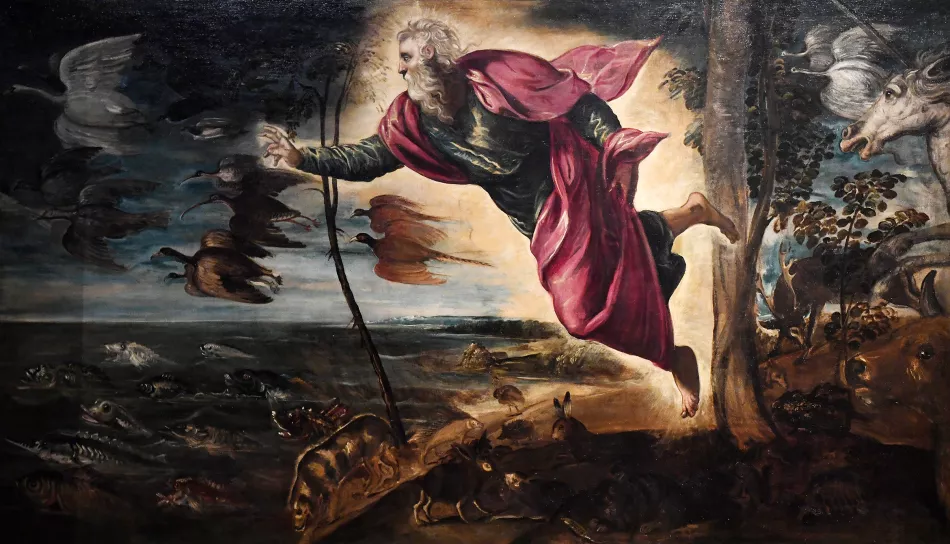
Tintoret, La Création des animaux, 1550-1553, huile sur toile, 140 x 196 cm, Venise, Gallerie dell'Accademia crédit photo: Eric Vandeville / akg-images


Tintoret, Sainte Catherine d'Alexandrie et un ange (connu comme « Le Tintoret de David Bowie ») vers 1557-1570, huile sur toile, 177.1 x 99.3 cm collection particulière, Crédit photo : private collection. All rights reserved.


Édouard Manet, Copie de l'Autoportrait du Tintoret, 1854, huile sur toile, 64 x 50 cm, Dijon, Musée des Beaux-Arts © Musée des Beaux-Arts de Dijon/Hugo Martens


Tintoret, Adoration des bergers, v. 1555-1560, huile sur toile, 162x284cm, Paris, Conservation des œuvres d'arts religieuses et civiles de Paris, église Saint-Honoré d'Eylau, en dépôt à l'église Saint-Eustache © Ville de Paris, COARC/Claire Pignol.


Tintoret, Le Miracle de saint Augustin, 1547 - 1549, huile sur toile, 255 x 174,5 cm, Vicence, Musei Civici di Vicenza - Palazzo Chiericati credit : Musei Civici di Vicenza - Museo Civico di Palazzo Chiericati


Tiintoret, La Déploration du Christ, deuxième moitié du XVIe siècle, huile sur toile, 104 x 137 cmNancy, musée des Beaux-Arts, dépôt du musée du Louvre Crédit photographique : Thomas Clot


Tintoret, Danaé, vers 1570-1583, huile sur toile, 142 x 182 cm, Lyon, Musée des Beaux-Arts Image © Lyon MBA - Photo Martial Couderette


Tintoret, Portrait d'homme, vers 1550, huile sur toile marouflée sur panneau, 113 x 87,5 cmOxford, Christ Church Picture Galleryavec l'aimable autorisation du Governing Body de Christ Church, Oxford Crédit photo : © The Governing Body of Christ Church, Oxford


Tintoret, Suzanne et les vieillards, vers 1555-1556, huile sur toile, 146 cm × 193,6 cm, Vienne, Kunsthistorisches Museum, Gemäldegalerie ©KHM-Museumsverband


Tintoret, Autoportrait, vers 1588, huile sur toile, 63 x 52 cm, Paris, Musée du Louvre, département des Peintures Crédit photo : © GrandPalaisRmn (musée du Louvre) Jean-Gilles Berizzi


Paul Cézanne, La Tentation de saint Antoine, vers 1870 huile sur toile, 57 x 76 cm, Zurich, Kunsthaus / Foundation E.G. Bührle Collection Photo credit: Kunsthaus Zürich


Eugène Delacroix, Crucifixion, 1835, huile sur toile, 182 x 135 cmVannes, musée des Beaux-Arts, la Cohue, Crédit photo : collection musée des beaux-arts de Vannes © Musées de Vannes


Jean-Auguste-Dominique Ingres, L'Arétin dans l'atelier de Tintoret, 1848, huile sur toile, 44.1 x 35.8 cm New York, The Metropolitan Museum of Art, Robert Lehman Collection, 1975 (1975.1.185) Crédit photo : Courtesy of the Metropolitan Museum of Art - CC0


Tintoret, Étude d'après un moulage de la sculpture de Michel-Ange dite 'Le Jour', pierre noire et gouache sur papier, 27 x 37,8 cm, Paris, Musée du Louvre, département des Arts graphiques © GrandPalaisRmn (musée du Louvre) / Michèle Bellot


Tintoret, Léda et le cygne vers 1578, huile sur toile, 162 x 218 cmFlorence, Gallerie degli Uffizi, crédit photo : ©Gabinetto Fotografico delle Gallerie degli Uffizi


Tintoret, La Création des animaux, 1550-1553, huile sur toile, 140 x 196 cm, Venise, Gallerie dell'Accademia crédit photo: Eric Vandeville / akg-images

Monday, September 21, 2026

ARTIST ROOMS: Robert Rauschenberg

Tate Modern

21 September 2026 to December 2027

 
Robert Rauschenberg is organised in collaboration with the Robert Rauschenberg Foundation. It is curated by Gregor Muir, Director of Collection, Tate; Andrew de Brún, Assistant Curator, International Art, Tate Modern; and Julia Blaut, Senior Curator, Robert Rauschenberg Foundation.
 

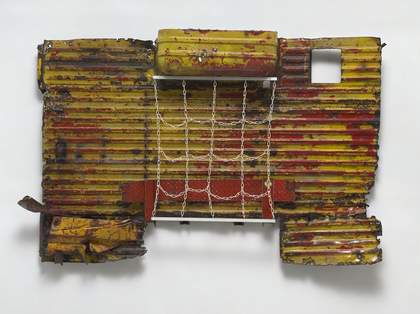
Robert Rauschenberg, Rasputin's Revenge Early Winter Glut 1987. © Robert Rauschenberg Foundation. Photo: Ron Amstutz

ARTIST ROOMS: Robert Rauschenberg, a large-scale free display in the ARTIST ROOMS gallery at Tate Modern, opens on 21 September. It brings together over 20 works by Rauschenberg (1925-2008) spanning three decades, including paintings, prints, and his unique kinetic and light works. At the heart of the presentation are a selection of the artist’s renowned Glut sculptures, including three newly gifted by the Robert Rauschenberg Foundation to mark 100 years since the artist’s birth. These have been donated to Tate Americas Foundation for the ARTIST ROOMS collection, which is jointly shared by Tate and the National Galleries of Scotland. The display at Tate Modern foregrounds how these works relate to the artist’s engagement with dance and performance.

One of the most influential American artists of the 20th century, Rauschenberg’s practice moved freely between painting, collage, sculpture, performance and photography. In his early practice in the 1950s, he challenged the dominance of Abstract Expressionism in the US, making work that blurred the distinction between art and everyday life. In Almanac 1962, one of his first silkscreen works, he printed imagery taken from books, magazines and his own photographs onto canvas. Integrating found objects such as Coca-Cola signs, ironing boards and newspapers into his work, he developed a series combining aspects of painting and sculpture called ‘Combines’. In works like Dylaby 1962, he gives new purpose to these overlooked materials, questioning how we assign meaning to the objects around us.

Fuelled by a curiosity about how he could work with the materials around him, Rauschenberg invented new methods of art making. Taking their inspiration from the abandoned petrol stations, cars and machinery that dotted the Texan landscape in the wake of the 1980s oil surplus, his Gluts series from 1986-94 are made from scrap metal scavenged from junkyards. He saw these works as a stark warning about the consequences of the ‘throwaway culture’ of capitalist society. Three Gluts gifted by the Robert Rauschenberg Foundation are central to the display at Tate Modern. Combining layers of crumpled metal, G-I Glut 1986 is one of a group made using petrol station signage which together reveal the phrase ‘$AVING$, while Rasputin's Revenge Early Winter Glut 1987 embraces the readymade colours and dents of the salvaged materials.

Rauschenberg was attracted to the sense of 'liveness' he could achieve when he activated his work with performance and movement, and frequently made costumes, sets and props throughout his career. Made from scrap metal, Mobile Cluster Glut (Neapolitan) 1987 is adapted from a set he made for a performance of Trisha Brown Dance Company’s Lateral Pass 1985, one of the most important works in postmodern dance. Film documentation of the performance, which took place in Naples, Italy, shows the pieces suspended above the stage. Also on display are examples of the costumes he designed for the dancers in Trisha Brown’s Set and Reset 1983, for which he screen-printed his own photographs of urban and industrial scenes onto transparent fabric.

Rauschenberg was interested in technology’s potential for artmaking. The display features an example from his Carnal Clocks series 1969, kinetic artworks that keep time, containing a mechanism that switches electrical lights on and off at regular intervals. He also experimented with new printing techniques in works such as


Tides, Drifts and Gulf from 1969, creating overlapping images to evoke reflections on the surface of water. Inspired by the colour and texture of silk he saw in Ahmedabad, India, he made a series of works titled the Jammers 1975-6, made predominantly from sewn fabric with rattan poles. In another textile-based series the Hoarfrosts 1974-6, transferred imagery is obscured by multiple layers of fabric.


Mobile Cluster Glut (Neapolitan)1987 Assembled metal with plastic hose104.8 x 240 x 47 cmRobert Rauschenberg Foundation© Robert Rauschenberg FoundationPhoto: Ron Amstutz


G-I Glut 1986 Assembled metal264.2 x 142.2 x 61 cmRobert Rauschenberg Foundation© Robert Rauschenberg FoundationPhoto: Ron Amstutz


Almanac 1962 Oil and silkscreen ink on canvas243.8 x 152.4 cmTate. Presented by the Friends of the TateGallery 1969© Robert Rauschenberg Foundation


Dylaby 1962 Combine: oil, metal objects, metal spring, metalCoca-Cola sign, ironing board, and twine onunstretched canvas tarp on wood support224 x 182 x 48.5 cm variableRobert Rauschenberg Foundation©Robert Rauschenberg FoundationPhoto: Ron Amstutz