|
|
|
|
|

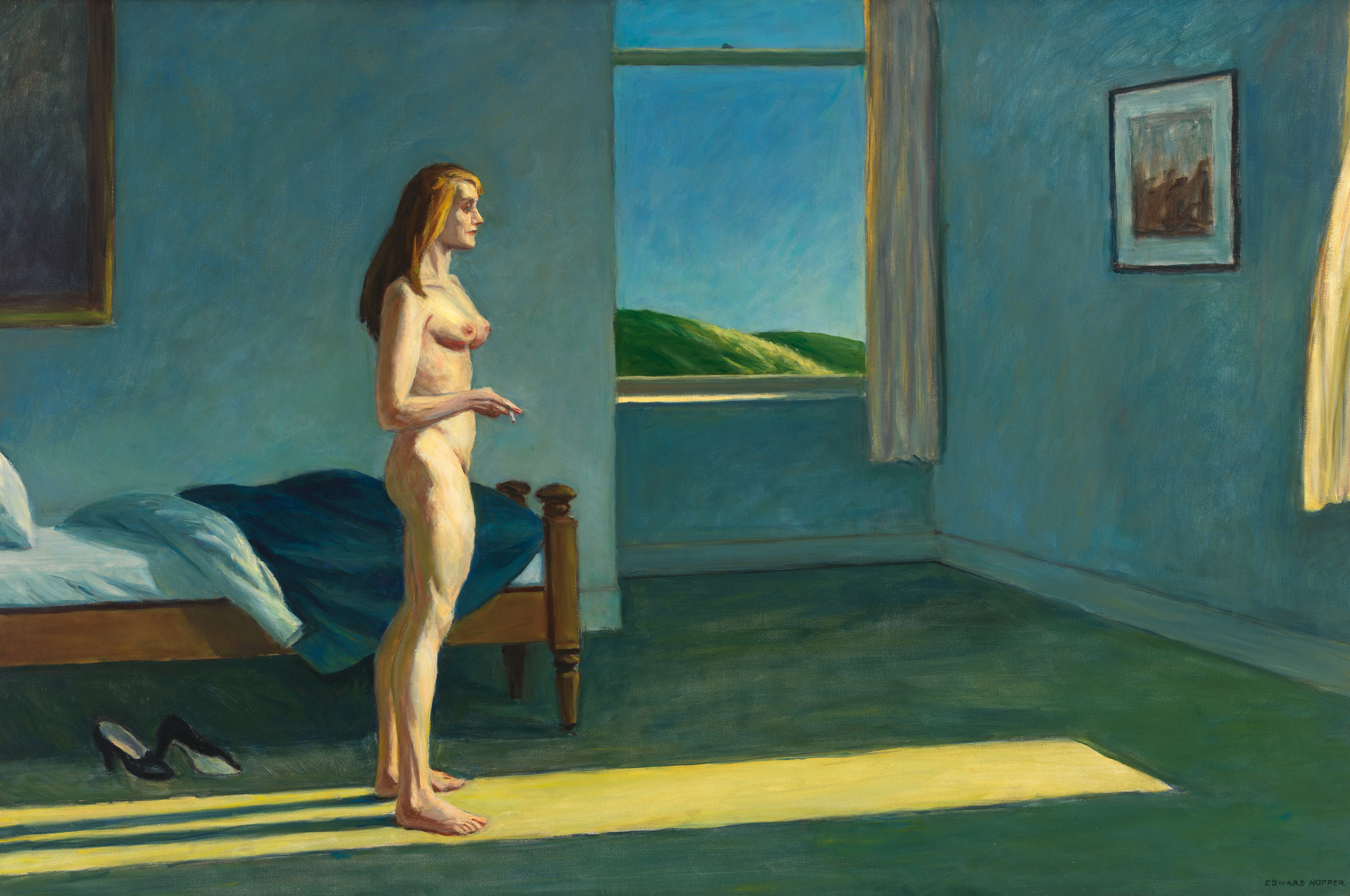
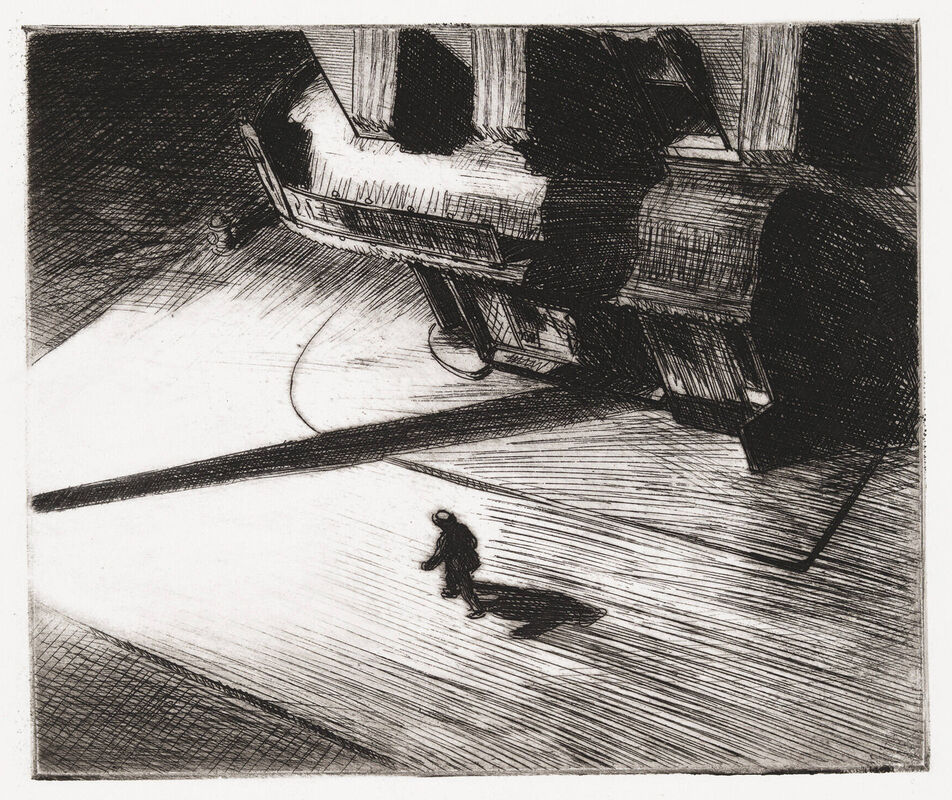
Edward Hopper
A Woman in the Sun
1961, Whitney Museum of American Art, New York; 50th Anniversary Gift of Mr. and Mrs. Albert Hackett in honor of Edith and Lloyd Goodrich
|
|
|
|
|
1961, Whitney Museum of American Art, New York; 50th Anniversary Gift of Mr. and Mrs. Albert Hackett in honor of Edith and Lloyd Goodrich

Among the most profound and prolific were a cohort of young Jewish immigrants, who arrived with varying levels of training and contact with their artistic traditions, yet who created among the most innovative and stunning examples of contemporary art.
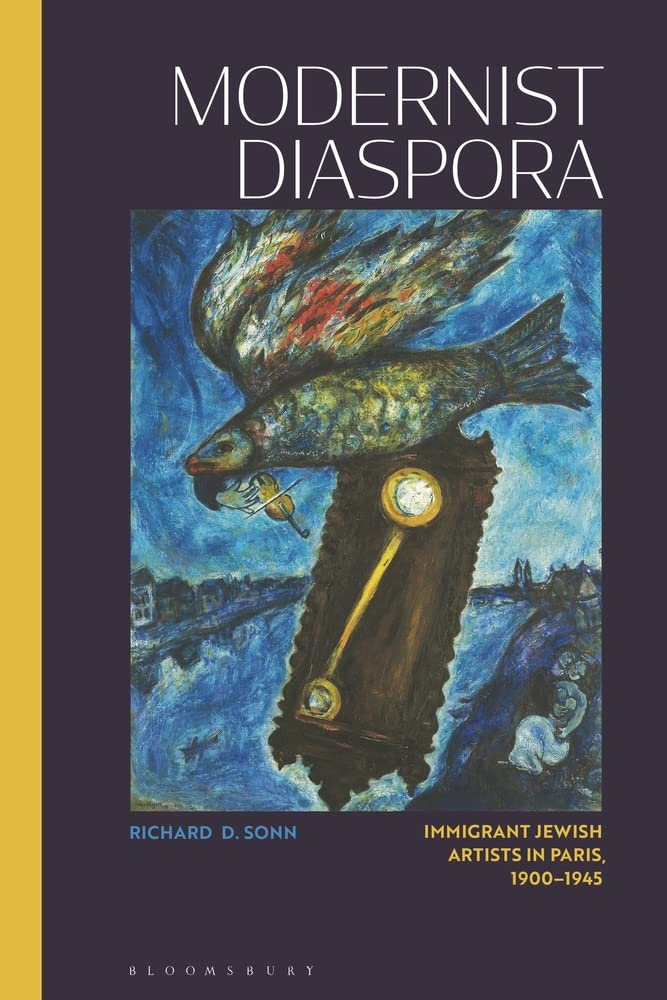
Their experiences are the subject of Modernist Diaspora: Immigrant Jewish Artists in Paris, 1900-1945, a new book by historian Richard Sonn.
Rich with examples from period art, Sonn reveals the critical role of intellectual and cultural exchange among the city’s Jewish immigrant artists in creating the vibrancy of Parisian modernism. By tracing the experiences of Jewish artists who made their way to Paris in the years between the beginning of the 20th century and the end of the World War II, the author gives readers a close look at a unique cultural and social environment that was key to the work of a generation of artists who “produced the greatest efflorescence of art in the long history of the Jewish people.”
At the heart of the book is the left-bank neighborhood of Montparnasse, where Jewish painters and sculptors gathered amidst the rising tide of antisemitism and nationalism in Europe. The works of great artists such as Marc Chagall, Amedeo Modigliani, Chaim Soutine, and Sonia Delaunay-Terk were created here, made possible by the diverse, cosmopolitan society of Paris and the swirling artistic trends of the 20th century.
“The matrix of modernism granted immigrant artists the right to innovate freely and independently, while the artists’ colony allowed its denizens to live differently, in ways that challenged prevailing attitudes toward racism, antisemitism and militarism,” Sonn said.
The last chapter explains how these artists responded personally and artistically to the Holocaust, with the lucky ones finding exile in the U.S. and Switzerland, and others going into hiding in the south of France. More than a hundred were deported, of whom only a handful returned to Paris.
Published by Bloomsbury, Modernist Diaspora: Immigrant Jewish Artists in Paris, 1900-1945 includes 60 illustrations, most in color.
Richard Sonn is professor of history at the University of Arkansas, where he specializes in modern European and modern French history and is active in the university's Jewish Studies program. His previous work has emphasized cultural and intellectual history in France, with a keen interest in the emerging modernist milieu of the late 19th and early 20th centuries. His previous books include Anarchism and Cultural Politics in Fin-de-Siècle France, published by University of Nebraska Press; Anarchism by Twayne Publishers; and Sex, Violence, and the Avant Garde: Anarchism in Interwar France, by Penn State University Press.
|
As a part of its 15th anniversary celebration, the Grohmann Museum is organizing a blockbuster exhibition from one of the premier collections of American industrial art—The Shogren-Meyer Collection. A collection focused primarily on the art of the 1930s and 40s, it also includes many fine examples from the surrounding decades, with many created during the depression era—a time of both toil and triumph.
A grand opening event will be held for A Time of Toil and Triumph on Friday, Sept. 9 from 5 to 8 p.m. The free event will include a Gallery Talk with the collectors, Dan Shogren and Susan Meyer at 6:30 p.m.
Now making their home in the Twin Cities, Shogren and Meyer met while in college at the University of Minnesota Duluth, where both majored in history. It was at that time they took a keen interest in the era on which the collection is based, the “interwar period,” a time of American reinvention—economically, socially, and artistically.
They have since built one of the finest collections of American Art concentrated on this time. Selected from the hundreds of works in their collection, A Time of Toil and Triumph will include dozens of paintings and photographs by Aaron Bohrod, Margaret Bourke-White, John Steuart Curry, Walker Evans, Lewis Hine, Edmund Lewandowski, Dorothea Lange, Thornton Oakley, and Isaac Soyer, among many others.

John Stockton De Martelly (1903-1979), Whiskey Going into Barrels to Age (Marking the Casks), 1946, Oil on canvas, 36 x 33 in.

Robert Gilbert (1907–1988) Industrial Composition, 1932, Oil on canvas, 47 x 34 in.

Joe Jones (1909–1963), Levee, 1933, Oil on canvas, 30 x 41 in.

Edmund Lewandowski (1914-1998), The Waterfront (Buoy Tenders), 1935, Oil on canvas, 32 x 47 in.

Thornton Oakley (1881-1953), The Wonderland of Oil, ca.1942, Pastel and gouache on paper, 30 x 40 in.
National Gallery of Art
October 8, 2022-January 8, 2023
Rijksmuseum,
February 10–June 4, 2023
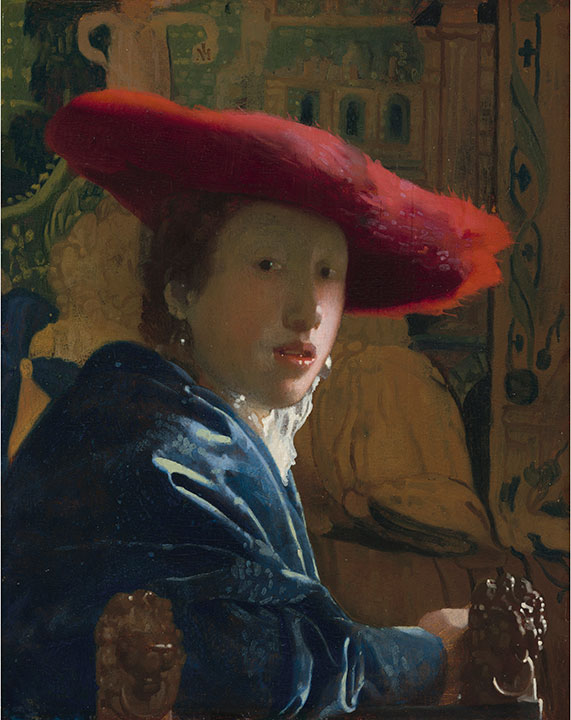
Johannes Vermeer
Girl with the Red Hat, c. 1666/1667
oil on panel
painted surface: 22.8 x 18 cm (9 x 7 1/16 in.)
support: 23.2 x 18.1 cm (9 1/8 x 7 1/8 in.)
framed: 40.3 x 35.6 x 4.4 cm (15 7/8 x 14 x 1 3/4 in.)
National Gallery of Art, Washington, Andrew W. Mellon Collection
Vermeer’s Secrets will unveil new findings about him and his process. The exhibition offers a behind-the-scenes look at how National Gallery curators, conservators, and scientists investigated the museum’s four treasured paintings by and attributed to Vermeer—as well as two 20th-century forgeries—to understand “what makes a Vermeer a Vermeer.”
Johannes Vermeer (1632–1675) is one of the most significant artists of the 17th century, yet much of the Dutch painter’s life and practice remain a mystery. On view at the National Gallery of Art from October 8, 2022, through January 9, 2023
Building on a half-century of technical study, National Gallery researchers took advantage of the museum’s COVID-related closures in 2020/2021 to examine these paintings, which are rarely taken off view. Using advanced imaging techniques that virtually penetrate layers of paint to visualize what lies beneath in combination with microscopic examination of the paintings’ delicate surfaces, these experts now have a clearer understanding of Vermeer’s process, materials, and compositional changes and are eager to share these revelations with the public.
There are around 35 known paintings by Vermeer in the world. As the National Gallery’s research team examined and compared the museum’s four works, one of their goals was to evaluate whether one of them—Girl with a Flute (probably 1665/1675), whose authorship has been long debated—is in fact by Vermeer. Exact findings of the team’s studies will be announced ahead of the exhibition’s opening.
In 2021, the team shared preliminary findings that enhance our understanding of Vermeer’s process. Chemical imaging visualized layers beneath the surface of Woman Holding a Balance (c. 1664), revealing quick, spontaneous, sometimes textured brushstrokes in the underlayers—radically different from the precise finished composition, where individual brushstrokes are barely perceptible. This discovery brings into question the common assumption that the artist was a painstakingly slow perfectionist.
Vermeer’s Secrets will also be the final opportunity for visitors to experience the National Gallery’s paintings by Vermeer before the works travel to Amsterdam for inclusion in an exhibition at the Rijksmuseum, February 10–June 4, 2023.
“Vermeer’s Secrets encourages visitors to play the role of art detective, inviting them to join our art historians, conservators, and scientists in studying the works and learning what stories paintings tell about the hand that made them,” said Kaywin Feldman, director of the National Gallery of Art. “The National Gallery’s paintings by Johannes Vermeer are some of the jewels of our collection, and thanks to this talented team of collaborators and their cutting-edge research, we have a greater understanding of this Dutch master and his process.”
The exhibition is organized by the National Gallery of Art.
The exhibition is curated by Marjorie E. Wieseman, curator and head of the department of northern European paintings, and Alexandra Libby, associate curator, department of northern European paintings, both of the National Gallery of Art.

Johannes Vermeer Woman Holding a Balance, c. 1664 oil on canvas painted surface: 39.7 x 35.5 cm (15 5/8 x 14 in.) stretcher size: 42.5 x 38 cm (16 3/4 x 14 15/16 in.) framed: 62.9 x 58.4 x 7.6 cm (24 3/4 x 23 x 3 in.) National Gallery of Art, Washington, Widener Collection

Johannes Vermeer A Lady Writing, c. 1665 oil on canvas overall: 45 x 39.9 cm (17 11/16 x 15 11/16 in.) framed: 68.3 x 62.2 x 7 cm (26 7/8 x 24 1/2 x 2 3/4 in.) National Gallery of Art, Washington, Gift of Harry Waldron Havemeyer and Horace Havemeyer, Jr., in memory of their father, Horace Havemeyer

Attributed to Johannes Vermeer Girl with a Flute, probably 1665/1675 oil on panel painted surface: 20 x 17.8 cm (7 7/8 x 7 in.) framed: 39.7 x 37.5 x 5.1 cm (15 5/8 x 14 3/4 x 2 in.) National Gallery of Art, Washington, Widener Collection
Research Team
Research for the exhibition was conducted by:
Marjorie E. Wieseman, curator and head of the department of northern European paintings
Alexandra Libby, associate curator, department of northern European paintings
Dina Anchin, associate paintings conservator
E. Melanie Gifford, former research conservator of painting technology
Lisha Deming Glinsman, former conservation scientist
Kathryn A. Dooley, imaging scientist
John K. Delaney, senior imaging scientist
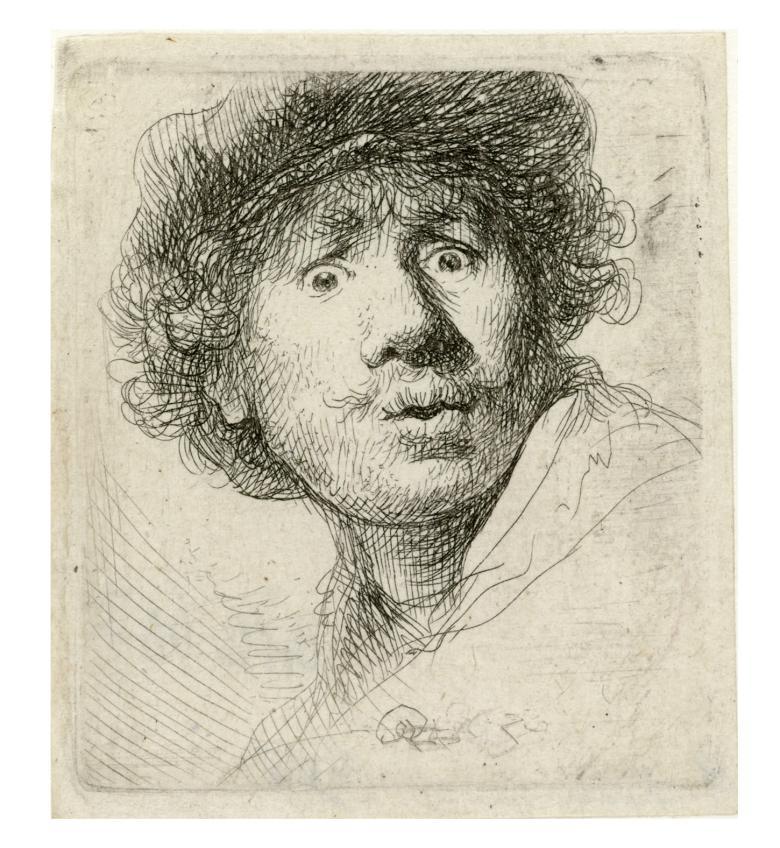
Rembrandt van Rijn (1606-1669), Self-Portrait in a Cap, Wide Eyed and Open Mouthed, 1630. Rijksmuseum, Amsterdam.
On Saturday 16 July 2022, the exhibition Dutch Drawings: highlights from the Rijksmuseum opened at the National Gallery of Ireland. Forty-eight works by 31 different artists who worked during the seventeenth century will go on display. This historic and important exhibition will give Irish audiences the unique opportunity to view, at close quarters, drawings and prints by seventeenth-century Dutch artists from the Rijksmuseum's collection. The works in the exhibition give intimate insights into life in the Netherlands in the seventeenth century, from a child taking its first steps, to a captive monkey.
Anne Hodge, curator of the exhibition, commented: "Shakespeare’s well-known lines ‘All the world’s a stage, and all the men and women merely players …’ encompass the diversity of subject matter contained within these works on paper chosen from the Rijksmuseum’s renowned collection. All of life is here, from studies of plants and animals to portraits of loved ones, and records of conflagrations and comets, architecture and landscape."
The exhibition will complement the Gallery’s strong collection of seventeenth-century Dutch paintings, and will be a must-see for visitors who have a familiarity with and fondness for Dutch art.
This exhibition will include works in a wide variety of media and techniques: graphite, ink, watercolour, chalks, etching and woodcut. Although predominately comprised of drawings, the exhibition also includes a small number of delicately executed prints by Rembrandt. Notable artists include Hendrik Avercamp, Nicolaes Berchem, Jan van Goyen, and Jacob van Ruisdael.
The drawings in this exhibition were produced for a multitude of reasons: as part of the process of making a painting, to practice drawing skills, to record a likeness, to mark an unusual event, to describe to science a plant from a far-off land, or to hang framed on a wall. They illustrate how artists strove to understand the world around them. Drawing, with its portable and inexpensive media and supports, was the tool that allowed artists to experiment and translate ephemeral images into lasting works of art.
The exhibition gives a sense of what life was like in the Netherlands in the seventeenth century and the real importance of drawing at that time. This display of exquisitely skilful works on paper emphasises the ever-lasting importance of drawing within the wider world of art.
Ilona van Tuinen, Head of the Rijksmuseum Print Room, added: “This promises to be a wonderful exhibition, thoughtfully curated by Anne Hodge. I am delighted that the Irish public will be able to enjoy and admire some of our best works on paper. It is equally thrilling that our drawings and prints will benefit from the stimulating new context provided by the National Gallery of Ireland’s rich holdings of Dutch seventeenth-century paintings.”
Dutch Drawings: highlights from the Rijksmuseum is on display at the National Gallery of Ireland from 16 July, closing on 6 November 2022.

A fully illustrated exhibition catalogue and a programme of learning events will complement the exhibition.