Tuesday, April 4, 2023

The Rossettis


Tate Britain

6 April – 24 September 2023

Dante Gabriel Rossetti, Paolo and Francesca da Rimini, 1855 (detail) © Tate


In April 2023 Tate Britain will present a major exhibition charting the romance and radicalism of the Rossetti generation – Dante Gabriel, Christina and Elizabeth (neé Siddal) – showcasing their revolutionary approach to life, love and art. Moving through and beyond the Pre-Raphaelite years, the exhibition will feature 150 paintings and drawings as well as photography, design, poetry and more. This will be the first retrospective of Dante Gabriel Rossetti at Tate and the largest exhibition of his iconic pictures in two decades. It will also be the first full retrospective of Elizabeth Siddal for 30 years, featuring her rare surviving watercolours and important drawings. Christina and Dante Gabriel’s poetry will be interwoven with the artworks through spoken word and beautifully illustrated editions of their work.

The Rossettis led a progressive counterculture, blending past and present to reinvent art and life for a fast-changing modern world. The children of an Italian revolutionary exile, they grew up in London in a scholarly family and they began their artistic careers as teenagers. The exhibition will begin with a celebration of their young talent, opening with Dante Gabriel’s Ecce Ancilla Domine (The Annunciation) 1850, the stark and evocative painting for which his sister Christina and brother William Michael posed. This will be shown with an immersive installation of Christina’s poetry, as well as examples of Dante Gabriel’s teenage drawings, reflecting his precocious skill and his enthusiasm for original voices like William Blake and Edgar Allan Poe.

Works from the Pre-Raphaelite years will demonstrate how the spirit of popular revolution inspired these artists to initiate the first British avant-garde movement, rebelling against the Royal Academy’s dominance over artistic style and content. More personal forms of revolution will be explored through the Rossettis’ refusal to abide by the constraints of Victorian society. Works such as Dante Gabriel’s Found begun 1854, Elizabeth Siddal’s Lady Clare 1857 and Christina’s famous poem The Goblin Market 1859 will show how they questioned love in an unequal and materialist world. Following new research, the surviving watercolours of Elizabeth Siddal will also be shown in a two-way dialogue with contemporary works by Dante Gabriel, exploring modern love in jewel-like medieval settings. As a working-class artist who was largely self-taught, Siddal’s work was highly original and inventive, but has often been overshadowed by her mythologisation as a muse and her tragic early death.

The exhibition will take a fresh look at the fascinating myths surrounding the unconventional relationships between Dante Gabriel, Elizabeth Siddal, Fanny Cornforth and Jane Morris. The poetic portraits from the later part of Dante Gabriel’s career, such as Bocca Baciata 1859, Beata Beatrix c.1864-70 and The Beloved 1865-73, will be shown in the context of the achievements and experiences of the working women who modelled for them. The exhibition will also explore how the poetic and artistic evolution of the femme fatale informed works such as Lady Lilith 1866-8 and Mona Vanna 1866.

Alongside art and poetry, visitors will also be able to experience how the Rossettis’ trailblazing new lifestyles transformed the domestic interior through contemporary furniture, clothing and design. The exhibition will conclude by showing how the Rossettis inspired the next generation, including William Michael’s children who started the anarchist magazine The Torch, and how they continue to influence radical art and culture to this day.


Images


Dante Gabriel Rossetti Venus Verticordia1868 © Private Collection


Dante Gabriel Rossetti Beata Beatrix1864 © Tate Presented by Georgiana, Baroness Mount-Temple in memory of her husband, Francis, Baron Mount-Temple 1889


Dante Gabriel Rossetti Ecce Ancilla Domini (The Annunciation)1849-50© Tate, Purchased 1886


Dante Gabriel Rossetti Head of a Young Woman [Mrs. Eaton?]1863-65© Cantor Arts Center, Stanford University; Museum Purchase Fund


Dante Gabriel Rossetti Monna Vanna1866 © Tate


Dante Gabriel Rossetti The Girlhood of Mary Virgin1848-9 © Tate


Elizabeth Eleanor Siddal Lady Affixing Pennant to a Knight's Spear1856© Tate


Christina Rossetti Goblin Market1865© Tate
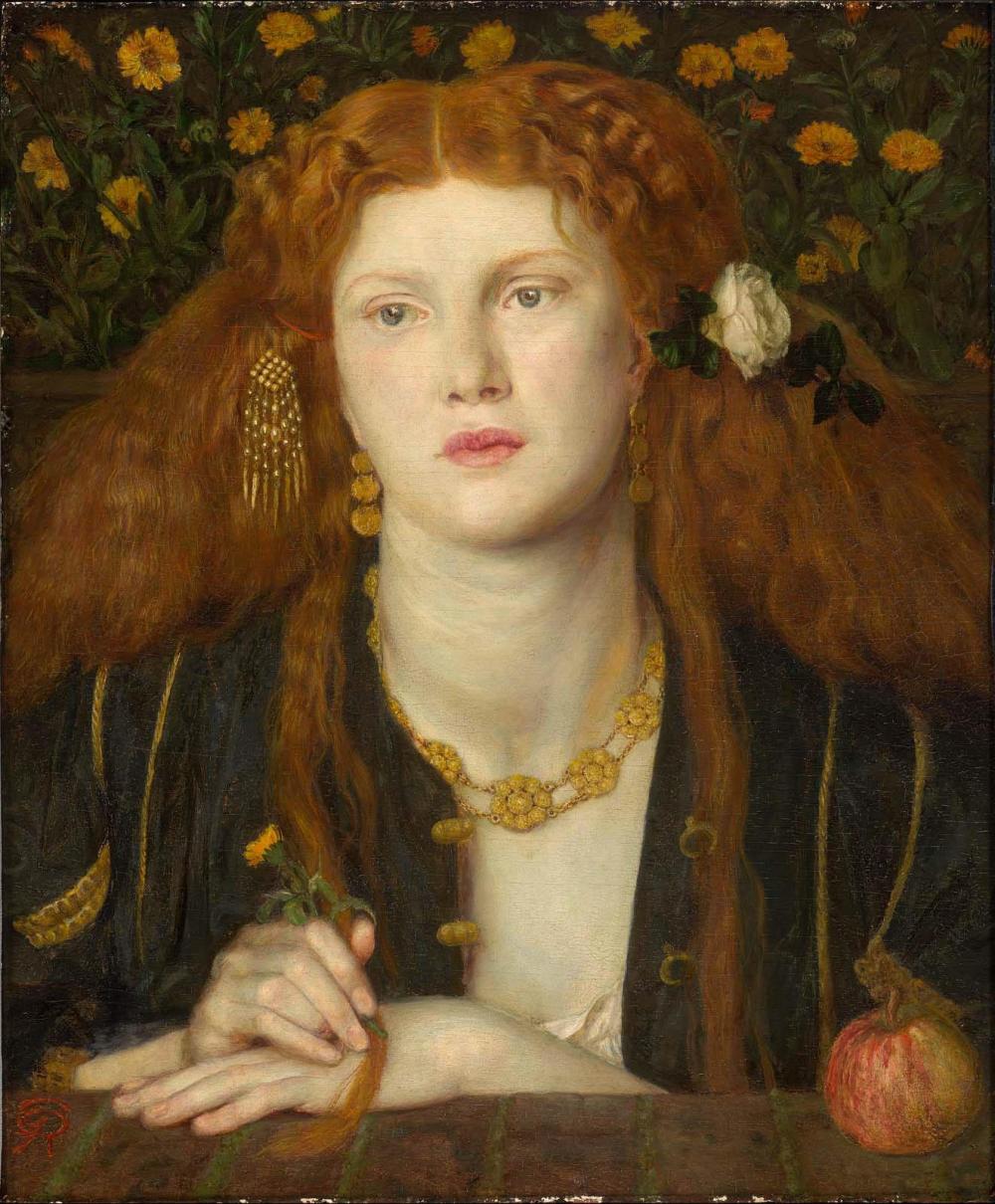


Dante Gabriel Rossetti Bocca Baciata 1859 ©Museum of Fine Arts Boston


Dante Gabriel Rossetti Proserpine1874© Tate


Dante Gabriel Rossetti Paolo and Francesca da Rimini1855© Tate Purchased with assistance from Sir Arthur Du Cros Bt and Sir Otto Beit KCMG through the ArtFund 1916


Dante Gabriel Rossetti La Ghirlandata1873© Guildhall Art Gallery


Dante Gabriel Rossetti Lady Lilith, 1866-1868 (altered 1872-1873) Delaware Art Museum, Samuel and Mary R. Bancroft Memorial, 1935

Monday, April 3, 2023

Soutine Kossoff


Opening at Hastings Contemporary on April 1, 2023, Soutine Kossoff pairs two major figures of 20th-century painting: one a master of the School of Paris, the other a master of the School of London. Soutine|Kossoffis the first ever museum exhibition to explore the artistic relationship between British artist Leon Kossoff (1926-2019) and Belarus-born painter Chaim Soutine (1893-1943).Undertaken with the full support of the Kossoff estate, it brings together around 40 important loans from public and private collections in the UK, USA and beyond.

Aside from Soutine Portraits(Courtauld, 2017) at around 20 works, this is the largest group of Soutines shown together in UK since 1982, and the first since then to show both portraits and landscapes, providing a fascinating follow-up to The Barnes Foundation’s 2021 show Soutine / DeKooning.

The discovery of Soutine’s paintings in the early 1950’s was a significant moment for Kossoff, who was already finding his way towards the kind of direct and expressive use of paint he saw in his predecessor’s work. Soutine grew up in Belarus before migrating to Paris as a young man, while Kossoff was born and raised in London, his parents having arrived there fromUkraine as children. Although their life experiences were very different, the two artists shared an Eastern European Jewish heritage which perhaps brought a particular cultural sensibility to their work.To create transcendent works from the stuff of everyday life became Kossoff’s mission, as it had been Soutine’s. The main focus of Soutine|Kossoff is on the areas of interest shared by both artists: landscape and portraiture. 

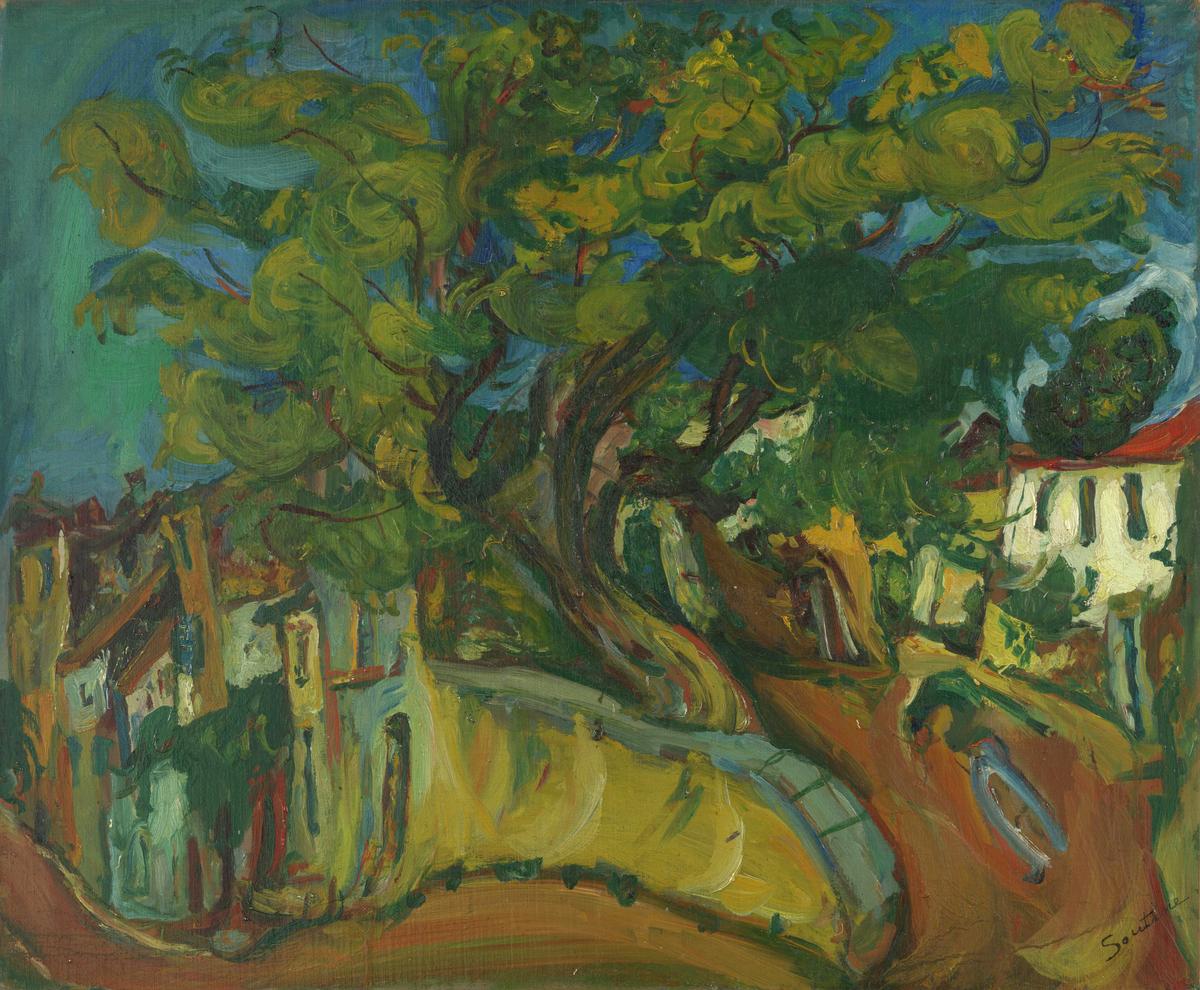
The exhibition features seminal landscapes painted by Soutine in southern France in the early 1920s, with highlights including 


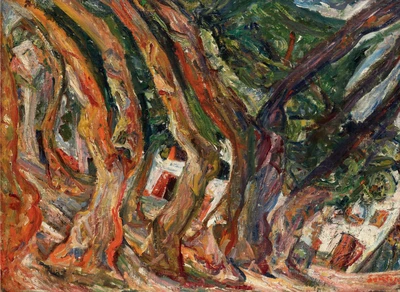
Chaim Soutine, Les Platanes a Ceret, c.1920 (oil on canvas). Collection Diethard Leopold. Image courtesy of Sotheby's

and 


Cagnes Landscape with Tree,(c.1925-26,Tate).  

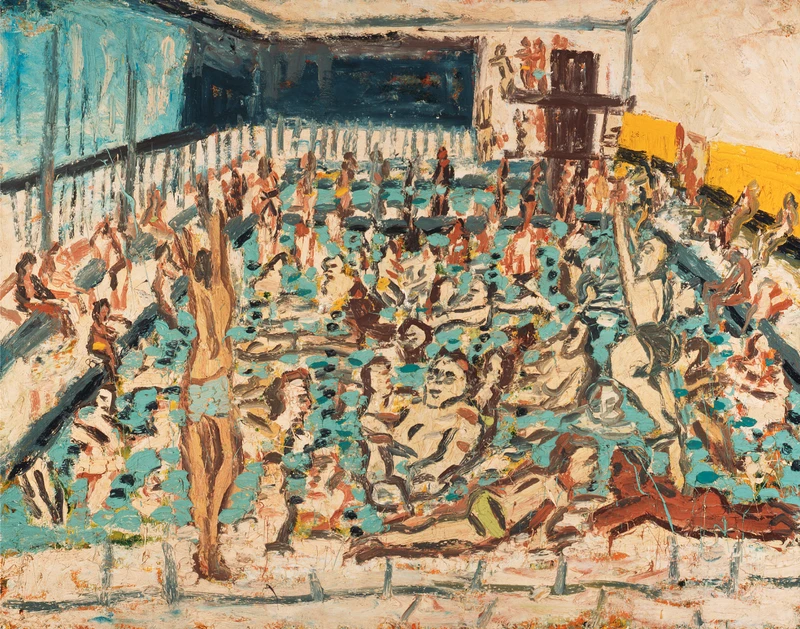
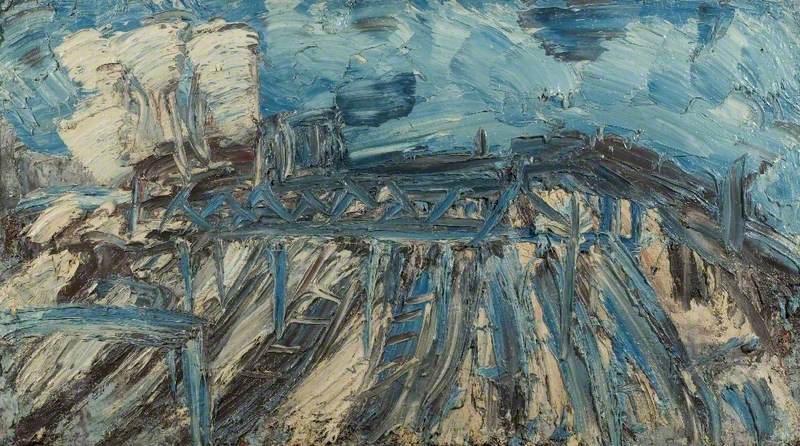
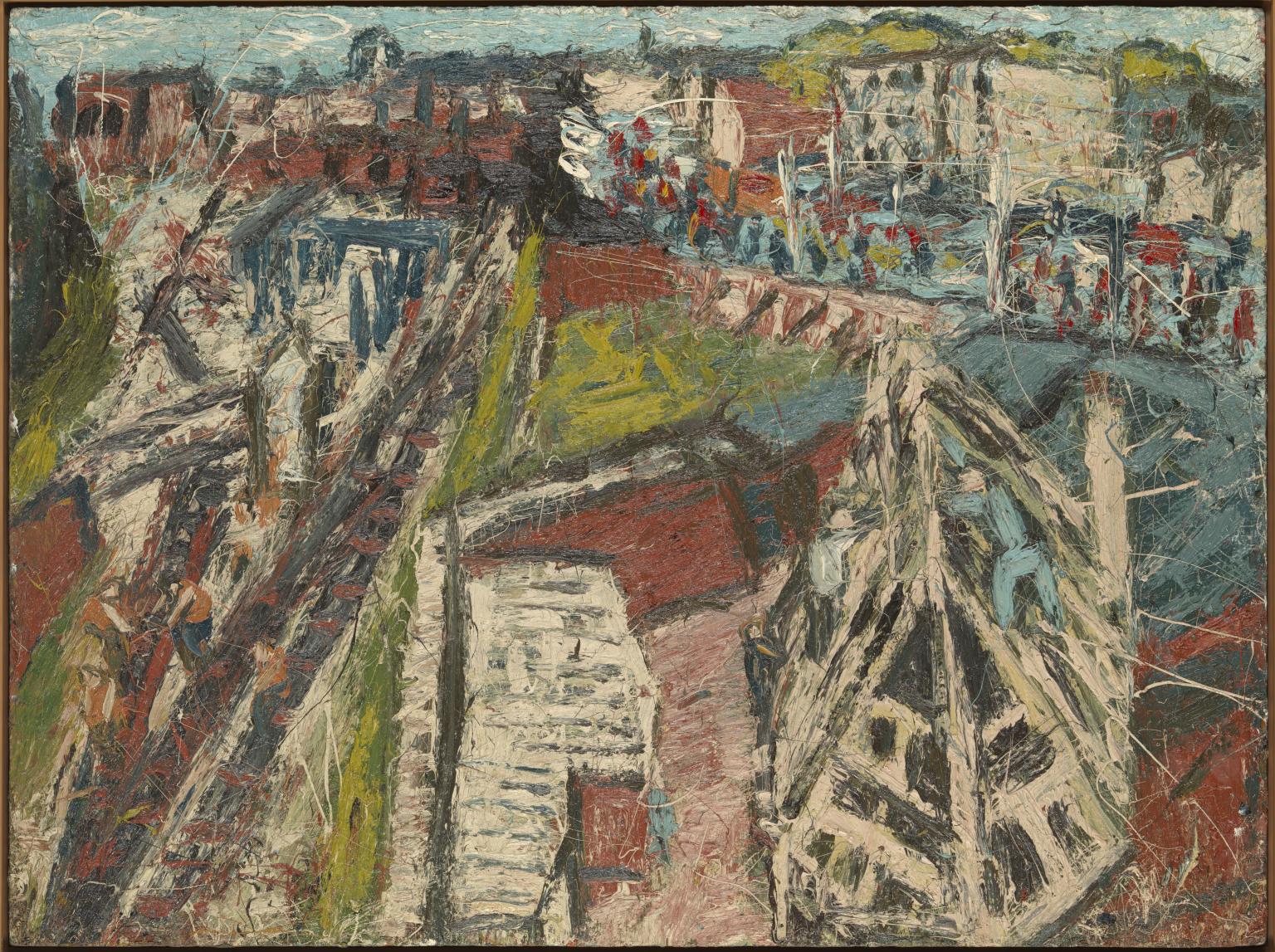
From Kossoff come major paintings of railway junctions, building sites and other scenes of unexpected beauty found in north and north-west London, among them

Leon Kossoff, Children’s Swimming Pool Autumn Afternoon, 1971. ©Tate


© the artist's estate. Photo credit: Alfred East Art Gallery Permanent Collectio

Willesden Junction, Summer, No.2,(1966, Alfred East Art Gallery) 


Visitors will have a rare opportunity to view 


alongside works such as his powerful Seated Woman(1957) 


A major group of Soutine portraits includes


and


Chaim Soutine, Le valet de chambre, c. 1927 (oil on canvas), THE LEWIS COLLECTION


A publication will accompany the exhibition.

Soutine|Kossofis curated by Hasting Contemporary’s guest curator James Russell, whose recent show Seafaring opened to a4-star review fromThe Daily Telegraph. 

Saturday, April 1, 2023

Juan de Pareja, Afro-Hispanic Painter


First Major Exhibition on Afro-Hispanic Painter Juan de Pareja, the Subject of Diego Velázquez’s Iconic Portrait, to Open at The Met

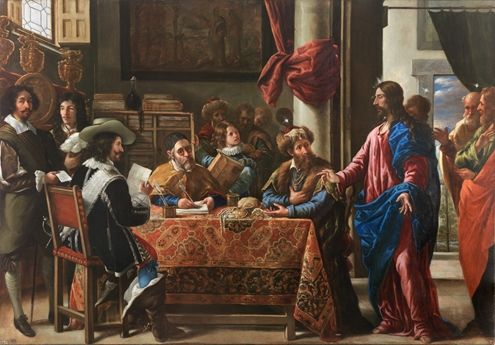
A painting of a group of men seated at a table in brightly colored robes leaning to speak to the standing figure of Matthew on the right.

Image: Juan de Pareja (Spanish, ca. 1608–1670). The Calling of Saint Matthew, 1661. Oil on canvas, 88 9⁄16 × 130 in. (225 × 325 cm). Museo Nacional del Prado, Madrid. Photo: © Photographic Archive Museo Nacional del Prado

Exhibition Dates: April 3–July 16, 2023
Location: The Met Fifth Avenue, Galleries 955 and 960–962

Español

Juan de Pareja, Afro-Hispanic Painter offers an unprecedented look at the life and artistic achievements of Juan de Pareja (ca. 1608–1670). Largely known today as the subject of The Metropolitan Museum of Art’s iconic portrait by Diego Velázquez, Pareja was enslaved in Velázquez’s studio for more than two decades before becoming an artist in his own right. Opening April 3, 2023, this exhibition is the first to tell his story and examine the ways in which enslaved artisanal labor and a multiracial society are inextricably linked with the art and material culture of Spain's “Golden Age.” The presentation brings together approximately 40 paintings, sculpture, and decorative arts objects, as well as an array of books and historic documents, from The Met’s holdings and other collections in the United States and Europe.

“This exhibition takes us to the very heart of 17th-century Spanish painting to reveal Juan de Pareja’s incredible personal story,” said Max Hollein, Marina Kellen French Director of The Met. “By reexamining the narrative around one of the most celebrated works in the history of western portraiture, the presentation challenges us to question existing notions about historical art and objects—and introduces a remarkable artist whose name may be familiar to many but whose work had not been explored in depth.” 

In the exhibition, representations of Spain’s Black and Morisco populations in works by Francisco de Zurbarán, Bartolomé Estebán Murillo, and Velázquez join works that chart the ubiquity of enslaved labor across media. The Met’s portrait, executed by Velázquez in Rome in 1650, is contextualized by his other portraits from this period and the original manumission document freeing Pareja. The exhibition culminates in the first gathering of Pareja’s rarely seen paintings, including his self-portrait, featured in his vast The Calling of Saint Matthew (Museo Nacional del Prado). 

Additionally, the collection and writings of Harlem Renaissance figure Arturo Schomburg—who was vital to the recovery of Pareja’s work—serve as a thread connecting 17th-century Spain with 20th-century New York.

David Pullins, exhibition co-curator and Associate Curator in The Met’s Department of European Paintings, said, “The Met’s purchase of Velázquez’s painting in 1971 made headlines at the time, but scholars and the press said practically nothing about the man depicted. Not only does this exhibition shed more light on Pareja’s life but it also places emphasis on his agency as a creative force through his long overlooked paintings. Fleshing out Pareja’s story acts as a kind of wedge that makes space for entirely new narratives about the art and material culture of 17th-century Spain.” 

Vanessa K. Valdés, exhibition co-curator and Associate Provost for Community Engagement and Professor of Spanish and Portuguese at The City College of New York, added, “Pareja’s artistic legacy reverberates across the canons of Western art and the African diaspora into our time. This project follows in the footsteps of Arturo Schomburg and joins the efforts of scholars who continue to recover the contributions of all peoples of African descent, including those of Afro-Hispanic heritage like Pareja, in order to better understand the full complexity and richness of the global Black experience.”
 
Exhibition Overview
 
Juan de Pareja, Afro-Hispanic Painter is organized thematically into four sections.
 
Pareja’s New York story began long before his portrait arrived at The Met. During the 1910s, as part of a broader project to recover evidence of excellence within global Black history, Schomburg pioneered a new understanding of Pareja. A Black Puerto Rican intellectual and collector who lived in New York, Schomburg traveled to Europe, spending time first in Seville, Granada, and Madrid, where he conducted research that reconstructed the multiracial society of Pareja’s time in which people of African descent had played a crucial, unrecognized part. The exhibition’s first section highlights Schomburg’s work through a core group of loans from The New York Public Library’s Schomburg Center for Research in Black Culture and other sources, including his landmark essay “The Negro Digs Up His Past,” photographs from his travels, and several books. Quotations from Schomburg woven throughout the remaining galleries emphasize the central role that retrieval plays in the rewriting of received histories.
 
Pareja was born around 1608 in Antequera, Spain, probably to an enslaved woman of African descent and a white Spaniard. Although no known documents from Pareja’s lifetime speculate on his family origins or skin color, archival records from 17th-century Spain offer ample evidence of a multiracial society in which artists and artisans engaged enslaved labor. 

The exhibition’s second section illuminates the oft-obscured traces of enslaved labor in surviving objects from the era, demonstrated in polychrome wooden sculptures and other examples of woodwork, silverwork, and ceramics. Rare depictions of the region’s Black and Morisco (Spanish Muslims forced to convert to Catholicism) populations include 


a monumental painting by Francisco de Zurbarán (The Met). 

Three surviving versions of Velázquez’s painting of a kitchen maid—gathered together for the first time in this exhibition (from The National Gallery of Ireland; The Art Institute of Chicago; and The Museum of Fine Arts, Houston)—center a person of color as the composition’s primary protagonist. This unprecedented configuration in European painting attests to the burgeoning market for such images during that period, a market which Bartolomé Estebán Murillo would later cater to in his painting 


Three Boys (Trustees of the Dulwich Picture Gallery).
 
The exhibition’s third section focuses on the trip between 1649 and 1651 that Velázquez and Pareja took to Italy, where Velázquez painted his portrait of Pareja:


Exhibited to great acclaim, the image paved the way for Velázquez to create an extraordinary series of portraits, including those of the papal retinue and friends. Velázquez’s portrait of Pareja secured a peculiar kind of celebrity for its subject and raises important questions about the relationship between portraitist and sitter when one is legally owned by the other. The trip was a turning point in Pareja’s professional and personal life: his enslaved status perversely afforded him rare access to monuments of European art that would inform his artistic voice. Velázquez also signed manumission papers (Archivio di Stato di Roma) in Rome, documenting his decision to free Pareja four years later and opening the door for Pareja’s choice to pursue his own career as a painter after their return to Madrid.
 
The exhibition concludes with the first-ever gathering of Pareja’s paintings, some of enormous scale, made after his manumission in 1654. By placing himself in dialogue with a group of artists known today as the Madrid School, whose lively palettes and compositions contrasted with Velázquez’s courtly sobriety, Pareja charted his own artistic path rather than following the style of his former enslaver. 

On display are Pareja’s The Calling of Saint Matthew (Museo Nacional del Prado), which includes a self-portrait on the far left; (above)


The Flight into Egypt (The John and Mable Ringling Museum of Art); 


Portrait of José Ratés (Museu de Belles Arts de València); 


and The Baptism of Christ (Museo Nacional del Prado). The latter features a trompe l’oeil “carving” of Pareja’s name into a rock, his most adamant claim to artistic authority. The gathering of these works marks a new chapter in the continued recovery of Pareja’s art.
 
Credits and Related Content
 
Juan de Pareja, Afro-Hispanic Painter is co-curated by David Pullins, Associate Curator in The Met’s Department of European Paintings, and guest curator Vanessa K. Valdés, Associate Provost for Community Engagement and Professor of Spanish and Portuguese at The City College of New York. The exhibition took shape in dialogue with an external advisory committee.


A fully illustrated catalogue accompanies the exhibition. Published by The Metropolitan Museum of Art and distributed by Yale University Press, it is available for purchase from The Met Store.


Berthe Morisot: Shaping Impressionism

Dulwich Picture Gallery 

31 March – 10 September 2023)

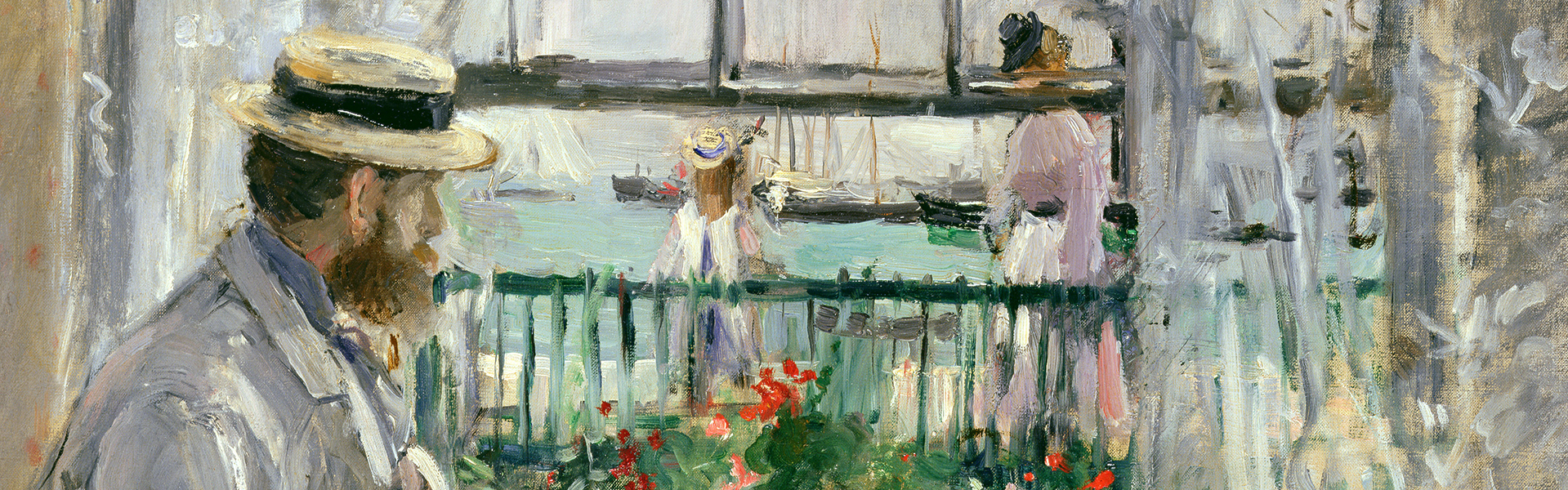
Berthe Morisot, Eugène Manet on the Isle of Wight, 1885 © Musée Marmottan Monet, Paris. (detail)

In Spring 2023, Dulwich Picture Gallery will present Berthe Morisot: Shaping Impressionism, the first major UK exhibition of the renowned Impressionist since 1950. In partnership with the Musée Marmottan Monet, Paris, it will bring together 40 of Morisot’s most important works from international collections, many never seen before in the UK, to reveal the artist as a trailblazer of the movement as well as uncovering a previously untold connection between her work and 18th century culture, with around 20 works for comparison.


A founding member of the Impressionist group, Berthe Morisot (1841-1895) was known for her swiftly painted glimpses of contemporary life and intimate domestic scenes. She featured prominently in the Impressionist exhibitions and defied social norms to become one of the movement’s most influential figures. Now, in a bold new retelling of Morisot’s story, Dulwich Picture Gallery will draw on new research and previously unpublished archival material from the Musée Marmottan Monet to trace the roots of her inspiration, revealing the ways in which Morisot engaged with 18th century art and culture, while also highlighting the originality of her artistic vision, which ultimately set her apart from her predecessors.

Highlights will include Eugène Manet on the Isle of Wight (1875), painted while Morisot was on honeymoon in England, and her striking Self-Portrait (1885), which will appear alongside Jean-Honoré Fragonard’s Young Woman (c.1769) from Dulwich Picture Gallery’s collection. Apollo revealing his divinity to the shepherdess Issé, after François Boucher (1892), In the Apple Tree (1890) and Julie Manet with her Greyhound Laerte (1893), are among nine paintings on loan from the Musée Marmottan Monet, many receiving their first ever showing in the UK.

Central to the exhibition is the story of the “rediscovery” of 18th century art in France and its impact on Impressionism with an accompanying body of work by artists including François Boucher, Jean-Baptiste-Siméon Chardin, Jean-Honoré Fragonard and Antoine Watteau. After falling out of favour following the French Revolution, the art of the ancien regime was enthusiastically acquired by 19th century collectors and reintroduced to the public through exhibitions and new rooms devoted to its artists at the Musée du Louvre. Morisot copied works by Boucher; she experimented with red chalk, a technique closely associated with Rococo drawing; and declared her admiration for Jean-Baptiste Perronneau and Georges de La Tour. Uniquely amongst her compatriots, Morisot also expressed a passionate enthusiasm for English painters Thomas Gainsborough, Sir Joshua Reynolds and George Romney.

The exhibition will demonstrate the numerous ways in which Morisot engaged with 18th century themes, drawing on her depictions of everyday life, fashion, interiors and intimate scenes. Works such as At the Ball (1875) reflect the elegance of the fête galante tradition and 18th century portraiture. Hung alongside Watteau’s Les Plaisirs du Bal (c.1715-17) from Dulwich Picture Gallery, a clear comparison can be drawn between the elegantly dressed and costumed figures and Morisot’s glamorous sitter with her 18th century fan.

Morisot was known for painting glimpses into women’s private spaces along with an ability to capture feeling and emotion. Works including The Psyche Mirror (1876) and Woman at her Toilette (1875/80) form a point of comparison and contrast with 18th century examples by artists such as Boucher and Fragonard, reflecting the different priorities and perspectives of a woman Impressionist working in a modern 19th century exhibition context, compared with male Rococo painters working for private collectors.

About Berthe Morisot
Berthe Marie Pauline Morisot (1841-1895) was a French painter and a founding member of Impressionism. In 1864, she exhibited for the first time in the highly esteemed Salon de Paris. Her work was selected for exhibition in six subsequent Salons until, in 1874, she joined the “rejected” Impressionists in the first of their own exhibitions, which included Paul Cézanne, Edgar Degas, Claude Monet, Camille Pissarro, Pierre-Auguste Renoir and Alfred Sisley. Morisot went on to participate prominently in almost all of the following eight Impressionist exhibitions between 1874 and 1886; she missed one in 1878 when she gave birth to her daughter Julie who she had with her husband Eugène Manet, the brother of her friend and colleague Édouard Manet. In 1894, she was described by influential French art critic Gustave Geffroy as one of “les trois grandes dames” of Impressionism alongside Marie Bracquemond and Mary Cassatt.

The exhibition will be co-curated by Dr Lois Oliver (Curator at the Royal Academy, Adjunct Professor in History of Art at the University of Notre Dame (USA) in London and a Visiting Lecturer at the Courtauld Institute of Art), Dr Marianne Mathieu (Scientific Director of the exhibition) and Dr Dominique d’Arnoult (independent curator and Professor of Art History at the University of Lausanne). 


The exhibition will be accompanied by a fully illustrated scholarly catalogue published in both English and French. 


Edited under the Scientific Direction of Dr Marianne Mathieu, this publication will present ground-breaking archival research and fresh perspectives.

Jennifer Scott, Director of Dulwich Picture Gallery, said:

“Morisot was an innovator and a leader of the Impressionist movement. We are excited to be working in partnership with Musée Marmottan Monet to bring a remarkable body of Morisot’s work to UK audiences, and to present ground-breaking comparisons to reveal the inspiration behind Impressionism itself.”

Musée Marmottan Monet
The Musée Marmottan Monet is housed in a magnificent townhouse once owned by writer and art collector Paul Marmottan. In addition to its collection of pre-modern paintings, sculptures and illuminations, it boasts the world’s leading collections of works by Claude Monet and Berthe Morisot. This outstanding Impressionist treasure is further enriched by works from Delacroix, Boudin, Manet, Degas, Caillebotte, Sisley, Pissarro, Gauguin and Rodin, with Chagall representing the modernist period.
www.marmottan.fr

Dr Lois Oliver, co-curator and Curator at the Royal Academy, said:

“Morisot was one of the greatest of the Impressionist artists, and yet her work has rarely been shown in the UK. It is an absolute pleasure to be bringing Morisot’s art to Dulwich, where for the first time it will be juxtaposed with the 18th century art that inspired her, including works by the English painters who made such an impression on Morisot during her honeymoon in England in 1875.”

Dr Marianne Mathieu, Scientific Director of the exhibition, is a specialist of Berthe Morisot who has made recent research discoveries around Morisot and her circle. She said:

“Musée Marmottan Monet is the world’s leading research centre for the work of Berthe Morisot. Dulwich Picture Gallery holds a celebrated collection of 18th century painting. Through this special collaboration we shine new light on Impressionism, Berthe Morisot, and the enduring influence of the 18th century.”


Images


Berthe Morisot, Eugène Manet on the Isle of Wight, 1885 © Musée Marmottan Monet, Paris.


Berthe Morisot, Self-portrait, 1885 © Musée Marmottan Monet, Paris.


Berthe Morisot, Woman at her Toilette, 1875-80. Image courtesy of The Art Institute of Chicago, Stickney Fund.


Berthe Morisot, At the Ball, 1875 © Musée Marmottan Monet, Paris.


Berthe Morisot, Two Nymphs, from Apollo revealing his divinity to the shepherdess Issé, after François Boucher, 1892. © Musée Marmottan Monet, Paris.


Berthe Morisot, Resting, 1892, oil on canvas. Private Collection

Berthe Morisot, Julie Manet with her Greyhound Laerte, 1893. © Musée Marmottan Monet, Paris.


Jean-Honoré Fragonard, Young Woman, c.1769. Courtesy Dulwich Picture Gallery.


Antoine Watteau, Les Plaisirs du bal, c. 1715-17. Courtesy Dulwich Picture Gallery.