Sunday, August 11, 2024

Discover Constable and The Hay Wain


The National Gallery  (London)
17 October 2024 – 2 February 2025

In winter 2024‒25, as part of our NG200 celebrations, the National Gallery will stage the exhibition Discover Constable and The Hay Wain focussing on John Constable’s masterpiece The Hay Wain (1821).

This will be the first loan exhibition held at the National Gallery on John Constable (1776–1837) and the first to explore the social, political and artistic context of the English landscape at the time of 'The Hay Wain’s' production.

An exhibition on 'The Hay Wain' in the National Gallery’s Bicentenary year is apt as 1824 was a key international moment for Constable, when the painting garnered great acclaim at the Paris Salon, receiving a gold medal from the French King Charles X.

Now a symbol of a quintessential and somewhat romantic British countryside, 'The Hay Wain' has entered our collective visual memory and pop culture as an icon of traditional British landscape painting, and it is hard to imagine that 'The Hay Wain' was once considered radical. Yet, when it was first exhibited at the Royal Academy in 1821, it was viewed as an innovative reimagining of the landscape tradition. 

One of the principal aims of the exhibition is to show how Constable came to be established as a master in the history of British art as his work entered the collections of major galleries and museums. It will introduce major donations from Isabel Constable, the artist’s daughter, and the art collectors John Sheepshanks and Henry Vaughan to the national collections of the V&A (South Kensington Museum), and the National Gallery, a number of which are now held in the collections of Tate Britain. 

The exhibition will also look at the ownership of the painting and its acquisition by the National Gallery in 1886 and examine the rise in popularity of both Constable and 'The Hay Wain' since this point. 

Constable, as the son of a wealthy mill owner and corn merchant, was intimately connected to the subject matter. The painting is of a rural scene on the River Stour in which three horses pull what appears to be a large farm wagon across the river. The house of Willy Lott, a tenant farmer, is visible on the far left. The setting is near Flatford Mill which belonged to Constable’s father. The picture is very conservative in some respects as Constable paints – in the context of a fast-changing social and political landscape – a scene he would have known and loved since childhood, and yet Constable managed, with this painting, to bring novelty and innovation to the genre of landscape painting. This paradox will be explored in the exhibition. 

At the time in Britain, landscape painting was still considered an ‘inferior’ genre compared to history painting, although this was fast evolving due to the influence of great artists of the European tradition. The Hay Wain was painted in the artist’s London studio over five months in preparation for the Royal Academy annual exhibition which Constable had entered numerous times before. He painted it from several preliminary sketches, probably created ‘en plein air’, a revolutionary approach for the period which Constable eagerly adopted in his quest to represent ‘truth to nature’. 

The use of the colour green (as opposed to traditional brown) to show foliage was also innovative, as was the precise – almost scientific – depiction of cloud formations. His looser, expressive handling of the paint with noticeable brushstrokes, the generous application of paint on foliage, the flecks of white paint (often dismissively referred to as ‘Constable’s snow’) to represent the sparkling or reflection of sunlight, were noted and sometimes criticised as making his paintings looking unfinished, yet these effects were instrumental in conveying emotions and an energy rarely seen before in landscape painting.

The sheer size of the painting – six feet in width – reminiscent of some of his predecessors such as RubensRuisdael and Claude, was a conscious decision by Constable to try and create some impact at the Royal Academy exhibition. 'The Hay Wain', originally titled 'Landscape: Noon' is the third in the series (of six canvases), following 'The White Horse' in 1819 and 'Stratford Mill', exhibited in 1820. 

The first section of the exhibition sets out the artistic and social context in which Constable made 'The Hay Wain'. The spiritual landscape is examined through the works of William Blake (1757–1827), and the political landscape through satirical contemporary prints (Charles Williams, 'Political Balance', 1816, University of Nottingham) that address topical issues, such as the corn laws. Paintings by Turner ('The Vale of Ashburnham', 1816, British Museum), John Crome ('Marlingford Grove', about 1815, National Museums Liverpool, Lady Lever Art Gallery) and Thomas Gainsborough (Cornard Wood, 1748, The National Gallery, London) will be included in this section.


John Constable

The Hay Wain

1821

Oil on canvas

130.2 × 185.4 cm

© The National Gallery, London


John Constable

The Wheat Field, 1816

Oil on canvas

54.6 x 78.1 cm

© Sterling and Francine Clark Art Institute, Williamstown, Massachusetts, USA (2007.8.27)


John Constable

Willy Lott’s House, 1802

Oil on canvas

33.7 x 42.5 cm

Sterling and Francine Clark Art Institute, Williamstown, Massachusetts, USA (2013.1)

© Sterling and Francine Clark Art Institute, Williamstown, Massachusetts, USA, image courtesy of Lowell Libson Ltd


John Constable

The Mill Stream about 1814

IPSMG:R.1941.72

Oil on canvas

71.1 x 91.5 cm

© Ipswich Borough Council Collections: Colchester + Ipswich Museum Service


John Constable

Willy Lotts house, East Bergholt, about 1812-1813

D.1952.RW.1505

Graphite

28.4 x 20.1 cm

The Samuel Courtauld Trust, The Courtauld Gallery, London

© The Courtauld, London/ Bridgeman Images


John Constable

Rowing boat moored beneath a bank, unknown

D.1952.RW.3943

Graphite

12.6 x 9 cm

The Samuel Courtauld Trust, The Courtauld Gallery, London

© The Courtauld, London/ Bridgeman Images


John Constable

Full-Scale Study for The Hay Wain, about 1821

987-1900

Oil on canvas

137 x 188 cm

Victoria and Albert Museum, London

© V&A Images / Victoria and Albert Museum, London


John Constable

Willy Lotts House, near Flatford Mill, about 1810-1815

166-1888

Oil on paper

24.1 x 18.1 cm

Victoria and Albert Museum, London

© V&A Images / Victoria and Albert Museum, London


John Constable

Salisbury Cathedral from the Bishops Ground, 1823

FA.33[O]

Oil on canvas

87.6 x 111.8 cm

Victoria and Albert Museum, London

© V&A Images / Victoria and Albert Museum, London

The second and third sections of the exhibition look at where Constable was in his career before 1821 and in 1821 when he produced 'The Hay Wain' and his process of building final works from sketches and studies produced over many years. Two deeply personal works by Constable ('Golding Constable’s Flower Garden', and 'Golding Constable’s Kitchen Garden', 1815, Ipswich Borough Council Collections: Colchester and Ipswich Museum Service) made after the death of his mother Ann, allude to her interest in horticulture while representing a landscape he cherished. The flower garden had been created and tended by his mother for her own pleasure. while the view of the kitchen garden reflects his father Golding’s cultivation of, and commercial profit from, the land. Constable’s engagement with meteorology will also be highlighted with some sketches ('Cloud Study: Horizon of Trees', 1821, Royal Academy of Arts; and 'Cloud Study, Hampstead, Tree at Right, 11 September 1821', Royal Academy of Arts) and the inclusion of his copies of Alexander Cozens’s cloud studies ('Cloud Studies (after Alexander Cozens’ ‘Engravings of Skies’), about 1822‒1823, The Courtauld, London (Samuel Courtauld Trust)), which influenced his understanding of cloud formation. 

The last section of the exhibition will include works made shortly after 'The Hay Wain', which entered public collections and established the artist’s reputation: 'Salisbury Cathedral from the Bishop’s Ground' (1823) to the South Kensington Museum (now the V&A); and The Cornfield, 1826, the first of his works to enter the National Gallery, London.

This exhibition is part of the ‘Discover’ series, staged in the National Gallery’s Sunley Room, which explores well-known paintings from fresh and unexpected perspectives. This will be the fourth in the series after Manet & Eva GonzalèsLiotard & The Lavergne Family Breakfast, and Degas & Miss La La.

The exhibition is curated by Christine Riding, Director of Collections and Research and Dr Mary McMahon, Associate Curator NG200 Collections at the National Gallery.

Christine Riding, Director of Collections and Research, says ‘It is very rewarding for a curator to see the paintings of the National Gallery with a fresh outlook, especially when it is a painting you know so well. The Discover series allows us and our visitors to do just that, rediscover well-known paintings by exploring the context in which they were made and their enduring impact. The generous loans to the exhibition will allow our visitors to understand how radical 'The Hay Wain' was when it was made and how it has become one of the most cherished paintings in the UK.’

Dr Mary McMahon, Associate Curator NG200 Collections, says ‘Today 'The Hay Wain' is Constable’s most well-known painting and considered a nostalgic image of the English landscape. This status was far from a given when it was first exhibited in 1821, and neither was Constable’s current standing as a key figure in the history of British art. This exhibition provides an opportunity to explore the rise in appreciation for both the painting and artist over the last 200 years, and how this is linked to the history of the National Gallery Collection.’ 

Discover Degas & Miss La La

 National Gallery London

Until 1 September 2024

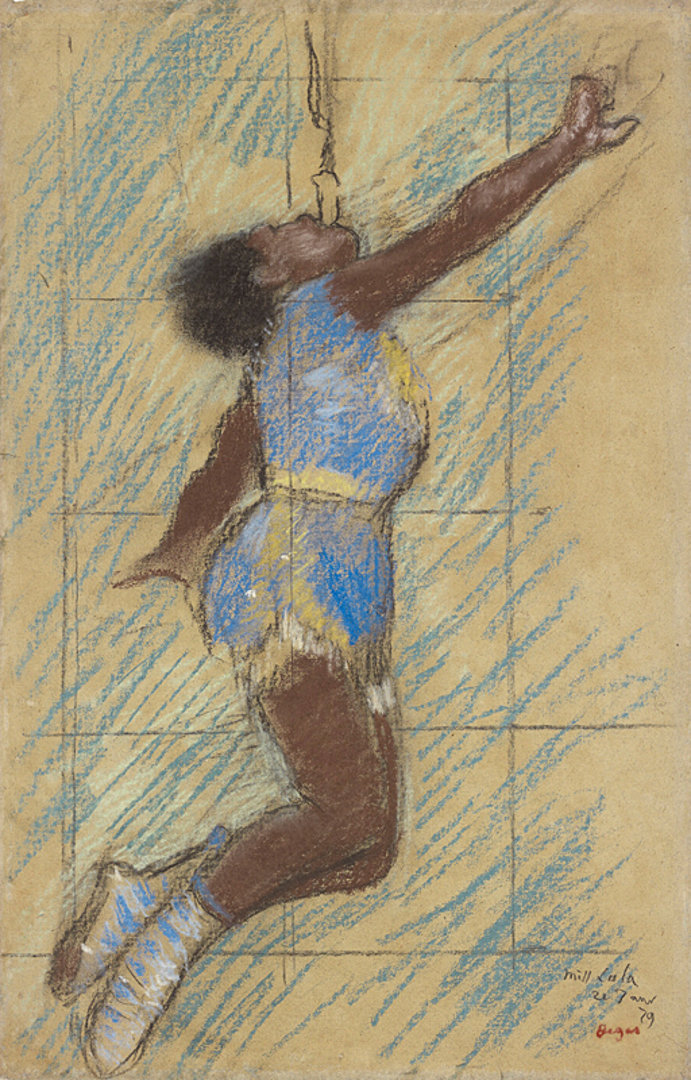
In June 2024, as part of the National Gallery’s free ‘Discover’ series, Degas’s Miss La La at the Cirque Fernando, 1879, took centre stage. This landmark Impressionist painting records an extraordinary moment and features a remarkable sitter – the circus artist Miss La La, (her stage name; she was born Anna Albertine Olga Brown, 1858‒1945). This exhibition will take a closer look at Degas’s painting and will reveal new information about Miss La La, her life and career to the public for the first time, including a number of never-before-seen photographs of Olga, as she was known to her friends and family.

In January 1879 French painter Edgar Degas attends performances at the newly built Cirque Fernando in Paris. There, he is mesmerised by the dexterity and technical prowess of star acrobat Miss La La, full of poise and grace, and about to reach international fame. Degas makes her the subject of one of his most original and arresting paintings, capturing her in possibly one of her most striking and perilous acts – when, suspended from a rope clenched between her teeth, she spirals towards the circus ceiling.

Among all other works shown at the 4th Impressionist Exhibition in Paris in April 1879, the painting is no doubt one of the most uncompromisingly daring and modern. A significant ensemble of Degas’s preparatory drawings, reunited for this exhibition, shows him at work, observing and sketching this remarkably talented sitter. These include a large drawing of Miss La La – last published over a hundred years ago – with her profile delineated three times. In addition, two newly discovered, unpublished drawing by Degas are displayed: a rare sketch of Miss La La depicted against the circus architecture, hanging from its vertiginous rafters and an entirely unknown drawing of her stage partner Theophilia, from the ‘Miss La La and the Kaira Troupe’, also posing for Degas.

Born in Szczecin, Prussia (now Poland) to a European mother and an African-American father, Olga’s racial identity, both as a performer and a person, will be addressed in the exhibition. Showcasing recent research into Black models, the exhibition will restore Miss La La’s name – Anna Albertine Olga Brown – redressing the historic anonymity of non-white sitters. A selection of posters will attest to Olga’s brilliant career, the extent of which had until recently not been fully grasped – and her immense success in France, England and beyond. Newly discovered photographs of Olga depict her as a successful aerialist, in her acrobat outfit, posing next to props or her circus partners. Other photographic portraits of her, also unveiled here for the first time, show multiple facets of her life outside of her work. They show Olga as a woman in society, as well as her later life as a successful circus manager and as a family woman.


Hilaire-Germain-Edgar Degas
'Miss La La at the Cirque Fernando', 1879
Oil on canvas
117.2 × 77.5 cm
The National Gallery, London


Hilaire-Germain-Edgar Degas
'Miss La La at the Cirque Fernando', 1879
Pastel
46.4 x 29.8 cm
The J. Paul Getty Museum, Los Angeles, California (2004.93)
Digital image courtesy of the Getty's Open Content Program

Focusing on one of Degas’s masterpieces, and his only painting depicting a non-white sitter whose identity is known, the exhibition will also look at how Degas himself represented and related to people of colour. Although he was himself the son of a Creole mother (of European descent) and was fascinated by the ethnic diversity he saw during a trip to New Orleans in 1872‒73, Degas is believed to have only painted two works representing people of colour. Drawing on recent academic research, a section of the show will investigate his complex relationship to the representation of race.

As the painting, acquired for the nation in 1925 thanks to the Courtauld Fund, is about to celebrate 100 years in the collection of the National Gallery, the exhibition also looks at how it influenced and inspired British art in the 1920s. Works by artists such as Thérèse Lessore and Duncan Grant form the final section of the exhibition, looking at how 'Miss La La at the Cirque Fernando' inspired British artists after the First World War and beyond.

Featuring new material, from hitherto untraced drawings of her by Degas, to entirely unpublished photographic portraits, and showcasing ground-breaking new research, the exhibition casts a frank, direct light on Anna Albertine Olga Brown, while inviting us to look afresh at the painting 'Miss La La at the Cirque Fernando'. Its particular resonance today will be emphasised, engaging our visitors with an inspirational story not previously told at the National Gallery. This is the third in a series of ‘Discover’ exhibitions, which explore lesser-known masterpieces in a new light. Other exhibitions in this series include Discover Manet & Eva Gonzalès and Discover Liotard & The Lavergne Family Breakfast.

Anne Robbins, lead curator of 'Discover Degas & Miss La La', says: 'Working on this exhibition has been an incredible adventure, with so many new discoveries – about Miss La La herself, about Degas’s working process and about his complex approach to his model, Olga Brown. We cannot wait to share with the public this fascinating information, and these stunning artworks which have never been seen or published before. They change the way we look at this painting and its extraordinary sitter forever.'

Monday, August 5, 2024

Rosario de Velasco

 Museo Nacional Thyssen-Bornemisza

                    18 June to 15 September 2024

Museo de Bellas Artes de Valencia

7 November 2024 to 16 February 2025

The Museo Nacional Thyssen-Bornemisza is jointly presenting with the Museo de Bellas Artes de Valencia an exhibition on the Spanish figurative painter Rosario de Velasco (Madrid, 1904 - Barcelona, 1991). Curated by Miguel Lusarreta and Toya Viudes de Velasco, the artist’s great-niece, the exhibition brings together around 30 paintings from the 1920s to the 1940s - the earliest and the most important from Velasco’s career - and also has a section on her work as an illustrator 

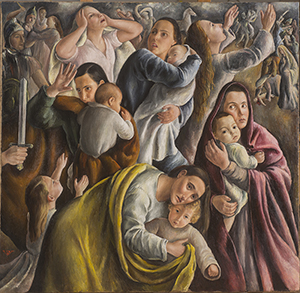
Rosario de Velasco, 'La matanza de los inocentes', 1936
Rosario de Velasco, The Massacre of the Innocents, 1936. Oil on canvas. 164 x 167,5 cm. Museo de Bellas Artes de Valencia 

The exhibition, which is benefiting from the support of the Region of Madrid and the City Council of Madrid, aims to present and draw attention to the work of one of the great Spanish women artists of the first half of the 20th century. In addition to well-known paintings from museum collections, such as the famous oil Adam and Eve (1932) from the Museo Nacional Centro de Arte Reina Sofía, The Massacre of the Innocents (1936) from the Museo de Bellas Artes de Valencia, Maragatos(1934) from the Museo del Traje, Madrid, and Carnival (before 1936) from the Centre Pompidou, Paris, the exhibition features works still with the artist’s family and in private collections and others that have only been rediscovered and located in the past few months. Following its showing in Madrid, the exhibition will be presented at the Museo de Bellas Artes de Valencia from 7 November 2024 to 16 February 2025. 

Rosario de Velasco’s work represents an outstanding example of the so-called “return to order” in Spain, a movement parallel to German New Objectivity and Italian Novecento with a style that combined tradition and modernity. Velasco admired painters such as Giotto, Masaccio, Piero della Francesca, Mantegna, Velázquez and Goya, but also avant-garde figures such as De Chirico, Braque, Picassoand the exponents of the “return to order” in Germany and Italy, whom she encountered via magazines and exhibitions held in Madrid in the 1920s.

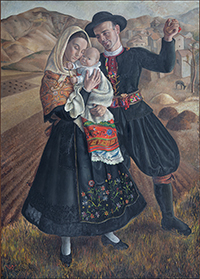
Rosario de Velasco, 'Maragatos', 1934
Rosario de Velasco. Maragatos, 1934. 
Oil on canvas, 210 x 150 cm. 
Museo del Traje, Madrid

The exhibition also focuses on Velasco’s activities as an illustrator, revealing a graphic artist of great versatility. This is evident, for example, in her illustrations for the 1928 edition of Stories for dreaming by María Teresa León and Stories for my grandchildren (1932) by Carmen Karr. 

Rosario de Velasco (Madrid, 1904 – Barcelona, 1991) 

Born into a very traditional and religious family in Madrid, Rosario de Velasco began to study art aged fifteen at the academy of the genre painter Fernando Álvarez de Sotomayor, a member of the Royal San Fernando Academy of Fine Arts and two-time director of the Museo del Prado. Dating from that period is her Self-portrait (1924), which she signed with a monogram consisting of the initials R, D and V. Inspired by Dürer’s monogram, it has been fundamental to locating some of the artist’s paintings.

The young artist was, however, aware that she needed to go beyond tradition and assimilate the new trends and avant-gardes in her desire to compete as an equal in a largely male world. Her openness and cultural curiosity led her to associate with numerous creators of her generations, particularly women painters and writers such as Maruja Mallo, Rosa Chacel and María Teresa León. Other women friends included Mercedes Noboa, Matilde Marquina, Concha Espina and Lilí Álvarez, the tennis champion whom Velasco painted in the 1930s and with whom she enjoyed playing the sport. Velasco was also a tireless traveller and enjoyed mountaineering, skiing and rock climbing.

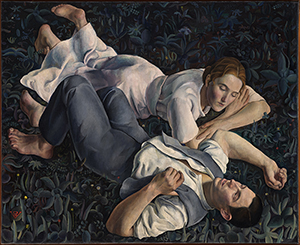
Rosario de Velasco, 'Adán y Eva', 1932
Rosario de Velasco, Adam and Eve
1932. Oil on canvas, 109 x 134 cm. 
Museo Nacional Centro de Arte 
Reina Sofía, Madrid.

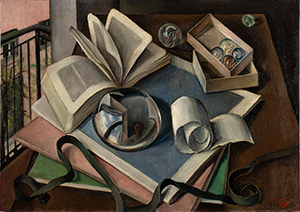
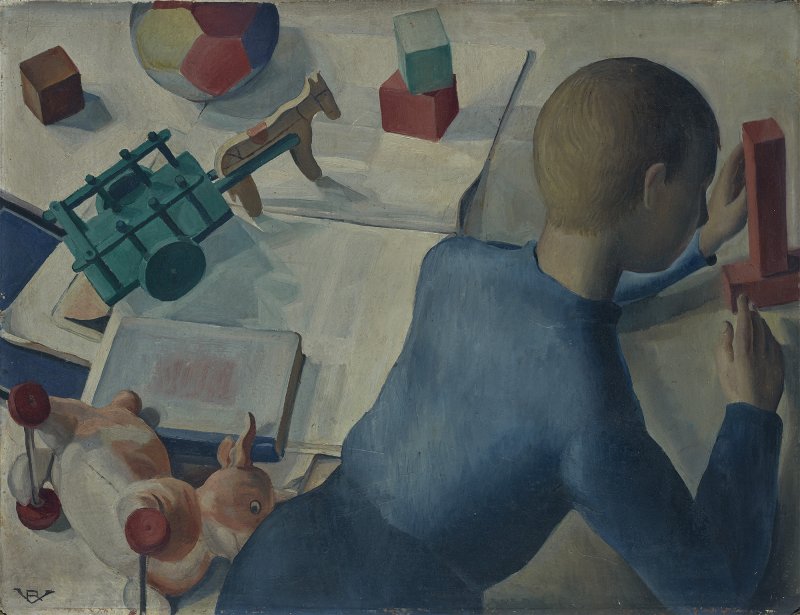
In 1924, the year she completed her studies, the artist participated in the National Fine Arts Exhibition in Madrid and also produced her first illustrations. By the 1930s Rosario de Velasco had established a considerable reputation, taking part in numerous group shows and competitions, such as the National Fine Arts Exhibition of 1932 in which she presented the canvas Adam and Eve, which earned her a second prize medal in the Painting category. The work was exhibited together with all the other entries in the Palacio de Exposiciones in the Retiro park and in various exhibitions organised by the Society of Iberian Artists held in Copenhagen and Berlinwhere it was warmly praised by critics for its power and originality and Velasco was singled out as the major discovery of the season.The work is startling in its play of perspective, employing a bird’s-eye view, a device also used in various still lifes and in (Untitled) The Children’s Room (1932-33), another work in the collection of the Museo Reina Sofía, in which the artist disrupts the space through an original arrangement of objects that recalls Cubism.

Rosario de Velasco. Cosas, 1933. Colección privada.
Rosario de Velasco. Things, 1933. 
Oil on canvas, 45,5 x 65,5 cm.
 Private collection.

The majority of Velasco’s most important works date from that decade: Maragatos, which was awarded second prize in the National Painting competition of 1932; The Massacre of the Innocents (ca. 1936), which for many years was attributed to Ricardo Verde due to the signature “RV”, until it was correctly attributed to Velasco in 1995; and Laundresses (1934), a wedding gift to her brother, Dr Luis de Velasco, who appears in another work in the present exhibition.

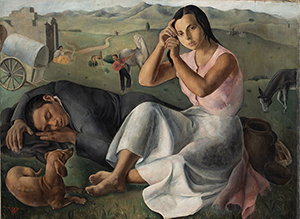
In 1935 Gypsies was selected to participate in the Carnegie International, an exhibition of artists from different countries organised by the Carnegie Museum of Art in Pittsburgh. Velasco’s work shared space with that of Carlo Carrá, Otto Dix, Edward Hopper and Georgia O’Keeffe, as well as Picasso and Dalí. Lost for years, the painting has only recently been located and is one of the major discoveries made during the preparation of this exhibition.

Rosario de Velasco, 'Gitanos', 1934
Rosario de Velasco. Gypsies, 1934. 
Oil on canvas, 95 x 132 cm.
 Private collection.

On the outbreak of the Spanish Civil War the artist’s membership of the Falange and her family context led her to leave Madrid. She went first to Valencia and later to Barcelona, to Sant Andreu de Llavaneres where she met a doctor, Javier Farrerons, who later became her husband and who succeeded in liberating her from the Modelo prison in Barcelona where she was being held. After the war Velasco settled in Barcelona with her husband and their daughter María del Mar.

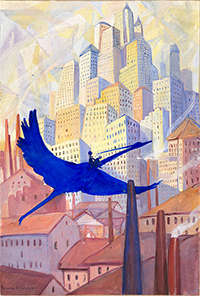
Rosario de Velasco, 'El pájaro azul', 1927
Rosario de Velasco. The Blue Bird, 1927. 
Drawing for the cover of the book 
Cuentos para soñar by María Teresa 
León. Mixed media on paper.
Colección González Rodríguez

In 1939 Velasco participated in the National Exhibition of Painting and Sculpture in Valencia and in 1940 presented her first solo exhibition, in Barcelona. Over the following years she continued to exhibit in Madrid although less often, for example at the National Fine Arts Exhibitions of 1941 and 1954, and at various galleries. In 1944 Velasco was selected for the 2nd Salón de los Once, organised by the Academia Breve de Crítica de Arte, founded by Eugenio d’Ors to promote art of the immediate post-war period. D’Ors was one of the well known figures in the artist and her husband’s circle of friends, together with Dionisio Ridruejo, Pere Pruna and Carmen Conde, among others.

The recent search for works by Velasco which was undertaken via the social media and the media in general has resulted in the identification in private collections of both celebrated works of which all trace had been lost, such as Things (1933), Motherhood (1933), Gypsies (1934) and Pensive Woman (1935), as well as various illustrations for books and a preparatory drawing for the oil painting Carnival (before 1936). It has also brought to light some previously completely unknown works such as Still Life with Fish (ca. 1930), and Girls with a Doll (1937). 


Rosario de Velasco, Portrait of Doctor Luis de Velasco, circa 1933. Oil on canvas, 114 × 84 cm. Colección José A. de Velasco. © Rosario de Velasco, VEGAP, Madrid, 2024.


Rosario de Velasco Untitled (The Children's Room), 1932-1933

Oil on canvas. 55 x 73 cm. Museo Nacional Centro de Arte Reina Sofía, Madrid. © Rosario de Velasco, VEGAP, Madrid, 2024. Photo: © Archivo Fotográfico Museo Nacional Centro de Arte Reina Sofía