Saturday, December 28, 2024

Dream – Identity – Reality


Hamburger Kunsthalle


until 6 April 2025


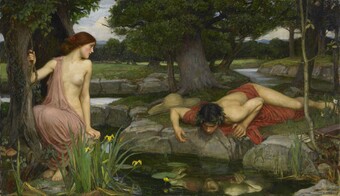
With a large-scale exhibition spanning several epochs, the Hamburger Kunsthalle looks at the diverse facets of the theme of illusion in art from the Old Masters to the present day. Trompe-l’œil has been widely used in art since antiquity, flourishing in particular in the Renaissance and Baroque periods. And this technique continues to fascinate artists today, when the spread of fake news is almost normal, when people are confronted daily with manipulated images on the internet and virtual reality seems to be expanding our cosmos into infinity. We now live in the certainty that we can no longer trust our eyes, that images are deceptive and are used to depict what is desired rather than what is. But the exhibition shows how illusion means far more than merely deceiving the eye. It is manifested in the (illusionistic) self-love of Narcissus as well as in spatial illusions in architecture, in the play of concealing and revealing via the pictorial motifs of the curtain and the mask, in the meaning of the open or closed window onto the world, and in images of visions and dreams. Based on some 150 paintings, drawings, prints, photographs, sculptures, installations and video works, the show traces the many different forms taken by hyperrealism, reality, fiction, dream, transformation and deception. Among the exhibits are major works from the Hamburger Kunsthalle as well as loans from national and international collections.


The Hamburger Kunsthalle app offers audio tours of the exhibition for adults (in German and English) and for children and young people aged 8 and over (in German). In addition, visitors can explore four of the exhibited artworks interactively at a Virtual Reality Station integrated into the galleries.

An exhibition catalogue (Hatje Cantz Verlag, 320 pages) is available for 35 euros in the museum shop or via www.freunde-der-kunsthalle.de at a bookstore price of 54 euros. Introductory essays as well as detailed commentaries on the exhibits examine in depth the varied facets of the concept of illusion. In addition, literary excerpts, poems and philosophical discussions by Jean Baudrillard, Bertolt Brecht, André Breton, Ovid and William Shakespeare underline the timelessness of the topic and its interdisciplinary nature. The publication has been funded by the two foundations Ernst von Siemens Kunststiftung and Martha Pulvermacher Stiftung.


Featured artists: Helene Appel, Hans Arp, Thomas Baldischwyler, Max Beckmann, Paris Bordone, Carl Gustav Carus, Marc Chagall, Jean-Baptiste Siméon Chardin, Adriaen Coorte, Lovis Corinth, Edgar Degas, Robert Delaunay, Johann Friedrich Dieterich, Gerrit Dou, Wilhelm Schubert von Ehrenberg, Lars Eidinger, Elmgreen & Dragset, James Ensor, Max Ernst, M. C. Escher, Juan Fernández, Charles de la Fosse, Caspar David Friedrich, Johann Heinrich Füssli, Xaver Fuhr, Jean-Léon Gérôme, Cornelis Gijsbrechts, Nan Goldin, Francisco de Goya, Andreas Greiner, Joachim Grommek, Duane Hanson, Vilhelm Hammershøi, Johann Georg Hinz, David Hockney, Samuel van Hoogstraten, Roni Horn, Gerard Houckgeest, Horst Janssen, Alexander Kanoldt, Howard Kanovitz, Anish Kapoor, Oskar Kokoschka, Jens Lausen, François Lemoyne, Lorenzo Lippi, Simon Luttichuys, Alfred Madsen, René Magritte, Tony Matelli, Stefan Marx, Adolph Menzel, Frans van Mieris d. Ä., Piet Mondrian, Ron Mueck, NEAL, Giovanni Battista Piranesi, Sigmar Polke, Gerhard Richter, Joachim Ringelnatz, Jan van Rossum, Pieter Jansz. Saenredam, Godfried Schalcken, Markus Schin­wald, Oskar Schlemmer, Georg Schrimpf, Cindy Sherman, Kiki Smith, Antonie van Steenwinckel, Theodoor van Thulden, Nikos Valsamakis, Victor Vasarely, Wolf Vostell, Friedrich Wasmann, John William Waterhouse, Jacob de Wit and Francisco de Zurbarán.


Curator: Dr. Sandra Pisot
Assistant Curator: Dr. Johanna Hornauer

Jana Schiedek, Hamburg State Councillor for Culture and Media: »The theme of ILLUSION in art goes far beyond optical tricks and touches on fundamental questions of how we see reality. In the ILLU- SION exhibition, cleverly selected exhibits from several centuries and periods illustrate the many different responses artists have given to the question of whether the opposite of truth must always be a lie. On display are works from the Kunsthalle’s own collection as well as high-calibre loans from Germany and abroad. Based on these artworks, the Kunsthalle spans an arc to the present day, raising questions about authenticity and the (im)possibility of alternative truths that go far beyond art to affect politics and our everyday media consumption. An exciting exhibition that sharpens our view of the world.«

Dr. Martin Hoernes, Secretary General of the Ernst von Siemens Kunststiftung: »The exhibition ILLUSION. Dream Identity Reality at the Hamburger Kunsthalle is dedicated to a theme of timeless and universal relevance: the question of reality versus fiction. It delves into the power wielded by illusion- ist images and explores how art can shape and challenge our understanding of reality across disciplines and epochs. At a time when fake news and artificial intelligence are increasingly blurring the boundaries between reality and fiction, the show also highlights key societal debates in the twenty-first century.« 


IMAGES


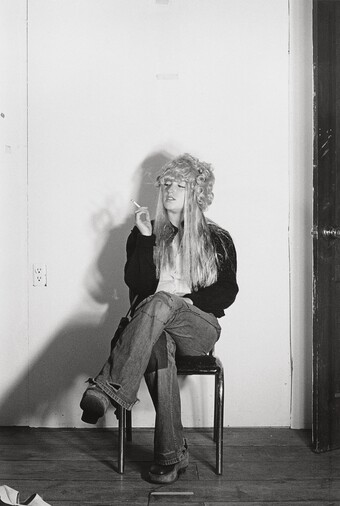
Cindy Sherman (*1954) Bus Rides, 1976/2000, © Cindy Sherman Courtesy the artist and Hauser & Wirth

Cindy Sherman Bus Rides , 1976/2000

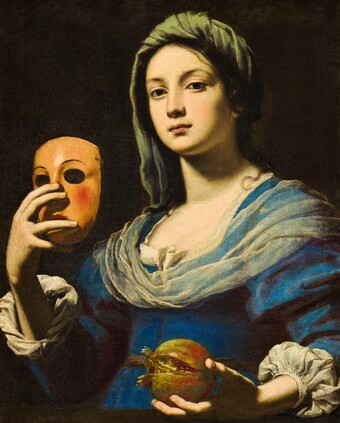
Lorenzo Lippi (1606–1665) Allégorie de la Simulation, um 1640, Musées d’Angers © Musées d’Angers, RMN-Grand Palais / Benoît Touchard

Lorenzo Lippi Die Allegorie der Täuschung (Allégorie de la Simulation) , um 1640

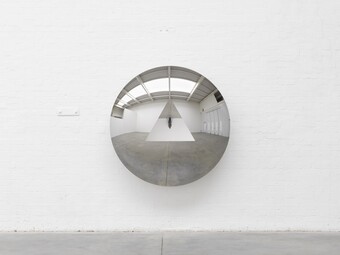
Anish Kapoor (*1954) Concave Convex Mirror (Triangle), 2019, © Anish Kapoor; Courtesy Lisson Gallery. Photography by Dave Morgan.


Anish Kapoor (*1954) Concave Convex Mirror (Triangle) , 2019

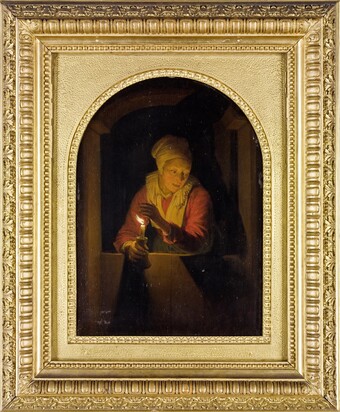
Gerrit Dou (1613–1675), Alte Frau mit Kerze, 1661, Wallraf-Richartz-Museum & Fondation Corboud, Köln © Foto: Rheinisches Bildarchiv Köln, rba_d029745

Gerrit Dou Alte Frau mit Kerze , 1661

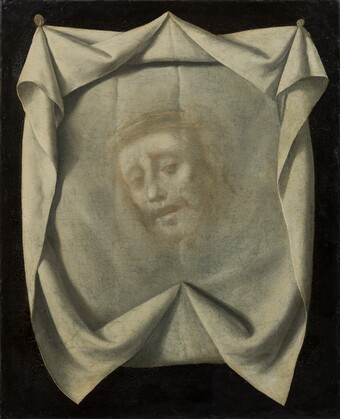
Francisco de Zurbarán (1598–1664) Schweißtuch der hl. Veronika, um 1635–40, Stockholm, Nationalmuseum Foto: Anna Danielsson / Nationalmuseum

Francisco de Zurbarán Schweißtuch der hl. Veronika , um 1635–40

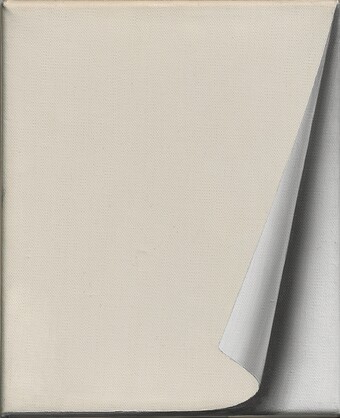
Gerhard Richter_Umgeschlagenes Blatt_1965, Gerhard Richter Archiv, Staatliche Kunstsammlungen Dresden. Schenkung von Karin Girke aus der Sammlung Raimund und Karin Girke, 2021

Gerhard Richter Umgeschlagenes Blatt , 1965

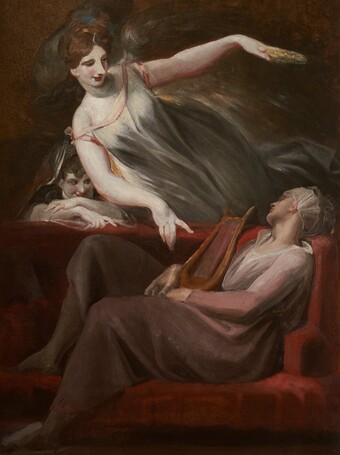
Johann Heinrich Füssli (1741–1825) Die Vision des Dichters (Shakespeare), 1806–07, Stiftung für Kunst, Kultur und Geschichte, Winterthur. Foto: SKKG 2020

Johann Heinrich Füssli Die Vision des Dichters (Shakespeare) , 1806–07

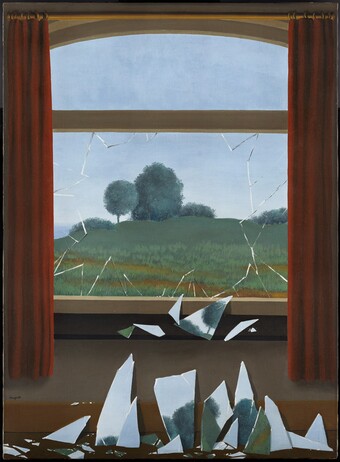
René Magritte (1898–1967) The Key of the Field (La Clef des champs), 1936, Museo Nacional Thyssen-Bornemisza, Madrid © René Magritte VEGAP, Madrid, 2024

René Magritte The Key of the Field (La Clef des champs) , 1936

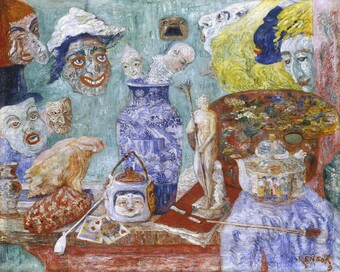
James Ensor (1860–1949), Stillleben mit Masken, 1896, © SHK / Hamburger Kunsthalle / bpk  Foto: Elke Walford

James Ensor Stillleben mit Masken , 1896

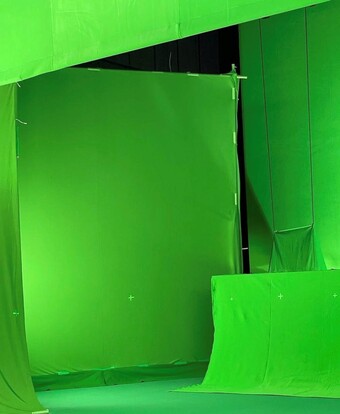
Lars Eidinger (*1976) Berlin, 2022, © Lars Eidinger; Courtesy Ruttkowski;68, Köln, Düsseldorf, Paris, New York

Lars Eidinger Berlin , 2022

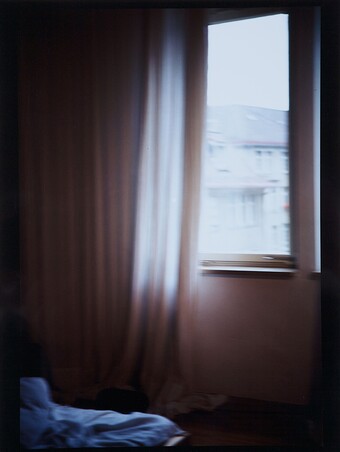
Nan Goldin (*1953), Hotel Room Zurich, 1988, Fotografie, 39,4 x 26,7 cm, Kunstpalast, Düsseldorf, Sammlung Hanck © Nan Goldin Foto: Kunstpalast – Horst Kolberg – ARTOTHEK

Nan Goldin Hotel Room Zurich , 1988

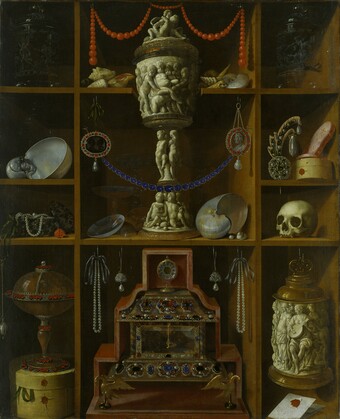
Johann Georg Hinz (um 1630/31–1688), Kunstkammerregal, 1666, © Hamburger Kunsthalle / bpk Foto: Elke Walford

Johann Georg Hinz Kunstkammerregal , 1666

John William Waterhouse (1849–1917), Echo und Narziss, 1903, Öl auf Leinwand, 109,2 x 189,2 cm, National Museums Liverpool, Walker Art Gallery © Courtesy National Museums Liverpool, Walker Art Gallery

John William Waterhouse Echo und Narziss , 1903

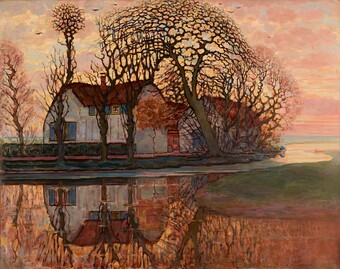
Piet Mondrian (1872–1944) Bauerngehöft in der Nähe von Duivendrecht, 1916, Kunstmuseum Den Haag – bequest Salomon B. Slijper

​​​​​​​Piet Mondrian Bauerngehöft in der Nähe von Duivendrecht , 1916


Wednesday, December 25, 2024

Jean-Michel Basquiat. Engadin’


Hauser & Wirth St. Moritz

14 December 2024 – 29 March 2025

Exploring various artistic motifs that combine the natural and cultural landscape of the Engadin with the metropolis of New York, Jean-Michel Basquiat’s first solo exhibition dedicated to the paintings he created in and inspired by his visits to Switzerland opens on 14 December at Hauser & Wirth St. Moritz. ‘Jean-Michel Basquiat. Engadin’ traces the renowned artist’s connections to the country, which began in 1982 with his first show at Galerie Bruno Bischofberger in Zurich, returning over a dozen times to St. Moritz, Zurich and Appenzell, as well as other places in Switzerland. The Engadin region in particular continued to fascinate Basquiat long after his return to New York, resulting in a body of work that captures his impressions of the Swiss Alpine landscape and culture through the lens of his highly distinctive and personal artistic language. 


‘Jean-Michel Basquiat. Engadin’ will be accompanied by a catalog from Hauser & Wirth Publishers, featuring a foreword by Bruno Bischofberger and a text by Dr. Dr. Dieter Buchhart to give visitors a unique insight into this specific chapter of one of the most important artists of the 20th Century. 

About the exhibition Born in Brooklyn, New York in 1960 and coming of age in the downtown, post-punk artistic scene of the late 1970s and early 1980s, Basquiat drew on the diversity and intensity of New York City within his multi-disciplinary practice. His expressive paintings combined bold text and imagery from his expansive references across art, film, history and music, as well as his experiences of everyday racism as a young Black man in the US. 

After his first exhibition with Galerie Bruno Bischofberger in 1982, the same year Basquiat became one of the youngest ever artists to participate at Documenta in Kassel, the influences of the disparate cultural landscapes of New York City and Switzerland began to take shape in his work, incorporating the motifs of ski lifts, fir trees, mountains and German phrases into his expansive visual lexicon. ‘From then on, Jean-Michel Basquiat often visited me in Switzerland, where he particularly liked it. About half a dozen times in Zurich and exactly seven times in St. Moritz, four of them in the summer’, says Bischofberger. Basquiat was captivated by the Engadin’s vast natural landscape, cultural history and the hospitality of the Bischofberger family. Perhaps what drew Basquiat most to this part of Switzerland was, as Dr. Dr. Dieter Buchhart writes, ‘the contrast between the pulsating life, the clubs, the street noise, and the breakneck speed of the metropolis New York and the ‘discovery of slowness’ in the unique, overwhelming landscape of the Engadin.


IMAGES


Jean-Michel Basquiat The Dutch Settlers 1982 Acrylic and oilstick on canvas 183 x 549 cm / 72 x 216 1/8 in © Estate of Jean-Michel Basquiat. Licensed by Artestar, New York Nicola Erni Collection. Photo: Reto Pedrini Photography 

ks on view in the exhibition is the monumental painting ‘The Dutch Settlers’ from 1982. Composed of nine canvases, the painting is a prime example of Basquiat’s innovative approach of marrying William S. Burroughs’ ‘cut-up’ technique with a method akin to sampling technology used in hip hop. The montage of nine canvas panels enabled Basquiat to assemble, combine and recombine different image fields – creating a multi-layered work that emanates a visual rhythm described as an ‘Eye Rap’ by art historian Robert Storr. The artist paints powerful motifs which reference the African Diaspora and slavery (evoked through words such NUBIA and TOBACCO) alongside images of the Engadin, depicting fir trees, a mountain road, as well as an ibex, the heraldic animal of the canton of Graubünden and native to the region. 

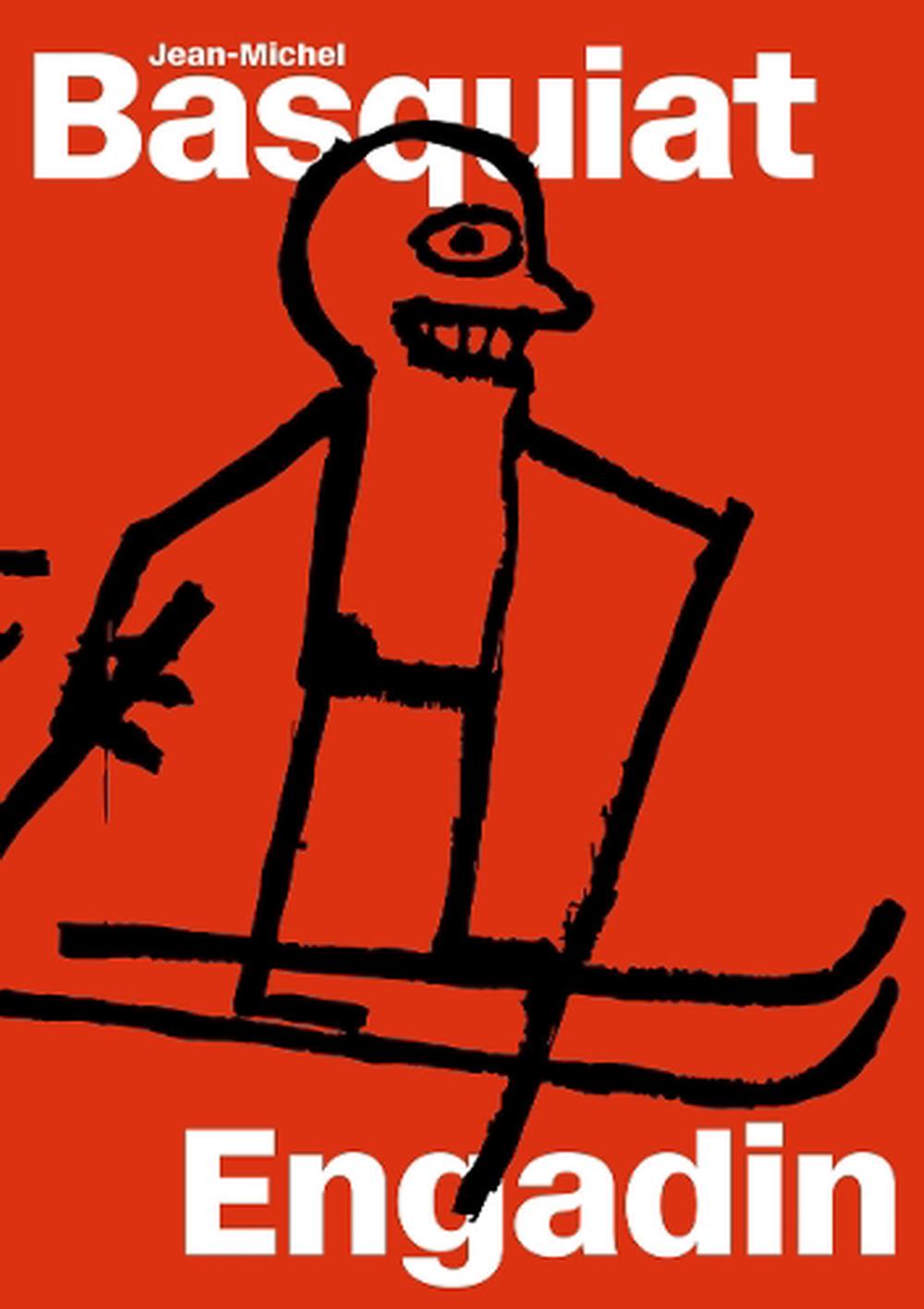
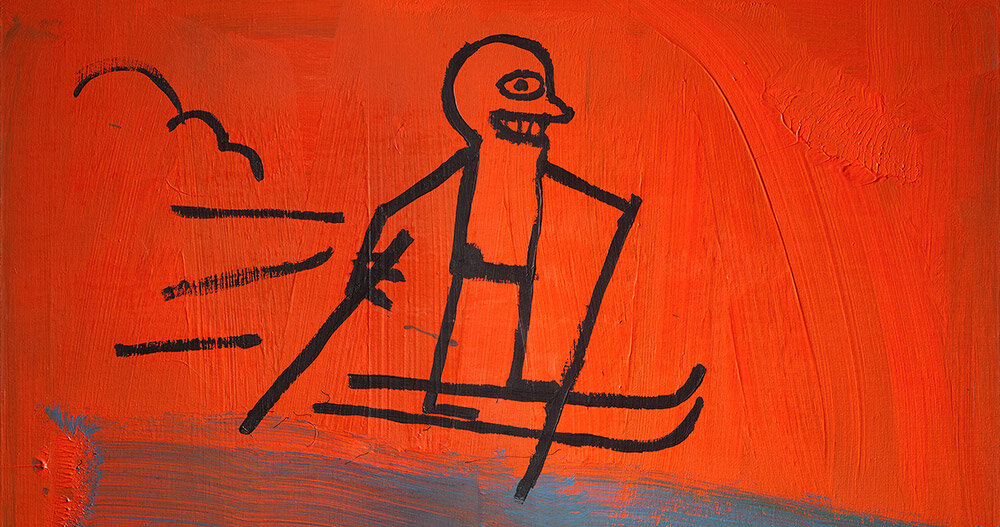
  • Jean-Michel Basquiat Skifahrer 1983 Oil on canvas 70 x 90 x 2 cm / 27 1/2 x 35 3/8 x 3/4 in © Estate of Jean-Michel Basquiat. Licensed by Artestar, New York Collection Carmignac, Photo: Thomas Hennocque

  • Jean-Michel Basquiat See (Lake) 1983 Oil on canvas 100 x 100 cm © Estate of Jean-Michel Basquiat. Licensed by Artestar, New York Courtesy Private Collection Photo: Jon Etter 

This mountain iconography can also be seen in the playful works ‘Skifahrer (Skier)’ and ‘See (Lake)’ on view in the exhibition. The former depicts a comic-like figure on a bright red background and the latter the local landscape at night, both painted in St. Moritz a year later. These works were part of a series that Basquiat made for a dinner with collectors in Bischofberger’s ‘hunting lodge’ as the artist called it, meaning the family’s home in St. Moritz. Beside photographs of the Engadin by Albert Steiner, there was no modern art hanging in the dining room that season.

In the winter of 1983/1984, during one of Basquiat’s visits to the Engadin, Bischofberger and the artist began discussing the idea for a collaboration between Basquiat, Andy Warhol and Francesco Clemente. The three artists each created four paintings and a drawing, which were subsequently transported between them to complete. 

  • Jean-Michel Basquiat / Andy Warhol / Francesco Clemente In Bianco 1984 Acrylic, silkscreen, and pastel on canvas 122 x 168 cm / 48 x 66 1/8 in © Estate of Jean-Michel Basquiat. Licensed by Artestar, New York © Francesco Clemente © The Andy Warhol Foundation for the Visual Arts, Inc. / 2024, ProLitteris, Zurich © Fundación Almine y Bernard Ruiz Picasso -- FABA – 2024 

‘In Bianco’ (1983) showcases the clearly distinguishable artistic contributions from all three, demonstrating how each artist reacted respectfully to the parameters of the others. As Buchhart notes, ‘the cornerstone for this important collaboration was laid in St. Moritz’, marking a turning point in Basquiat’s artistic practice and proving Switzerland to be of great historical significance for the artist in more ways than one.


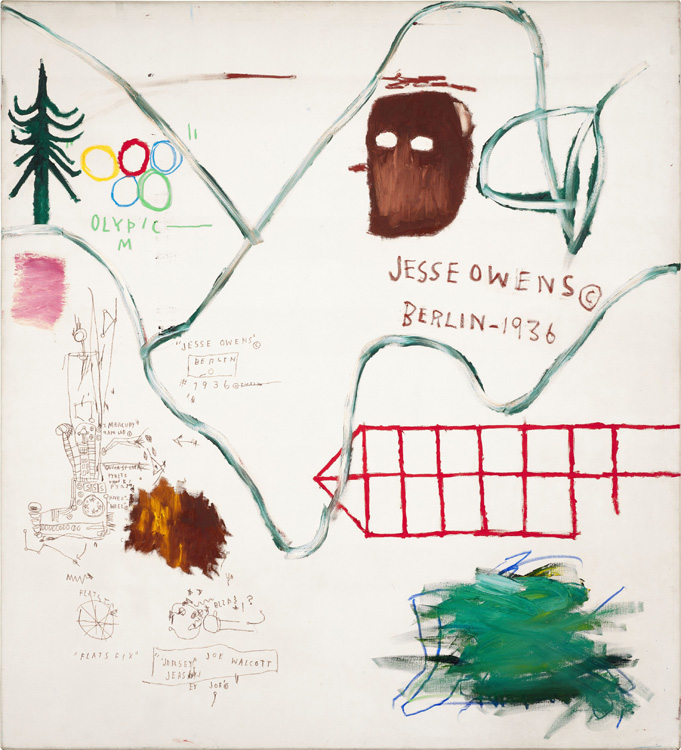
  •  Jean-Michel Basquiat Big Snow 1984 Oil, acrylic, felt-tip pen and oilstick on canvas 168 x 151.5 cm / 66 1/8 x 59 5/8 in Private Collection © Estate of JeanMichel Basquiat. Licensed by Artestar, New York


Integrating the immediate world around him with his varied encyclopaedic knowledge, ‘Big Snow’ (1984) sees Basquiat once again processing his impressions of the Engadin in conjunction with themes relating to race and Black history, combining motifs of the Swiss mountains, snow and skiing with the Berlin Olympic Games of 1936 and Jesse Owens’ win of four gold medals. In 1985, Basquiat would go on to be part of a group show at the Segantini Museum in St. Moritz, showcasing his work ‘See (Lake)’ (1983) in an exhibition titled ‘The Engadine in Painting’. 

The latest body of work on view includes a group of monochrome paintings titled ‘To Repel Ghosts’ which Basquiat created in 1986 during his time in Zurich and St. Moritz, exploring themes of emptiness as well as spirituality in relation to the African Diaspora. Musing on what kept drawing the artist back to Switzerland, Buchhart writes, ‘For Basquiat, the Engadin meant work, inspiration, friendship, and rest and relaxation, all at the same time.’


Tuesday, December 24, 2024

Georgia O’Keeffe and Henry Moore


Museum of Fine Arts, Boston)

through January 20, 2025

American painter Georgia O’Keeffe (1887–1986) and British sculptor Henry Moore (1898–1986) are among the most distinctive artists of the 20th century. They have long been admired for their extraordinary distillations of natural forms into abstraction—O’Keeffe’s iconic paintings of flowers and Moore’s monumental public sculpture. Georgia O’Keeffe and Henry Moore is the first to bring these two artists together, using compelling visual juxtapositions to explore their common ways of seeing. Each artist experimented with unusual perspectives, shifts in scale, and layered compositions to produce works that were informed by their surroundings—O’Keeffe in New Mexico and Moore in Hertfordshire, England.

Featuring over 150 works—including about 60 works by O’Keeffe and 90 by Moore—the exhibition includes paintings, sculptures, and works on paper, as well as faithful recreations of each of the artists’ studios containing their tools and found objects. Organized by the San Diego Museum of Art, Georgia O’Keeffe and Henry Moore is an unprecedented collaboration with the Georgia O’Keeffe Museum and the Henry Moore Foundation.

“Looking at O’Keeffe and Moore together, we can see how both artists were inspired by and also made use of natural forms. O’Keeffe hoped that her paintings would make people pay attention to things they usually overlooked—the soft gradations of a flower petal, the patterns within a landscape, or the shapes between two objects. As O’Keeffe said herself, ‘to see takes time.’ The chance to see her work in person is not to be missed,” said Erica Hirshler, Croll Senior Curator of American Paintings.

“While many of our visitors here in Boston will know O’Keeffe’s work and reputation well, they might be less familiar with Moore, one of the most important British artists of the 20th century. The generous loans from the Henry Moore Foundation allow us to recreate the artist’s studio and will really help bring Moore alive and show how found objects played a role in the creation of his large-scale public sculpture,” said Courtney Harris, Assistant Curator of European Decorative Arts and Sculpture.

Through careful observation of their surroundings and the objects they collected, O’Keeffe and Moore reimagined natural forms—bones, stones, shells, flowers, and the land itself—into dynamic abstractions. Each played with scale, exploring the effects of making small things large. They twisted and turned pieces in space, searching for balance, looking within their complex interiors, and exploring how objects transform the spaces around them. The exhibition presents their works both individually and in dialogue, presenting unique juxtapositions such as:


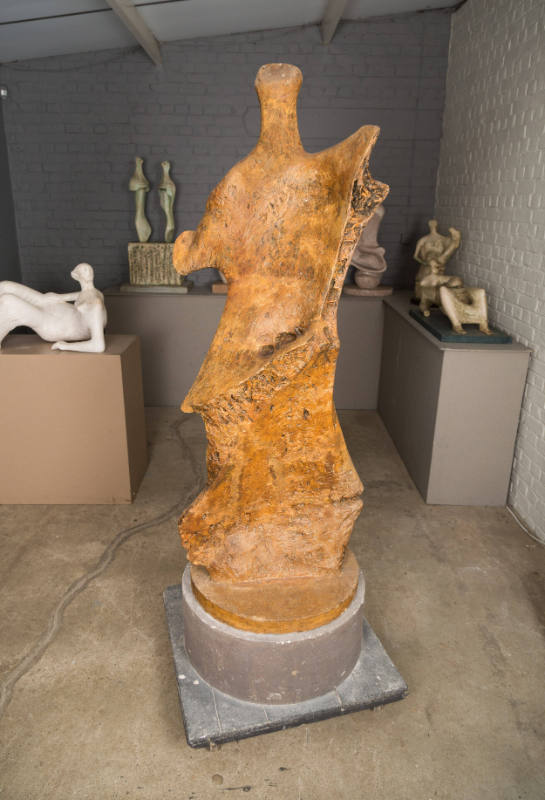
  • O’Keeffe’s Red Tree, Yellow Sky (1952, Museum of Fine Arts, Boston) and Moore’s Working Model for Standing Figure: Knife Edge (1961, The Henry Moore Foundation): O’Keeffe often envisioned how miniature forms might become monumental. In this painting she juxtaposed a small piece of wood against a distant landscape, conflating near and far, large and small. Moore similarly made a small thing enormous, inspired by the breastbone of a bird to create a figurative sculpture that twists in space and encourages viewers to walk around it.


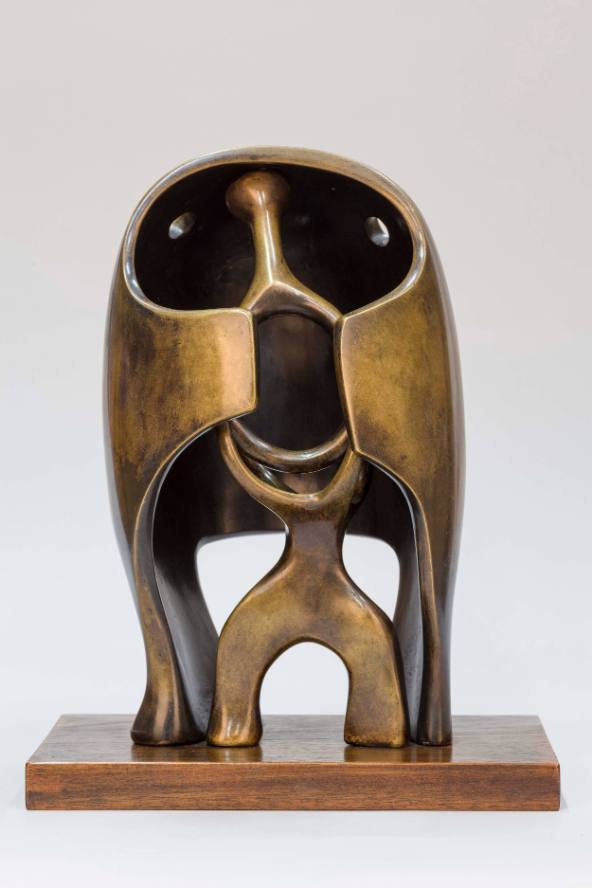
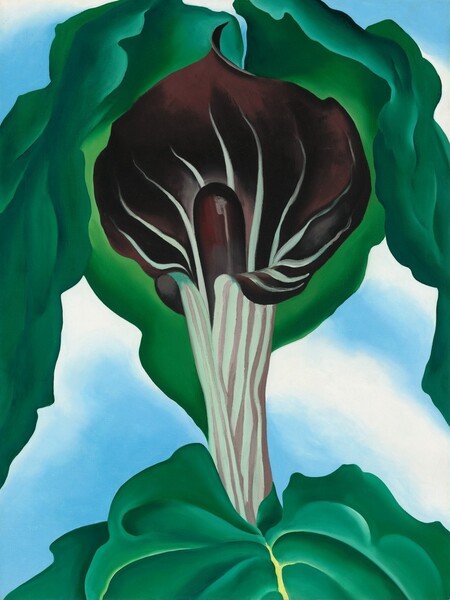
  • Moore’s Helmet (1939–1940, The Henry Moore Foundation) and O’Keeffe’s Jack-in-the-Pulpit No. 3 (1930, National Gallery of Art, Washington): This work by Moore was the first in a series of small sculptures with hollow shells that encased unique interior forms. O’Keeffe similarly used a technique of enclosure in her painting of a deep purple flower with its complex interior and billowing leaves.


  • O’Keeffe’s Pelvis IV (1944, Georgia O’Keeffe Museum) and Moore’s Reclining Figure Bone (1975, The Henry Moore Foundation): O’Keeffe plays with scale, depth, and perspective by showing an entire vista through the aperture of a sun-bleached pelvic bone. Her interest in simplification and negative space is mirrored in Moore’s reduction of the human figure to a simple curve. His choice of travertine, with its porous texture and off-white color, maintains its connection to his inspiration in a weathered animal bone.

There were many other artists active in the U.S. and Europe in the mid-20th century who also looked to nature. The MFA’s presentation of Georgia O’Keeffe and Henry Moore draws upon the Museum’s modernist collection to provide a broader context. O’Keeffe and Moore’s works are put into dialogue with photographs, prints, sculpture, and paintings by artists including Edward Weston (1886–1958), Alexander Calder (1898–1976), Barbara Hepworth (1903–1975), Arthur Dove (1880–1946), Jean Arp (1886–1966), Imogen Cunningham (1883–1976), and Maria Montoya Martinez (Poveka or Water Pond Lily), (Powhogeh Owingeh [San Ildefonso Pueblo]) (1887–1980).

At the core of the exhibition are recreations of the artists’ studios, built with original contents from O’Keeffe’s Ghost Ranch studio in the hills of New Mexico and Moore’s Bourne Maquette Studio in Perry Green, a small hamlet surrounded by sheep fields in Hertfordshire, England. Though both O’Keeffe and Moore remained within reach of city life, the two artists worked in rural settings, both amassing large personal collections of animal bones, stones, seashells, and other natural materials that served as key sources of inspiration. These found objects can be seen in these spaces alongside tools, unfinished works, and plaster maquettes. The studio installations illuminate the heart of O’Keeffe and Moore’s artistic practices—something rarely made visible in museum spaces—and create richer portraits of the artists by encouraging visitors to imagine how they worked and lived.

Artist Biographies

Georgia O’Keeffe was born in 1887 and grew up in rural Sun Prairie, Wisconsin. She first studied art in Chicago and then, in New York, with the American Impressionist painter William Merritt Chase. But she pursued a more modern approach, inspired by Arthur Wesley Dow, whose compositional theories were rooted in Japanese art. In the 1910s, O’Keeffe, then an art teacher in West Texas, began to make nature-based abstractions, learning to love the landscapes of the southwest.

O’Keeffe came to New York in 1916. Without her knowledge, a friend had sent her drawings to the New York art dealer, photographer, and champion of modernism Alfred Stieglitz, who gave O’Keeffe her first show at his gallery 291. With Stieglitz’s support, she came back to New York in 1918. They began a romantic relationship, marrying in 1924. O’Keeffe painted flowers, skyscrapers, and, following trips to New Mexico, bones, which she shipped back in barrels to New York. But the stark beauty of the southwest always beckoned. O’Keeffe visited for long periods and began to acquire property, first at Ghost Ranch and then in Abiquiú. She moved to New Mexico permanently after Stieglitz’s death in 1946.

O’Keeffe carefully nurtured her art, her career, and her persona, earning a place in the center of the New York art world. Her work was featured in a solo exhibition at MoMA in 1946—the museum’s first show devoted to a woman artist. She gained public recognition after a 1968 cover story in Life magazine. In 1997, The Georgia O’Keeffe Museum in Santa Fe, New Mexico opened to the public.

Henry Moore was born in 1898 in Castleford, a mining town in the northern English county of Yorkshire. He served in World War I and upon his return, enrolled at the Leeds School of Art as the first student of a new sculpture department. Through the 1920s and ’30s he exhibited at shows in London and worked in a studio in Hampstead in northern London. During the World War II, he served as an Official War Artist, making drawings of Londoners sheltering in the Underground during the Blitz.

In 1940, after his London home was damaged by German bombs, Moore settled permanently at Hoglands, a cottage in Perry Green in Hertfordshire, about 35 miles north of London. He spent the next four decades creating some of the most recognizable works of public sculpture of the 20th century. He was enormously successful and well known. He was honored with a solo exhibition at MoMA in 1946, the same year as O’Keeffe’s. He was appointed to represent Britain at the Venice Biennale in 1948, and participated in the Festival of Britain in 1951.

Today, Moore’s legacy lives on through the Henry Moore Foundation at Perry Green and in Leeds. His work is also celebrated in an important suite of galleries at Tate Britain in London and in the Henry Moore Sculpture Centre at the Art Gallery of Ontario in Toronto. His sculpture can be found in public spaces across the world.


Friday, December 20, 2024

Hans/Jean Arp & Sophie Taeuber-Arp. Friends, Lovers, Partners

Bozar

20 sept. ‘24 → 19 jan. ‘25 

This autumn, Bozar is devoting a major exhibition to one of the most important artist-

couples in art history: Hans/Jean Arp and Sophie Taeuber-Arp, two central figures of


20th-century abstract art. With over 250 works, the exhibition offers an overview of their

extremely varied artistic oeuvre, encompassing painting, sculpture, drawing, textile,


design and literature. This is the largest retrospective devoted to the Arp and Taeuber-

Arp couple in 35 years.


“From the moment they met in Zurich in 1915, Hans/Jean Arp and Sophie Taeuber-Arp shared

the same conception of art, namely that there is no hierarchy between the ‘fine arts’ and the

applied arts, between major and minor art, between the visual and the functional,” explains

Walburga Krupp, curator of the exhibition.


Zoë Gray, Director of Exhibitions at Bozar, points out that “Neither Arp nor Taeuber-Arp

allowed their creativity to be bounded by strict disciplines. Indeed, they were ahead of their

time in embracing trans-disciplinarity. That's what makes their work so relevant to us today.”


The exhibition at Bozar is a unique opportunity to rediscover the biomorphic forms, collages

and sculptures of Hans/Jean Arp, as well as the impressive abstract, colourful and

geometric work of Sophie Taeuber-Arp. ‘While during her lifetime she met with international

recognition and commercial success, Taeuber-Arp’s legacy was overshadowed by Arp’s in

the decades following her death, despite his attempts to the contrary recalls Zoë Gray. ‘It is

only in recent years that Taeuber-Arp’s importance has been recognised by institutions and

art historians. This exhibition presents the two artists as equals, tracing the development of

their practices as friends, lovers and partners.”


In addition to their individual artistic creations, the exhibition also

presents the works they produced together, four-handed, from

the very beginning of their relation until Sophie Taeuber-Arp's

untimely death in 1943.\


Walburga Krupp adds: “What distinguishes them from other

artist couples is that they didn't just work together on projects or

commissions. At the end of the 1930s, they also created works

known as ‘duo-works’, in which their mutual influence is

palpable and individuality dissolves. This is what makes the

work of this pair of artists so special.” The exhibition offers a rich overview of the artistic output of the

Arp & Taeuber-Arp couple. More than 250 works (230 paintings,

sculptures, collages, drawings, textiles, jewellery, reliefs; 70

photographs, books, archive documents, etc.) from over 75

international museums, foundations and private collections have

been brought together at Bozar for the occasion. 


Exceptional

European and American loans are coming form MoMA, Tate, Kunstmuseum Basel, Kunsthaus

Zürich, Fondation Arp (Clamart), Fondazione Marguerite Arp (Locarno), Stiftung Arp e.V.,

Berlin/Rolandswerth, Yale University Art Gallery, etc.

Some fifty works in the show have rarely been shown before, and some

are being exhibited for the very first time, including an embroidery by

Sophie Taeuber-Arp from c. 1920, now at the Museum für Gestaltung in

Zurich, which has been restored especially for the exhibition. Another

work that will be shown for the first time is Arp’s watercolour Man and

Woman (1928) - used for the exhibition's campaign image – coming from

a private Belgian collection.


This link with Belgium is no coincidence, since the first international

breakthrough and commercial success for Hans/Jean Arp came in

Brussels, at exhibitions at the gallery L'Époque (May 1928) and the gallery

Le Centaure (Nov 1928). Almost 100 years later, some of his works are

reunited in the Bozar exhibition in Brussels.


The exhibition is curated by Bozar & Walburga

Some fifty works in the show have rarely been shown before, and some

are being exhibited for the very first time, including an embroidery by

Sophie Taeuber-Arp from c. 1920, now at the Museum für Gestaltung in

Zurich, which has been restored especially for the exhibition. Another

work that will be shown for the first time is Arp’s watercolour Man and

Woman (1928) - used for the exhibition's campaign image – coming from

a private Belgian collection.

This link with Belgium is no coincidence, since the first international

breakthrough and commercial success for Hans/Jean Arp came in

Brussels, at exhibitions at the gallery L'Époque (May 1928) and the gallery

Le Centaure (Nov 1928). Almost 100 years later, some of his works are

reunited in the Bozar exhibition in Brussels.


The exhibition is curated by Bozar & Walburga Krupp, one of the leading experts on the life

and work of Sophie Taeuber-Arp. She co-curated the exhibition ‘Sophie Taeuber-Arp: Living

Abstraction’ at the Kunstmuseum Basel, Tate Modern in London and MoMA in New York in

2021-2022. After Bozar, the exhibition will travel to the Henie Onstad Kunstsenter in

Høvikodden (near Oslo), Norway, where it will be on show from 20 February to 11 Mayfrom over 75

international museums, foundations and private collections have

been brought together at Bozar for the occasion. Exceptional

European and American loans are coming form MoMA, Tate, Kunstmuseum Basel, Kunsthaus

Zürich, Fondation Arp (Clamart), Fondazione Marguerite Arp (Locarno), Stiftung Arp e.V.,

Berlin/Rolandswerth, Yale University Art Gallery, etc.


EN

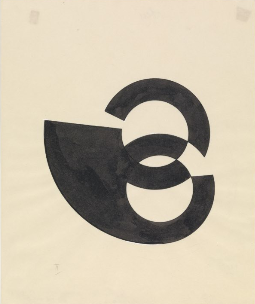
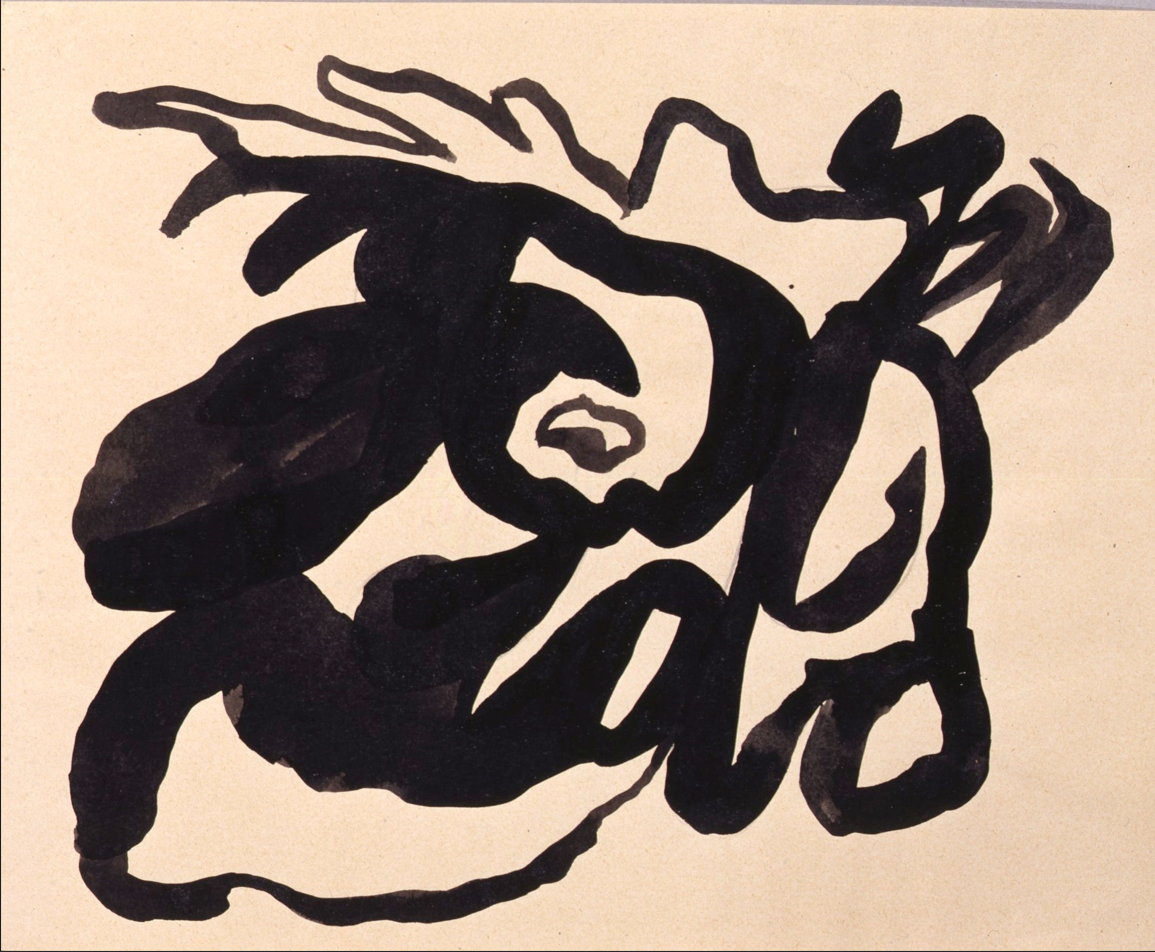
Hans/Jean Arp, Untitled, c. 1916, ink and pencil on paper, 19.5 x 23.7 cm. Fondazione Marguerite Arp, Locarno. © SABAM Belgium 2024, photo: Carlo Reguzzi.

FR

Hans/Jean Arp, Sans titre, vers 1916, encre et crayon sur papier, 19,5 x 23,7 cm. Fondazione Marguerite Arp, Locarno. © SABAM Belgium 2024, photo : Carlo Reguzzi.

NL

Hans/Jean Arp, Zonder titel, ca. 1916, inkt en potlood op papier, 19,5 x 23,7 cm. Fondazione Marguerite Arp, Locarno. © SABAM Belgium 2024, foto: Carlo Reguzzi.


EN

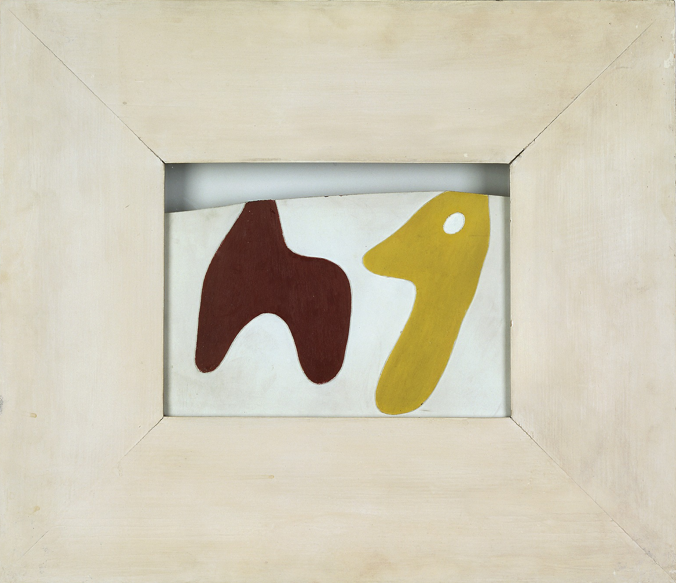
Hans/Jean Arp, Chair and Bottle, 1926, paint on cardboard, 23 x 30 cm. Stiftung Arp e.V., Berlin/Rolandswerth. © SABAM Belgium 2024.

FR

Hans/Jean Arp, Chaise et Bouteille, 1926, peinture sur carton, 23 x 30 cm. Stiftung Arp e.V., Berlin/Rolandswerth. © SABAM Belgium 2024.

NL

Hans/Jean Arp, Stoel en fles, 1926, beschilderd karton, 23 x 30 cm. Stiftung Arp e.V., Berlin/Rolandswerth. © SABAM Belgium 2024.


ARP24_010

EN

Hans/Jean Arp, Man and Woman, c. 1928, watercolour and pencil on paper, 22.5 x 30.5 cm. Private collection. © SABAM Belgium 2024, photo: Fabien de Cugnac.

FR

Hans/Jean Arp, Homme et femme, vers 1928, aquarelle et mine de plomb sur papier, 22,5 x 30,5 cm. Collection privée. © SABAM Belgium 2024, photo : Fabien de Cugnac.

NL

Hans/Jean Arp, Man en vrouw, ca. 1928, waterverf en potlood op papier, 22,5 x 30,5 cm. Privéverzameling. © SABAM Belgium 2024, foto: Fabien de Cugnac.


ARP24_274

EN

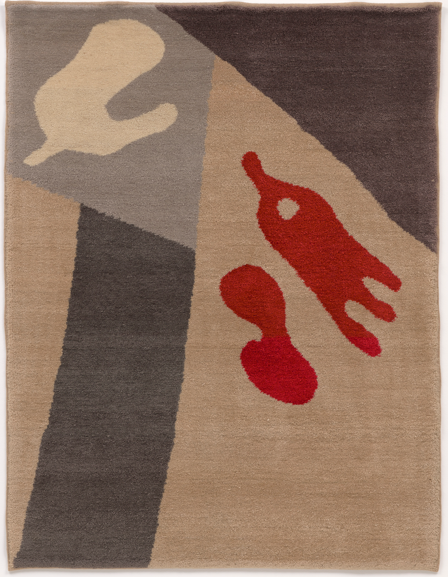
Hans/Jean Arp, Untitled (Rug), c. 1930, wool (manufactured by Myrbor), 198.1 x 151.1 cm. The Museum of Modern Art, New York. Abby Aldrich Rockefeller Fund, 1939. © SABAM Belgium 2024, photo: 2024©Photo Scala, Florence/The Museum of Modern Art, New York. 

FR

Hans/Jean Arp, Sans titre (Tapis), vers 1930, laine (fabriqué par Myrbor), 198,1 x 151,1 cm. The Museum of Modern Art, New York. Abby Aldrich Rockefeller Fund, 1939. © SABAM Belgium 2024, photo : 2024©Photo Scala, Florence/The Museum of Modern Art, New York. 

NL

Hans/Jean Arp, Zonder titel (Tapijt), c. 1930, wol (vervaardigd door Myrbor), 198,1 x 151,1 cm. The Museum of Modern Art, New York. Abby Aldrich Rockefeller Fund, 1939. © SABAM Belgium 2024, foto: 2024©Photo Scala, Florence/The Museum of Modern Art, New York. 


ARP24_065

EN

Hans/Jean Arp, Leaves IV, 1930, paint on wood, 19 x 34 cm. Stiftung Arp e.V., Berlin/Rolandswerth. © SABAM Belgium 2024.

FR

Hans/Jean Arp, Feuilles IV, 1930, peinture sur bois, 19 x 34 cm. Stiftung Arp e.V., Berlin/Rolandswerth. © SABAM Belgium 2024.

NL

Hans/Jean Arp, Bladeren IV, 1930, beschilderd hout, 19 x 34 cm. Stiftung Arp e.V., Berlin/Rolandswerth. © SABAM Belgium 2024.


ARP24_136


EN

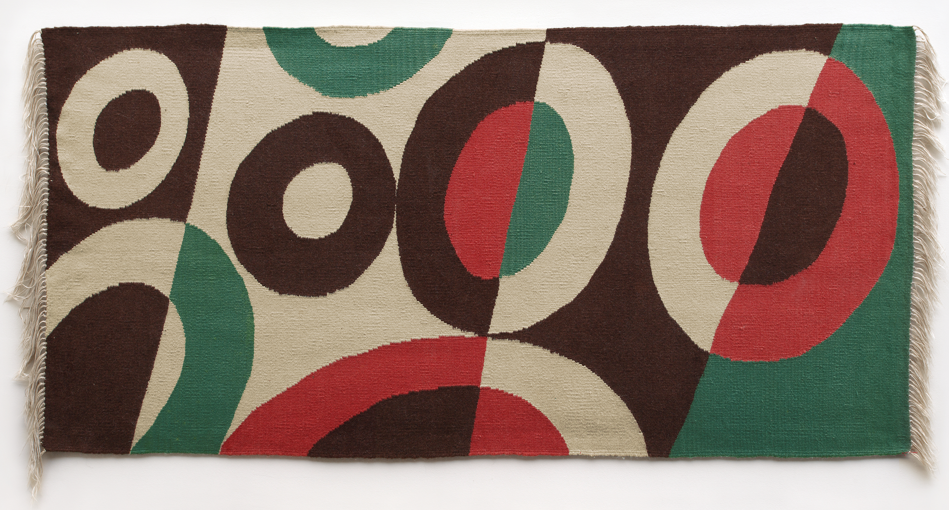
Hans/Jean Arp, Composition, c. 1929, wool (woven by Alice Frey-Amsler), 69 x 139 cm. Arp Museum Bahnhof Rolandseck, Remagen, Germany. © SABAM Belgium 2024, photo: Mick Vincenz.

FR

Hans/Jean Arp, Composition, vers 1929, laine (tissé par Alice Frey-Amsler), 69 x 139 cm. Arp Museum Bahnhof Rolandseck, Remagen, Allemagne. © SABAM Belgium 2024, photo : Mick Vincenz.

NL

Hans/Jean Arp, Compositie, ca. 1929, wol (geweven door Alice Frey-Amsler), 69 x 139 cm. Arp Museum Bahnhof Rolandseck, Remagen, Duitsland. © SABAM Belgium 2024, foto: Mick Vincenz.


ARP24_066

EN

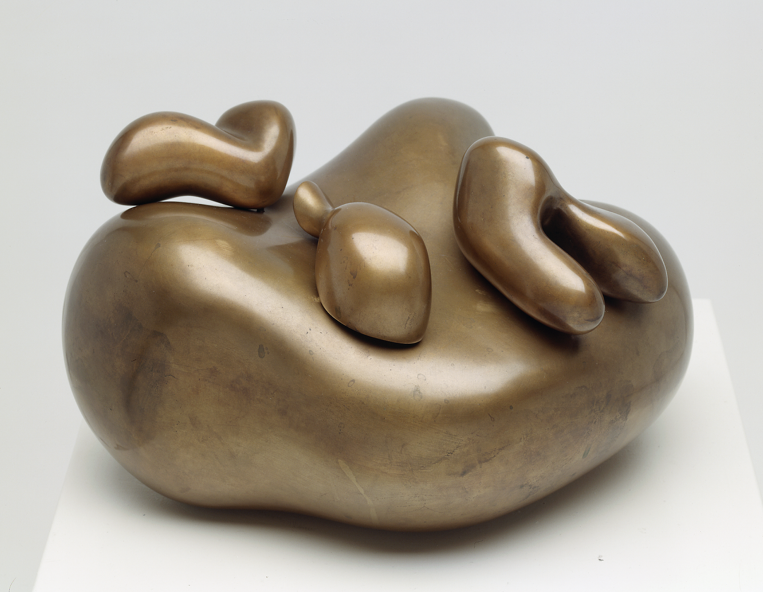
Hans/Jean Arp, Head with Annoying Objects, (1933), bronze (3/5, 1971), 23 x 34 x 30 cm. Stiftung Arp e.V., Berlin/Rolandswerth. © SABAM Belgium 2024.

FR

Hans/Jean Arp, Trois objets désagréables sur une figure, (1933), bronze (3/5, 1971), 23 x 34 x 30 cm. Stiftung Arp e.V., Berlin/Rolandswerth. © SABAM Belgium 2024.

NL

Hans/Jean Arp, Hoofd met drie onaangename objecten, (1933), brons (3/5, 1971), 23 x 34 x 30 cm. Stiftung Arp e.V., Berlin/Rolandswerth. © SABAM Belgium 2024.


ARP24_238

EN

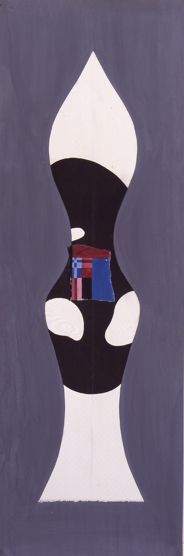
Hans/Jean Arp, The little prince, 1963, collage on painted cardboard (with a fragment of a watercolour by Sophie Taeuber), 68.5 x 23 cm. Fondazione Marguerite Arp, Locarno. © SABAM Belgium 2024.

FR

Hans/Jean Arp, Le petit prince, 1963, collage sur carton peint (avec un fragment d'aquarelle de Sophie Taeuber), 68,5 x 23 cm. Fondazione Marguerite Arp, Locarno. © SABAM Belgium 2024.

NL

Hans/Jean Arp, De kleine prins, 1963, collage op beschilderd karton (met een fragment van een aquarel door Sophie Taeuber), 68,5 x 23 cm. Fondazione Marguerite Arp, Locarno. © SABAM Belgium 2024.


ARP24_242

EN

Hans/Jean Arp, Poupée, 1962, paint on wood, 26.5 × 7.8 × 3.5 cm. Fondazione Marguerite Arp, Locarno. © SABAM Belgium 2024.

FR

Hans/Jean Arp, Poupée, 1962, peinture sur bois, 26,5 × 7,8 × 3,5 cm. Fondazione Marguerite Arp, Locarno. © SABAM Belgium 2024.

NL

Hans/Jean Arp, Poupée, 1962, beschilderd hout, 26,5 × 7,8 × 3,5 cm. Fondazione Marguerite Arp, Locarno. © SABAM Belgium 2024.


WORKS SOPHIE TAEUBER-ARP


ARP24_157

EN

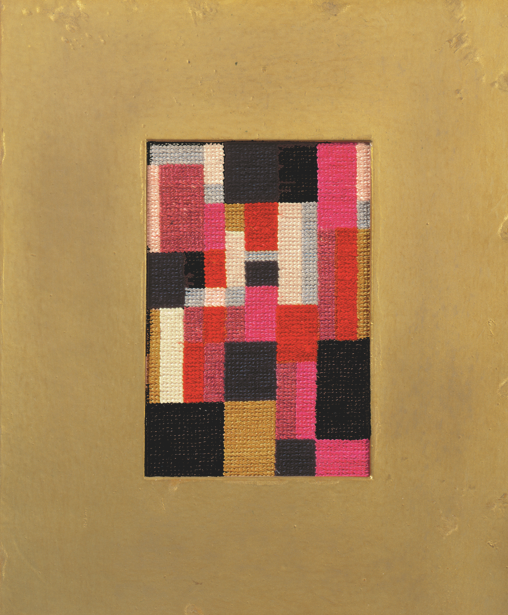
Sophie Taeuber-Arp, Embroidery (Vertical-Horizontal Composition), c. 1917, cotton on canvas, 17 x 11.5 cm. Private collection, on long-term loan to the Aargauer Kunsthaus Aarau. © Photo: Peter Schälchli.

FR

Sophie Taeuber-Arp, Broderie (Composition verticale-horizontale), vers 1917, coton sur toile, 17 x 11,5 cm. Collection privée, en prêt à long terme à l’Aargauer Kunsthaus Aarau. © Photo : Peter Schälchli.

NL

Sophie Taeuber-Arp, Borduurwerk (Verticale-horizontale compositie), ca. 1917, katoen op doek, 17 x 11,5 cm. Privéverzameling, in langdurige bruikleen aan Aargauer Kunsthaus Aarau. © Foto: Peter Schälchli.


ARP24_207

EN

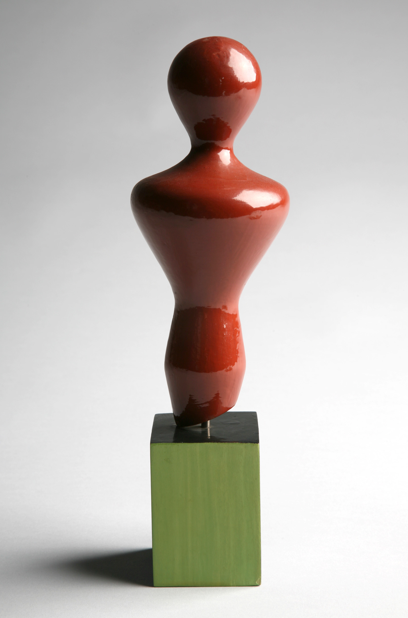
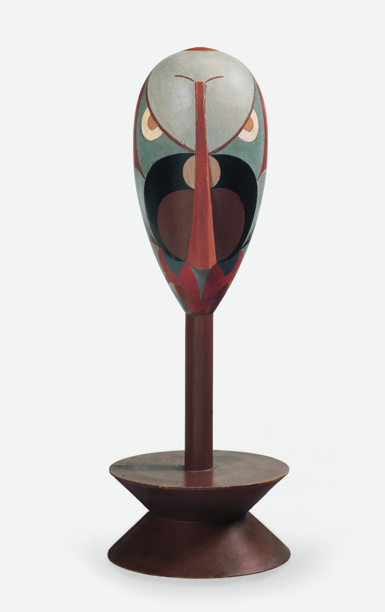
Sophie Taeuber-Arp, Portrait H[ans] A[rp], 1918, oil on wood, height: 25 cm, diam.: 9 cm. Private collection.

FR

Sophie Taeuber-Arp, Portrait H[ans] A[rp], 1918, huile sur bois, hauteur : 25 cm, diam. : 9 cm. Collection privée. 

NL

Sophie Taeuber-Arp, Portret H[ans] A[rp], 1918, olieverf op hout, hoogte: 25 cm, diam.: 9 cm. Privéverzameling.


ARP24_263 

A metal spider with long legs and blue handles

Description automatically generated 

EN 

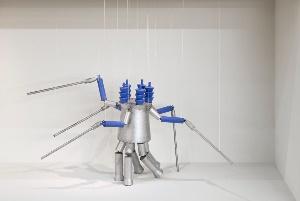
Sophie Taeuber-Arp, Guards (marionette for King Stag) (copy 2), 1918 (copy 2: 1993), mixed media, 56 × 18 × 18 cm. Museum für Gestaltung Zürich 

, Decorative Arts Collection, ZHdK. © Photo: Umberto Romito & Ivan Šuta, Museum für Gestaltung Zürich, Decorative Arts Collection, ZHdK. 


FR 

Sophie Taeuber-Arp, Gardes (marionnette pour Le Roi Cerf) (copie 2), 1918 (copie 2 : 1993), techniques mixtes, 56 × 18 × 18 cm. Museum für Gestaltung Zürich, Collection Arts décoratifs, ZHdK. © Photo : Umberto Romito & Ivan Šuta, Museum für Gestaltung Zürich, Collection Arts décoratifs, ZHdK. 


NL 

Sophie Taeuber-Arp, Bewakers (marionet voor Koning Hert) (kopie 2), 1918 (kopie 2: 1993), mixed media, 56 × 18 × 18 cm. Museum für Gestaltung Zürich, Collectie Decoratieve Kunsten, ZHdK. © Photo: Umberto Romito & Ivan Šuta, Museum für Gestaltung Zürich, Collectie Decoratieve Kunsten, ZHdK. 


ARP24_265 

A close-up of a puppet

Description automatically generated 

EN 

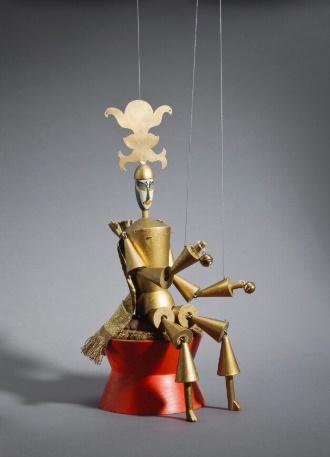
Sophie Taeuber-Arp, Deramo, The King (marionette for King Stag) (copy), 1918 (copy: 1989), mixed media, 60 x 15 x 9 cm. Museum für Gestaltung Zürich, Decorative Arts Collection, ZHdK. © Photo: Umberto Romito & Ivan Šuta, Museum für Gestaltung Zürich, Decorative Arts Collection, ZHdK. 


FR 

Sophie Taeuber-Arp, Deramo, Le Roi (marionnette pour Le Roi Cerf) (copie), 1918 (copie : 1989), techniques mixtes, 60 x 15 x 9 cm. Museum für Gestaltung Zürich, Collection Arts décoratifs, ZHdK. © Photo : Umberto Romito & Ivan Šuta, Museum für Gestaltung Zürich, Collection Arts décoratifs, ZHdK. 


NL 

Sophie Taeuber-Arp, Deramo, De Koning (marionet voor Koning Hert) (kopie), 1918 (kopie: 1989), mixed media, 60 x 15 x 9 cm. Museum für Gestaltung Zürich, Collectie Decoratieve Kunsten, ZHdK. © Foto: Umberto Romito & Ivan Šuta, Museum für Gestaltung Zürich, Collectie Decoratieve Kunsten, ZHdK. 


ARP24_048

EN

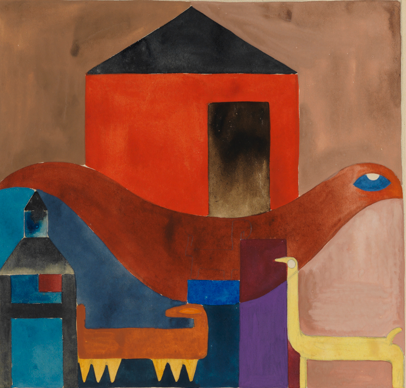
Sophie Taeuber-Arp, Siena, Houses, Animals, gouache and pencil on brown paper, 18.7 x 19.5 cm. Etienne Bréton / Saint-Honoré Art Consulting.

FR

Sophie Taeuber-Arp, Sienne, maisons, animaux, gouache et crayon sur papier brun, 18,7 x 19,5 cm. Etienne Bréton / Saint-Honoré Art Consulting.

NL

Sophie Taeuber-Arp, Siena, huizen, dieren, gouache en potlood op bruin papier, 18,7 x 19,5 cm. Etienne Bréton / Saint-Honoré Art Consulting.


ARP24_214

EN

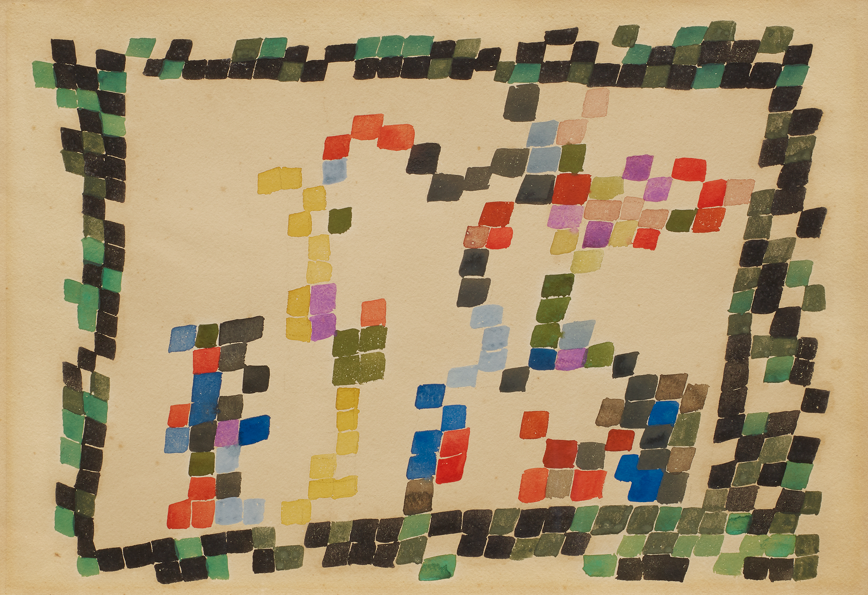
Sophie Taeuber-Arp, Quadrangular Strokes, Evoking and Framing Figures, 1920, gouache and pencil on paper on board. Bischofberger Collection, Männedorf-Zürich, Switzerland.

FR

Sophie Taeuber-Arp, Taches quadrangulaires évoquant et encadrant des personnages, 1920, gouache et crayon sur papier sur carton. Collection Bischofberger, Männedorf-Zürich, Suisse.

NL

Sophie Taeuber-Arp, Vierhoekige strepen die figuren oproepen en omlijsten, 1920, gouache en potlood op papier op karton. Collectie Bischofberger, Männedorf-Zürich, Zwitserland.


ARP24_220

EN

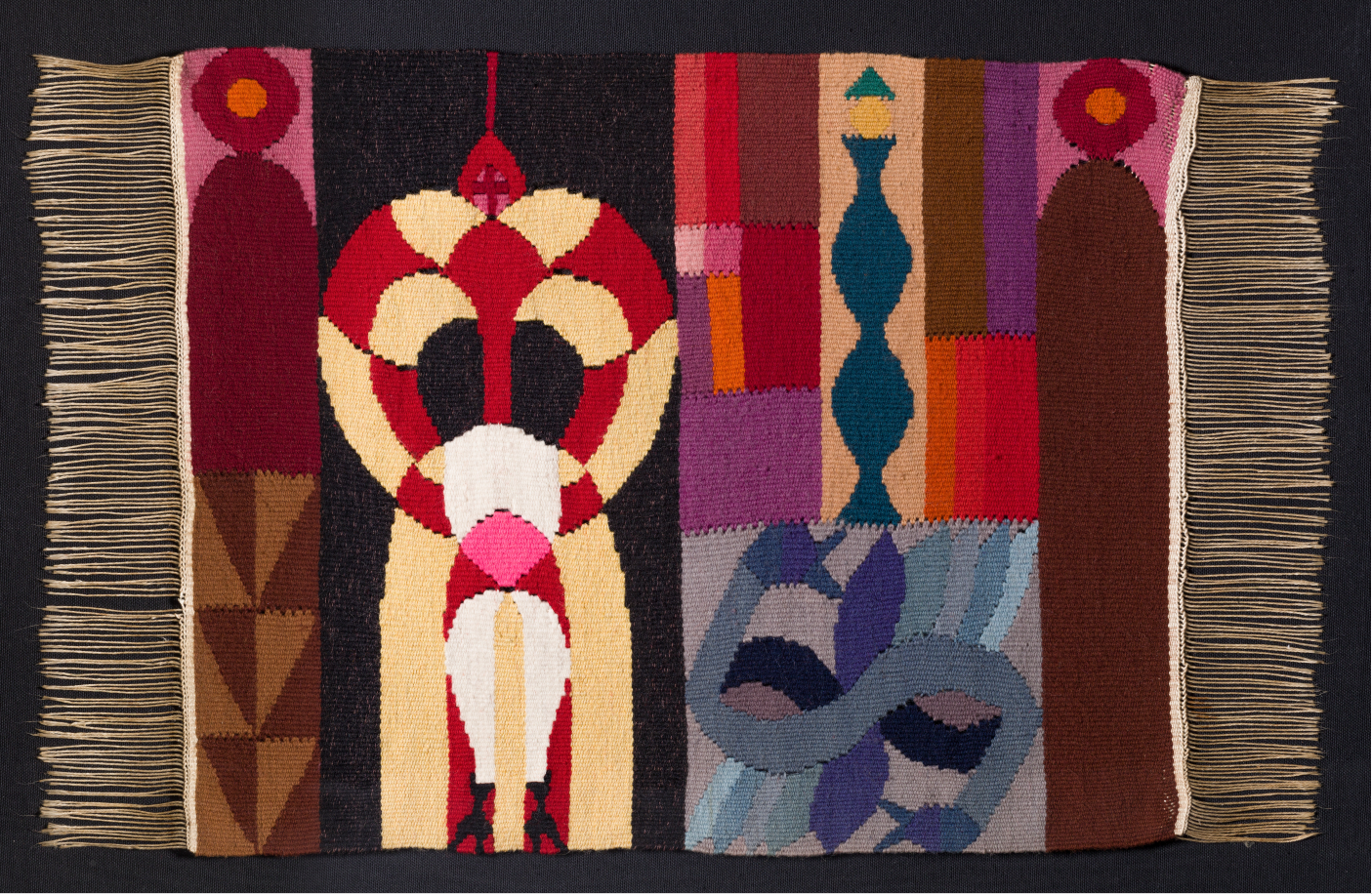
Sophie Taeuber-Arp, Tapestry, 1924, wool and cotton, 40 x 50 cm. Fondazione Marguerite Arp, Locarno. © Photo: Roberto Pellegrini, Bellinzona.

FR

Sophie Taeuber-Arp, Tapisserie, 1924, laine et coton, 40 x 50 cm. Fondazione Marguerite Arp, Locarno. © Photo : Roberto Pellegrini, Bellinzona.

NL

Sophie Taeuber-Arp, Wandtapijt, 1924, wol en katoen, 40 x 50 cm. Fondazione Marguerite Arp, Locarno. © Foto: Roberto Pellegrini, Bellinzona.


ARP24_054

EN

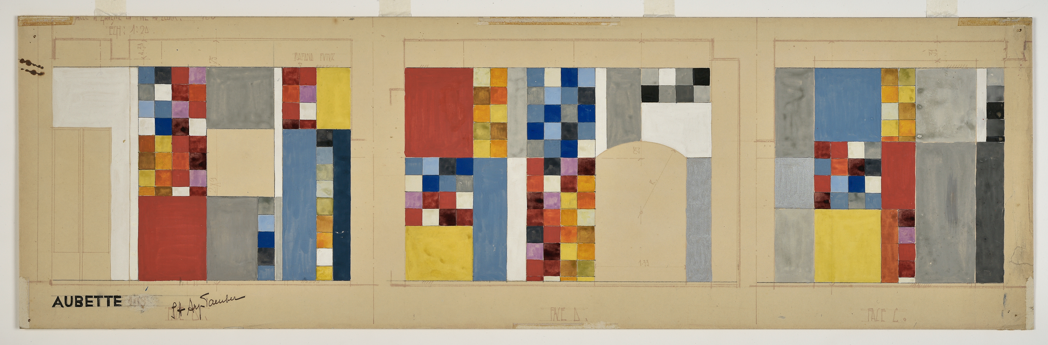
Sophie Taeuber-Arp, Aubette 198 (design for three walls of the Aubette Bar in the Aubette, Strasbourg, France), 1927, gouache, metallic paint, pencil, ink and coloured ink on diazotype on board, 22 x 73 cm. Musée d'Art moderne et contemporain de Strasbourg, France. © Musées de la ville de Strasbourg, M. Bertola.

FR

Sophie Taeuber-Arp, Aubette 198 (projet pour trois murs de l’Aubette-Bar à l’Aubette, Strasbourg, France), 1927, gouache, peinture métallique, crayon, encre et encre de couleur sur diazotype sur carton, 22 x 73 cm. Musée d'Art moderne et contemporain de Strasbourg, France. © Musées de la ville de Strasbourg, M. Bertola.

NL

Sophie Taeuber-Arp, Aubette 198 (ontwerp voor drie muren van de Aubette Bar in de Aubette, Straatsburg, Frankrijk), 1927, gouache, metallic verf, potlood, inkt en gekleurde inkt op diazotype op karton, 22 x 73 cm. Musée d'Art moderne et contemporain de Strasbourg, Frankrijk. © Musées de la ville de Strasbourg, M. Bertola.


ARP24_341

EN

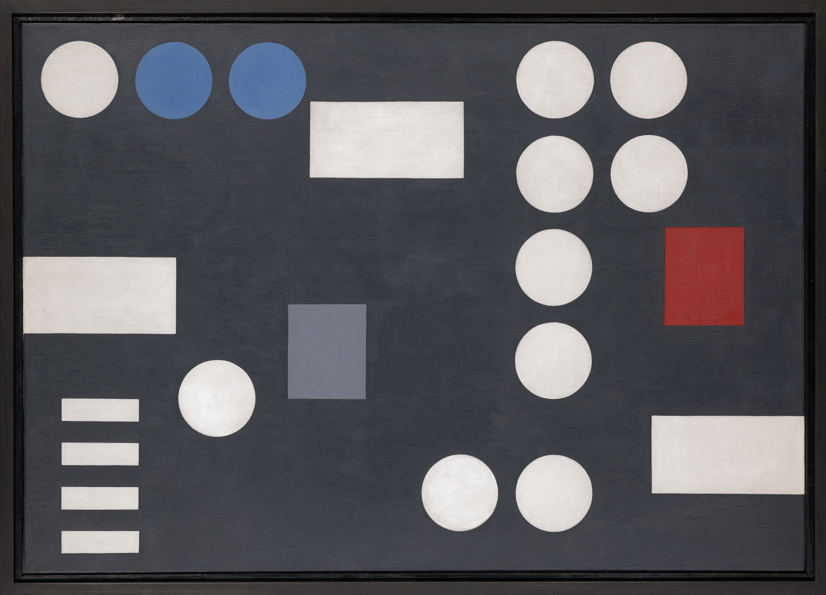
Sophie Taeuber-Arp, Circle Picture, 1931, oil on canvas, 64.5 x 92 cm. Kunstmuseum Basel, inv. no. G 1968.105, Gift of Marguerite Arp-Hagenbach 1968. © Bilddaten gemeinfrei - Kunstmuseum Basel, photo: Martin P. Bühler.

FR

Sophie Taeuber-Arp, Peinture à cercles, 1931, huile sur toile, 64,5 x 92 cm. Kunstmuseum Basel, n° inv. G 1968.105, Don de Marguerite Arp-Hagenbach 1968. © Bilddaten gemeinfrei - Kunstmuseum Basel, photo : Martin P. Bühler.

NL

Sophie Taeuber-Arp, Cirkelbeeld, 1931, olieverf op doek, 64,5 x 92 cm. Kunstmuseum Basel, inv.nr. G 1968.105, Schenking van Marguerite Arp-Hagenbach 1968. © Bilddaten gemeinfrei - Kunstmuseum Basel, foto: Martin P. Bühler.


ARP24_294

EN

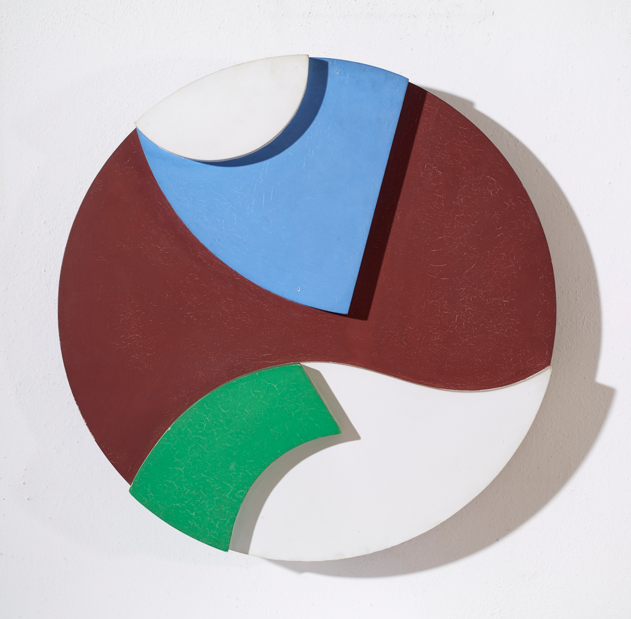
Sophie Taeuber-Arp, Relief, 1937-38, oil on wood. Private collection.

FR

Sophie Taeuber-Arp, Relief, 1937-1938, huile sur bois. Collection privée. 

NL

Sophie Taeuber-Arp, Reliëf, 1937-1938, olieverf op hout. Privéverzameling.


ARP24_321

EN

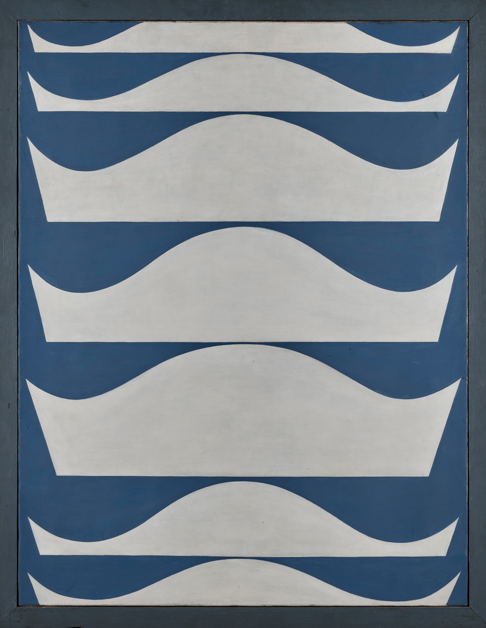
Sophie Taeuber-Arp, Gradation, 1934, oil on canvas, 65 x 50 cm. Private collection, Switzerland. © Photo: Luis Lourenço.

FR

Sophie Taeuber-Arp, Échelonnement, 1934, huile sur toile, 65 x 50 cm. Collection privée, Suisse. © Photo : Luis Lourenço.

NL

Sophie Taeuber-Arp, Gradatie, 1934, olieverf op doek, 65 x 50 cm. Privéverzameling, Zwitserland. © Foto: Luis Lourenço.


ARP24_271

EN

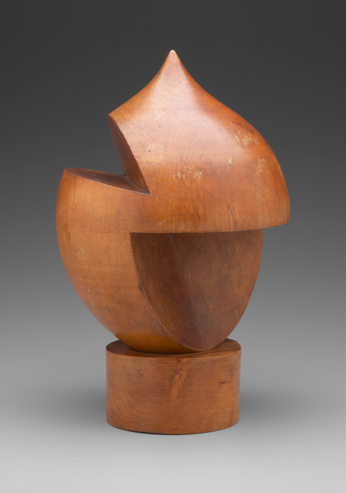
Sophie Taeuber-Arp, Head, 1937, wood, height: 38.9 cm, diam.: 19.7 cm. Yale University Art Gallery, Gift of Jean Arp in memory of Sophie Taeuber-Arp.

FR

Sophie Taeuber-Arp, Tête, 1937, bois, hauteur: 38,9 cm, diam.: 19,7 cm. Yale University Art Gallery, Don de Jean Arp à la mémoire de Sophie Taeuber-Arp.

NL

Sophie Taeuber-Arp, Hoofd, 1937, hout, hoogte: 38,9 cm, diam.: 19,7 cm. Yale University Art Gallery, Schenking van Jean Arp ter nagedachtenis aan Sophie Taeuber-Arp.


ARP24_381

EN

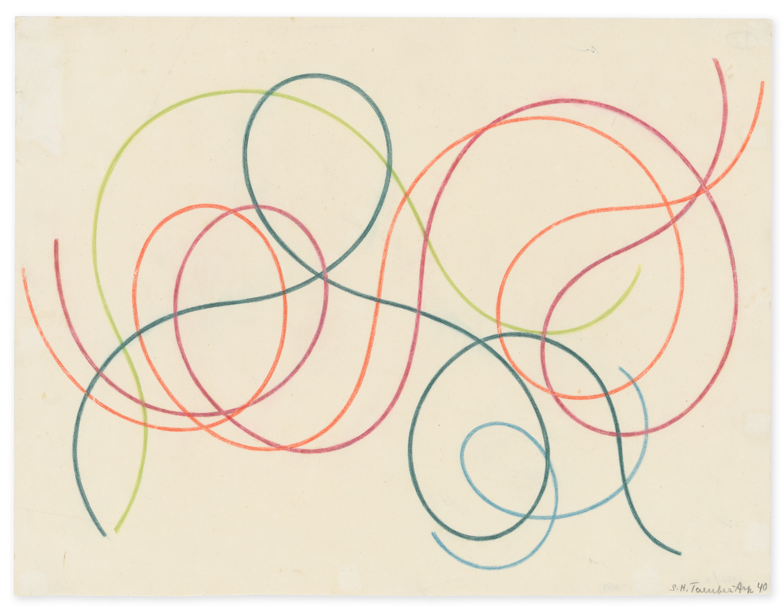
Sophie Taeuber-Arp, Movement of Coloured Lines, 1940, coloured pencil and pencil on paper, 26.3 x 34.5 cm. Stiftung Arp e.V., Berlin/Rolandswerth.

FR

Sophie Taeuber-Arp, Mouvement de lignes en couleurs, 1940, crayon de couleur et crayon sur papier, 26,3 x 34,5 cm. Stiftung Arp e.V., Berlin/Rolandswerth.

NL

Sophie Taeuber-Arp, Beweging van gekleurde lijnen, 1940, kleurpotlood en potlood op papier, 26,3 x 34,5 cm. Stiftung Arp e.V., Berlin/Rolandswerth.


RP24_103 


EN 

Sophie Taeuber-Arp, Geometric Construction, 1942, ink, pencil, and gouache on paper, 25.2 x 20.9 cm. Stiftung Arp e.V., Berlin/Rolandswerth. 


FR 

Sophie Taeuber-Arp, Construction géométrique¸1942, encre, crayon et gouache sur papier, 25,2 x 20,9 cm. Stiftung Arp e.V., Berlin/Rolandswerth. 


NL 

Sophie Taeuber-Arp, Geometrische constructie, 1942, inkt, potlood en gouache op papier, 25,2 x 20,9 cm. Stiftung 

 Arp e.V., Berlin/Rolandswerth.