Tuesday, June 16, 2026

Sotheby’s Modern and Contemporary Evening auction in London on 24 June

Exceptional Water Lily Painting by Claude Monet to Lead Sotheby’s Modern and Contemporary Evening Sale in London With £30-40 Million Estimate - The Highest Estimate Ever Placed on a Work by Monet to Come to Auction in Europe - Alongside An Early Portrait of the Artist’s First Wife, One of Only a Handful Featuring Camille Monet Ever to Appear at Auction

This extraordinary ‘reunion’ brings together two defining works by Claude Monet. Painted in 1870, the portrait of Camille reads almost as a manifesto of his pioneering plein air approach, and is remarkable for its freshness, spontaneity and immediacy of vision. Set beside the water lilies - arguably Monet’s defining and most recognisable body of work - painted almost half a century later, one can trace the extraordinary arc of his artistic evolution. In many ways, the painting of Camille reveals the origins of everything that followed, visually laying the foundations for all the revolutionary language Monet would go on to create, one that would ultimately alter the course of Modern art.” Helena Newman Sotheby’s Chairman, Europe & Chairman, Impressionist & Modern Art Worldwide 

Two exceptional works by Claude Monet, painted nearly four decades apart, will headline Sotheby’s Modern and Contemporary Evening auction in London on 24 June. Together, the paintings encapsulate both the origins and culmination of Monet’s revolutionary artistic practice, drawing on two of his most enduring sources of inspiration: his water garden at Giverny, and his beloved wife Camille. Leading the sale is Nymphéas (1907), a lyrically ethereal and luminous view of Monet’s famed water lily pond at Giverny, carrying the highest estimate ever placed on a work by the artist to come to auction in Europe (est. £30-40m). It is joined by Camille assise sur la plage à Trouville, an intimate early portrait of Monet’s beloved wife Camille on the Normandy coast during the summer of 1870 (est. £7-10m).
 Offered from the same private collection, the two paintings share distinguished American provenance. Nymphéas remained in the collection of renowned patron and collector Anne Bass for nearly four decades, while Camille assise sur la plage à Trouville formerly belonged to Peggy and David Rockefeller. Having resided in major American collections for generations, both works will now be presented in London for the first time. Seen together, the paintings offer a compelling through-line across Monet’s artistic evolution – one that would ultimately set to alter the course of art history. 

Painted on the cusp of Impressionism, the Trouville portrait captures a fleeting, wind-swept moment with striking immediacy, while Nymphéas, executed at the height of Monet’s powers, reflects his profound reimagining of landscape, light, and perception. 

Together with the Lewis Collection and other major works, this remarkable pairing arrives at a defining moment for the London art market, bringing an exceptional concentration of museum-quality works to auction, including some of the highest-value works ever offered in Europe presented under one roof. 


CLAUDE MONET Nymphéas (1907) Estimate: £30-40 million 

Painted at a landmark moment during Monet's career, Nymphéas belongs to the pivotal group of water lily paintings executed between 1904 and 1909, a period during which the artist radically transformed the language of landscape painting. Dispensing with the horizon line and dissolving spatial boundaries, Monet rendered the surface of his pond as a boundless field of light, colour, and reflection. His water garden at Giverny offered an infinite array of shifting effects and hence, for the artist, an inexhaustible source of inspiration, presenting subtle tensions between surface and depth, near and far, permanence and transience – all unified within an ever-changing, luminous atmosphere. Nymphéas is executed in the highly coveted square format, a compositional innovation that proved critical to Monet’s artistic evolution. By renouncing traditional landscape and portrait orientations, he abolished the horizon line entirely, intensifying the immersive, near-abstract quality of his water lilies while enabling an intimate and contemplative focus on floating vegetation and rippling reflections. The work signals a decisive departure from traditional landscape conventions and anticipates later developments in abstraction, exerting a profound influence on generations of artists, including figures such as Mark Rothko, whose work will be exhibited alongside this canvas in the sale. Softly atmospheric and richly textured, the composition captures the delicate interplay between floating blossoms, reflected sky, and rippling water, blurring the distinction between the tangible and the ephemeral.


CLAUDE MONET Camille assise sur la plage à Trouville (1870) Estimate: £7-10 million 

Painted at a formative moment in the emergence of Impressionism, this intimate portrait of Camille Monet, the artist’s beloved first wife, stands as a striking example of the artist’s pioneering plein air practice, distinguished by its immediacy, spontaneity, and freshness of execution. Works depicting Monet’s first wife are exceptionally rare: this is one of only a small handful of such portraits ever to appear at auction. The painting has never been exhibited or offered for sale in the UK and has been shown publicly only once, in Paris in 1970. Unlike most of Monet’s coastal scenes of the 1860s, which focus on maritime activity, this composition captures a quiet, personal moment, elevating the everyday into something profoundly modern. It remained in Monet’s possession until 1875, when it was acquired by the poet and critic Émile Blémont, an early advocate of Impressionism. Painted in the summer of 1870, on the eve of the Franco-Prussian War, the scene is notably untouched by the political turbulence of the moment. Shortly thereafter, Monet fled to London with Camille and their son, taking works from this pivotal period with him.

Also:
 
Buste d’homme (New York II)

103. Alberto Giacometti

Buste d’homme (New York II)

Estimate:

1,200,000 - 1,800,000 GBP


Untitled

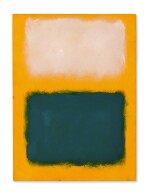
106. Mark Rothko

Untitled

Estimate:

4,000,000 - 6,000,000 GBP


Landscape with Grass

108. Roy Lichtenstein

Landscape with Grass

Estimate:

2,000,000 - 3,000,000 GBP


Cabin Essence

109. Peter Doig

Cabin Essence

Estimate:

10,000,000 - 15,000,000 GBP


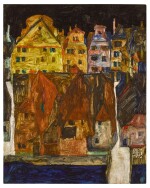
Tote Stadt IV (Blick über Dächer auf Häuserfassaden des Krumauer Ringplatzes) (Dead City IV (View across Roofs of Ringplatz Facades in Krumau))

110. Egon Schiele

Tote Stadt IV (Blick über Dächer auf Häuserfassaden des Krumauer Ringplatzes) (Dead City IV (View across Roofs of Ringplatz Facades in Krumau))

Estimate:

2,500,000 - 3,500,000 GBP


Natura morta

111. Giorgio Morandi

Natura morta

Estimate:

800,000 - 1,200,000 GBP


Two Chairs and a Wooden Spoon, July 1988

112. David Hockney

Two Chairs and a Wooden Spoon, July 1988

Estimate:

1,200,000 - 1,800,000 GBP


Tête de femme

114. Pablo Picasso

Tête de femme

Estimate:

3,000,000 - 5,000,000 GBP


The Hill

115. Philip Guston

The Hill

Estimate:

2,500,000 - 3,500,000 GBP


Fragment zu Improvisation II (Trauermarsch) (Detail of Improvisation II (Funeral March))

117. Wassily Kandinsky

Fragment zu Improvisation II (Trauermarsch) (Detail of Improvisation II (Funeral March))

Estimate:

4,000,000 - 6,000,000 GBP


Untitled (Beach Scene)

119. Hurvin Anderson

Untitled (Beach Scene)

Estimate:

1,800,000 - 2,500,000 GBP


Roter Fisch

123. Sigmar Polke

Roter Fisch

Estimate:

1,000,000 - 1,500,000 GBP


Head of a Soldier

124. Mikhail Larionov

Head of a Soldier

Estimate:

800,000 - 1,200,000 GBP


Despair

125. Roy Lichtenstein

Despair

Estimate:

1,000,000 - 1,500,000 GBP


Rue pavoisée au Havre

127. Raoul Dufy

Rue pavoisée au Havre

Estimate:

800,000 - 1,200,000 GBP


Down in Chinatown

134. George Condo

Down in Chinatown

Estimate:

1,500,000 - 2,000,000 GBP


Love Is In The Air (life size)

137. Banksy

Love Is In The Air (life size)

Estimate:

3,500,000 - 5,500,000 GBP


Portrait d'une jeune femme triste

142. Tamara de Lempicka

Portrait d'une jeune femme triste

Estimate:

800,000 - 1,200,000 GBP 

Willem de Kooning Drawing

Willem de Kooning. Untitled [man and woman], about 1947–48. Matte opaque paint (possibly oil) with fine particulate filler, enamel, carbon transfer drawing, and graphite pencil on pressed paper cover stock, mounted on secondary support. 54.5 × 42.5 cm (21 7/16 × 16 3/4 in.). Private collection. © 2026 The Willem de Kooning Foundation / Artists Rights Society (ARS), New York. Photo courtesy of TAJAN.

The Art Institute of Chicago is pleased to announce Willem de Kooning Drawing, on view June 14 through September 20, 2026. This is the first major exhibition to examine the artist’s expansive drawing practice, and the first solo presentation of his work at the Art Institute since 1969. 

Willem de Kooning Drawing gathers more than 200 works from across the globe, many of which have never been shown together before, to reveal how the act of drawing was foundational to de Kooning’s entire artistic process and production. The exhibition includes drawings along with major paintings, sculptures, and prints to showcase the totality of his graphic production, from his earliest existing works to his late calligraphic paintings.

Rigorously trained at the Academy of Visual Arts and Technical Sciences in Rotterdam, de Kooning achieved a remarkable command of traditional drawing techniques while still in his teens. In 1926, at the age of 22, he immigrated to the United States to pursue his dream of becoming an illustrator. In New York City, de Kooning found work as a house painter, freelance commercial artist, and window display designer. He became immersed in the New York art scene, ultimately becoming a key figure of the movement that would be known as “Abstract Expressionism” or the “New York School” with contemporaries including Jackson Pollock, Lee Krasner, Barnett Newman, and Mark Rothko.

Ambiguity would become a distinguishing feature of de Kooning’s practice, as his work increasingly dissolved the boundaries between representation and abstraction, male and female figures, “high” and “low” art forms, and, in particular, the disciplines of drawing and painting. Compelled to continually innovate and surprise even himself, de Kooning began experimenting with unconventional drawing methods including working with his eyes closed, which opened up new directions for his art. 

“Willem de Kooning continually innovated throughout his career, exploring and expanding ways of seeing and rendering what is seen. He drew incessantly and famously blurred the line between drawing and painting. In the process, he produced a staggering body of work that transformed modern art,” said Kevin Salatino, Chair and Anne Vogt Fuller and Marion Titus Searle Curator. “We are profoundly grateful to The Willem de Kooning Foundation for its unstinting support and commitment to this exhibition. The discoveries that came out of our years of research will allow visitors to gain an entirely new understanding and appreciation of de Kooning.”

This landmark exhibition offers an unprecedented opportunity to experience the full scope of de Kooning’s drawing practice—and drawing’s influence on his work in other media—shedding light not only on its evolution over seven decades but also on the ways it redefined the possibilities of modern and contemporary art.

Willem de Kooning Drawing is organized by the Art Institute of Chicago, in collaboration with the Rijksmuseum, Amsterdam, and in consultation with The Willem de Kooning Foundation. The exhibition’s curatorial team at the Art Institute includes Kevin Salatino, Chair and Anne Vogt Fuller and Marion Titus Searle Curator, Prints and Drawings; Mel Becker Solomon, associate research curator, Prints and Drawings; and Charlotte Healy, senior research associate, Prints and Drawings, with contributions from Margaret Holben Ellis, exhibition paper conservator. 

The exhibition is accompanied by essays and insights published in an illustrated catalogue.

Watercolor Stories: Art of Charles E. Burchfield


Munson Museum of Art 

 June 12 – Sept. 13, 2026

Watercolor Stories: Art of Charles E. Burchfield presents the fascinating artistic relationship between renowned painter Charles E. Burchfield and Munson’s benefactor Edward Wales Root. The two met in 1929 and began a 25-year conversation about their mutual enthusiasm for art, music, and nature. Watercolor Stories features Munson’s collection of 24 expressive watercolors by the artist as well as a substantial collection of related artwork and archival material from the Burchfield Penney Art Center in Buffalo, N.Y. The exhibition is accompanied by a new catalogue of Munson’s drawings.


Charles E. Burchfield (American, 1893–1967), The Sphinx and the Milky Way, 1946. Watercolor, chalk, and crayon on paper. 52 1/2 x 44 3/4 in. Munson Museum of Art, 48.45. © The Charles E. Burchfield Foundation


Charles E. Burchfield (American, 1893–1967), Childhood’s Garden, 1917. Watercolor with graphite on paper. 27 x 19 in. Munson Museum of Art, Edward W. Root Bequest, 57.90. © The Charles E. Burchfield Foundation


Charles E. Burchfield (American, 1893–1967), Decorative Landscape, Hot Morning Sunlight, 1916. Watercolor with graphite on paper. 13 7/8 x 19 7/8 in. Munson Museum of Art, Edward W. Root Bequest, 57.94. © The Charles E. Burchfield Foundation


Charles E. Burchfield (American, 1893–1967), Poplar Walk (Three Poplars, Hot Sunlight; Row of Poplars), 1916. Watercolor on paper. 19 7/8 x 13 15/16 in. Munson Museum of Art, Edward W. Root Bequest, 57.103. © The Charles E. Burchfield Foundation 


Monday, June 15, 2026

New scientific method can now tell real Van Goghs from fakes

A new study published in the peer reviewed journal Surface Topography: Metrology and Properties introduces a pioneering, non‑invasive technique that can distinguish authentic artworks from forgeries, offering museums, collectors and auction houses a major advantage in tackling art fraud.

The study, developed at the Université Polytechnique Hauts-de-France introduces a method that analyses the microscopic “texture” of a painting by converting high-resolution images into 3D‑like maps allowing researchers to measure how rough or detailed the surface is using fractal dimensions. This measurement captures subtle patterns created by an artist’s brushwork – patterns so consistent that they act like a morphological signature unique to that artist.

Using works attributed to Vincent van Gogh, the researchers showed that the method can reliably distinguish between authentic paintings and known forgeries. In tests, the well‑documented fake The Plowmen was identified as a strong outlier, while the recently authenticated Sunset at Montmajour aligned closely with Van Gogh’s known works. The approach also successfully separated the stylistic signatures of Van Gogh and 17th‑century painter David Klöcker Ehrenstrahl, demonstrating its wider potential.

Art forgery is a growing problem, and traditional authentication relies on a combination of expert opinion, historical research, pigment analysis and digital techniques. These approaches are powerful but also resource‑intensive and sometimes inconclusive. This technology can strengthen authentication, especially when combined with complementary analyses such as the chemical examination of materials, while reducing financial risk and helping to safeguard cultural heritage

The urgency for better authentication tools has never been clearer. A recent investigation reported by The Guardian revealed that AI technology identified up to 40 counterfeit artworks, including pieces labelled as Monet and Renoir, being sold on major online marketplaces. In these cases, scientists provide analysis that helps experts make informed decisions. Using a range of different methods leads to more reliable conclusions, helping to detect fraud and protect cultural heritage.

Lead researcher of the study, Francois Berkmans, says: “Fractal analysis gives us a measurable fingerprint of an artist’s brushwork without needing to sample or disturb the painting. This approach won’t replace traditional expertise, but it significantly strengthens it. Our results show that our technique can clearly point out genuine artists and reliable detect known forgeries.”


ENDS

10.1088/2051-672X/ae7136  

Saturday, June 13, 2026

Diego Rivera and the Construction of Modern Art in Mexico in the 20th Century

Capitoline Museums, Palazzo Caffarelli

June 9 – December 13, 2026


This exhibition is the largest showcase of Mexican art in Europe in recent decades and the first ever held in Italy dedicated to Diego Rivera. A journey through the colors of Mexico set against the magnificent backdrop of the Capitoline Museums—Villa Caffarelli—this intense retrospective is dedicated to the renowned Mexican painter and muralist. His work serves as a bridge between tradition and the future, creating a distinctive, autonomous visual language for modern Mexican art.


Alongside works by Diego Rivera, the exhibition presents masterpieces by extraordinary artists such as Frida Kahlo, José María Velasco, José Clemente Orozco, David Alfaro Siqueiros, María Izquierdo, Tamayo, Lozano, Montenegro, Ruiz, Dr. Atl, Saturnino Herrán, and many others. The exhibition is further enriched by evocative videos and photographs, including images of Rivera captured by Tina Modotti.


This group of artists successfully wove together tradition, the avant-garde, and a plurality of aesthetic languages. The exhibition traces the genealogy of Mexican modernity, positioning Rivera at the heart of a visual and conceptual tapestry where academic training engages in dialogue with experimentation and a profound focus on the social realities of the time.


Through an extraordinary selection of over 140 works—thirty of which are by Diego Rivera—the exhibition reveals the complexity of a process rooted in the birth of independent Mexico in 1821. That era saw the emergence of a need for a cultural identity capable of representing a new, diverse, and constantly evolving nation. In this context, art becomes a privileged tool for visually shaping the face of Mexico, as well as a vehicle for cultural transformation projects that blend tradition and modernity, projecting a diverse and constantly evolving image onto the international stage.


During the first half of the 20th century, Mexican art redefined itself by creating a distinctly national language and iconography. Artistic practice turned its focus toward a fusion of pre-Columbian heritage, folk cultures, and the social imperatives that emerged in the post-revolutionary period. Within this framework, the visual arts played a decisive role in rebuilding the country’s social fabric, with the Muralist movement standing out as one of the most influential projects both nationally and internationally. Championed in 1921 by José Vasconcelos and solidified by artists José Clemente Orozco, David Alfaro Siqueiros, and Diego Rivera, Muralism helped democratize art and construct an epic narrative of Mexican history—one in which the people, workers, and peasants took center stage. The result was a new national iconography that spoke to communities and public spaces while redefining the artist's social role.


The exhibition is organized into four thematic sections:

Academy and Tradition – Rivera’s Training: explores the engagement with 19th-century legacies and the lineage of the craft—spanning academies and fine arts schools—to understand the technical and cultural roots of Mexican modernity.

The Contribution of Diego Rivera and Mexico to European Avant-Gardes – The European Years: focuses on dialogues with Cubism and the avant-garde, as well as the original contribution Mexican artists made to the international scene through a new visual syntax.

The Mexican Cultural Renaissance: analyzes the post-Revolutionary era, when visual arts, literature, architecture, and music converged to define a modern national identity, blending pre-Columbian heritage, folk traditions, and social imperatives. Beyond Social Realism:examines the dissemination of models and ideas beyond the canons of Muralism, moving toward explorations that expand the lexicon of modern Mexican art and attest to its enduring vitality.

Each section brings together emblematic works from the 19th and 20th centuries, accompanied by critical essays from distinguished art historians featured in the exhibition catalogue, published by Gangemi Editore.

IMAGES

Diego Rivera (1886-1957) Mujer sentada con flores Donna seduta con fiori 1944 olio su tela, 118 x 150 cm Città del Messico, Colección de Arte BBVA México, inv. CCB062 © Banco de México

Diego Rivera (1886–1957) Seated Woman with Flowers, 1944, oil on canvas, 118 x 150 cm, Mexico City, BBVA Mexico Art Collection, inv. CCB062 © Banco de México

Diego Rivera (1886-1957) Adoración de la Virgen Adorazione della Vergine 1912-1913 olio su tela, 151 x 122 cm Città del Messico, Colección Manuel Reyero © Banco de México

Diego Rivera (1886-1957) Autorretrato Autoritratto 1906 olio su tela, 54.1 x 53 cm Culiacán (Messico), Colección Museo de Arte de Sinaloa. Instituto Sinaloense de Cultura. Gobierno de Sinaloa, inv. D-7300 © Banco de México

Diego Rivera (1886–1957), Self-Portrait, 1906, oil on canvas, 54.1 x 53 cm. Culiacán (Mexico), Museo de Arte de Sinaloa Collection. Sinaloa Institute of Culture. Government of Sinaloa, inv. D-7300 © Banco de México

Frida Kahlo (1907–1954) Still Life with Parrot and Flag, 1951, oil on Masonite, 28 x 40 cm, Mexico City, private collection, courtesy AC Associates © Banco de México