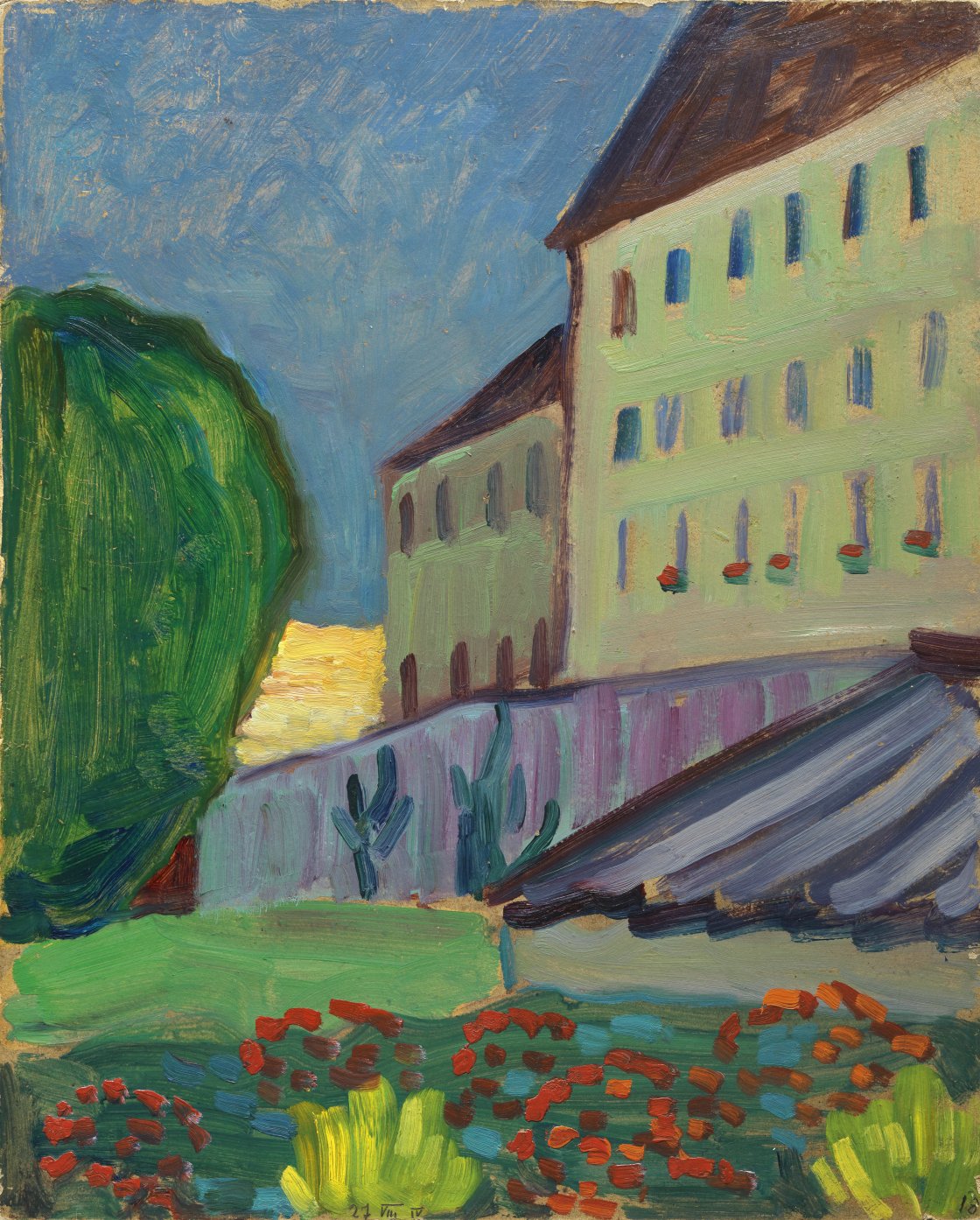
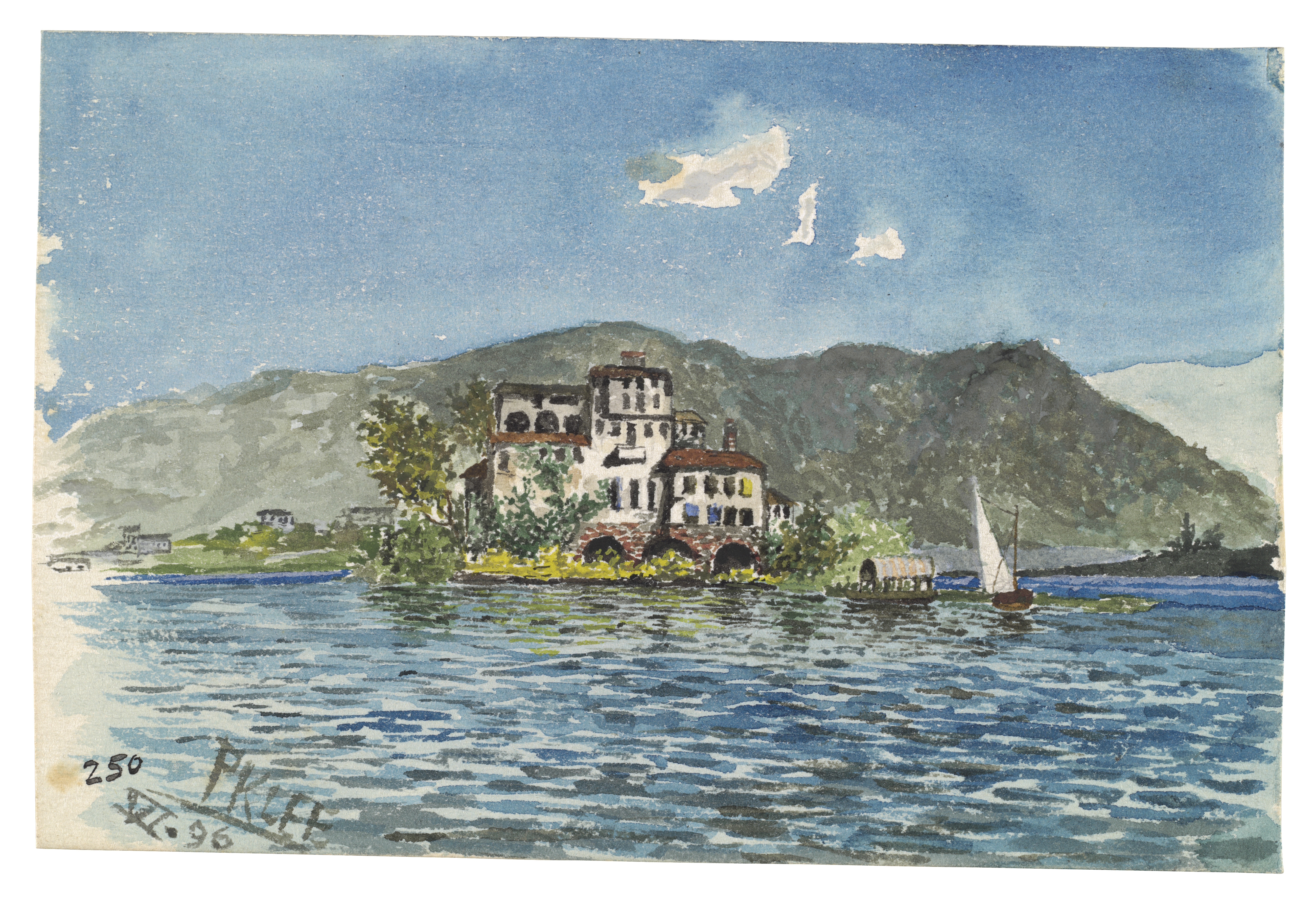
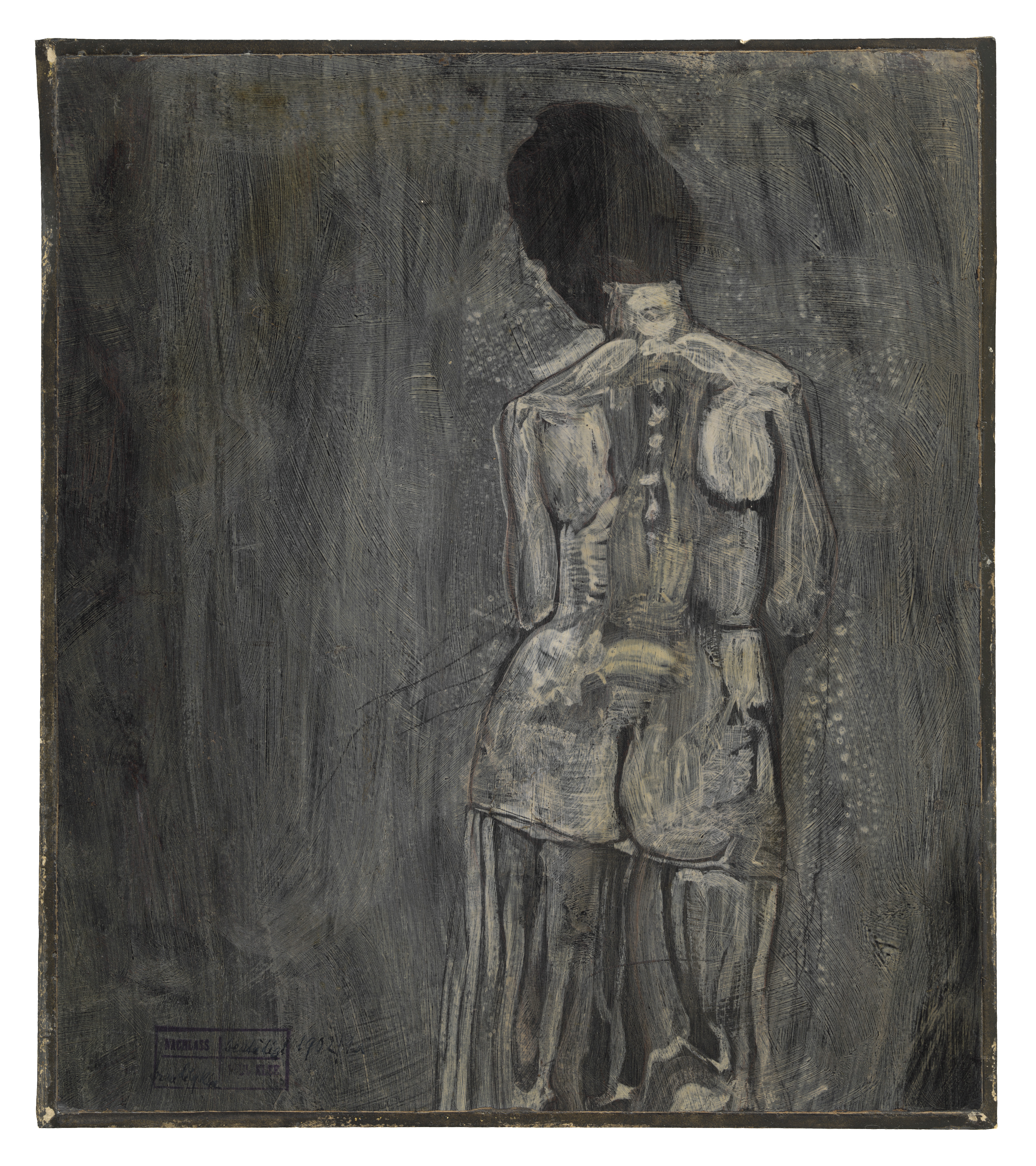
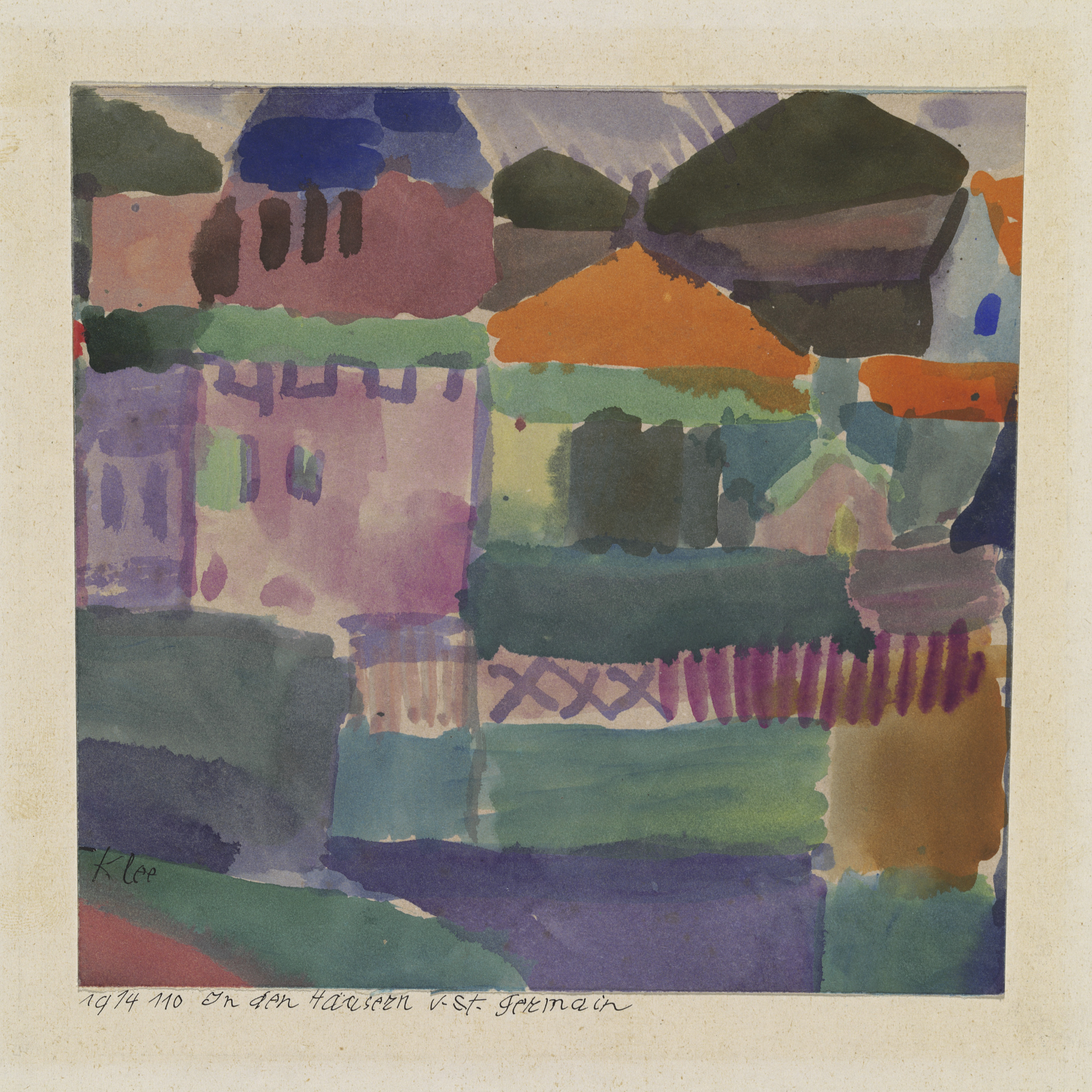
The dynamic permanent exhibition devoted to Paul Klee invites visitors to immerse themselves in the life and work of this important modern artist. With some 80 changing works from the collection, Kosmos Klee offers a chronological survey of Klee’s artistic career. Biographical and archival material provide an insight into his life and time.
Paul Klee
Ohne Titel (Villa am Langensee)
[Untitled (Villa at the Langensee)],
1896
Watercolour on paper
9,9 × 15 cm
Private collection, Switzerland,
deposit at the im Zentrum Paul Klee Bern
Paul Klee
Ohne Titel (Rückenakt) [Nude from
Behind], 1902
Pencil on paper on cardboard
32,5 × 28,5 cm
Private collection, Switzerland,
deposit at the im Zentrum Paul
Klee, Bern
Paul Klee
In den Häusern v. St. Germain [In
the Houses of St. Germain], 1914,
110
Watercolour on paper on cardboard
15,5 × 15,9/16,3 cm
Zentrum Paul Klee, Bern, donation
of Livia Klee
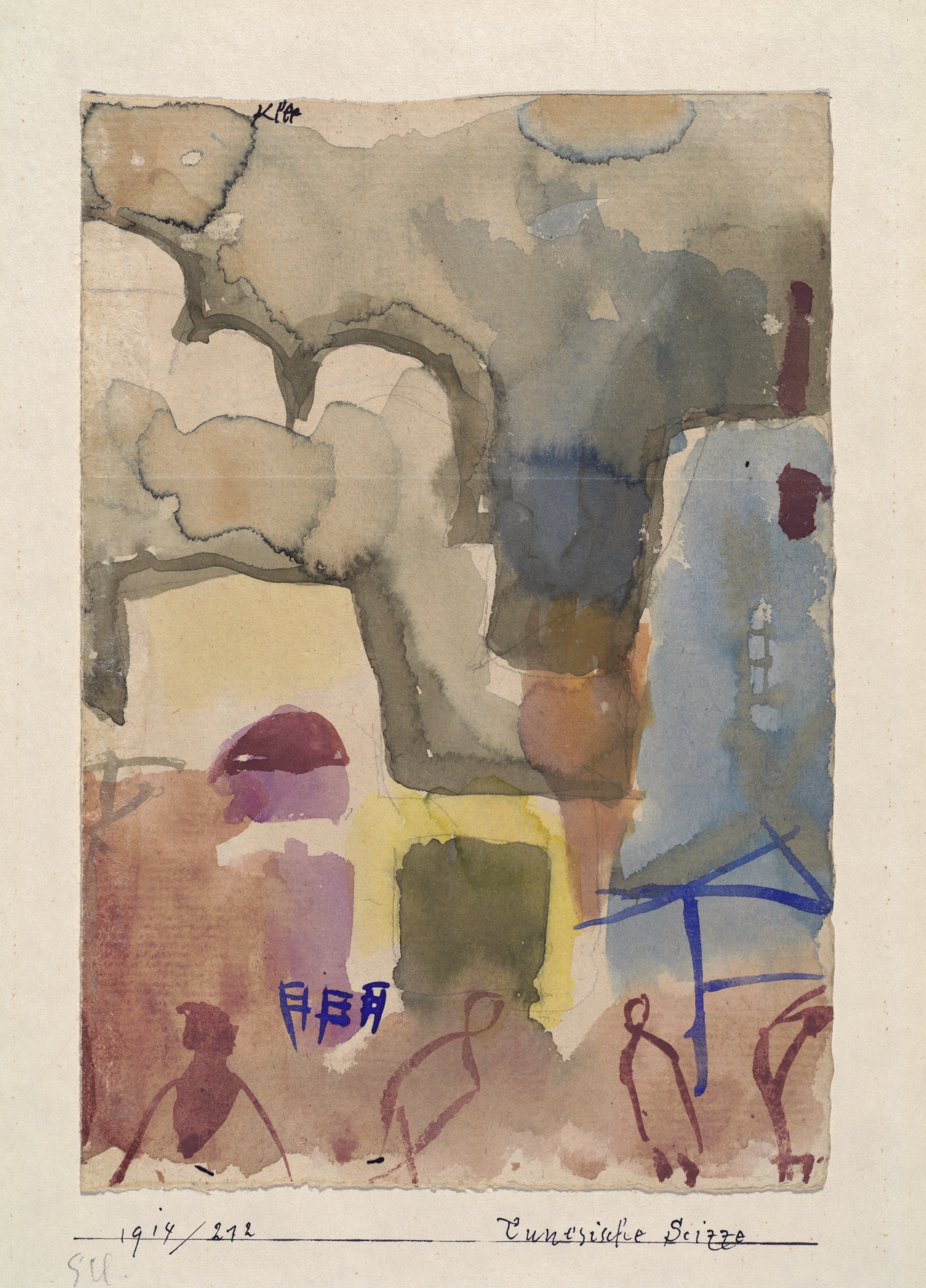
Paul Klee
Tunesische Scizze [Tunisian
Sketch], 1914, 212
Watercolour and pencil on paper on
cardboard
17,9 × 12,2 cm
Zentrum Paul Klee, Bern, donation
of Livia Klee
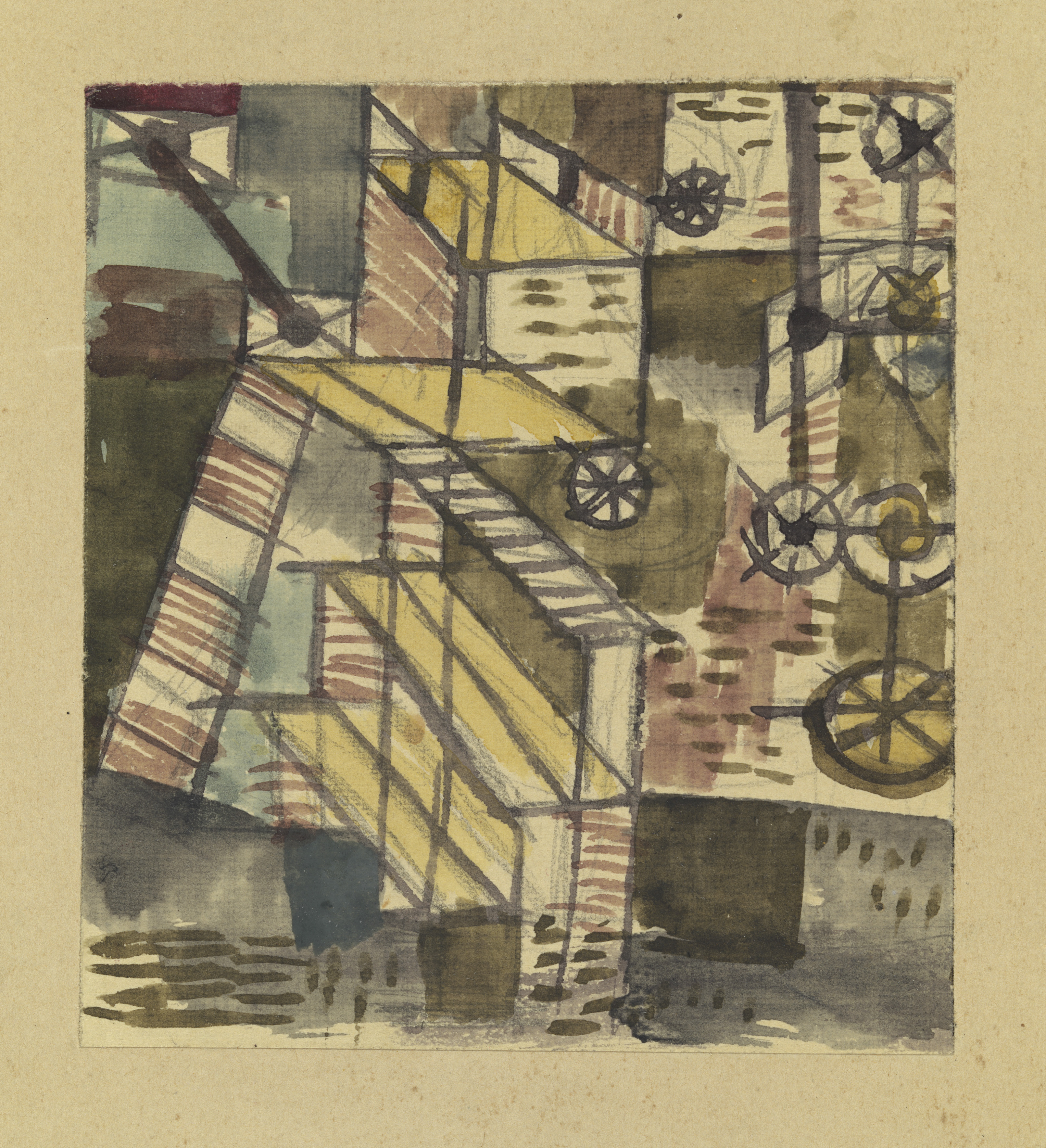
Paul Klee
Ohne Titel (Fabrikanlage) [Untitled
(Factory Plant)], 1922
Watercolour and pencil on paper on
cardboard
10 × 8,9 cm
Zentrum Paul Klee, Bern, donation
of Livia Klee
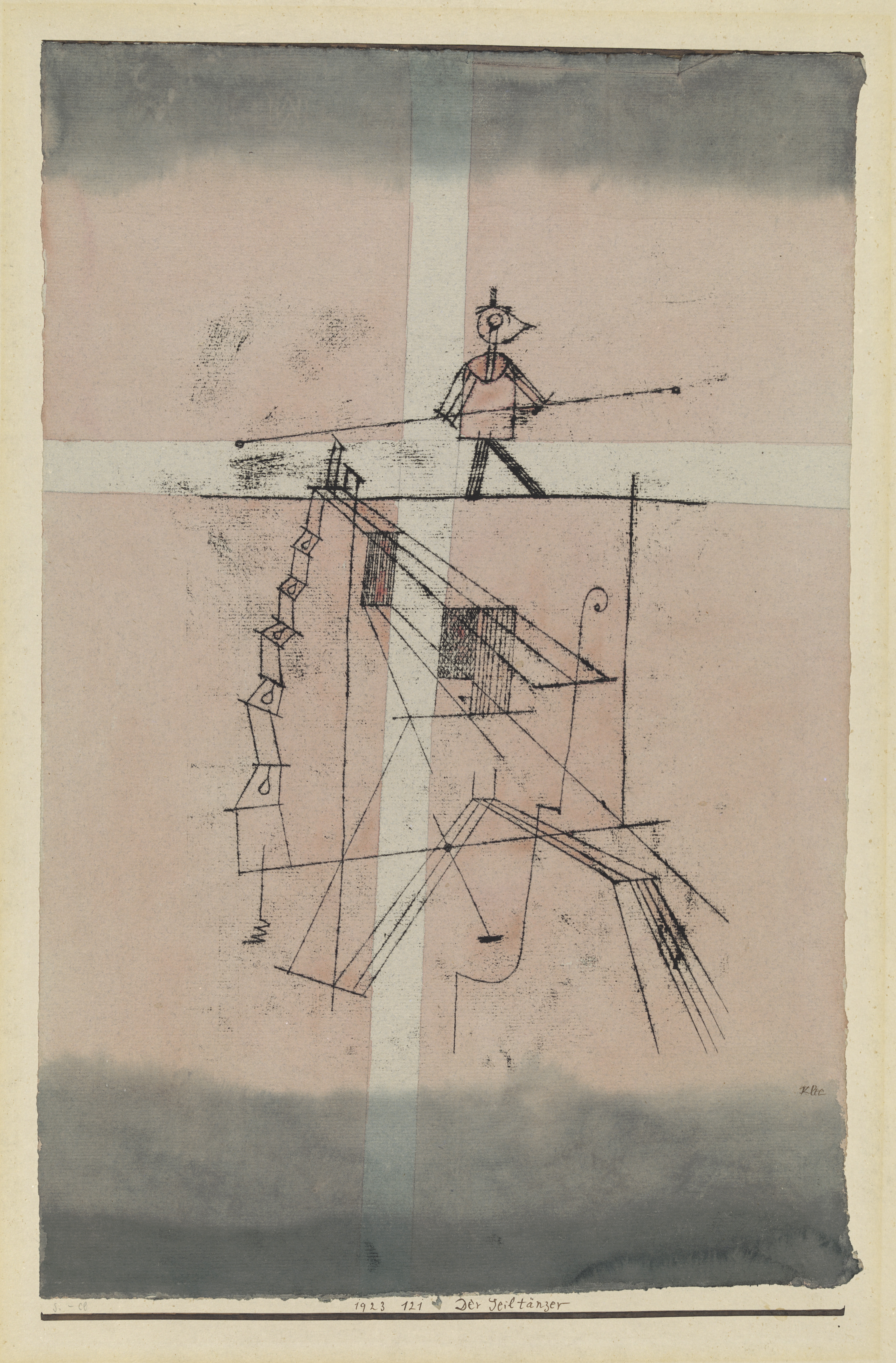
Paul Klee
Seiltänzer [Tightrope Walker],
1923, 138
Lithograph
43,2 × 26,8 cm
Zentrum Paul Klee, Bern
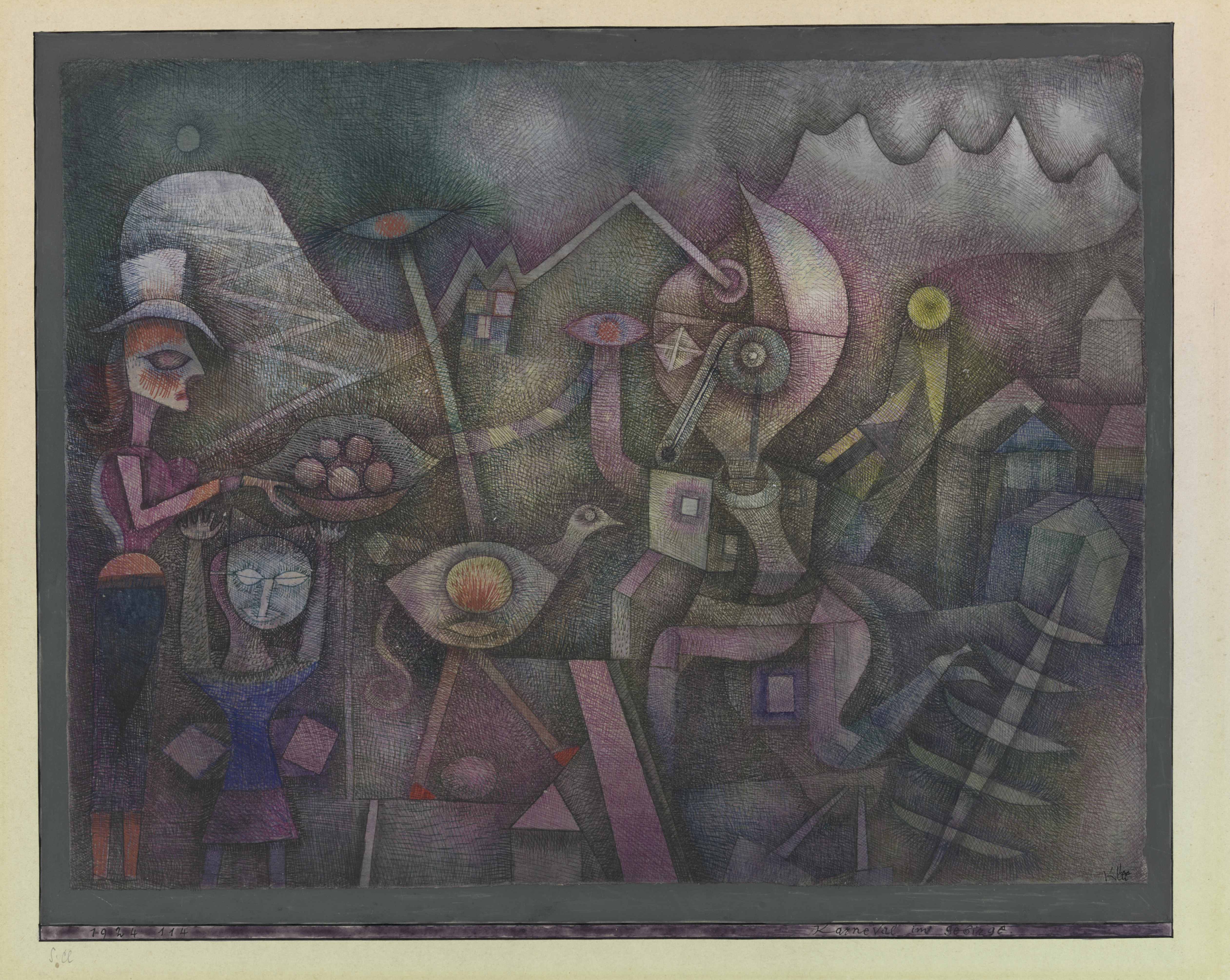
Paul Klee
Karneval im Gebirge [Carnival in the
Mountains], 1924, 114
Watercolour on primed paper on
cardboard
24 × 31,3 cm
Zentrum Paul Klee, Bern
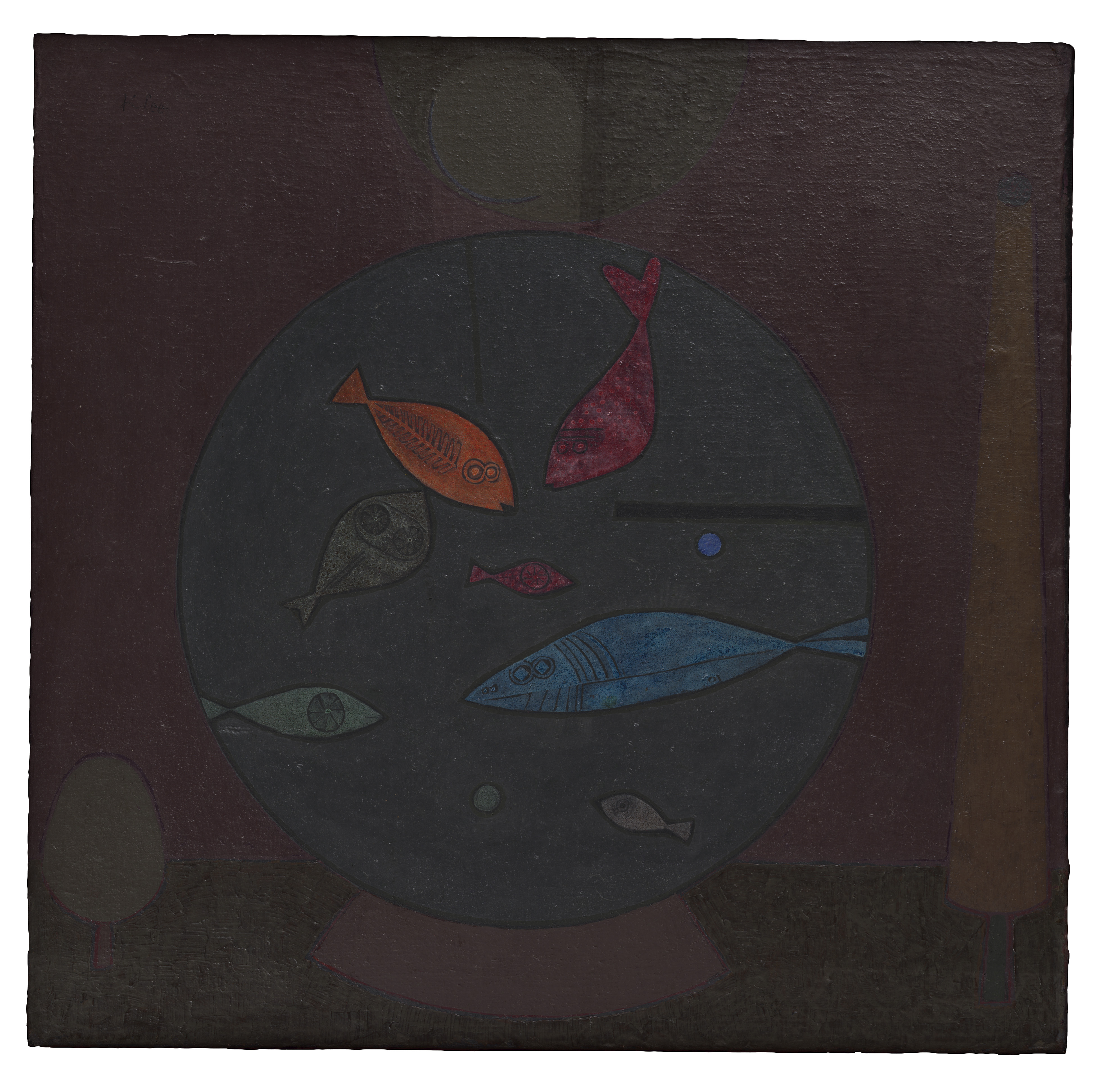
Paul Klee
Fische im Kreis [Fishes in a Circle],
1926, 140
Oil and tempera on primed muslin
on cardboard
42 × 43 cm
Zentrum Paul Klee, Bern, donation
of Livia Klee
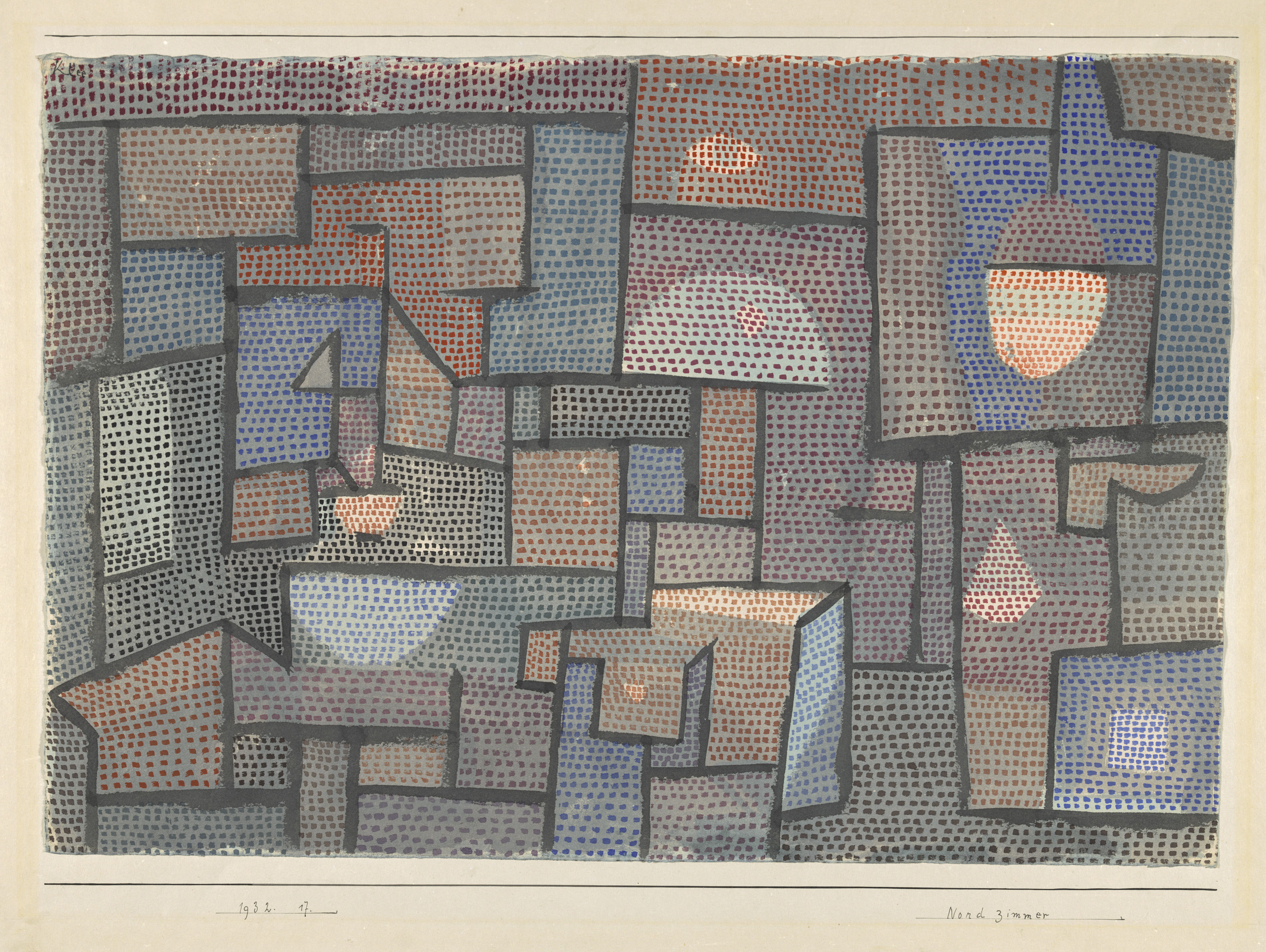
Paul Klee
Nordzimmer [North Room], 1932,
17
Watercolour on paper on cardboard
37 × 55 cm
Zentrum Paul Klee, Bern
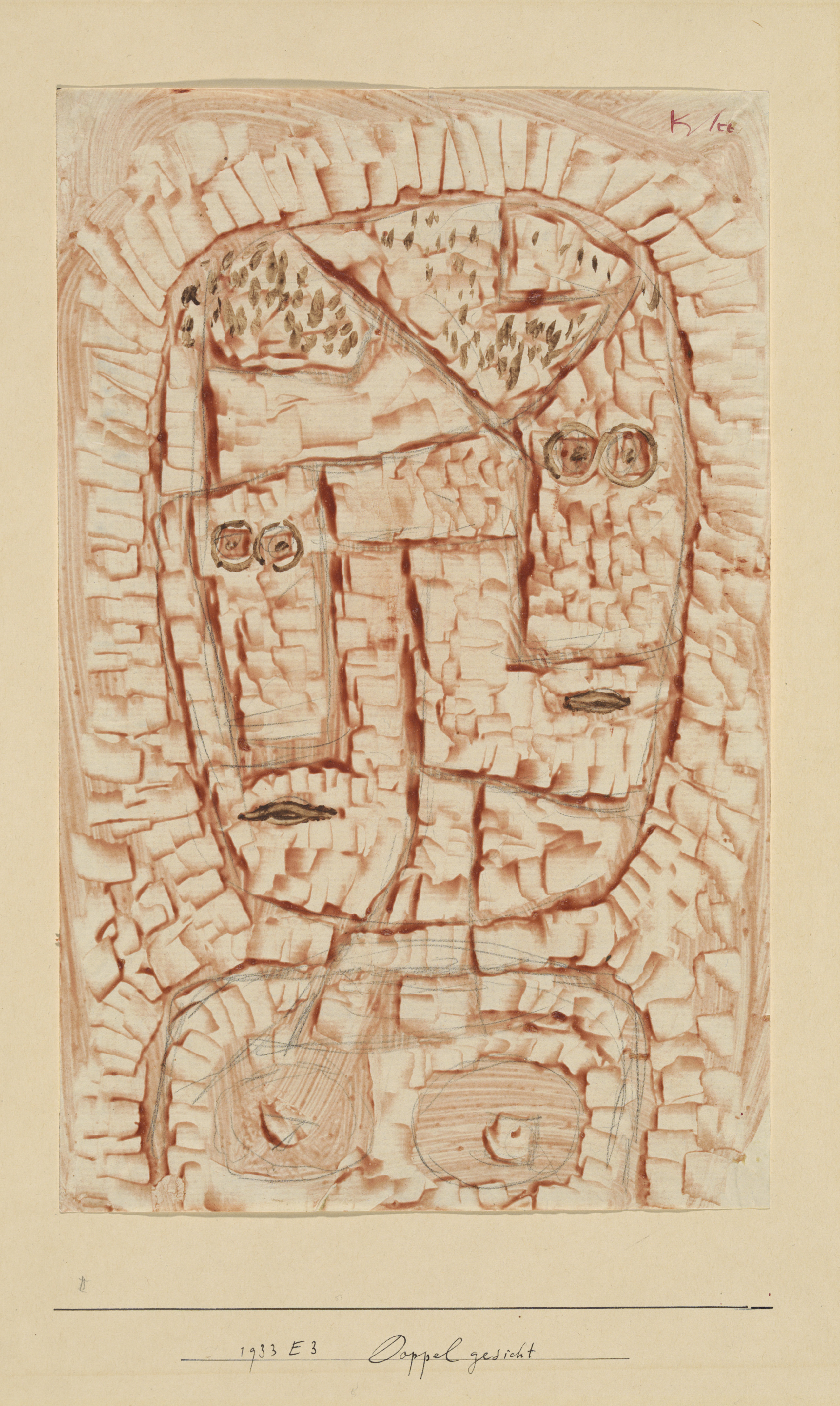
Paul Klee
Doppel gesicht [Double face], 1933,
383
Coloured paste and pencil on paper
on cardboard
33 × 21 cm
Zentrum Paul Klee, Bern, donation
of Livia Klee
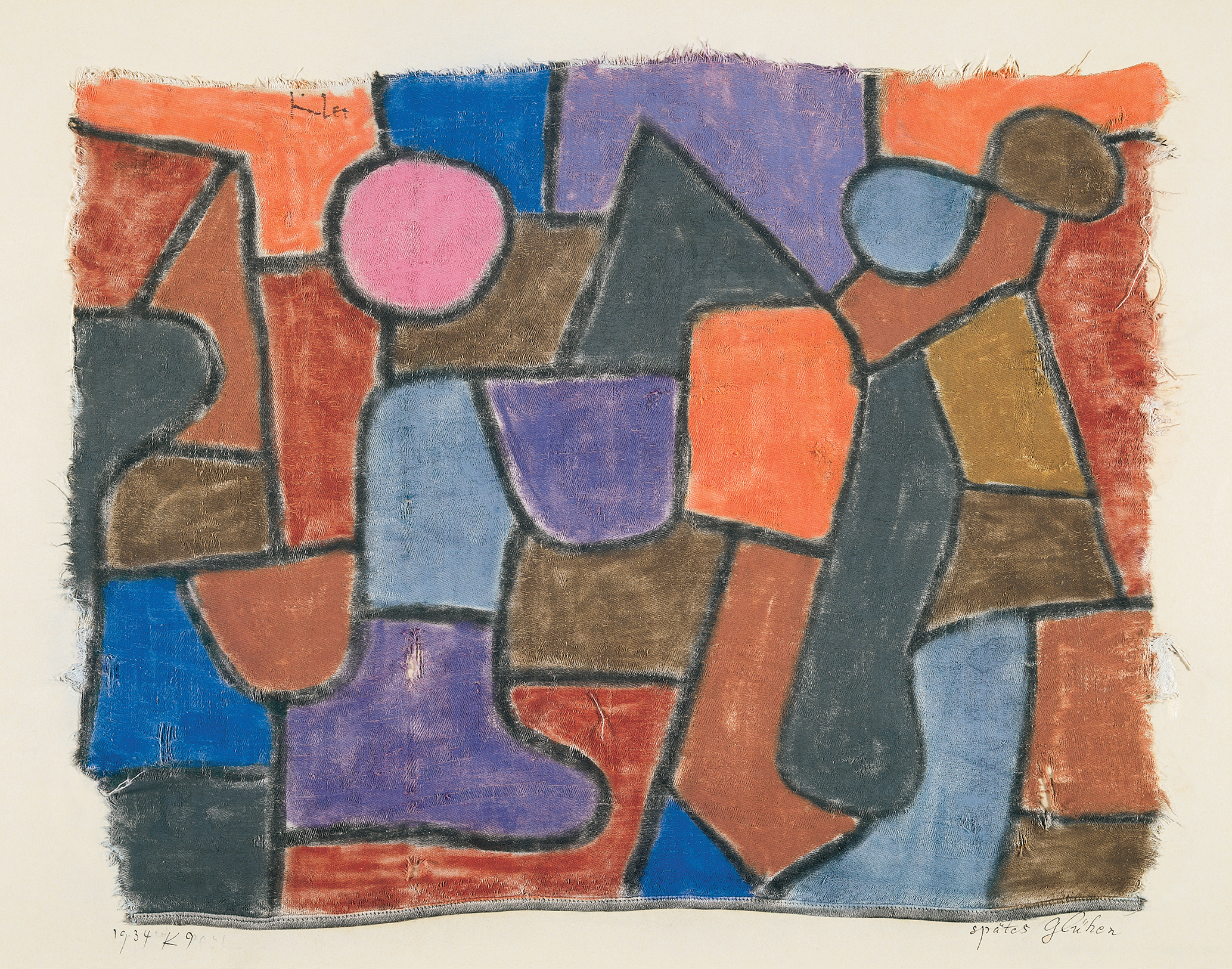
Paul Klee
spätes Glühen [Late Glowing], 1934,
29
Pastel on damask on cardboard
26,8 x 32,5/34,3 cm
"The human soul is international." (Bulletin international du surréalisme [Mezinárodní Buletin Surrealismu], Prague, April 1935)
Surrealism was a political movement of international reach and internationalist conviction. While it had its origins in art and literature, it far exceeded both. Surrealists declared reality to be insufficient. Their ambition was to radically alter society and reimagine life.
As early as the dawn of the movement in the 1920s, surrealists denounced the European colonialist project. They organized against fascists, fought in the Spanish Civil War, called on Wehrmacht soldiers to commit sabotage; were detained in camps and persecuted, escaped Europe, and died in war. They wrote poems, worked on paintings and collective drawings, took photographs, assembled collages, and organized exhibitions—all of which were aimed at disarticulating a supposedly rational language in a supposedly rational world. They refused to grant the "pathetic" imaginary world of daily politics access into their art.
The government and occupation by fascist parties in Europe and throughout the world, as well as the World Wars and colonial wars, shaped Surrealism at the time of its emergence, and forced the lives of its protagonists into unpredictable trajectories. At the same time, these upheavals resulted in remarkable encounters and actions of international solidarity, whose red lines connecting links ran from Prague to Coyoacán in Mexico City, from Cairo to republican Spain, from Marseille to Fort-de-France on Martinique, from Puerto Rico and Paris to Chicago and back. Surrealist thinking and action, then as today, happened in various places simultaneously. Thus, instead of presenting a didactic, linear narrative, the exhibition is organized into several episodes, arranged like a map. The goal is to make Surrealism visible as the contentious, connected, and politicized movement its protagonists understood it to be.
Within their artistic work, the surrealists insisted on an absolute freedom that was to infect the rest of society. The surrealists' understanding stood at odds with Fascist freedom: the freedom to command and obey. For the surrealists, emancipation meant a way of life whose rhythm was not that of wage labor and whose goals were larger than the glorious Nation and bottomless Profit. They bemoaned the stunted imagination of a society for which art and poetry had become eccentric activities. "If anyone comes to tell us that our present has other things on its mind than writing poetry, we’ll reply: 'So do we!'," wrote a member of La Main à plume, a group that fought in the Resistance in occupied Paris and secretly published volumes of poetry.
Not least because of this constitutive but open relationship between art and politics, later movements repeatedly invoked Surrealism: for example, as a method that can often be linked quite naturally to emancipatory goals, it was taken up during the 1968 protests and by representatives of the Black Liberation Movement. The exhibition at Lenbachhaus is conceived as a bundling of attempts to revise a still narrowly defined and politically trivialized Surrealist canon. Our goal is to arrive, together with our public, at new answers to the question, "What is Surrealism?"
With works and texts by: Manuel Álvarez Bravo, Art & Liberté, Die Badewanne, Enrico Baj, Georges Bataille, Hans Bellmer, Erwin Blumenfeld, Victor Brauner, André Breton, Claude Cahun und Marcel Moore, Leonora Carrington, Aimé Césaire, Suzanne Césaire, Chicago Surrealists, Laura Corsiglia, Jayne Cortez, Roberto Crippa, Robert Desnos, Óscar Domínguez, Gianni Dova, Paul Éluard, Max Ernst, Erró, Esteban Francés, Eugenio Granell, Groupe Octobre, John Heartfield, Jindřich Heisler, Jacques Hérold (geb. Herold Blumer), Kati Horna, Pierre Jahan, Ted Joans, Germaine Krull, Erich Kahn, Marion Kalter, Wifredo Lam, Heinz Lohmar, Jean-Jacques Lebel, Dyno Lowenstein, Dora Maar, René Magritte, La Main à plume, André Masson, Roberto Matta, China Miéville, Lee Miller, Joan Miró, Amy Nimr, Wolfgang Paalen, Ronald Penrose, Pablo Picasso, Antonio Recalcati, Ré Soupault, Jindřich Štyrský, Yves Tanguy, Karel Teige, Toyen, Raoul Ubac, Remedios Varo, Wols
Jindřich Heisler, Untitled. From the series "De la même farine" (From the same flour), 1944, Private collection, Paris
Dyno Lowenstein, Group portrait of European refugees saved by the Emergency Rescue Committee on board the Paul-Lemerle, a converted cargo ship sailing from Marseilles to Martinique, 1941. Photo: United States Holocaust Memorial Museum, courtesy of Dyno Lowenstein
Claude Cahun (Lucie Schwob) + Marcel Moore (Suzanne Malherbe), Untitled (Interior of a prison cell drawn on cigarette packet), 1944/1945, Jersey Heritage
Clé: Bulletin mensuel de la F.I.A.R.I. (Fédération international de l’art révolutionnaire indépendant), January 1, 1939
Paris: Révolution surréaliste? The first Surrealist group formed around the poet André Breton in Paris in the 1920s. The Surrealists wanted to fundamentally change life and society. This desire arose not least from the traumatic experience of the First World War, which several founding members spent at the front. The utter lack of meaning and the brutality of the war made them question the logic of bourgeois society and its ideals. They drew on a combination of Marxism and Sigmund Freud's theory of the unconscious to formulate their accusation of capitalist society. They revered chance, spontaneity, and dreams, as well as any method that helped to undermine the alleged rationality of modern thought. To this end, they developed work techniques such as automatic writing (écriture automatique) or cadavres exquis (a joint drawing in which several people participate without knowing what the others are doing). The beginnings of surrealist strategies were literary, but they were soon adopted in the visual arts, photography, film and theater. From the outset, the group was notable for its political activities. Numerous pamphlets, articles and manifestos provide impressive proof of this. Certain events shaped the political self-understanding of Surrealism in particular: these included the Rif War between the Spanish and French colonial powers in Morocco (1925–1926) and the Exposition Coloniale in Paris (1931), which the Surrealists and the Communist Party boycotted. They also organized a counter-exhibition. The Groupe Octobre, led by Jacques Prévert, saw itself as proletarian and anti-fascist theater troupe and formed the wing of early Surrealism that was more inclined to realpolitik. The threat of fascism looming in many places in Europe was also evident in the immediate Parisian surroundings: in 1930, a Surrealist group exhibition took place in the same cinema that showed Luis Buñuel’s film L’Âge d’or (an excerpt is projected here). Fascists vandalized it, damaging works by Yves Tanguy, Salvador Dalí, Max Ernst and Joan Miró. The capital of colonial France, Paris, was also a meeting place for people from all over the world. Surrealism as well is international, and even in its early days was not exclusive to the Breton circle in Paris: in their surrealist and Marxist journal Légitime défense, the editors, a group of students from Martinique, raised the “question of the Antilles;” the Bulletin international du surréalisme appeared in four bilingual issues in Prague, Santa Cruz de Tenerife, Brussels and London. A group of surrealist “dissidents” formed around the philosopher Georges Bataille. The political discussions of the Surrealists are reflected in numerous other magazines, from La Révolution surréaliste to Surréalisme au service de la révolution (Surrealism in the Service of the Revolution), and there were also collaborations with communist party organs, including the Association des Écrivains et Artistes Révolutionnaires, or A.E.A.R (Association of Revolutionary Writers and Artists).
Prague: “A specter is haunting Europe ... the specter of fascism,” proclaimed the founding manifesto of the Czechoslovak Surrealist Group, Skupina surrealistů v ČSR, in 1934, penned by Vítězslav Nezval. The phrasing was an adaptation of the first sentence of the Communist Manifesto of 1848—a central text for the group: While its authors Friedrich Engels and Karl Marx used the “specter of communism” to mockingly allude to the conservative rumors surrounding the emerging communist movement, the specter of fascism in 1930s Europe was all too real. With the National Socialist’s rise to power, Prague had become a center of the anti-fascist avant-garde where exiles such as John Heartfield were active. The Munich Agreement of September 1938 between Nazi Germany, the United Kingdom, Italy and France stipulated that Czechoslovakia cede the Sudetenland to the “German Reich.” On October 1, 1938, the Wehrmacht invaded the Sudetenland, followed by the invasion of the rest of the Czechoslovakia when Hitler deliberately disregarded the agreement: on March 15, 1939, the Germans took Prague. Even before this point in time, the Prague Surrealists had closely linked the development of new artistic forms with the battle against capitalism and fascism: While their artistic work largely denied access to the intrusive clamor or current political events, the group members organized themselves in communist and anarchist movements, published anti-fascist anthologies, and discussed the relationship between artistic work and Marxism. The Surrealist group emerged from the Devětsil movement, which was founded in 1920 and included not only authors and artists but also actors, designers, architects, and photographers. Devětsil sought to engage with popular culture and to establish closer ties between art and literature and the proletarian class, characteristics that also prevailed in the Surrealist group. The Prague Surrealists were initially suspicious of Parisian Surrealism. It was only with Breton’s Marxist turn with the Second Manifesto of Surrealism in 1929 that closer ties developed with Paris. During the 1930s, the Skupina surrealistů established a broad sphere of influence through exhibitions and publications. In addition to Toyen, its members included the painter Jindřich Štyrský, Vítězslav Nezval, the psychoanalyst Bohuslav Brouk, the group’s chief theorist Karel Teige, and other members from the fields of theater, film, and linguistics. Toyen and Jindřich Štyrský’s work in painting was essential to the development of the group’s identity: Beginning in the mid-1920s they elaborated a dialectical form of painting in which contradiction such as foreground and background, proximity and distance, volume and hollowness were mediated. In 1938, the photographer and poet Jindřich Heisler joined the Prague group. As a Jew, he was particularly threatened by the German occupation. He created his surreal photographic works during the four years he spent in hiding in Toyen’s apartment.
The Spanish Civil War (1936–39) received extensive media coverage worldwide and inspired great international solidarity. Spain had been a republic since 1931. In 1936, a coup d’état was carried out by monarchist and fascist military forces under the leadership of General Francisco Franco, with the support of Germany, Italy, and Portugal. “The revolution divided Spain into two factions. On the one side were the poorly armed, improvised militias with their socialist ideal. On the other side, Franco was supported by the powerful armies of the modern fascist states” (Eugenio Granell). The POUM (Partido Obrero de Unificación Marxista) played a special role; it was the most important left-wing Marxist party during the civil war. The poets Benjamin Péret, Mary Low and Juan Breá were members of the POUM. Other intellectuals and artists whose works are shown in this exhibition were involved in various ways supporting the Republic: for example, the German art historian Carl Einstein and the artists André Masson and Wifredo Lam. The photographer Kati Horna documented the everyday life of the civilian population and illustrated satirical magazines. In response to the defeat of the Republicans, Max Ernst created his Angel of Hearth and Home. The most famous work is surely Pablo Picasso’s Guernica, which was dedicated to the eponymous Spanish town that had been destroyed by German and Italian air raids in April 1937. The giant painting was first shown in the Spanish Pavilion at the 1937 World’s Expo in Paris. While Germany and the Soviet Union erected ostentatious propaganda buildings, the pavilion of the Spanish Republic stood out for its modern and open appearance. It had been designed by the architects Luis Lacasa and Josep Lluís Sert. A model of his famed building is on view here. In addition to documentary information about the Spanish regions, it contained agitprop and numerous other works of art: Joan Miró designed the mural El Segador (Catalan Peasant in Revolt), Alexander Calder designed the Mercury Fountain and Alberto Sánchez designed the surrealist outdoor sculpture El pueblo español tiene un camino que conduce a una estrella (The Spanish People Have a Way That Leads to a Star). Miró and Picasso designed prints that were sold for the benefit of the Republic. The films Aidez l’Espagne (Help Spain) by Pere Portabella, named after the eponymous print by Miró, and Guernica by Alain Resnais represent two different aesthetic approaches. Both intercut footage from the Spanish Civil War with artworks by Picasso and Miró respectively: While Guernica is accompanied by Paul Éluard’s poetry to dramatic effect, Portabella’s film is more documentary and agitational in style.
“Documents, not dreams. De Sade, not Marx.” This provocative formula was used by the philosopher George Bataille to describe the difference between his ideas and the Surrealism of André Breton. Bataille considered the people in Breton’s circle to be “emmerdeurs idéalistes” (idealistic nuisances). He and his fellow campaigners countered this idealism of lofty ideas with a so-called “lower materialism.” An example of this is Jacques-André Boiffard’s photograph of a toe that is much too close—the opposite of the idealistic head. Breton’s highhandedness, which earned him the sobriquet “Pope” of Surrealism, was the subject of the pamphlet Un Cadavre (A Corpse). It appeared in 1930 and shows Breton wearing a crown of thorns. Documents was the name of the journal published by the group around Bataille and the German art historian Carl Einstein between 1929 and 1931. The ethnologist Michel Leiris described the journal as a “war machine against preconceived opinions and ideas.” The Documents group was essentially composed of two different Parisian circles: the circle around the Bibliothèque nationale, where Bataille worked as a librarian, and a second circle consisting of ethnologists, most of whom were associated with the Musée d’ethnographie du Trocadéro (renamed the Musée de l’homme in 1937). In their texts, they reversed habitual patterns: They posited the objects of European culture as foreign, while rejecting the commonplace exoticization of artifacts from other areas of the world. Carl Einstein, an expert of Cubism, wrote art criticism for Documents, in which he examined what a revolutionary form could be. He saw it realized in the work of Paul Klee, to whom he devoted an entire chapter in his volume on 20th-Century Art (Propyläen Kunstgeschichte, 1931). In Klee’s quasi-magical painting, he saw “new figures drilling into reality” and recognized a “new formation of reality.” Einstein’s break with Surrealism was marked by the text Fabrication of Fictions, a reckoning with “the intellectuals” and the “artists.” As soon as he had finished, Einstein moved to Spain in 1936 to fight on the Republican side. A dispute over direction that led to further breaches in the Surrealist movement concerned the relationship to Stalinism. The Moscow show trials (1936–38) marked the beginning of the Great Terror: High-ranking officials of the Communist Party of the Soviet Union (Bolsheviks) and the entire leadership of the October Revolution were sentenced to death or forced labor for alleged subversive activities. Paul Éluard and Louis Aragon, important intellectuals of the anti-fascist resistance in France, remained loyal to the Soviet line. This led to a break with most of the Surrealists. A few years earlier, during the so-called Aragon Affair, the Surrealists had still defended the poet: Aragon was facing a five-year prison sentence for his poem Front Rouge (Red Front), published in 1931, which was said to have called for the murder of police officers and the refusal of orders by soldiers. Disagreements divided and united a wide range of groups within the Surrealist movement, even across generational lines. The pamphlet Nom de dieu! by the poetry and resistance group La Main à plume railed against Éluard for his close ties to the Communist Party, condemned Bataille’s as well as Ubac’s alleged mysticism. Rumpus in Paris
The National Socialists seized power on January 30, 1933. Hitler became Reich Chancellor, and the NSDAP (National Socialist German Workers’ Party) was the only party permitted in Germany. The art policy of the “Third Reich” radically rejected modernism and presented it as a manifestation of degeneration. Jewish and left-wing artists, some of whom had already emigrated, were defamed and persecuted in particular. The touring exhibition “Degenerate Art” began in Munich in 1937, and was shown simultaneously to the national socialist Great German Art Exhibition in the neighboring “Haus der Deutschen Kunst.” With our exhibition positing an inherently political Surrealism, the question arises as to the possibilities for Surrealism’s existence in Germany. Due to the (art) political situation, most of the Surrealists who were dedicated leftists and anti-fascists had to leave the country. We therefore speak of a surrealist void in Nazi Germany. An open and consistent continuation of surrealist practices possible only in exile, and even there under difficult conditions. Among the artists who lived in France for a time were Max Ernst, Wols, Hans Bellmer, Heinz Lohmar, Wolfgang Paalen, John Heartfield, Erwin Blumenfeld, and Kati Horna. In his texts, the Berlin critic Paul Westheim vehemently protested against the fascist distortion and defamation of modern art. In Paris, he was involved in publishing for the Freier Künstlerbund (Free Artists’ Association) This was the most important organization of émigré visual artists in the 1930s; it saw itself as a non-partisan organization fighting against National Socialist cultural policy worldwide. Many of the emigrated artists were interned as enemy aliens after the German invasion of France in the summer of 1940. The men’s internment camp at Les Milles, near Aix-en-Provence, was a pivotal point in this episode. Max Ernst, Hans Bellmer and Wols, among others, found themselves in the disused brick factory; Lion Feuchtwanger wrote about his time in the camp. During and after their internment, the artists created drawings in which they incorporated the striking brick structure of the camp building. Wols, who was not able to take photographs in the camp, began to draw here for the first time. But Live Here? No Thanks:
Paul Klee, Joan Miró und Pablo Picasso wurden zu Bühnenbildern und mit Tanz zum Leben erweckt, Gedichte von Paul Éluard oder André Breton in Szenen umgesetzt und musikalisch begleitet. Die gemeinsam improvisierten Abende wurden für ihren anarchistischen Charme gefeiert. Aber hier leben? Nein danke: Leerstelle Deutschland Teil 2 The Egyptian surrealist group Art et Liberté was founded in 1938 with the manifesto “Vive l’art dégénéré” (Long Live Degenerate Art) written by George Henein. They appropriated the term “degenerate” as a distinction and thus showed solidarity with internationally persecuted artists and intellectuals. The heterogeneous group, with connections to dozens of Arab, African and European countries, in addition to Henein included Amy Nimr, Lee Miller and Roland Penrose, among others. In 1940–1941, Miller documented “The Blitz,” the German air raids on Great Britain. From 1944 to 1945, she accompanied the U.S. military through northern France and Germany, photographing the Allied invasion and the liberation of Germany. Accredited through American Vogue, she was one of the few female war correspondents allowed to cover the war. The famous photographs by Lee Miller and David E. Scherman in the bathroom of Hitler’s Munich apartment were taken in the night after they had visited the recently liberated Dachau concentration camp. A surrealist cabaret founded in Berlin in 1949 was called “Die Badewanne” (The Bathtub). In the immediate post-war era, the group, with its anti-fascist selfimage, focused on French Surrealism in particular. The participants included poets, painters, dancers, and musicians. All art forms were to be given equal weight: paintings by Paul Klee, Joan Miró and Pablo Picasso were used as stage sets and brought to life with dance, while poems by Paul Éluard or André Breton were staged and accompanied by music. The evenings of collective improvisation were celebrated for their anarchic charm. But Live Here? No Thanks: The German Void—Part 2
Martinique In his travelogue Tristes Tropiques, French anthropologist Claude Lévi-Strauss describes his escape from Europe on a ship that left Marseille for Martinique in the Lesser Antilles in 1941. The Cuban painter Wifredo Lam is known to have fled there as well; after setting sail from Marseille writer Anna Seghers took notes for her novel Transit (1944) focusing on the experience of impossible bureaucracy and imposed exile. It turns out that all three traveled together and in good company: On March 24, 1941, the converted freighter Capitaine Paul-Lemerle left Marseille. Also on board were André Breton and Jacqueline Lamba Breton, the left-wing revolutionary and writer Victor Serge, the photographer Germaine Krull, who captured the crossing in photographs, and hundreds of other people. The rescue ship was provided by the Emergency Rescue Committee (ERC) and its local director, Varian Fry. A photograph by Dyno Lowenstein, a young man from Berlin who was fleeing from the Nazis with his mother, shows the arrival in Martinique (visible in the projection and the documentation on the wall). This journey was preceded by some of the ship’s passengers at the Villa Air Bel, an unheated mansion with a garden in Marseille. Other Surrealists also came and stayed here, such as Max Ernst, who had recently been released from the Les Milles internment camp and exhibited his paintings in the trees in the garden (allegedly because Breton would not let him into the villa). Also among them were Remedios Varo and Óscar Domínguez, who had fled Francoist Spain via Paris, and the Jewish-Romanian painters Jacques Hérold and Victor Brauner. All of them were waiting for the numerous documents they needed to escape: Only once departure had been approved, each country that had to be passed had granted transit, and a visa for the destination country had been obtained, could the departure take place. And even then, people were kept from boarding because of their political orientation or because of prior detainment in a camp. Most countries in the world refused to host refugees. The Evian Conference in July 1938 marked the culmination of a consistent refusal by the international community to respond to the life-threatening reality of people persecuted in Nazi Germany. Accordingly, the process of leaving the country was lengthy and accompanied by fear, if not impossible. While waiting in “Château Espère-Visa” (Visa Hope Castle), as Victor Serge christened the villa, the group entertained itself with collaborative drawings, the so-called cadavres exquis, or “exquisite corpses.” Some of the artists also designed the Jeu de Marseille, a set of 54 playing cards. Victor Brauner and Jacques Hérold were involved in the collaborative drawings. However, as Jews from Romania, they did not receive a visa and went into hiding in France. The episode Transit Marseille → Martinique shows works and documents from this period: drawings, photos, small paintings, and literary texts that originated from this shared experience. The encounter in Martinique with the writers Aimé and Suzanne Césaire, who published the surrealist magazine Tropiques, is the subject of the eponymous episode in the exhibition.
Tropiques The magazine Tropiques (1941–45), founded in Martinique, is an outstanding document of anti-colonial and anti-fascist cooperation. Important thinkers of “Négritude” (the literary-philosophical movement that advocates black self-assertion in Africa and the diaspora) collaborated on it. They developed an autonomous surrealist approach that engaged in critical dialogue with the former “center” of the movement, Paris, in poetic and essayistic texts. They celebrated surrealist strategies as an international language that could be applied in many contexts. In Martinique, Surrealism became the weapon of choice against the authoritarian Vichy government, whose policies were rigorously implemented by the High commissioner Georges Robert. Suzanne Césaire (née Roussi) wrote only seven texts during her lifetime, but they conveyed the magazine’s program in impressive language (“1943: Le Surréalisme et nous”). The magazine saw itself as the organ of an international movement emanating from the Antilles. Not least, Surrealism was supposed to overcome reactionary thought patterns and enable new connections worldwide. In this capacity, Tropiques was a sequel of the magazine Légitime défense, which had been founded in 1932, and referred to Marxism and Surrealism from a Martinican perspective. Tropiques’ disguise as an unassuming literary magazine did not last long, leading to direct confrontations with the censorship authorities (“Réponse de Tropiques”). All refugees from France were held in an internment camp for four weeks. Many of them later entered into contact with the editorial team of Tropiques. Apart from Suzanne Césaire and Aime Césaire, the team included René Ménil, Lucie Thesée, Aristide Maugée, Georges Gratiant and Etienne Léro. A few weeks later, André Masson arrived in Martinique as well. He began on a series of mythological paintings with titles such as Antilles or Pythie (Pythia – the Oracle of Delphi). For Lam, the exchange with the Césaires was a further step towards the conception of a specific “tropical,” syncretic Afro-Caribbean painting, that fused a wide range of visual idioms into a unique formal language. Like the editorial team of Tropiques he posited a philosophy of contacts. This favored a mutual permeation and transformation of cultures over a myth of cultural clarity, or worse, such notions as “purity.” A work that speaks to the long-lasting friendship of Lam and Aimé Césaire is Annonciation, a series of prints. Césaire responded to these images by way of poems. By then Aimé Césaire had already published his key work Discours sur le colonialism (Discourse on Colonialism, 1950). He is one of the most influential thinkers of anticolonialism.
France was occupied by the Wehrmacht between 1940 and 1944 and initially divided into two zones: a zone occupée (northern zone) under German control and a zone libre (free zone) in the south of France that collaborated with the Germans under Marshal Philippe Pétain (Vichy France). From 1942, the south of France was also administered by the Nazis; it is referred to as the zone sud (southern zone). In this historical situation, a new surrealist group, La Main à plume, was formed. Unlike many Surrealists of the older generation, they stayed in France and joined the armed struggle of the Resistance. The founding members had been politically socialized in leftwing circles and the majority of them were influenced by Trotskyism (the internationalist current of MarxismLeninism shaped by Leon Trotsky, which opposed Stalinism). They wanted to combine these Trotskyist attitudes with a renewed Surrealism. The group was heterogeneous, with a high number of refugees (for example from Spain and Romania), some of them Jewish, and most of them only in their 20s. Their approach forced them to live underground: they hid each other in private apartments in Paris and in the south, forged papers and earned money by copying paintings. The group named itself after an Arthur Rimbaud verse that questions the social division of labor between writing and manual labor (La Main à plume stood for “the leading” or “writing hand”). The members wrote poems that were not shaped by political circumstances and experimented with various artistic approaches to renew surrealist painting. To escape censorship, their publications appeared under different names. They often compiled collectively written poems, philosophical articles, and polemical discussions with the church, the Vichy government, and the French Communist Party (PCF). Despite its demand for the autonomy of poetry, La Main à plume saw its work as resistance. Its publications circulated in political networks and were intended to function like leaflets, distributing surrealist poetry instead of propaganda. The members secretly left politically more explicit writings in church pews, in telephone books or between toilet paper rolls, similar to Claude Cahun and Marcel Moore’s “Paper Bullets.” The majority of the members were active in political networks and various resistance organizations. Acts of sabotage, wiretapping, organizing escape routes, and founding an armed resistance unit near Fontainebleau came at a high price: many lost their lives in the antifascist struggle, while others were deported and murdered in concentration and extermination camps. The partners Claude Cahun and Marcel Moore (birth names Lucy Schwob and Suzanne Malherbe) hosted an artistic salon in Paris in the 1920s and 1930s and were part of the Surrealist circle. Claude Cahun was a writer who also took photographs and appeared in plays. Instead of identifying as male or female, they used neutral pronouns and played a wide range of roles in their self-portraits. Marcel Moore worked as an artist and graphic designer, including for the fashion industry. She assisted Cahun with the photography; together they created the photomontages for the 240-page book Aveux non avenus (Unavowed Confessions), which was published in 1930 after 10 years of work. It subverted the conventions of traditional autobiography using surrealist methods and contained kaleidoscopic illustrations, aphorisms and poetic texts. In 1932, they both joined the Association des Écrivains et Artistes Révolutionnaires (A.E.A.R), founded on the Soviet model; in 1935, Cahun co-founded ContreAttaque, a group of anti-Stalinist communists, surrealists, and political allies outside the orbit of the French Communist Party (PCF). As a surrealist artist, Jew, communist and openly living in a lesbian relationship, Cahun was a literal provocation to the reactionary and fascist view of humanity. In their anti-fascist texts, Cahun pleaded for the freedom of poetry and art and for artistic resistance against all forms of oppression. It is therefore fitting that in 1939 Cahun became a member of the short-lived International Federation of Independent Revolutionary Art (F.I.A.R.I.), which André Breton had founded with Leon Trotsky. From 1937, Claude Cahun and Marcel Moore lived on the small Channel Island of Jersey. When the German army occupied the Channel Islands, the two of them secretly distributed anti-fascist propaganda: messages written in German and signed as “soldier(s) without name.” These were intended to demoralize German soldiers. Cahun and Moore were interned for their political activities and sentenced to death. The end of the war and the liberation of the Channel Islands prevented the execution of the sentence. A self-portrait of Cahun from this period refers to the triumph over National Socialism: Cahun bites on a medal of the imperial eagle with a swastika.
Exile After the German occupation of France in the summer of 1940, it became increasingly difficult to obtain exit visas. Between 1940 and 1942, the Mexican consul general in Marseille, Gilberto Bosques, issued visas for his home country to around 40,000 people in Marseille (see also the episode Transit: Marseille → Martinique). Mexico City thus became an important center for exiled artists, revolutionaries, and writers. Among them were the authors Anna Seghers, Victor Serge, and Paul Westheim, the artists Leonora Carrington, Remedios Varo, and Wolfgang Paalen, and the photographer Kati Horna. They lived and worked in Mexico in the following years; many stayed well beyond the Second World War and often until the end of their lives. Exile led to many places. For André Breton, Jacqueline Lamba and André Masson, the route went from Martinique to New York; the Cuban Wifredo Lam, who lived in France, fled back to Cuba via Martinique and settled in Europe again after the Second World War. The life of the musician and painter Eugenio Granell was an odyssey: a Spaniard and Republican fighter in the Civil War, he went to Paris after the defeat, then via Marseille to Santo Domingo, Guatemala, and Puerto Rico, finally to New York, before returning to Spain in 1985. Manuel Álvarez Bravo’s photographs are among the earliest works of the episode. His everyday shots often have surreal echoes, showing workers, political events and the art scene. In 1938, he documented a meeting of Leon Trotsky, André Breton, and Diego Rivera: Mexico was a destination for revolutionaries. In 1938, the socialist president Lázaro Cárdenas had nationalized the country’s powerful petroleum industry and implemented a land reform that provided land expropriated from large landowners to cooperative collectives. Breton and his wife Jacqueline Lamba had traveled to Mexico City at the invitation of Trotsky, who was seeking protection from the Stalinist secret police. They stayed in the hospitable home of Frida Kahlo and Diego Rivera in the Coyoacán district, the Casa Azul. Trotsky and Breton co-authored a manifesto that led to the founding of the F.I.A.R.I. (International Federation of Independent Revolutionary Art). The aim was to “unite the revolutionary supporters of art to serve the revolution through the means of art and to defend the freedom of art itself against the usurpers of the revolution.” Since it was a manifesto that posed the question of art, Trotsky had the painter Rivera sign it in his place. Many Surrealists also joined the F.I.A.R.I. association.
París, Musée d’Art Moderne, 4 April to 24 August 2025
Curators: Marta Ruiz del Árbol, Isabelle Jansen and Mattias Mühling
Gabriele Münter (1877-1962) was one of the founders of The Blue Rider (Der Blaue Reiter), the legendary group of Expressionist artists based in Munich which emerged in late 1911, to which Wassily Kandinsky and Franz Marc, among others, also belonged. Münter is well known as an artist in Germany but it is only in recent years that she has started to enjoy greater recognition in the rest of Europe. The Museo Nacional Thyssen-Bornemisza, which has four of her paintings in its collections, is now organising the first retrospective on the artist in Spain, thus continuing its project of researching and highlighting the work of so many great women artists and the place they deserve in the history of art.
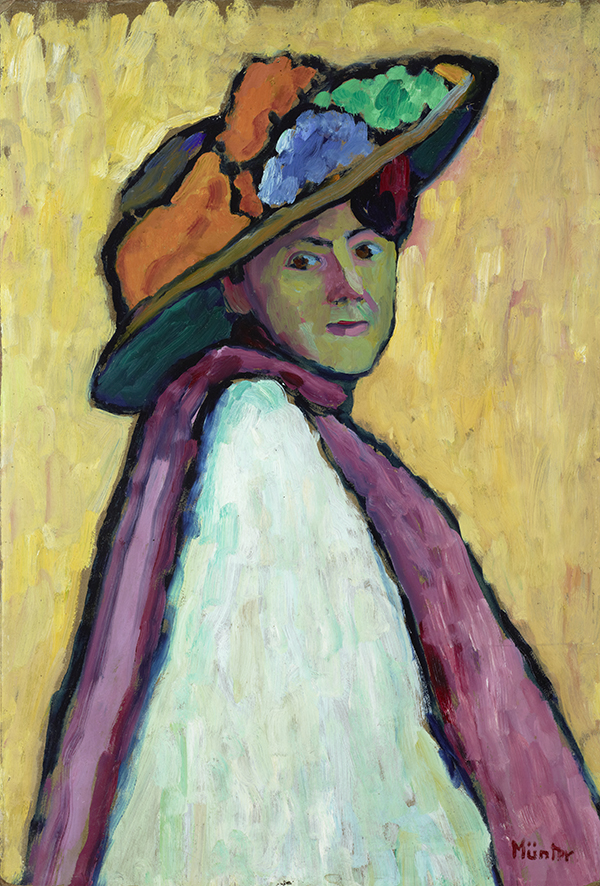
Gabriele Münter. Portrait of Marianne von Werefkin, 1909. Städtische Galerie im Lenbachhaus und Kunstbau München, donated by Gabriele Münter, 1957
Through 145 paintings, drawings, prints and photographs the exhibition aims to present not only Gabriele Münter’s artistic activities and the rich complexity of her work, but also an artist who rebelled against the limitations imposed on women of her day and who became one of the outstanding figures of German Expressionism at the start of the 20th century. Throughout her extensive career, on numerous occasions Münter demonstrated an ability to adapt, a tireless desire for experimentation and an openness to what was new or different. In her paintings, with their precise lines and intense colours, she immerses the viewer in her private world and through her highly perceptive gaze presents lovers, everyday objects, landscapes and herself, all refined to their essence.
The exhibition is the result of a collaborative project between the Museo Nacional Thyssen-Bornemisza, the Gabriele Münter and Johannes Eichner Foundation and the Städtische Galerie am Lenbachhaus und Kunstbau in Munich. It benefits from the support of the Comunidad de Madrid and the Art Foundation Mentor Lucerne. After its showing in Madrid the exhibition will be seen at the Musée d'Art Moderne in Paris.
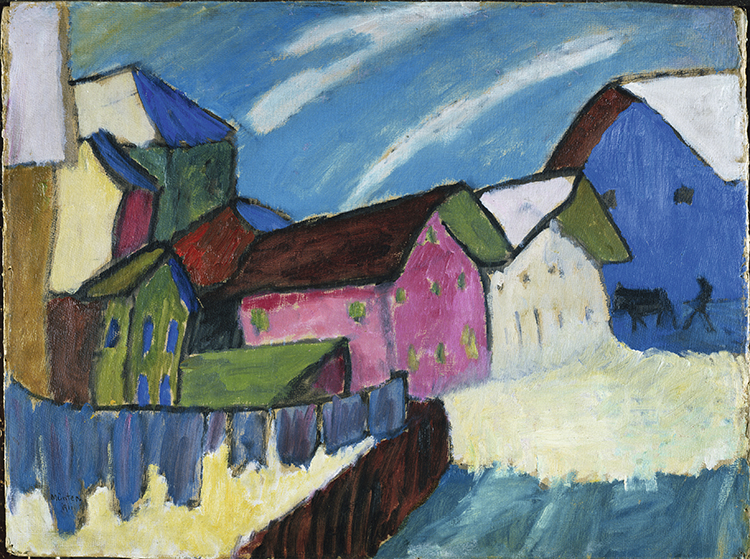
Gabriele Münter. Village Street in Winter, 1911. Städtische Galerie im Lenbachhaus und Kunstbau München, donated by Gabriele Münter, 1957
The exhibition opens with a section in which the artist presents herself to the public through a series of self-portraits and photographs, then continues along a thematic-chronological route which covers Münter’s entire, lengthy career. An extensive initial chapter is devoted to her beginnings as an amateur photographer, analysing how her relationship with this modern mode of expression, less codified than traditional fine arts, was fundamental for her later development. Her activity as a painter is then presented through a journey that starts with the works created on her travels around Europe and North Africa with her partner Wassily Kandinsky, and continues in a large space dedicated to her masterpieces from the Blue Rider period. Finally, the exhibition focuses on Münter’s exile in Scandinavia during World War I and the different paths of expression she encountered following her return to Germany in the 1920s.
1. Reflections and shadows
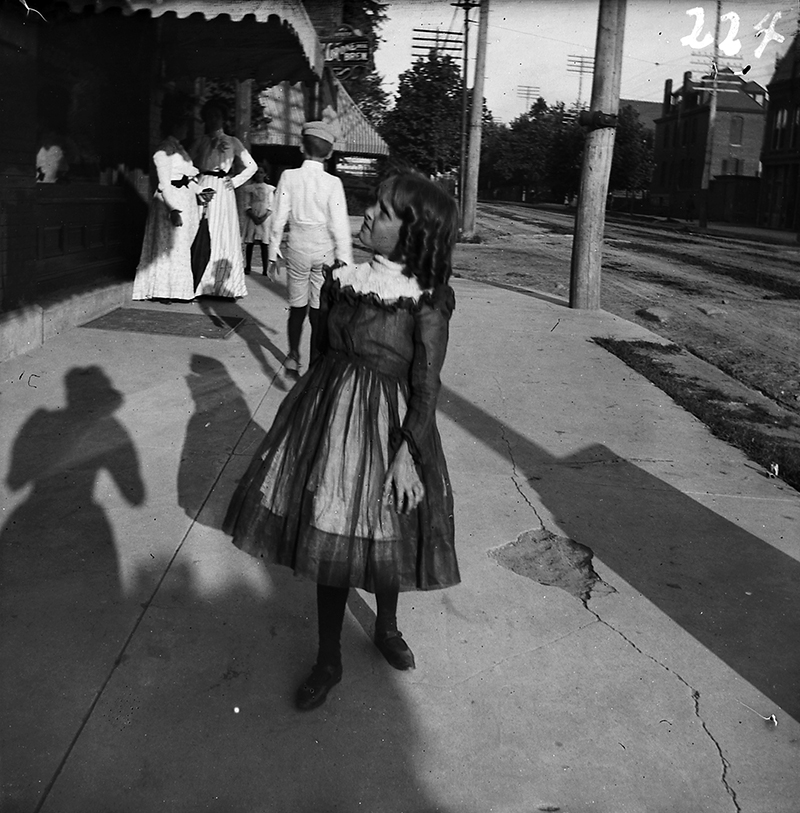
Little Girl Standing at the Side of a Street, Saint Louis, Missouri, 1900. The Gabriele Münter and Johannes Eichner Foundation, Munich
The first room of the exhibition is devoted to the self-portraits which Münter created throughout her career, but particularly between 1908 and 1914, the years when she was one of the key figures in the rise of Expressionism in Munich. Also included are a number of photographs in which the shadow of the artist appears projected in the image, a resource that functioned to include her figure in the composition and which she sometimes employed in her paintings, as in Boating (1910) and Breakfast of the Birds (1934), in both of which the painter is represented from behind in the foreground.
2. Begginings in black and white
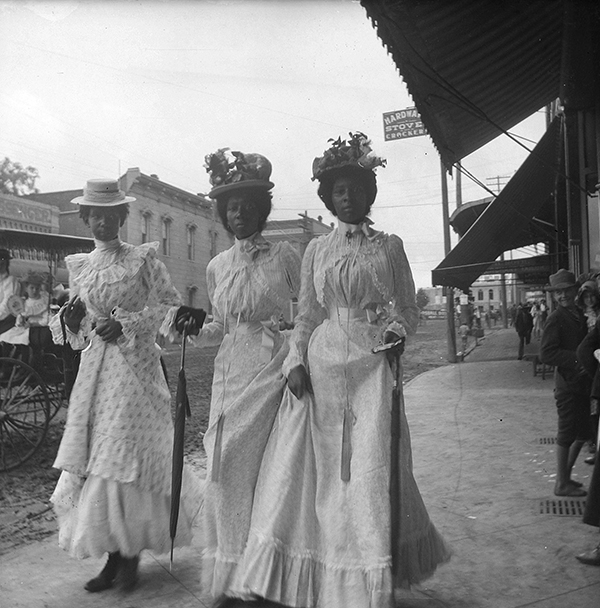
Three Women in Their Sunday Best, Marshall, Texas, 19 June 1900. The Gabriele Münter and Johannes Eichner Foundation, Munich
Between 1898 and 1900 Gabriele Münter visited the United States, a country where her parents, emigrants who had returned to Germany during the Civil War, had met and married and which she was now visiting for the first time. During those two years she lived with her maternal relatives in various places, becoming familiar with the reality of American society at first hand and recording everything that caught her attention in her sketchbooks. After being gifted one of the new Kodak portable cameras in 1899, photography made a decisive contribution to Münter’s activities as a draughtsman and she experimented with the creative possibilities of the new medium.
The exhibition brings together a selection of 20 photographs of the more than 400 which Münter took during tat decisive trip, images highly valued both for their artistic quality and their importance for her creative development. For the first time in these photographs she explores themes such as landscape, urban views, domestic interiors and the world of work, which would later become the subjects of her paintings. Her interest in capturing moments and the concept of working in series are other aspects that would subsequently emerge in her paintings, as well as her simple and analytical way of looking, capable of structuring space through a few lines, which is one of the principal characteristics of her pictorial compositions.
3. Outdoors
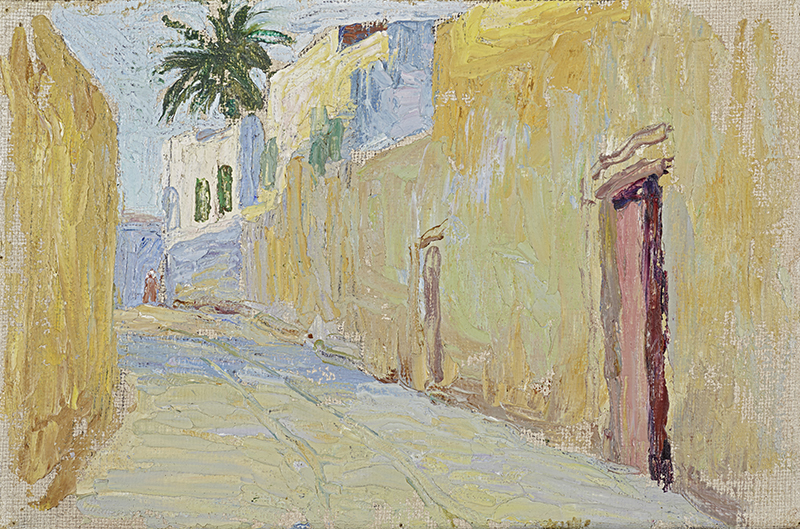
Gabriele Münter. Lane in Tunis, 1905. Canvas, 16,3 × 24,5 cm. The Gabriele Münter and Johannes Eichner Foundation, Munich
After her return to Germany in 1901 Münter embarked on her artistic training in Munich. The following year this would take her to the Phalanx art school of which Kandinsky was a founder and teacher. Its painting classes proved crucial for Münter’s decision to opt for painting rather than sculpture, which had initially attracted her. Between 1902 and 1903 she took part in the painting trips organised by Kandinsky in rural areas of Bavaria where she produced her first oil paintings. Subsequently, between 1904 and 1908, the two travelled around Europe and North Africa together and moved to Paris for a year, where they had the opportunity to see the work of Gauguin, Van Gogh and the Fauves, led by Matisse. During these trips Münter pursued her interest in photography and painted outdoors, often recording the same image with her camera and brushes. These paintings are stylistically linked to late Impressionism, revealing a greater interest in volume than in the study of atmospheric effects.
4. The discovery of Murnau
Gabriele Münter. School House, Murnau, 1908. Oil on cardboard. 40,6 × 32,7 cm. Carmen Thyssen Collection
After returning to Munich in the summer of 1908 Münter visited the Bavarian town of Murnau in the foothills of the Alps, again with Kandinsky and in the company of the artists and couple Alexej von Jawlensky and Marianne von Werefkin. Their close collaboration resulted in works considered foundational for South German Expressionism: “It was a wonderful, interesting and happy creative time in which we argued a lot about art.” Münter's paintings reveal the transition from her previous approach, with its short, heavily charged brushstrokes, to a new fluid style, expressed in compositions in which she progressively eliminated the anecdotal and gave free rein to colour. The following year she and her fellow artists returned to the town and acquired a house on the outskirts which would become her refuge and the epicentre of the early 20th-century, German artistic avant-garde.
5. People
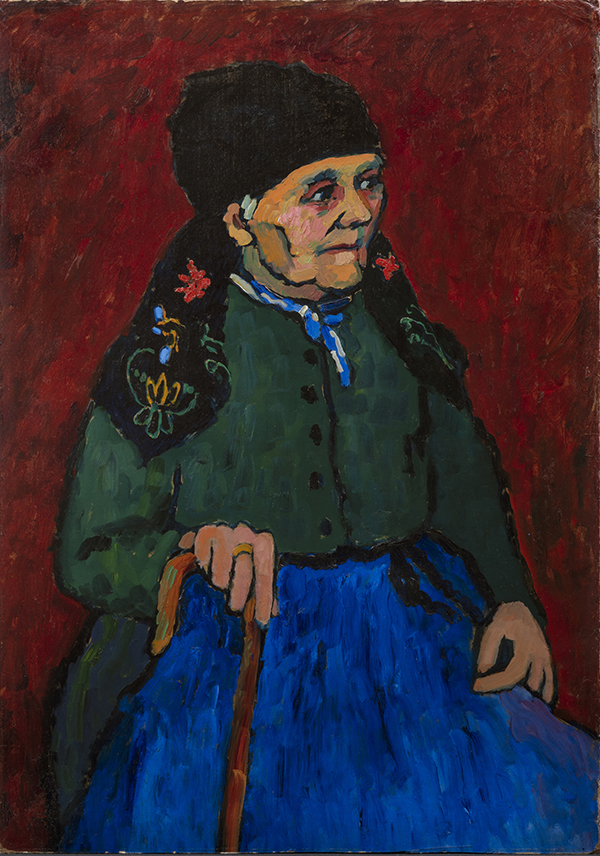
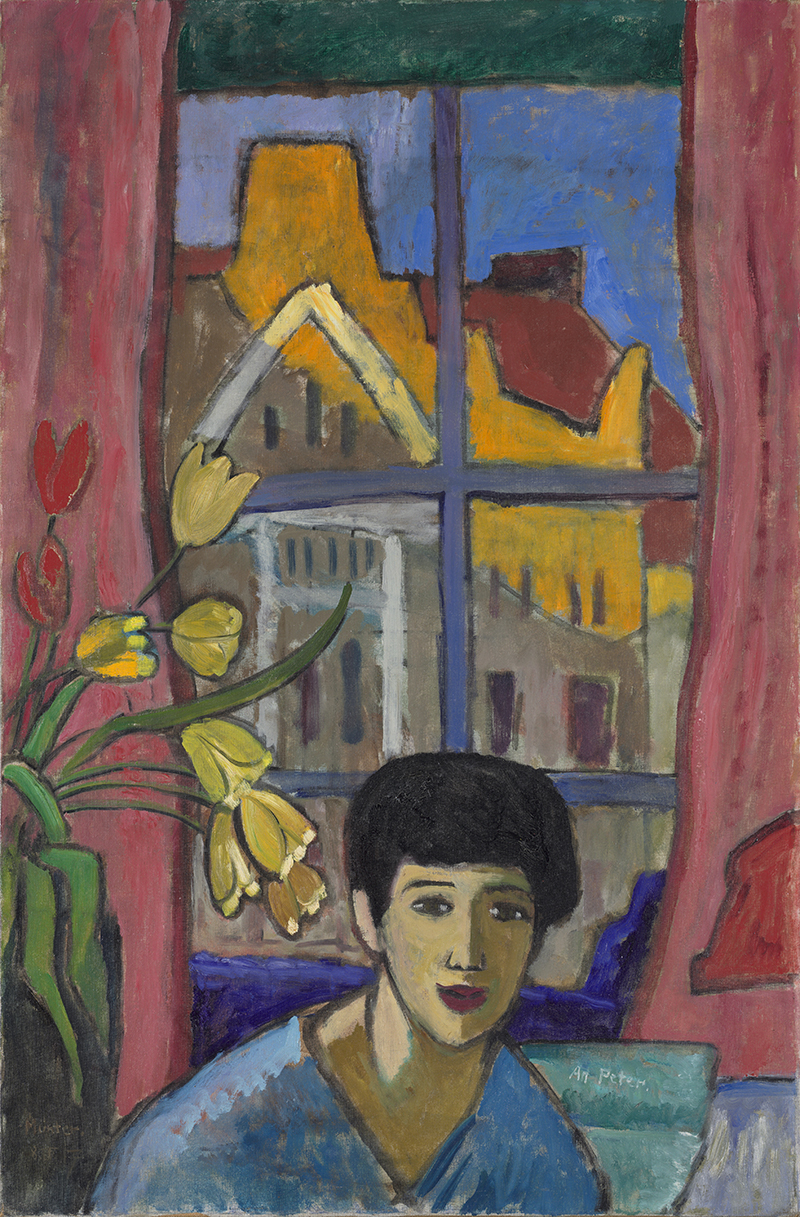
Gabriele Münter. Murnau Woman (Rosalie Leiss), 1909. Oil on cardboard, 92 × 64,8 cm. On permanent loan from the Ernst von Siemens Kunststiftung, Munich, and the PSM Privatstiftung Schlossmuseum Murnau en el Schlossmuseum Murnau
“Painting portraits is the most daring and difficult, the most spiritual, the most extreme endeavour for an artist.” Gabriele Münter was particularly interested in the depiction of people, as evident in her sketchbooks and photographs, with a clear preference for women and children. In these works she reveals a skill in combining a reduction of compositional elements with a fidelity to the physical resemblance of the person portrayed. Following the stylistic change that took place in her work in Murnau, her portraits employ more intense colours, simplified shapes and darker outlines. Above all, Münter painted people from her immediate surroundings, initially locating them against a plain background then later moving towards compositions in which the figures are integrated into genre scenes, located in interiors or in a dialogue with the objects around them.
6. Interiors and objects
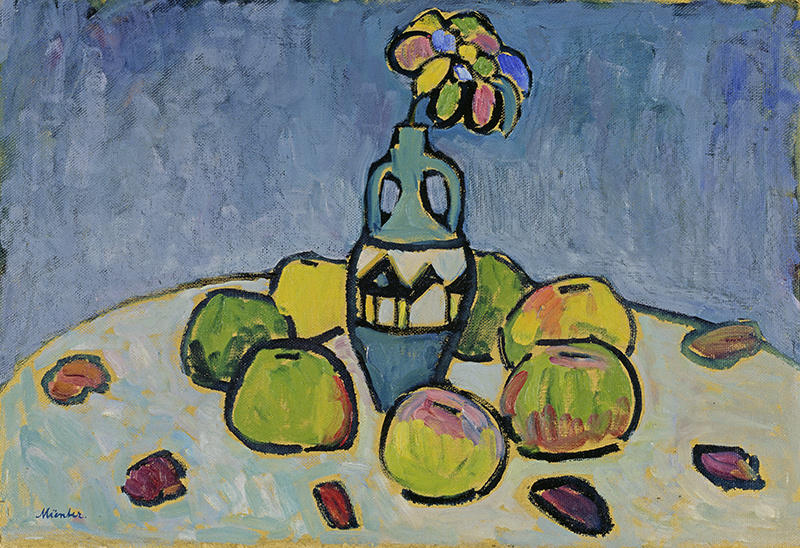
Gabriele Münter. Still Life in Gray, 1910. Oil on cardboard, 34,5 × 50,4 cm. Städtische Galerie im Lenbachhaus und Kunstbau München, Munich, donated by Gabriele Münter, 1957
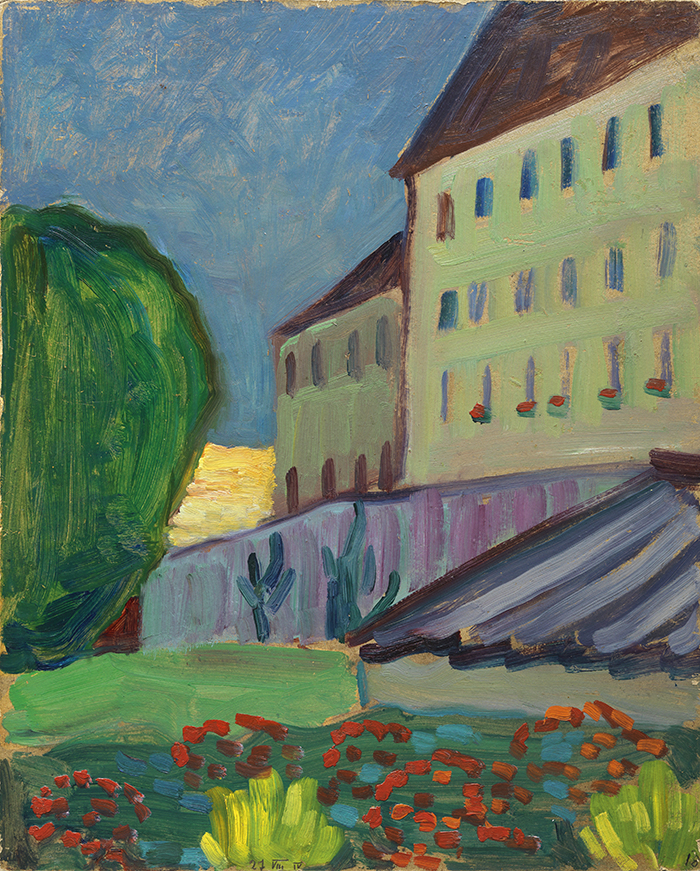
Between 1909 and the outbreak of World War I, Gabriele Münter alternated winters in Munich with long periods at her home in Murnau, which became the subject of some of her paintings and photographs. The utopian ideal she shared with Kandinsky of creating an artistic community linked to the rural world and connected with nature led them to renounce the comforts of the big city and lead a simple life, dressing in typical peasant costume and working on their vegetable patch. Münter discovered the painting on glass typical of the area, a type of folk art with simplified forms and expressive colours divided by thick, dark outlines, which fascinated her as it involved many of the elements she aspired to achieve in her painting. She acquired a number of pieces of this type which she used to decorate her home, as seen in her paintings and photographs. They became key motifs in her still lifes, in which she sought to connect with the spirituality of these primarily devotional objects. She also learned the technique herself and was the first of the group to produce her own works on glass.
7. The blue horsewoman
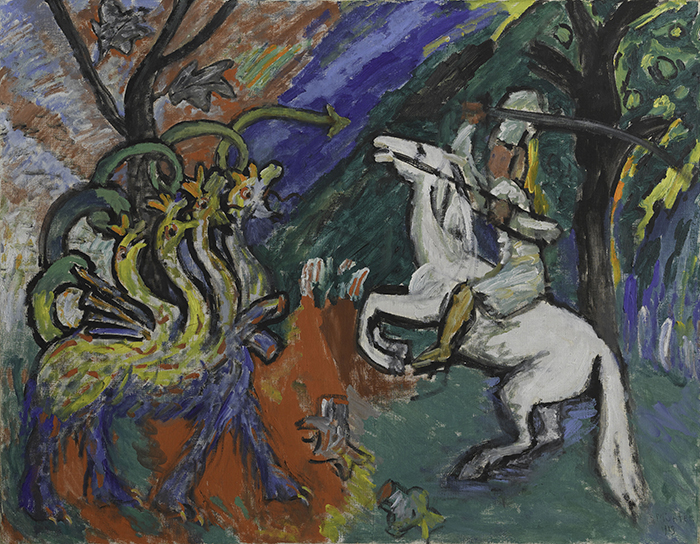
Gabriele Münter. Dragon Fight, 1913. Oil on canvas, 78 × 100 cm. Centre Pompidou, Paris, Musée national d’art moderne/Centre de création industrielle, donated by the Société Kandinsky, 2015
From 1909 Gabriele Münter actively participated in the New Association of Artists in Munich, in the exhibitions of The Blue Rider group from late 1911 and in the publication of its almanac of the same name. The photographs she took at this time demonstrate her role in the group, as well as her sophisticated understanding of the importance of visually recording these events. Like the rest of her companions, Münter aspired to achieve a form of expression that responded to what Kandinsky defined as “inner need”; a genuinely individual form of expression that led each of them to develop a different style even though they shared common sources of inspiration. Like all these artists, Münter was interested in European folk culture and the art of other continents: she collected children's drawings and copied some of them in a process of “unlearning” which she considered fundamental to her artistic evolution, and although she was an essentially figurative painter, on occasions she came close to abstraction.
8. Exile in Scandinavia
Gabriele Münter. Future (Woman in Stockholm), 1917. Oil on canvas, 97,5 × 63,8 cm. The Cleveland Museum of Art, gift of Mr. and Mrs. Frank E. Taplin, Jr
Following the outbreak of World War I Münter settled in neutral Sweden in July 1915, remaining there until 1920. She encountered the local art scene, which welcomed her as an important representative of the international avant-garde. The decorative Expressionism of these painters, influenced by their master Matisse, soon left its mark on some of her works, resulting in a more graphic style and softened colours. Münter travelled round Sweden and Norway in search of new pictorial motifs to replace her much-missed Murnau, producing landscapes with a greater emphasis on narrative and including small figures. Financial necessity led her to execute numerous commissioned portraits during these years, but she also painted a series of symbolic portraits representing different states of mind, works that reveal a renewed interest in human beings, particularly women.
9. A nomadic life
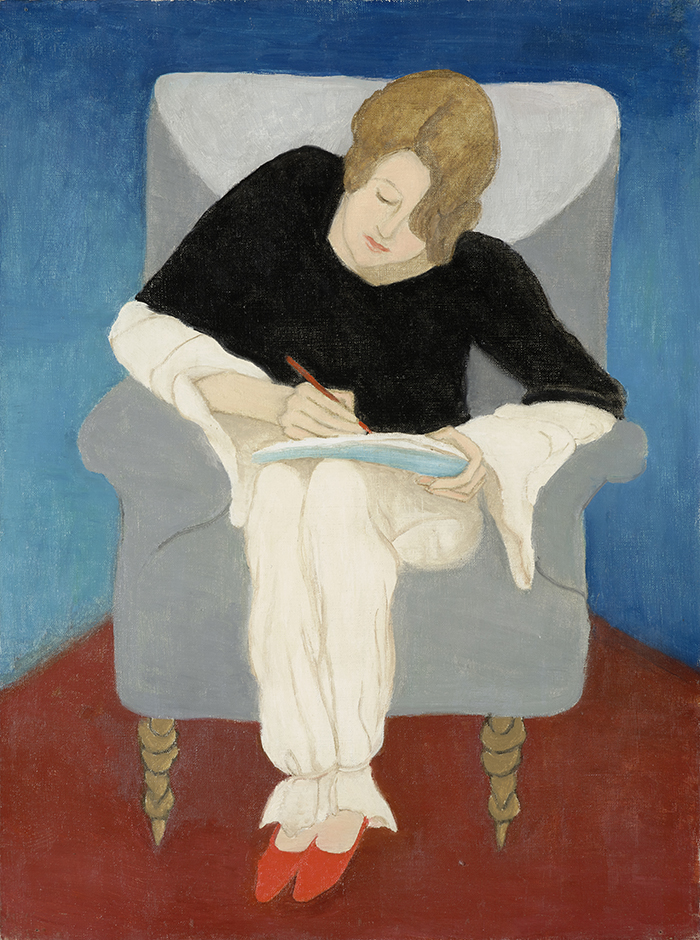
Gabriele Münter. Lady in an Armchair, writing (Stenography: Swiss Woman in Pyjamas), 1929. Canvas, 61,5 × 46,2 cm. The Gabriele Münter and Johannes Eichner Foundation, Munich
When Münter returned to Germany in 1920 her close circle of artists had disappeared, including Kandinsky who had returned to Russia during the war and embarked on a new relationship there. With no fixed address, during those years Münter focused on her activity as a graphic artist and on portraying the free and emancipated women with whom she socialised. “It was years before I had a studio. The sketchbook was my friend and the drawings the reflection of what I saw with my eyes […]. The result was mere sketches, works of the moment, sketches in a couple of strokes […]. They contained everything I had to say.” After living in various places, in 1925 she moved to Berlin, where she renewed her contacts with the German art world and attended Arthur Segal’s art school. A number of her works from the 1920s are stylistically linked to New Objectivity in their aim of reducing the chromatic range and making any trace of the brushstrokes disappear, although Münter never shifted her focus to the social critique associated with some of the artists of that movement.
10. Return to Murnau
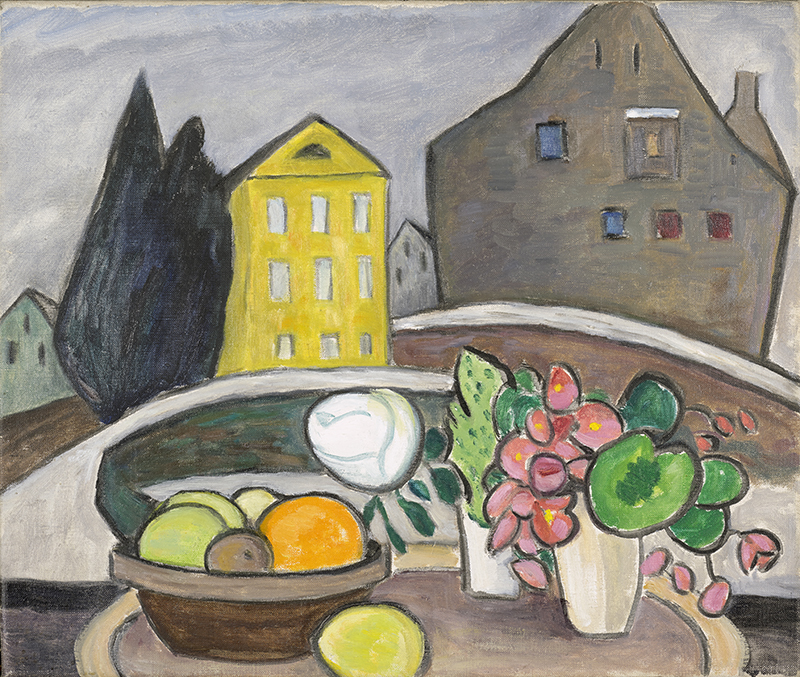
Gabriele Münter. Still Life in Front of the Yellow House, 1953. Canvas, 46,5 x 54, 5 cm. The Gabriele Münter and Johannes Eichner Foundation, Munich
After a fruitful period in Paris between October 1929 and June 1930 Münter’s itinerant life came to an end in 1931 when she permanently moved into her house in Murnau. The streets and surrounding landscapes once again became the principal themes and motifs of many of her works, paintings in which she frequently revived her own Expressionist tradition. During the years of the Third Reich Münter continued to live in Murnau, progressively reducing her public presence. The end of World War II led to a progressive rediscovery of her art and her reputation started to grow through numerous exhibitions and acquisitions of her work by museums and collectors. Gabriele Münter continued to work in the last years of her life. Some of her final paintings were versions of previous works in which she reflected on her life and artistic career.
On the occasion of her 80th birthday in 1957 Gabriele Münter made a large donation to the Lenbachhaus of works by her own hand and by other members of The Blue Rider group which she had kept hidden in her house during the Nazi period. The result was to transform the Lenbachhaus into the key museum for that artistic movement.
EXHIBITION INFORMATION
Title: Gabriele Münter. The Great Expresionist Woman Painter.
Organised by: Museo Nacional Thyssen-Bornemisza in cooperation with the Gabriele Münter and Johannes Eichner Foundation and the Städtische Galerie im Lenbachhaus und Kunstbau München in Munich, co-produced with the Musée d’Art Moderne de Paris.
With the collaboration of Comunidad de Madrid and the support of the Art Foundation Mentor Lucerne
Venue and dates: Madrid, Museo Nacional Thyssen-Bornemisza, 12 November 2024 to 9 February 2025; París, Musée d’Art Moderne, 4 April to 24 August 2025.
Curators: Marta Ruiz del Árbol, curator of Modern Painting at the Museo Nacional Thyssen-Bornemisza; Isabelle Jansen, director of the Gabriele Münter and Johannes Eichner Foundation, and Mattias Mühling, president of the Gabriele Münter and Johannes Eichner Foundation and director of the Städtische Galerie am Lenbachhaus und Kunstbau München, Munich.
Number of works: 145 by Gabriele Münter (86 paintings, 21 works on paper and 38 photographs), plus a further 19 photographs, works and various objects. Total: 164.
Publications: Catalogue with texts by Marta Ruiz del Árbol, Anna Storm and Isabelle Jansen. Educational guide and audio guide (Spanish and English). Gabriele Münter. Las tierras azules, comic by Mayte Alvarado, co-published with Astiberri.


![Remedios Varo (María de los Remedios Alicia Rodriga Varo y Uranga), Mi generalito (Le Marquis de la Contre-Croupe) [My Little General [The Marquis de la Contre-Croupe], 1959, Private collection © VG Bild-Kunst, Bonn 2024, Courtesy Gallery Wendi Norris](https://www.lenbachhaus.de/fileadmin/_processed_/5/0/csm_Varo_-_Mi_Generalito_-_1959__83e7dd2c8e.jpg)