Tuesday, December 17, 2024

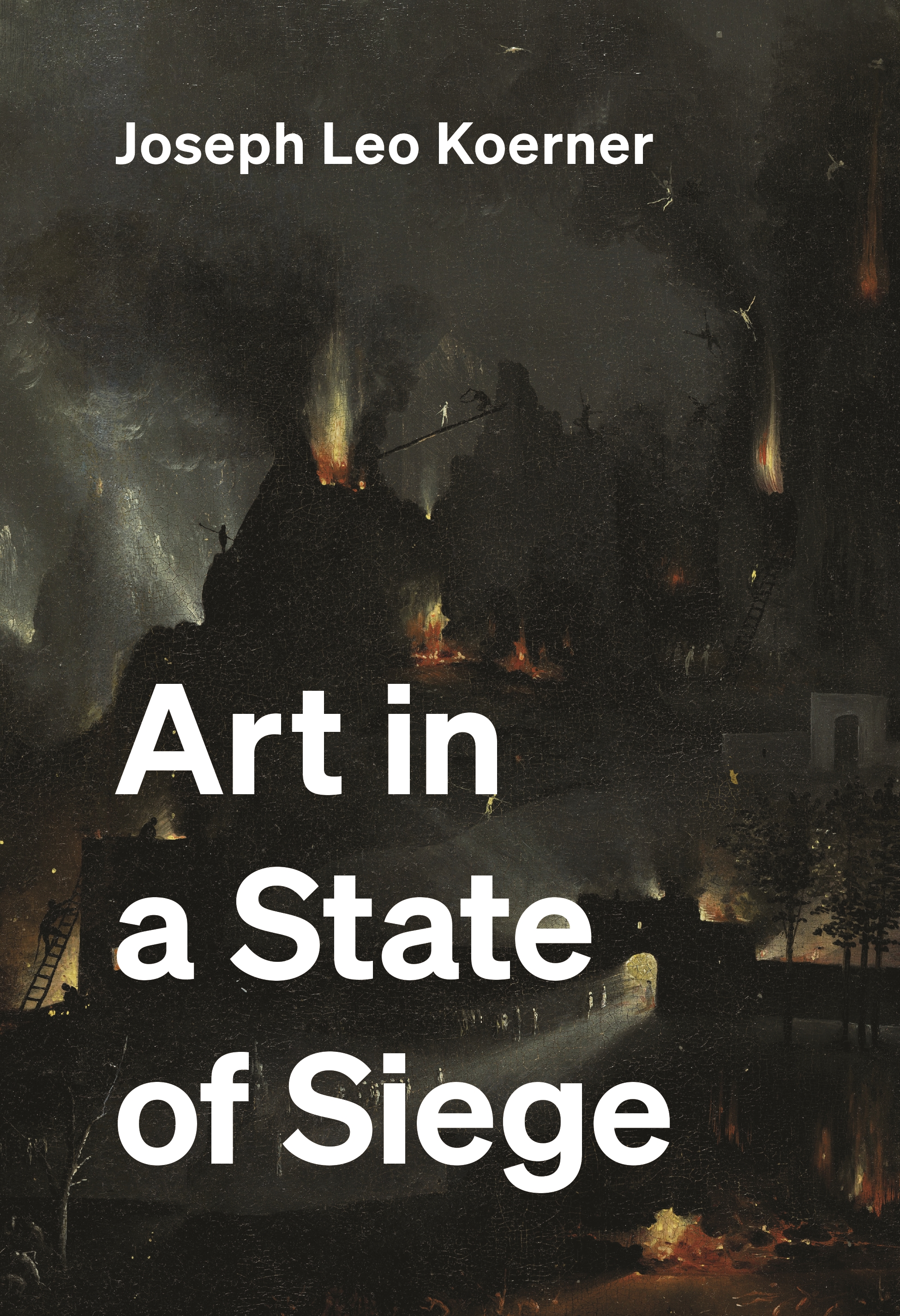
Book: Art in a State of Siege


 What do artworks look like in extreme cases of collective experience? What signals do artists send when enemies are at the city walls and the rule of law breaks down, or when a tyrant suspends the law to attack from inside? Art in a State of Siege tells the story of three compelling images created in dangerous moments and the people who experienced them—from Philip II of Spain to Carl Schmitt—whose panicked gaze turned artworks into omens.


Acclaimed art historian Joseph Koerner reaches back to the eve of iconoclasm and religious warfare to explore the most elusive painting ever painted. 


In Hieronymus Bosch’s Garden of Delights, enemies are everywhere: Jews and Ottomans at the gates, witches and heretics at home, sins overtaking the mind. 

Following a paper trail leading from Bosch’s time to World War II, Koerner considers 


a monumental self-portrait painted by Max Beckmann in 1927. Created when Germany was often governed by emergency decree, this image brazenly claimed to decide Europe’s future—until the Nazis deemed it to be a threat to the German people. For South African artist William Kentridge, Beckmann exemplified “art in a state of siege.” Koerner shows how his work served as beacon during South Africa’s racialist apartheid rule and inspired Kentridge’s breakthrough animations of drawings being made, erased, and remade.

Spanning half a millennium but urgent today, Art in a State of Siege reveals how, in dire straits, art becomes the currency of last resort.

Joseph Leo Koerner is the Victor S. Thomas Professor of History of Art and Architecture and Professor of Germanic Languages and Literatures, Harvard University, and Senior Fellow of Harvard’s Society of Fellows. The author of Bosch and Bruegel: From Enemy Painting to Everyday Life (Princeton) and Caspar David Friedrich and the Subject of Landscape, he has written and presented documentaries for the BBC and wrote, produced, and directed The Burning Child, a feature film on Viennese homemaking in the shadow of the Holocaust.

Praise

"[Art in a State of Siege is ] an engrossing ride. . . . [A] rewarding read."—Kirkus Reviews

“Devastating and necessary, Art in a State of Siege illuminates the violent, political, and ethical underpinnings of art history. Koerner, one of the most important historians writing today, recognizes the impossibility of separating the process of history from our individual and collective traumas under siege.”—Caroline Fowler, author of Slavery and the Invention of Dutch Art

Art in a State of Siege may be Joseph Koerner’s most brilliant book to date, which is saying a great deal. It is also unarguably his most political, and in more than one respect his most fiercely personal. No brief commentary can begin to do justice to the complexity of Koerner’s thinking on every page, or indeed to the intellectual passion, which is the stamp of his considerable achievement.”—Michael Fried, author of The Moment of Caravaggio

“The enemy surrounds us. The walls that we thought were secure are quickly breached. Even as the death count begins to rise, we rage not against the faceless, anonymous foe but against our own neighbors whom we now regard as the most lethal enemies of all. For thousands of years and throughout the world, such has been the recurrent nightmare of human societies. In this startlingly original book, weaving together brilliant interpretations of three major early modern, modern, and contemporary artists, Joseph Koerner provides a new and critically important theory of the function of art in a beleaguered world. Art in a State of Siege is essential reading for our time.”—Stephen Greenblatt, author of The Swerve: How the World Became Modern

“In this masterful triptych, Joseph Koerner reads art history as an ever-changing and unresolved conundrum of power and powerlessness, enmity and humanism, siege and redemption. Rich in surprising twists and uncanny connections, Art in a State of Siege is a brilliantly enlightening book on the perils and promise of art.”—Daniel Jütte, author of Transparency: The Material History of an Idea

Art in a State of Siege reads like an alchemical manual containing the secret formulas, hidden in plain sight, out of which an ongoingly good art history can be written. Joseph Koerner’s book is a tour de force.”—Alexander Nemerov, author of The Forest: A Fable of America in the 1830s


C C Land: The Wonder Of Art


National Gallery, London

10 May 2025 - 09 May 2026

The National Gallery is undertaking a major redisplay of its collection, today announced as C C Land: The Wonder of Art

'C C Land: The Wonder of Art' will display over 1,000 works as part of the Gallery’s free offering at Trafalgar Square, including the most renowned and beloved works collected for the nation over the last 200 years, which will hang alongside new loans of works by Andrea MantegnaAnthony van DyckWilliam Hogarth and Vincent van Gogh and acquisitions by Nicolas PoussinEva GonzalèzHilaire-Germain-Edgar Degas and a few surprises still to come.

Visitors can see the completed redisplay from 10 May 2025, to coincide with the opening to the public of the transformed Sainsbury Wing after more than two years of building works, reshaping the National Gallery for its third century and the next generation of visitors.

'The Wonder of Art' will follow a broadly chronological arrangement, with medieval and Renaissance pictures displayed in the Sainsbury Wing and later paintings in the Wilkins Building. It will include a range of more thematic interventions, such as ‘The Spectacle of Portraiture’, ‘Flowers’ and ‘Still Life’. Some newly restored works will be shown for the first time in several years, including the Pollaiuolo brothers’ The Martyrdom of San Sebastian and Jan van Eyck’s Portrait of a Man (Self Portrait?).

A series of rooms will feature the work of individual artists, marking the first time the Gallery’s works by Titian and Claude Monet will each be brought together. Other artists in focus include Peter Paul Rubens, Van Dyck, Rembrandt and Thomas Gainsborough. One new display focusses on Charles I (1600‒1649) as a collector and includes major loans from the Royal Collection.

We will reveal more about the making and meaning of art, including the importance of gold from 1260-1550; the use of the oil sketch to record nature; and the impact of pastel as a new medium.

'C C Land: The Wonder of Art' will also show anew how artists were inspired by those working before them. Specific pairings celebrating ‘artists looking at artists’ will include Vigée Le Brun’s Self Portrait in a Straw Hat, inspired by Rubens’s Portrait of Susanna Lunden(?) (‘Le Chapeau de Paille’), as well as Rembrandt’s Self Portrait at the Age of 34 , which is modelled on Titian’s Portrait of Gerolamo(?) Barbarigo.

The Gallery has drawn on years of research about our audiences, the type of stories they find most engaging and how they prefer to access them. This informs our new layered approach to the interpretation, which sets the collection in context, explores key themes and artists and integrates print with digital information.  

Visitors are able to access information about the collection in multiple ways: from printed panels and labels on the walls, by scanning paintings with their smart phones for more in-depth digital content, to listening to a range of voices speaking from different perspectives in our new audio guide. We have also significantly enhanced our free interpretation offer for visitors with a range of access requirements. 

The rehang is already in progress with some rooms being closed between now and May 2025 to facilitate the moving of paintings and refurbishment of the galleries. This will be carried out in stages to ensure the Gallery can keep as many rooms open to the public for as much time as possible.

Gabriele Finaldi, Director of the National Gallery, said: 'C C Land: The Wonder of Art has been in the making at the National Gallery for several years. Our Bicentenary provides the perfect opportunity to consider a new way to tell the story of the incredible paintings in our collection, and include some exciting surprises.'

Christine Riding, Director of Collections and Research, said: 'This is the first time in over 30 years that we have had such an exciting opportunity to rethink, and refresh, how we present one of the greatest art collections in the world, under one roof. Our visitors will discover anew some of the most famous and iconic works of art ever created, alongside personal favourites and recent discoveries and acquisitions.'

Dr Peter Lam, Deputy Chairman and Managing Director of C C Land, said: 'The National Gallery's Bicentenary is a momentous occasion, and we at C C Land are delighted to be a part of it. 'C C Land: The Wonder of Art' will not only transform the visitor experience but also leave a lasting legacy for years to come. We believe in the power of art and are confident this redisplay will inspire and engage audiences for generations, aligning with our own long-term vision for sustainable growth and community impact.'

IMAGES


Full title

Self Portrait at the Age of 34

Artist

Rembrandt

Artist dates

1606 - 1669

Date made

1640

Medium and support

oil on canvas

Dimensions

91 × 75 cm

Inscription summary

Signed; Dated and inscribed

Acquisition credit

Bought, 1861


Full title

Portrait of Susanna Lunden(?) ('Le Chapeau de Paille')

Artist

Peter Paul Rubens

Artist dates

1577 - 1640

Date made

probably 1622-5

Medium and support

oil on wood

Dimensions

79 × 54.6 cm

Acquisition credit

Bought, 1871

​​​​​​​


Full title

Self Portrait in a Straw Hat

Artist

Elisabeth Louise Vigée Le Brun

Artist dates

1755 - 1842

Date made

1782

Medium and support

oil on canvas

Dimensions

97.8 × 70.5 cm

Acquisition credit

Bought, 1897


Full title

Portrait of Gerolamo (?) Barbarigo

Artist

Titian

Artist dates

active about 1506; died 1576

Date made

about 1510

Medium and support

oil on canvas

Dimensions

81.2 × 66.3 cm

Inscription summary

Signed

Acquisition credit

Bought, 1904


Full title

Portrait of the Artist with his Wife and Daughter

Artist

Thomas Gainsborough

Artist dates

1727 - 1788

Date made

about 1748

Medium and support

oil on canvas

Dimensions

92.1 × 70.5 cm

Acquisition credit

Acquired under the acceptance-in-lieu scheme at the wish of Sybil, Marchioness of Cholmondeley, in memory of her brother, Sir Philip Sassoon, 1994


Monday, December 16, 2024

Christie’s 17th-century Dutch and Flemish paintings 5 February 2025

 Christie’s will offer a group of important and highly collectable 17th-century Dutch and Flemish paintings from the Museum of Fine Arts, Boston (MFA), during two live auctions, Old Masters I and Old Master Paintings and Sculpture II, taking place 5 February 2025 at Rockefeller Center. The MFA has one of the world’s finest collections of Netherlandish art, with holdings that span all categories of Dutch painting and include a wide range of artists.  This group of almost 20 paintings – many of which have been off the market for a half a century or more – is being auctioned to fund future acquisitions that will provide further depth and better serve the evolving needs of the museum’s audiences.

A Director of Old Master Paintings at Christie’s, John Hawley, said: “Collectors of Old Masters have long prized works from major American institutions, but only infrequently has a group with such provenance and quality appeared on the market as these Dutch and Flemish paintings from the collection of the Museum of Fine Arts, Boston. The MFA has one of the finest collections of Netherlandish paintings in the world and has long been at the vanguard of efforts to preserve, display and study the art of the Lowlands. The proceeds from the deaccession of these exceptional works will be used to further enrich the museum’s collection in this field.”

The Baker Curator of Paintings and Chair of Art of Europe at the Museum of Fine Arts, Boston, Frederick Ilchman said: “The MFA is extremely fortunate to have an exceptional collection of Dutch and Flemish paintings, with our holdings nearly doubling in 2017 thanks to the landmark gift from Rose-Marie and Eijk van Otterloo and Susan and Matthew Weatherbie. Over the past several years, our curatorial team carefully reviewed the entire collection. Our process revealed that some pictures were similar to, even duplicative of, other works by the same artists at the MFA. Given that these paintings were less likely to be displayed, we felt they could be deaccessioned for the benefit of the Museum. The proceeds from the Christie’s sale will allow us to continue to raise the caliber of the Dutch and Flemish collection, meeting the evolving needs of our community long into the future.”  

image/jpeg

The lead lot of the MFA pictures is Bandits Leading Prisoners, an Italianate landscape by a renowned master of this type of view, Jan Both (estimate: $1,000,000-1,500,000). 

image/jpeg

Other highlights among the close to 20 paintings in the group include Emanuel de Witte’s Nieuwe Kerk, (estimate: $400,000-600,000), an atmospheric interior view of the important 15th-century church on the Dam Square in Amsterdam; 

image/jpeg

a sizeable tonal still life by Pieter Claesz. (estimate: $150,000-250,000); 

image/jpeg

and a Jan Josefsz. van Goyen river view, River Landscape with a ferry and a church (estimate: 150,000-250,000).


Friday, December 13, 2024

Art and Process: Drawings, Paintings, and Sculptures from the 19th-Century


“Opportunities for museum-goers to witness the artistic process—which is sometimes shrouded in such mystery—are rare. Allowing visitors the chance to explore it and better understand what an artist was potentially thinking during creation has the ability to spark creativity in all of us,” said Gina Borromeo, Interim Co-Director. “In that way, Art and Process humanizes methods of making, illustrating how artists endeavored to refine their compositions and technique. We hope this exhibition adds depth to the visitor experience, creating a place to connect not just with the art on view, but to better understand the people behind the works as well.”

In Art and Process, varying degrees of artistic approach are on view, proving there is no right or wrong way to create. The exhibition details how some creatives create detailed preliminary sketches, allowing them to execute their finished work relatively quickly, while others sketched rarely or not at all, opting instead to create from memory or directly from a subject. Others demonstrate the possibility to stay with a composition and refine works for unusually long periods of time, sometimes a decade or more. In some cases, artists signed and dated what they believed to be a finished work, later returning to the composition and covering their inscriptions when they made changes.

In the case of Barye, sketches proved to be essential to the artist’s process, allowing him to clarify a composition with reference to both live and dead animals prior to sculpting, as seen in Sketches of a Lion (ca. 1832), a preparatory work for his famous life-size statue Lion and Snake. He also created a reduced version of this work in terracotta, a relatively inexpensive and easily manipulated medium, allowing him to further work out the composition before casting it in bronze. In terracotta, he altered the snake’s head to stand more away from its coils, confronting rather than retreating from the lion, adding to the drama of the scene.

“These artworks remind us that when we encounter a display in a museum, we see only the endpoint in a dynamic process—one that may have been long and involved many twists and turns,” said Jo Briggs, Jennie Walters Delano Curator of 18th- and 19th-Century Art. “Through trial and error, the artist may have made dozens of changes along the way, resulting in a final product that looks nothing like their initial idea. This context helps the viewer see these works as more fluid and less static, proving that art is a living, breathing process—not just a painting on a wall or a sculpture on a plinth.”

Art and Process: Drawings, Paintings, and Sculptures from the 19th-Century Collection is curated by Jo Briggs, Jennie Walters Delano Curator of 18th- and 19th-Century Art.


Images


Lion and Snake

1832
Antoine-Louis Barye (French, 1795–1875) Terracotta
Museum purchase with funds provided by the S. & A.P. Fund, 1955

Sketches of a Lion

ca. 1832
Antoine-Louis Barye (French, 1795–1875) Graphite on paper
Museum purchase, 1949

The Sheepfold, Moonlight

1856–1860
Jean-François Millet (French, 1814–1875) Oil on panel
Acquired by William T. Walters, 1884–1887

Study relating to “Study of Saint Sebastian”

1852
Jean-Baptiste-Camille Corot (French, 1796–1875) Charcoal on rough, moderately-thick,
brown wove paper
Acquired by William T. or Henry Walters

The Sheepfold, Moonlight

ca. 1858–1860
Jean-François Millet (French, 1814–1875)
Charcoal on beige, moderately thick, slightly textured wove paper
Acquired by William T. Walters, before 1884

. Study for Saint Sebastian

ca. 1867
Jean-Baptiste-Camille Corot (French, 1796–1875) Watercolor and graphite underdrawing on cream, moderately thick, slightly textured wove paper Acquired by William T. Walters, 1884

Two Students in the Life Room of the Heatherley School of Fine Art 1902

Nellie Joshua (British, 1877–1960)

Oil on canvas
Museum purchase, 2023

The Church at Eragny

1884
Camille Pissarro (French, 1831–1903)
Oil on canvas
Gift of Barbara B. Hirschhorn, Elizabeth B. Roswell, and Mary Jane Blaustein in memory of Jacob and Hilda Blaustein, 1991

The Sower

ca. 1865
Jean-François Millet (French, 1814–1875)
Pastel and crayon or pastel on cream buff paper Acquired by William T. Walters, 1884

View of Saint-Mammès

ca. 1880
Alfred Sisley (French and British, 1839–1899) Oil on canvas
Acquired by Henry Walters, 1909