Monday, April 27, 2026

“Across the Nation” National Gallery of Art

The National Gallery of Art has announced details of its “Across the Nation” partnership program bringing key works of art from its permanent collection to regional museums across the United States in 2025 and 2026. Through “Across the Nation,” the National Gallery has lent works of art by renowned artists from its collection—including Georgia O’Keeffe, Andy Warhol, Dorothea Lange, Sandro Botticelli, Rembrandt van Rijn, Henri Matisse, and Mark Rothko—to 10 partner museums in Alaska, Colorado, Connecticut, Idaho, Iowa, Michigan, Nevada, North Carolina, Utah, and Washington. This program creates unprecedented access to the nation’s masterworks by placing them directly in communities throughout the country. “Across the Nation” is part of the National Gallery’s programming commemorating the 250th anniversary of the United States of America in 2026.

Partner institutions have each selected between one and ten artworks on loan—spanning painting, photography, and installation—from the National Gallery’s collection. Partners include Anchorage Museum (Anchorage, AK), Boise Art Museum (Boise, ID), Denver Art Museum (Denver, CO), Figge Art Museum (Davenport, IA), Flint Institute of Arts (Flint, MI), Mint Museum (Charlotte, NC),  New Britain Museum of Art (New Britain, CT), Utah Museum of Contemporary Art (Salt Lake City, UT), and Whatcom Museum (Bellingham, WA). The Nevada Museum of Art (Reno, NV) is presenting an iteration of the National Gallery’s 2023–2024 exhibition Dorothea Lange: Seeing People

All “Across the Nation” presentations will be on view by May 2025, with several presentations on view now.

Partner institutions were selected to broaden access to the nation’s art collection in as many regions of the United States as possible. The lending program—including expenses associated with the transport and installation of the artworks—is supported by the National Gallery, with minimal to no cost for partner institutions. The National Gallery is also providing additional support by way of conservation services and training, as well as marketing. Marketing campaigns within the museums’ local communities are underwritten as part of the program, creating greater awareness for the program, and the National Gallery is collaborating with partners to develop and execute digital and educational programming pegged to their “Across the Nation” presentations in 2025–2026.

“‘Across the Nation’ is the manifestation of the National Gallery’s vision as the nation’s art museum, and we are so thrilled to bring some of the most beloved works from the nation’s collection of art directly into communities across the country,” said Kaywin Feldman, director of the National Gallery of Art.

For their “Across the Nation” presentations, partner museums selected works from the National Gallery’s collection that bring new perspectives to their own installations and complement public programs and interests of their respective communities. Loans include:

  • On view now, the Anchorage Museum (Anchorage, AK) is exhibiting paintings by Georgia O’Keeffe, Mark Rothko, and Nancy Graves.

Georgia O'Keeffe, Winter Road I, 1963, oil on canvas, Gift of The Georgia O'Keeffe Foundation, © Board of Trustees, National Gallery of Art, Washington, 1995.4.1


  • On view now, Denver Art Museum (Denver, CO) is presenting a painting by Rembrandt van Rijn alongside a portrait of Rembrandt painted by his studio, both from the National Gallery’s collection, offering a new perspective on the artist.
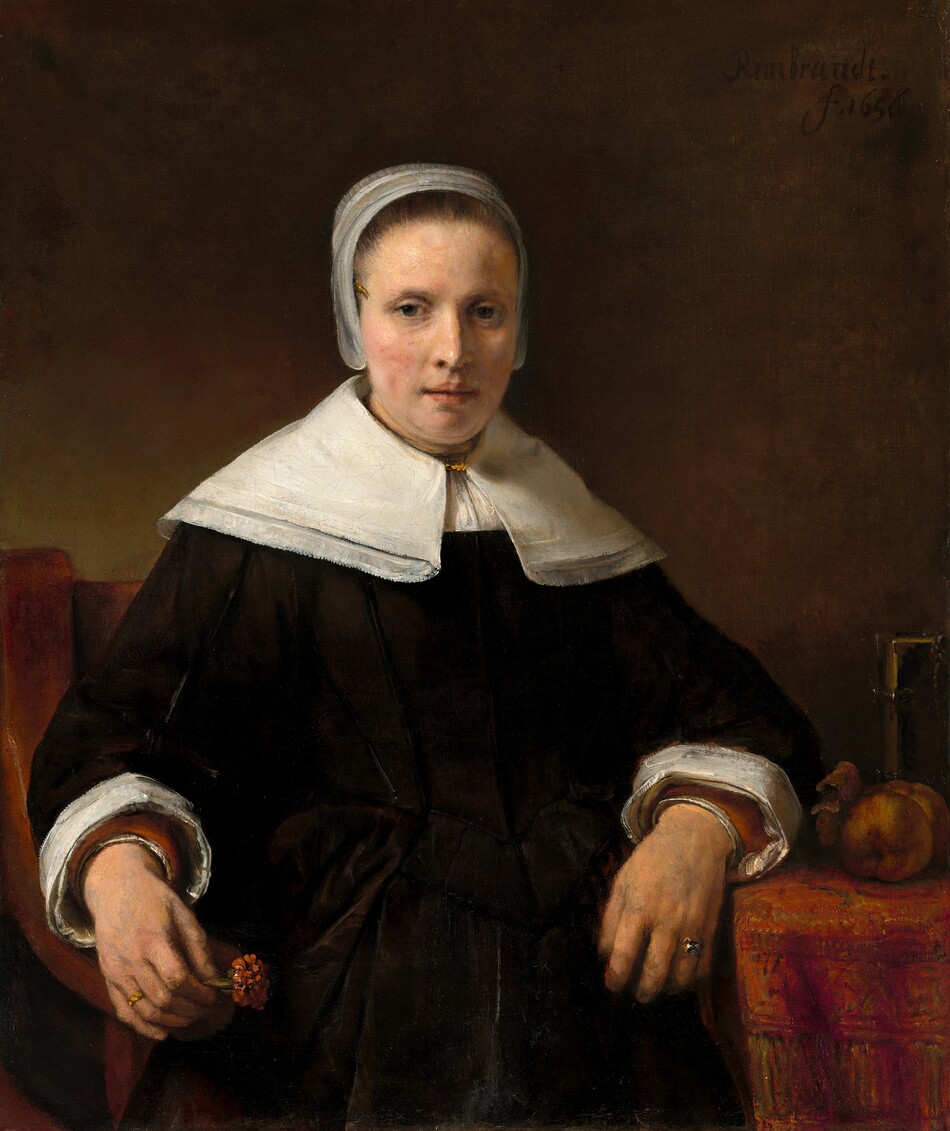
Shown from the lap up against a dark background, a pale-skinned woman wearing a black dress looks out at us in this vertical portrait. Soft light coming from our left highlights her oval face, the peach blush on her cheeks, and her crisp white collar, cap, and cuffs. Her brown hair is pulled back under the cap that flares slightly over her ears and the wide, lace-trimmed collar covers her shoulders. She has dark eyes, a straight nose, and her pink lips are slightly parted. Her left arm, on our right, rests on a table covered with a rose-red patterned carpet next to two pieces of fruit, perhaps apples, and a book fastened with metal clasps. She rests her other arm on the arm of the wooden chair and holds a deep pink carnation the same color as the carpet. She wears a ring on the third finger of each hand. The artist signed the work with black paint against the dark background near the upper right corner: “Rembrandt. f.1656.”
Rembrandt van Rijn, A Woman Holding a Pink, 1656, oil on canvas, Andrew W. Mellon Collection, 1937.1.75
  • On view now, the Whatcom Museum (Bellingham, WA) features works by leaders of the impressionist movement, including Henri Matisse, Auguste Renoir, and Paul Cezanne.
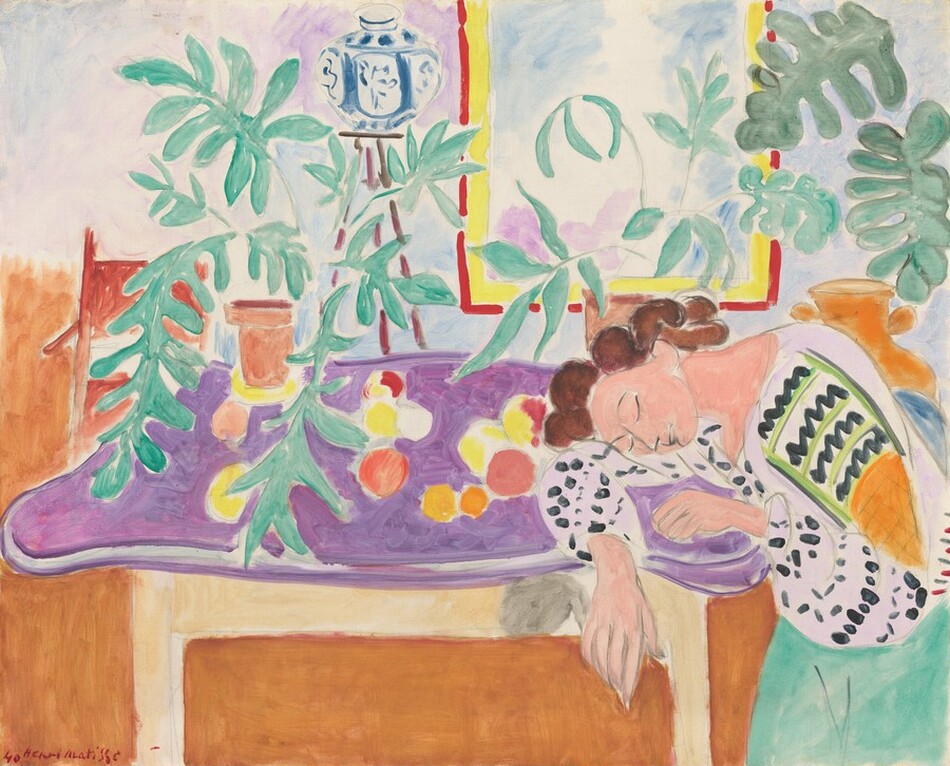
To our right in this vibrantly colored, stylized, nearly square painting, a woman with light, peach-colored skin and chestnut-brown hair sits slumped along a table as she sleeps, her head resting on one extended arm. The lilac-purple tabletop has round forms representing fruit scattered around a potted plant. Many of the forms are outlined with gray and filled in with mostly flat areas of color in mint and sage green, icy blue, coral red, orange, and lemon yellow. The tabletop curves around its edges and the surface is vivid purple, while the skirt and legs of the table are pale ginger brown. The woman’s head rests facing us on her bent right arm, that hand dangling over the front edge of the table. She rests her other hand, closer to us, near the crook of her elbow. She wears a white, blousy top with rows of navy-blue zigzags on the shoulder and elongated dots on the sleeves, and a light, mint-green skirt. Her brown hair seems to be pulled back and gathered into bunches of curving waves. Her stylized eyes, nose, and mouth are drawn simply with gray lines. The round orange, peach, and yellow fruit on the table are scattered near her arm and across the table to the other side, close to a plant in a brown clay pot. The plant has shoots of long, curving stems with vibrant spruce-green leaves. Two more plants are behind the woman near the back wall, in front a rectangular opening over the woman that could be a window or mirror. The glass is painted with streaks of baby blue and pale magenta pink around a field of white, and is outlined with a band of sunshine yellow and then scarlet red. The wall around it is also painted with watercolor-like, soft fields of pale blue and pink. The floor under the table and to our left is a flat field of caramel brown. Behind the table and to our left, forms suggest a wooden chair and a blue and white ceramic pot on a tall, spindly stand. In the lower left corner of the canvas, the artist signed and dated the work with dark red paint: “40 Henri Matisse.”
Henri Matisse, Still Life with Sleeping Woman, 1940, oil on canvas, Collection of Mr. and Mrs. Paul Mellon, 1985.64.26
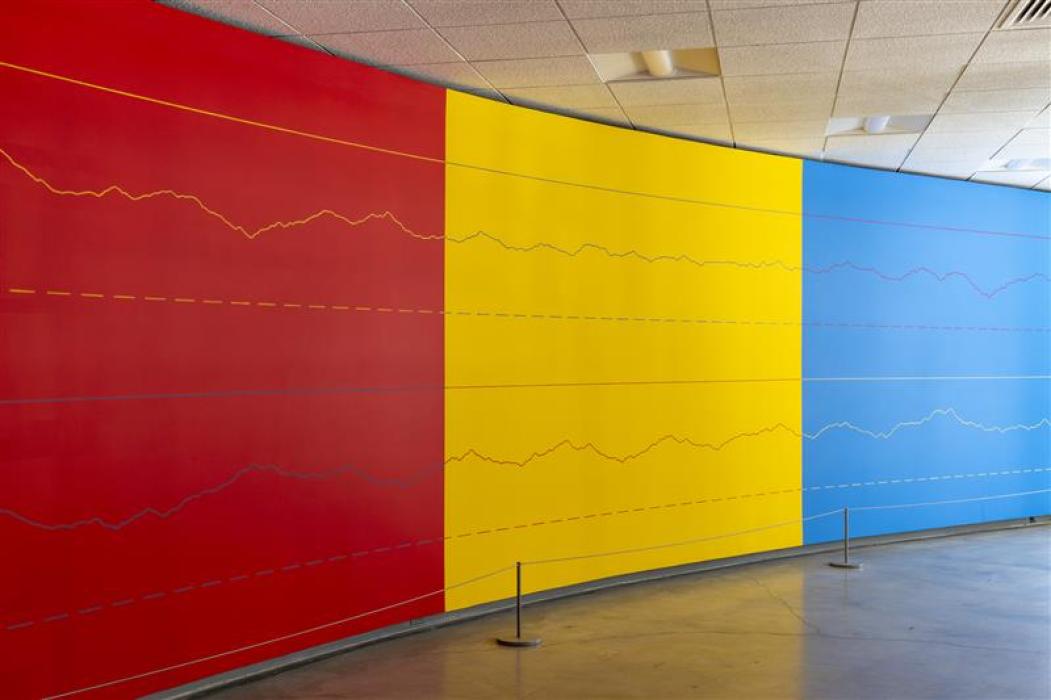
  • On view now, the Utah Museum of Contemporary Art (Salt Lake City, UT) presents a large-scale wall drawing by Sol Lewitt—marking the second time the work has ever been on view.
  • Opening in April, Boise Art Museum (Boise, ID) will exhibit paintings by Mark Rothko, Berthe Morisot, and Thomas Eakins.
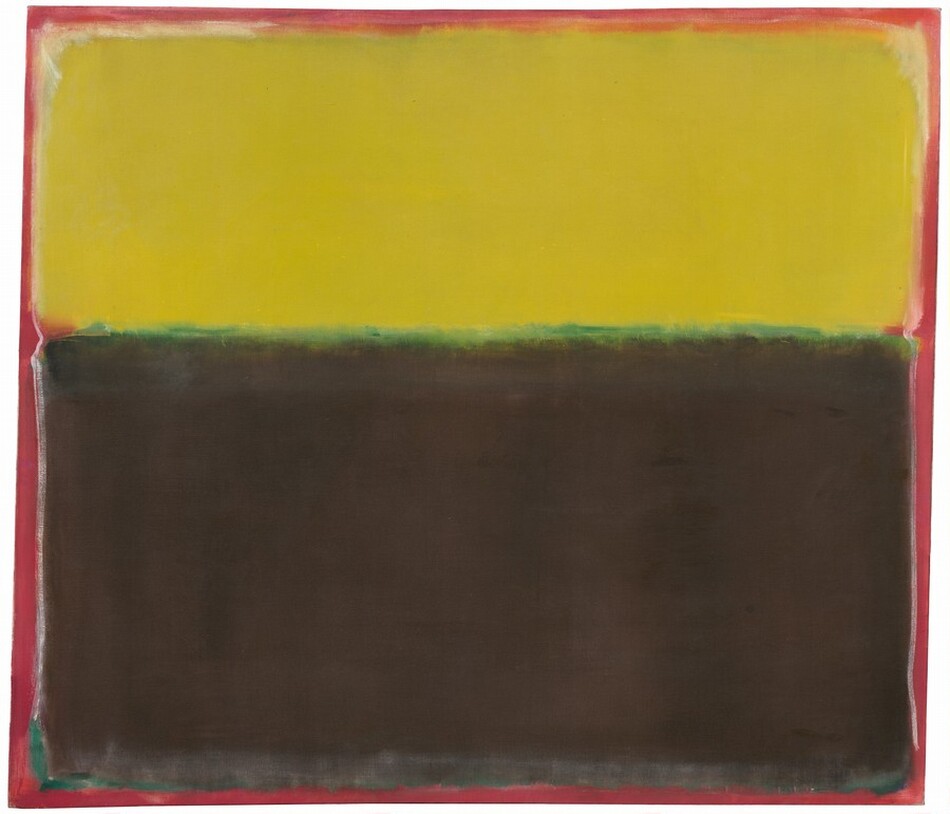
This painting displays two large rectangular blocks stacked on top of each other. The top section is yellow, while the bottom is black, with softly blurred edges and a small line of green where the two meet. The bottom rectangle is larger than the top rectangle. The rectangles are surrounded by a border of red and more hints of green at the bottom of the black rectangle. The paint has been applied unevenly in areas, creating some slight differences in color within the different sections.
Mark Rothko, Untitled, 1950, pigmented hide glue and oil on canvas, Gift of The Mark Rothko Foundation, Inc., 1986.43.159
  • Opening in April, the Flint Institute of Arts (Flint, MI) will exhibit three paintings spanning the breadth of art history by Sandro Botticelli, Hans Memling, and Andy Warhol.
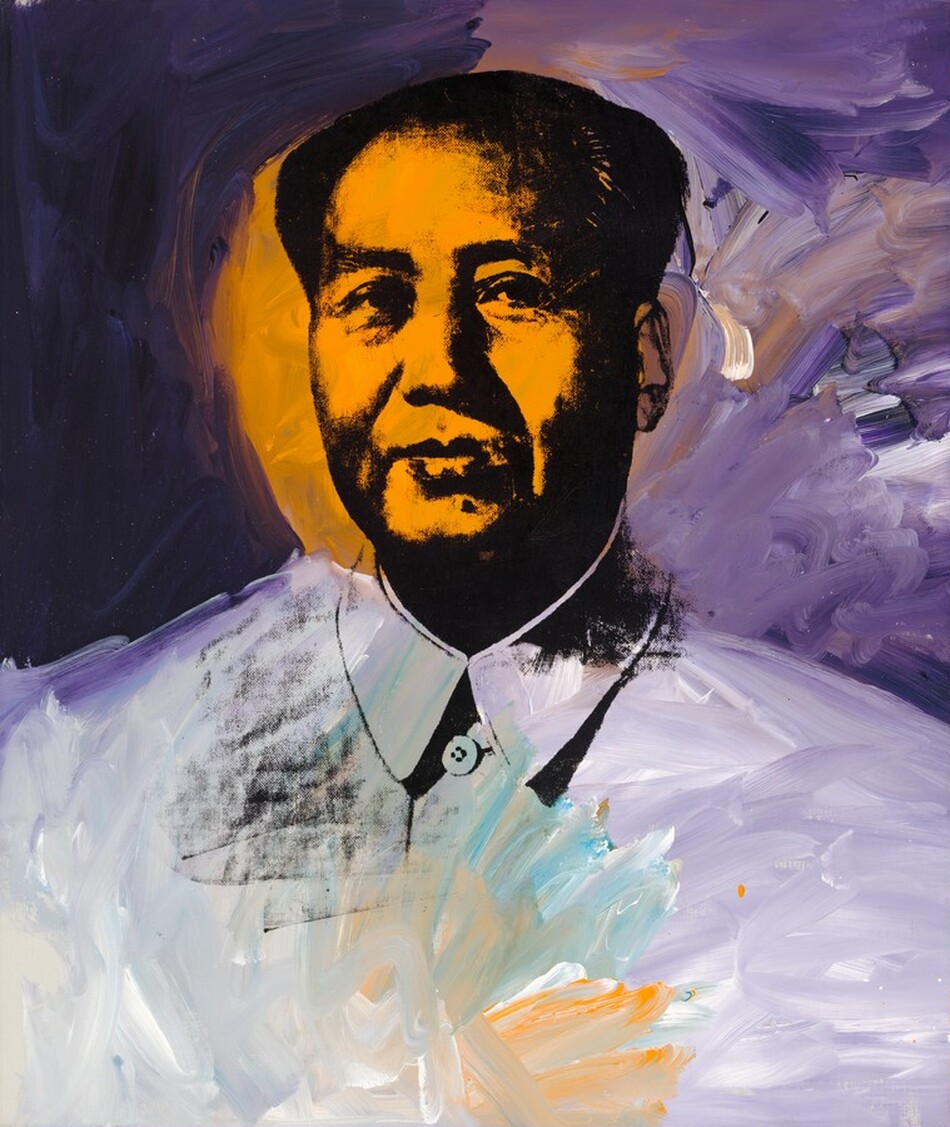
This painting shows a stylized portrait of a man. He faces forward, looking at us. His features are bold and graphic, with thick eyebrows, a slight smile, and dark shadows on his chin and neck. His face is a golden-orange color, and his hair is dark and close to his head. He wears a formal white collared shirt. The background to the left of his head is the same orange color as his face, while the rest of the background is in shades of light and dark purple. The bottom of his white shirt has areas of blue and orange. The paint has been applied with thick, visible brushstrokes, while the details of the man's face are in black, and appear to have been printed.
Andy Warhol, Mao, 1973, acrylic and silkscreen ink on linen, Corcoran Collection (Gift of the Friends of the Corcoran Gallery of Art), 2014.79.50
  • Opening in April, the Mint Museum (Charlotte, NC) will exhibit three paintings by Alma Thomas, Georgia O’Keeffe, and Edgar Degas.
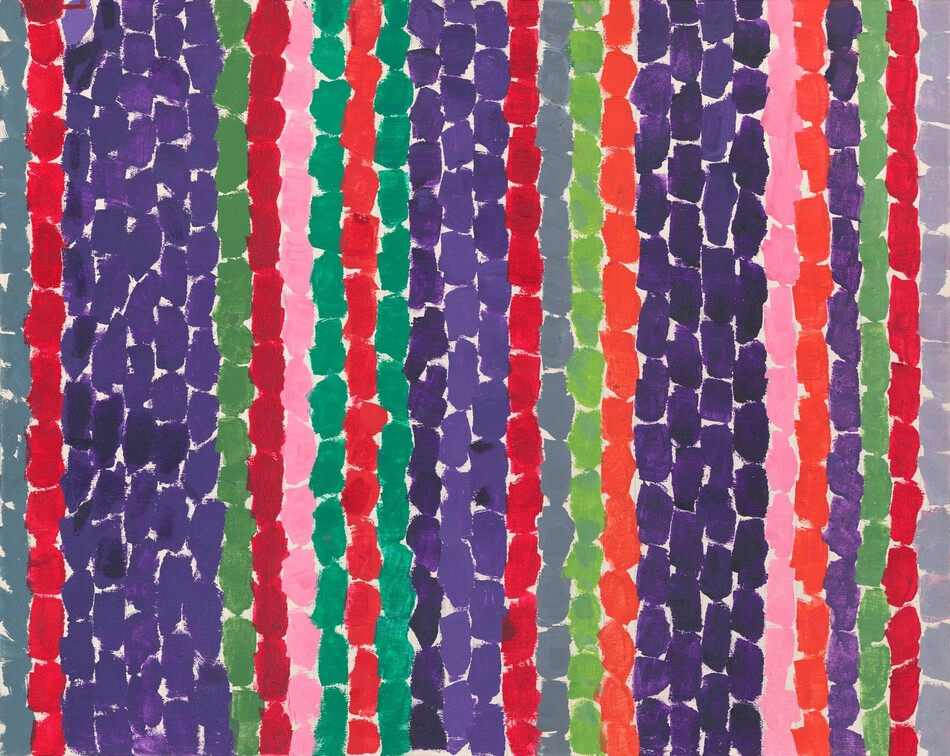
This painting is a composition of vertical lines made up of irregular segments. These lines are in various colors, and have been made with short, distinct brushstrokes. The lines are in purple, green, pink, red, and gray hues. Some of the white of the canvas is visible between the brushstrokes.
Alma Thomas, Autumn Drama, c. 1969, acrylic on canvas, Corcoran Collection (The Evans-Tibbs Collection, Gift of Thurlow Evans Tibbs, Jr.), 2015.19.211
  • Opening in May, the Figge Art Museum (Davenport, IA) will exhibit 10 historical masterworks from Northern Europe dating from 1537 to 1700, by artists including Lucas Cranach the Elder, Anthony van Dyck, Frans Hals, and Louis Vallée.
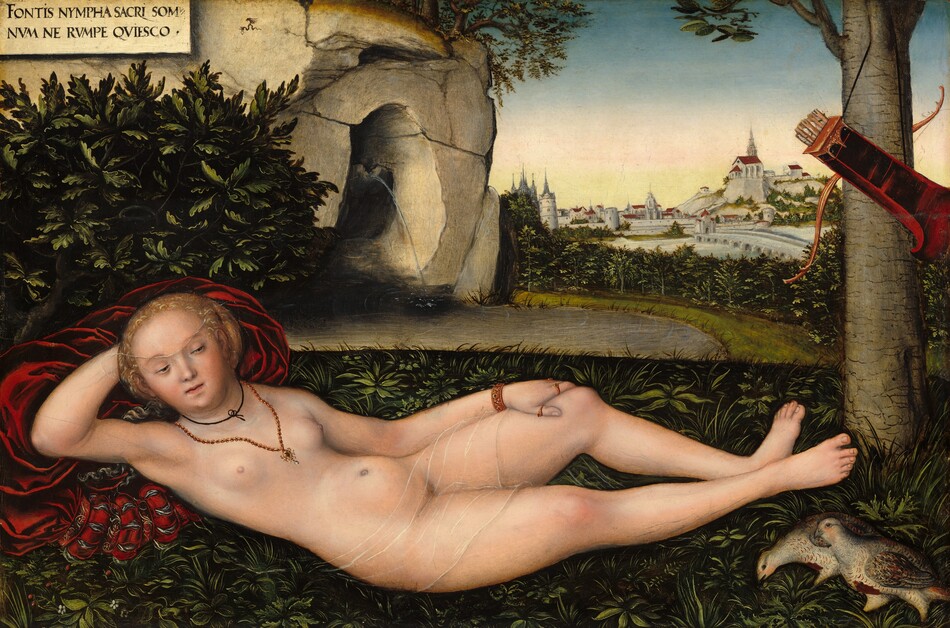
A nude woman with pale, rosy skin lies across a grassy field in front of a pool fed by water from a rocky outcropping, with a town in the distance in this horizontal painting. The woman lies back against a scarlet-red garment, presumably a dress, bunched under her shoulders, with her head to our left. Her face turns to us, but she cuts her eyes to our right, her lids nearly closed. She has a wide face, a pointed chin, and her thin, rose-pink lips are closed. Her blond hair is pulled back and gossamer fabric, nearly invisible, creates a veil reaching her arched eyebrows. She rests her head against her raised right arm, closest to the grass on which she lies, and her other arm rests along the side of her body. Her ankles are together but her knees fall slightly apart. More sheer fabric wraps across her hips. She wears a black cord tied in a bow around her neck and a longer, thick, gold chain necklace with a pendant with a ruby-red stone and pearls. On her left hand, along her body, she wears a crimson-red and gold, jeweled bracelet and three gold rings with red and blue jewels on her thumb, pointer, and pinkie fingers. The grass beneath her is painted with emerald-green plants and leaves against a dark, forest-green background. Two partridges walk in the grass, one pecking at the ground, near the lower right corner of the composition. An ash-gray tree trunk spans the height of the painting near the birds, and a bow and garnet-red, long, box-like quiver of arrows hang from a branch. Beyond the band of grass, to our left, is a pool being fed from a stream of water coming from the rocky, cave-like opening above. The pool is lined with more dark green trees and bushes. In the distance, to our right, is a town with slate-gray buildings with burgundy-red roofs. The sky above deepens from pale, sunshine yellow along the horizon to shell pink to watery blue. A rectangular plaque in the upper left corner reads, “FONTIS NYMPHA SACRI SOM NVM NE RVMP QVIESCO.” On the rock face of the cave nearby is a tiny silhouette of a serpent with folded wings holding a ring in its mouth.
Lucas Cranach the Elder, The Nymph of the Spring, after 1537, oil on panel, Gift of Clarence Y. Palitz, 1957.12.1
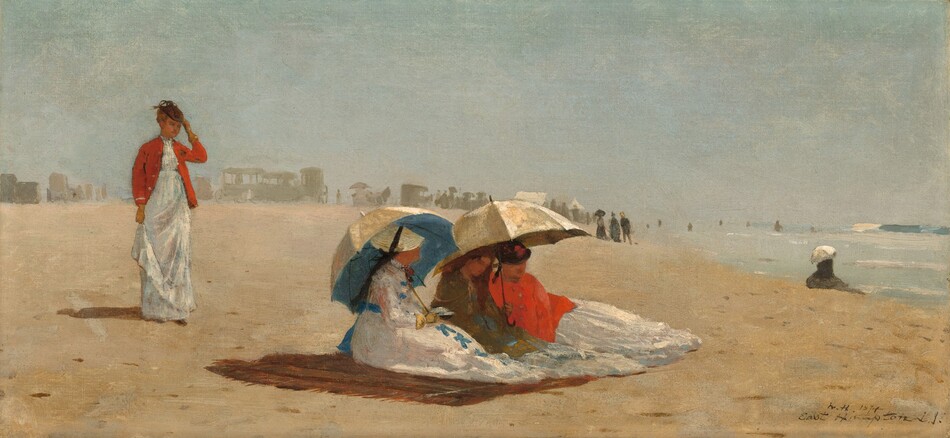
  • Opening in May, the New Britain Museum of Art (New Britain, CT), will present a historical painting by Robert Duncanson and a painting by Winslow Homer.
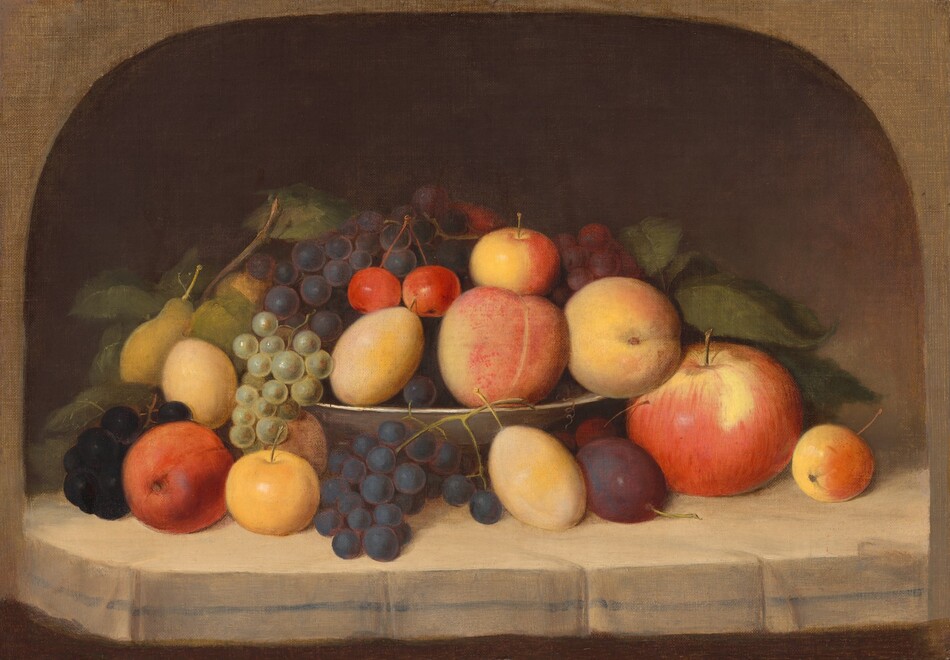
  • This painting shows various pieces of fruit arranged in a thin white bowl, including apples, peaches, green and purple grapes, cherries, pears, and plums. Some of the fruit is overflowing from the bowl, and rests on the white surface below, surrounding the bowl. Many of the pieces of fruit have thin stems attached to them, and some have thick green leaves. Behind the fruit, the background is dark brown, and there is a tan arched border around the painting.
    Robert Seldon Duncanson, Fruit Still Life, c. 1849, oil on canvas, Corcoran Collection (Museum Purchase through a gift from the Reserve for Purchase of Works of Art), 2014.136.106