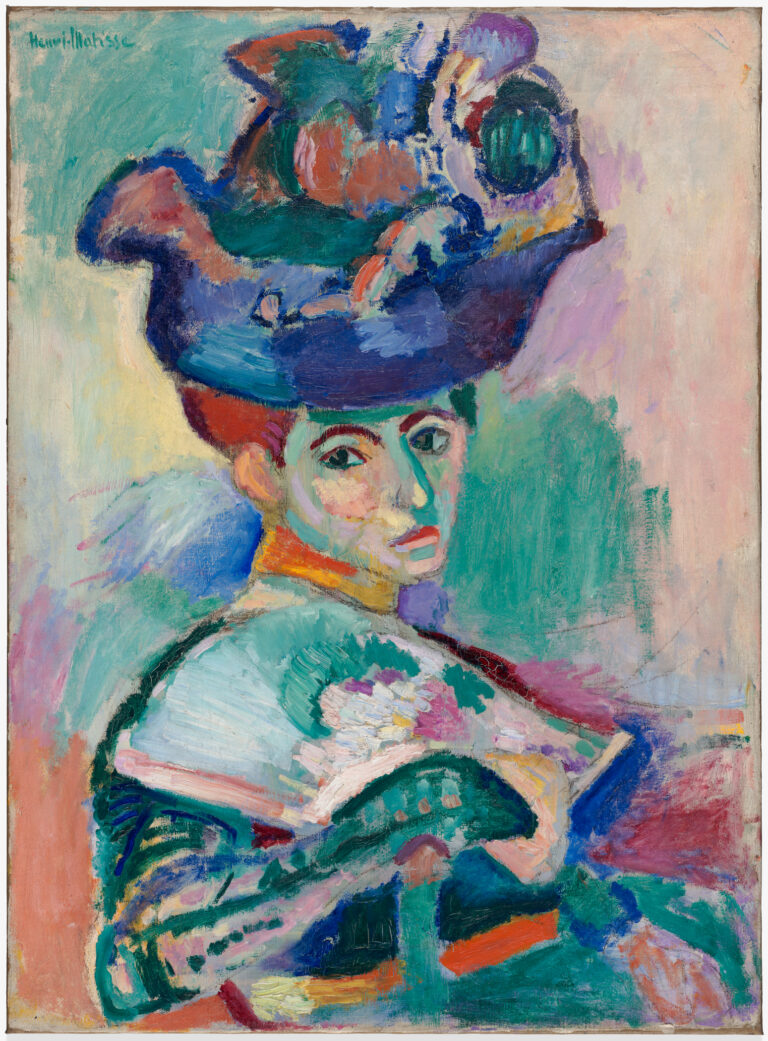
Henri Matisse ignited passionate controversy in 1905 with the public debut of Femme au chapeau (Woman with a Hat) at the Salon d’Automne in Paris. The portrait of the artist’s wife, Amélie, was at the center of a defining moment of rupture in the history of modern art, shocking audiences with its seemingly carefree brushstrokes and bright hues that purposefully departed from observed reality. It was established as the leading image of Fauvism, the first French avant-garde art movement of the 20th century.
From May 16 to September 13, 2026, the San Francisco Museum of Modern Art (SFMOMA) will present Matisse’s Femme au chapeau: A Modern Scandal, a major exhibition illuminating how the painting—now an icon of the museum’s collection—made its mark on art history. Positioning Matisse in dialogue with his peers, subsequent generations, as well as artists working today, the exhibition will examine in greater depth than ever before the painting’s historical context, subject, provenance, circulation through exhibitions and publications, and impact over more than a century.
The exhibition will also explore how the painting marked a pivotal moment in Matisse’s career, as it captured the attention of American expatriate collectors Leo and Gertrude Stein who, while living in Paris, acquired the work on the last day of the 1905 Salon d’Automne exhibition. In 1915, Femme au chapeau made its way to the Paris collection of their brother and sister-in-law, Michael and Sarah Stein, who brought it from France to the Bay Area in 1935. Matisse’s painting was shown in the US for the first time the following year, in an exhibition at the San Francisco Museum of Art (now SFMOMA) organized by its founding director, Grace McCann Morley. Since entering the museum’s collection in 1991 as a bequest of Levi’s heiress Elise S. Haas, who had purchased the work from Sarah Stein in 1948, it has continued to resonate with contemporary artists, who find inspiration in its bold approach to color and form. Under the terms of its bequest, Femme au chapeau does not travel, making SFMOMA the exclusive venue for this landmark exhibition.
“We are thrilled to have this opportunity to share the full story of Matisse’s Femme au chapeau—a painting that is emblematic of the artist’s radical break from convention in the early years of his career,” said Janet Bishop, SFMOMA’s Thomas Weisel Family Chief Curator. “Arguably SFMOMA’s most art-historically significant work of art, Femme au chapeau began sending shockwaves through the art world as soon as it left Matisse’s studio and has captivated viewers ever since. The exhibition will shed light on the painting in more detail than ever before, from its public debut in Paris in 1905, to its years as a must-see painting in Leo and Gertrude Stein’s Left Bank apartment, and, eventually to the walls of SFMOMA.
“Part of our vision at SFMOMA is to encourage our visitors to see the world—and art—in new ways. Matisse’s Femme au chapeau has long been a cornerstone of SFMOMA’s collection; through this exhibition we are able to consider the initial shock and enduring impact of this remarkable artwork through a range of different perspectives,” said Christopher Bedford, Helen and Charles Schwab Director of SFMOMA. “With stunning paintings by Matisse and his peers, as well as work by some of the most exceptional artists working today, this exhibition promises to captivate SFMOMA visitors this spring.”
EXHIBITION HIGHLIGHTS
The heart of the exhibition will restage the public debut of Matisse’s Femme au chapeau in Gallery VII of the 1905 Salon d’Automne in Paris. This gallery inspired the moniker fauve (wild beasts), coined in a review by critic Louis Vauxcelles in the October 17, 1905, issue of the periodical Gil Blas. Designed to echo the architectural context of the Salon, this space will feature work by all 10 of the artists included in the original presentation and will reunite the greatest number of objects from that gallery since 1905. The recreation of this seminal display will illuminate how and why works by Matisse, Charles Camoin, André Derain, Henri Manguin, Albert Marquet and Maurice de Vlaminck, among others sparked such heated debate and admiration during their time.
Other galleries will include focused analyses of different aspects of Femme au chapeau’s subject and history. An opening section will introduce the painting’s model, Amélie Matisse, as both a professional hat-maker and partner and close collaborator to Matisse. It will investigate the broader fashions of the time that informed her choice of headwear in the painting. Another explores the painting’s journey from the Paris salon to San Francisco as well as its circulation through exhibitions, and reproductions. Animated large-scale projections of both the Grand Palais and Leo and Gertrude Stein’s Left Bank apartment will provide immersive experiences, fostering further connections between visitors and the early twentieth-century Parisian avant-garde.
The final chapters of the exhibition will trace how artists have responded to Matisse’s painting over time—from works made by his peers such as Jacqueline Marval, Jean Metzinger, Kees Van Dongen, and Maurice de Vlaminck during or in the immediate aftermath of the Salon to those by artists working today such as Hilary Harkness, Rachel Harrison, David Hockney and others.The exhibition also uncovers its impact closer to home on Bay Area Figurative artists like Joan Brown, Richard Diebenkorn and David Park.

Woman with a Hat (Femme au chapeau), painted around 1905–1906 by the French Fauvist artist Maurice de Vlaminck.


André Derain, Henri Matisse, 1905; Tate;© 2026 Artists Rights Society (ARS), Courtesy of Tate

Fishing Boats, Collioure, an oil on canvas painting created in 1905 by André Derain

Paysage: Les genêts (Landscape: Broom) by Henri Matisse, painted in 1905–1906.
CATALOGUE

A richly illustrated 128-page book will accompany the exhibition, published by SFMOMA in association with DelMonico Books · DAP (Distributed Art Publishers). The volume will examine in unprecedented depth how Henri Matisse’s portrait of his wife Amélie impacted more than a century of art history. Contributors include Janet Bishop, Maria Castro, Claudine Grammont, Alison Guh, and Popy Venzal.
ORGANIZATION
Matisse’s Femme au chapeau: A Modern Scandal is organized by Janet Bishop, Thomas Weisel Family Chief Curator and Maria Castro, former Andrew W. Mellon Foundation Associate Curator of Painting and Sculpture with Alison Guh, Assistant Curator of Painting and Sculpture.
