Tuesday, June 4, 2013

American Spectrum: Paintings and Sculpture from the Smith College Museum of Art


A rare opportunity to trace the development of American art across more than 200 years was offered in American Spectrum: Paintings and Sculpture from the Smith College Museum of Art, on view March 4-May 27, 2001 at the Museum of Fine Arts, Houston. The collection of 62 works dating from 1733 to 1948 traveled to eight venues in the United States while the Smith College Museum of Art in Northampton, Massachusetts was closed for renovation and expansion. America's leading masters were represented in this show, including the painters Thomas Cole, John Singleton Copley, John Singer Sargent, Winslow Homer, and Childe Hassam, and the sculptors Alexander Calder, Daniel Chester French, Elie Nadelman, and Augustus Saint-Gaudens.


From


John Smibert's Mrs. John Erving (c. 1733)


to Jaune Quick-to-See Smith's The Red Mean: Self-Portrait (1992),


"American Spectrum: Paintings and Sculpture from the Smith College Museum" spanned over 250 years of American art. The seventy-five works selected for the exhibition represented many of America's most revered artists including painters Joseph Albers; Thomas Cole, NA; Winslow Homer, NA; Edward Hopper; George Inness, NA; Franz Kline; Robert Motherwell; Georgia O'Keeffe; John Singer Sargent, NA, and Gilbert Charles Stuart. Sculptors include Alexander Caider; Daniel Chester French, NA; Elie Nadelman; Louise Nevelson; and Augustus Saint-Gaudens, NA, among others.

The Smith collection began to take shape in 1879 when the college's first president L. Clarke Seelye decided he wanted students to have an art gallery where they could "be made directly familiar with the famous masterpieces." His early strategy was to acquire reproductive prints and casts of historic pieces, and to buy original contemporary art. Works in this exhibition that he bought directly from the artists include


Thomas Eakins's In Grandmother's Time


and Albert Pinkham Ryder's Perrette,


and possibly William Merritt Chase's Woman in Black.

Among them was Rockwell Kent's early work


Dublin Pond (1903),

a painting which the artist had recently submitted for the National Academy's Annual, purchased by the museum when the artist was only twenty-one, and the first works by the artist to be part of an institutional collection.

After Seelye firmly established the museum's American holdings, the collection continued to evolve into the 20th-century through equally astute acquisitions. Purchased in 1931,


Edith Mahon (1904)

was widely considered one of Thomas Eakins' finest portraits, and also constituted the first work by Eakins in any public art collection.


Notable bequests were also crucial in building the collection. They include


John Singleton Copley 's portrait of the Boston merchant, The Honorable John Erving, (c. 1772),

presented to the college by the judge's descendant and Smith Alumnus Alice Erving.

Gifts of modern and contemporary art include superb works by Arthur G. Dove, William Glackens, NA, Childe Hassam, NA, Willem de Kooning, Louise Nevelson, Joan Snyder, and Donald Sultan, and many others.


Albert Bierstadt, Echo Lake, Franconia Mountains, New Hampshire, 1861, oil on canvas, Smith College Museum of Art, Purchased with the assistance of funds given by Mrs. John Stewart Dalrymple (Bernice Barber, class of 1910), 1960.37)

Stories behind some of the works make them all the more intriguing.
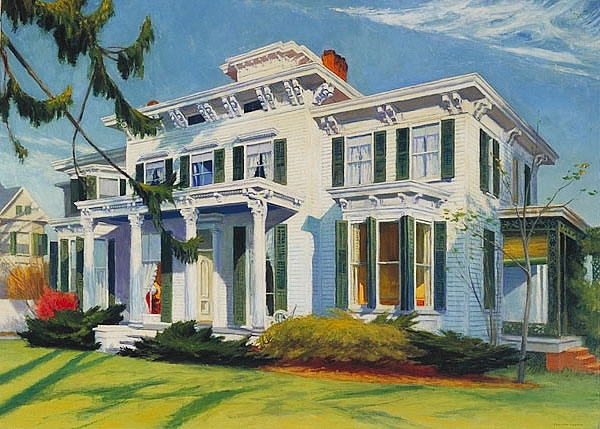


Edward Hopper's Pretty Penny (1939) is a joyous, light-filled portrait of the house of the actress Helen Hayes.

Hopper was commissioned to do the painting, but was reluctant to accept at first because he considered it tradesman's work. He eventually relented, creating a work without the darkness and alienation so common in his paintings of American houses. Hayes, who received an honorary doctorate from Smith in 1940, gave the painting to the museum in 1964.

Edwin Romanzo Elmer, a painter who died unknown, is represented by two paintings in the exhibition,


Mourning Picture (1890)


and A Lady of Baptist Corner, Ashfield, Massachusetts (the Artist's Wife), (1892).

Mourning Picture is a family portrait of the artist, his wife, and their daughter, who had died not long before, and a pet sheep against the backdrop of a Victorian house. It was first shown in a post office in 1890 and then was not seen again until 1950 when the artist's niece showed it to Henry-Russell Hitchcock, then director of the Smith Museum. Hitchcock recognized its value at once. It became one of the most popular and most frequently reproduced paintings in the collection. In the portrait of his wife operating a machine he invented to make whip snaps (the braided end of horsewhips), Elmer shows his love of detail - from the design of the carpet to the play of light and shadow in the scene.

Other paintings in the exhibition gloriously document man's achievements in transportation and industry.
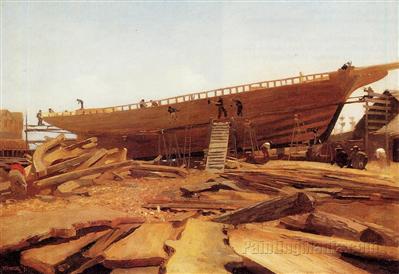


Winslow Homer's Shipyard at Gloucester (1871) captures a crew building a schooner so accurately that a historian has been able to determine the hull type and the details of the ship under construction.


Charles Sheeler, Rolling Power (1939)

Among the dozen sculptures in the exhibition were Elie Nadelman's elegantly designed Resting Stag (c. 1915) and Augustus Saint-Gaudens's Diana of the Tower (1899). Nadelman's deer, in gold-leafed veneer and a wood-veneered base, was created at the height of his career. Saint-Gaudens's bronze sculpture is one of a number of reductions the artist made of Diana, an 18-foot figure that sat atop a 330-foot-high tower at Madison Square Garden in New York at the turn of the century. The sculpture was created as weathervane. The Smith Museum's variant is 36 inches high and the only known kinetic version.


A 307-page catalogue, Masterworks of American Painting and Sculpture from the Smith College Museum of Art, accompanied the exhibition. In the book, 79 of the museum's most important American works are illustrated in full color and discussed in comprehensive essays. An illustrated checklist with 85 additional works from the museum is included. Linda Muehling, associate curator of painting and sculpture at Smith Museum, is the editor and principal author.


Childe Hassam, White Island Light, Isles of Shoals, at Sundown, 1899, oil on canvas, Smith College Museum of Art, Gift of Mr. and Mrs. Harold D. Hodgkinson (Laura White Cabot, class of 1922), 1965.4

American Spectrum: Paintings and Sculpture from the Smith College Museum of Art
was organized by the Smith College Museum of Art, Northampton, Massachusetts.

The eight venues for this exhibition were: Faulconer Gallery at Grinnell College in Grinnell, Iowa, February 5-April 23, 2000; National Academy of Design Museum, New York, June 21-September 10, 2000; Norton Museum of Art, West Palm Beach, Florida, October 28, 2000-January 7, 2001; the MFAH, March 4-May 28, 2001; Pennsylvania Academy of the Fine Arts, Philadelphia, June 29-September 30, 2001; Memorial Art Gallery of the University of Rochester, Rochester, New York, October 28, 2001-January 13, 2002; Tucson Museum of Art, Tucson, Arizona, February 16-April 28, 2002; and Katonah Museum of Art, Katonah, New York, June 23-September 15, 2002.


More images from the exhibition:
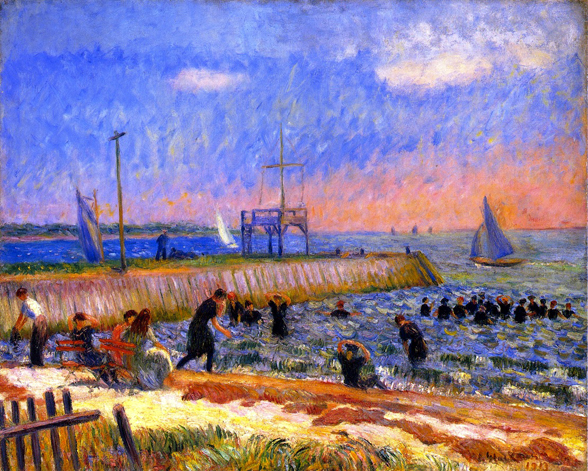


William Glackens, Bathers, Bellport, No. 1


Lyonel Feininger, Gables I, Lüneburg


Childe Hassam, Cab Stand at Night , Madison Square


Childe Hassam, Union Square in Spring


Childe Hassam, Street Scene, Christmas Morn


Georgia O'Keeffe, Squash Flowers No. 1
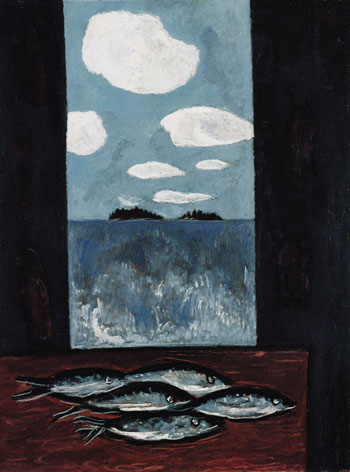


Marsden Hartley Sea Window - Tinker Mackerel


Charles Sheeler, Powerhouse


Alice Neel, Anthony Barton

Pierre Bonnard at The Museum of Modern Art


The first retrospective of the work of French painter Pierre Bonnard to be shown in New York since 1964 appeared at The Museum of Modern Art June 21-October 13, 1998. One of the most enigmatic of the great artists of the twentieth century, Bonnard (1867-1947) is perhaps best known for his extraordinary colors and sensuous nudes. As this comprehensive exhibition makes clear, however, Bonnard is not simply a painter of hedonistic beauty, but one of the great masters of structure and composition, who reconfigured pictorial space to convey complex emotional states.

By focusing on interiors, still lifes, landscapes, and figure paintings, including the famous bath paintings of his enigmatic wife, Marthe, as well as the remarkable self-portraits, this exhibition emphasized the consistency of Bonnard's preoccupation with the physical as modified by color and light, and showed how he was able to keep reshaping the familiar through compositions of increasing complexity, daring, and originality. Comprising some 80 works, Bonnard concentrates on the artist's foremost period of innovation, beginning in the mid-1910s. It presents celebrated works from public collections and little-known works in private hands, some of which had never been seen in the United States before. The exhibition also brought together the largest number of Bonnard selfportraits to be shown in one place, concluding with the stark and moving images of the artist's last years.

Bonnard occupied eight galleries. The first two showed the unfolding of Bonnard's art from around 1890 until the late 1920s. The remaining six galleries showed his later paintings grouped according to subject matter. Japanese prints and the work of Paul Gauguin influence early works like


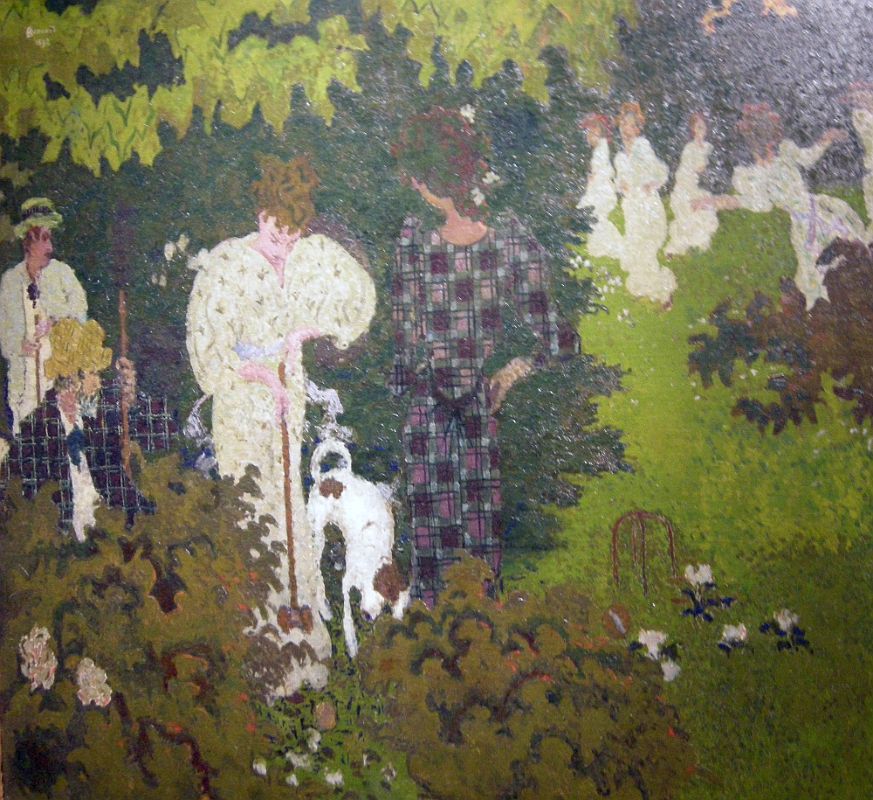
Intimacy (1891)


and The Croquet Game (1892),

in which Bonnard's fascination with how patterning can be used to hide things in a painting, slowing one's perception of them, is already evident. By 1900 Bonnard's subject matter had become moments of perception--he wanted to convey what it was like to come upon something unexpectedly for the first time. Bonnard surprised the viewer by making things strange: Everyday objects are oddly shaped, of uncertain texture or incredible color, hard to decipher, hidden in unlikely corners or reflected in mirrors, and so on. Having stopped a moment of time, he asks for our participation in unpacking the complexity of detail to be found there.

By 1920, Bonnard's mature style was formed and, while it did change as the years passed, the stylistic changes are finally less important than how Bonnard treated his key subjects--still life, landscape, bathers, interiors, and self-portraits.

Like all of Bonnard's mature works, his still lifes were painted on lengths of canvas tacked to the wall, some of them large enough to accommodate more than one picture. Bonnard would often crop the painted area slightly to square off the work, but he sometimes left raw canvas around the edges, as in


Basket of Fruit Reflected in a Mirror (1944-46).

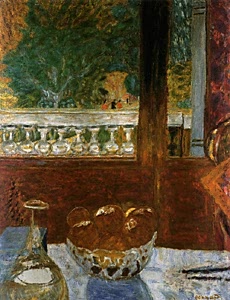
In either case, he paid particular attention to the edges of a painting, often reserving his most enigmatic or fragmentary imagery for the margins. This is most evident, perhaps, in the


Provençal Jug of 1930,

which shows the hand and arm of an unseen figure on the right. Bonnard's landscapes form a distinct group within his oeuvre. He made a point of leaving his own garden relatively untended, and his landscape paintings delight in the natural disorder of nature. They are, by far, the densest and most continuously patterned of his works. The range of markings is extraordinary: Dots, lines, bands, patches, scribbles, and streaks of multiple colors configure a strikingly active visual realm, a flat but dynamic map-making that opens into depth beneath the viewer's gaze.

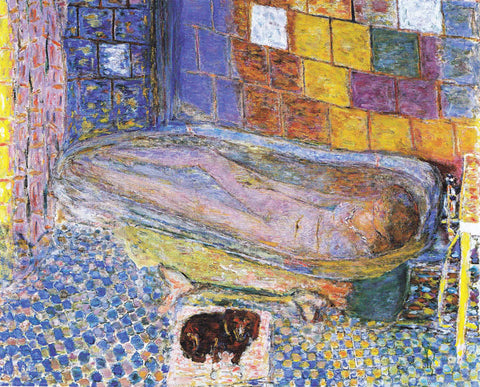
Bonnard's early images of female bathers were unquestionably influenced by the work of Edgar Degas--but eschew Degas's uncomfortably stressful poses for a mixture of frank domestic realism and a note of idealization taken from classical sculpture.

The three late bathtub paintings that were on view--


Nude in the Bath (1936),


The Large Bath, Nude (1937-9),


Nude in the Bath and Small Dog (1941-6)

--are widely considered the culmination of Bonnard's career. Returning to the image of immersed bathing in a 1925 painting, the artist makes what had been, in part, tomblike into something closer to a shrine--suggesting not only mortality but also the commemoration and celebration of things carnal. (In fact, Marthe died in 1942, while Nude in the Bath and Small Dog was in progress.) The figure of Marthe--whose likeness appears in some 380 of Bonnard's works--is at once iconic in a grand, distant way and an all-too-proximate fleshy substance, both peacefully floating and seeming to dissolve. The bathroom tiles form a iridescent screen that glitters and sparkles brilliantly.

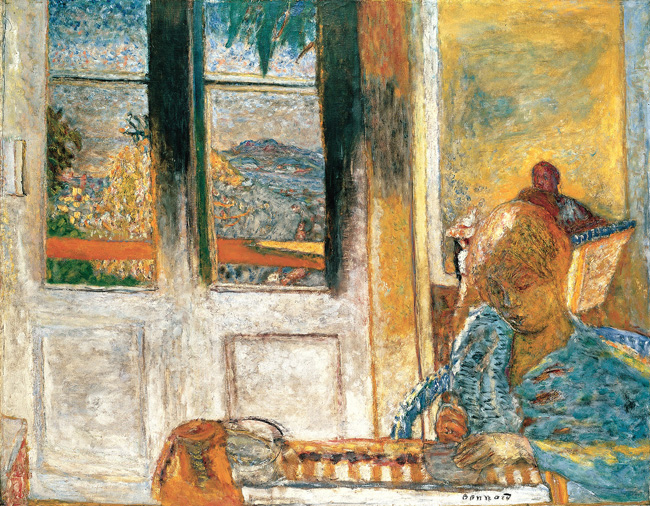
Bonnard's interiors are often presented as luminous spaces filled with familiar objects that become more unfamiliar the longer you examine them. The artist was often drawn to the same interior, as if trying to unravel its mystery. MoMA's magnificent


Dining Room Overlooking the Garden (The Breakfast Room) (1930-1), for example,


and Still Life in Front of the Window (1931)

show the same room at Arcachon, near Bordeaux;


Large Dining Room Overlooking the Garden (1934-5)


and Table in Front of the Window (1934-5)

depict the same room in a rented villa near Deauville;


and The French Window (1932)


and The Breakfast Table (1936)

are from the same room in Bonnard's house at Le Cannet.

The most daring of Bonnard's self-portraits make it clear that they are mirrored representations. In most of these late works the subject is transparently Bonnard's own mortality, and in two works,


Portrait of the Painter in a Red Dressing Gown (1943)


and Self-Portrait (1945),

this is metaphorically expressed by the wartime blackout curtain depicted next to the artist's image. They are among the most poignant self-representations in Western art: querulous apparitions, despairing, frightened, selfeffacing. Bonnard died in January 1947. Some fifteen months later, in May 1948, MoMA opened its first retrospective exhibition of his work; a second was held in 1964. This third Bonnard retrospective at the Museum celebrated a career that ended more than half a century ago but remains as vital and challenging as any in contemporary art.

Bonnard was organized by the Tate Gallery, London, in collaboration with The Museum of Modern Art. It was curated by Sarah Whitfield, independent Art Historian, for the Tate Gallery, in consultation with John Elderfield and art historian and critic David Sylvester. It was coordinated for and installed at The Museum of Modern Art by Mr. Elderfield, who also contributed an essay to the exhibition catalogue, and refined the selection of works for the New York showing.

Bonnard was shown at the Tate Gallery, London (February 12-May 17, 1998) prior to opening at MoMA, its final venue.

PUBLICATION


Bonnard, by Sarah Whitfield and John Elderfield. 270 pages; 273 illustrations (115 in color). Clothbound published in the United States and Canada by Harry N. Abrams, Inc.,


Frida Kahlo, Diego Rivera and Masterpieces of Modern Mexico from the Jacques and Natasha Gelman Collection


Fiery passion and the warm, festive atmosphere of Mexico define an exhibition opening on June 1 at The Nelson-Atkins Museum of Art in Kansas City. Frida Kahlo, Diego Rivera and Masterpieces of Modern Mexico from the Jacques and Natasha Gelman Collection showcases more than 100 paintings, sculptures, photographs and drawings collected by the Gelmans in their adopted homeland of Mexico.

“When the Don Hall Initiative was created at the beginning of my tenure with the Nelson-Atkins, we hoped to bring exhibitions here that would reverberate in the community,” said the Mexico City-born Julián Zugazagoitia, CEO and Director. “The Gelman Collection has universal appeal but is so close to my personal history that we are thrilled to present these masterpieces to Kansas City.”

Jacques Gelman, a Russian-born film production mogul, and Natasha, his Czechoslovakian-born wife, became Mexican citizens in 1942 following the couple’s marriage in 1941. Over the next five decades, the Gelmans supported generations of internationally renowned Mexican artists. They established friendships with and collected art by such icons of Mexican modernism as Frida Kahlo, Diego Rivera, David Alfaro Siqueiros, Rufino Tamayo, and Gunther Gerzso, among others.

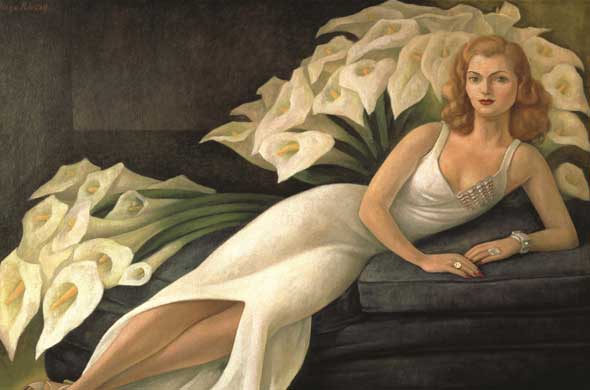
The Gelman Collection is the realization of an intimate collaboration spanning more than 40 years; it was the predominant passion of Jacques and Natasha. The collection began in 1943 with Rivera’s portrait of Natasha Gelman and continued to grow even after Jacques’ death in 1986. The couple collected art without hesitation. They acquired the canvases of Kahlo and Rivera when there were only a handful of collectors in Mexico.

Although their styles were radically different, Kahlo and Rivera were similarly captivated by painting’s potential to explore the human condition. Rivera painted massive murals depicting the heroic struggle of Mexican society forging its future; Kahlo explored the inner workings of her soul, which reflect the female condition today, in a series of self-portraits that revealed her tragic medical history and affirmed her Mexican identity.

The Gelman collection is, in and of itself, a work of art. It is also a work in progress. Owing to the enthusiasm they felt for Mexican art, the Gelmans desired that their collection be kept up to date. Works by significant contemporary artists such as Paula Santiago, Betsabeé Romero, Francis Alÿs and Gabriel Orozco have recently entered the Gelman collection. Thanks to the discerning eye of its president, Robert Littman, the collection continues to grow and evolve according to the forward-thinking couple’s wishes.


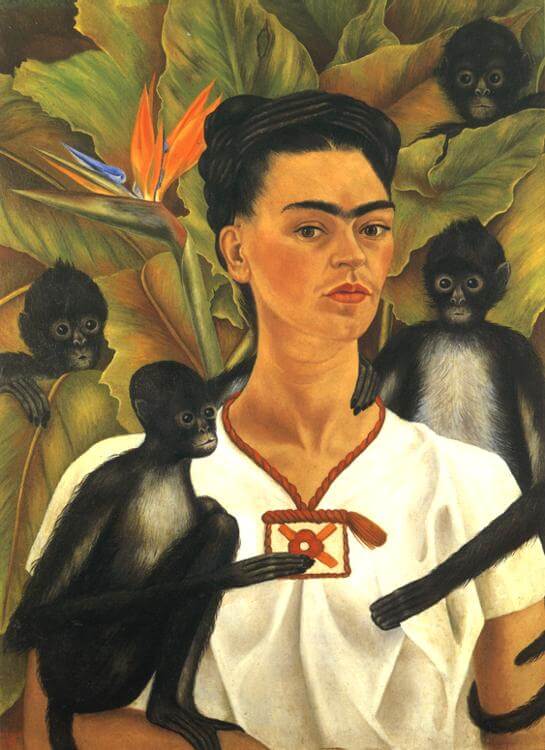
The exhibition includes key images by Kahlo such as


Self Portrait with Monkeys,(1943)

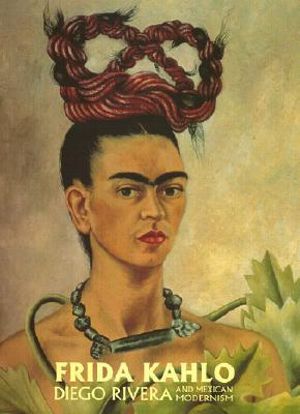
and Self Portrait as a Tehuana or Diego in My Thoughts, (below)


and the major work by Rivera, Calla Lily Vendors1943).


Reflecting the Gelmans' personal tastes, their collection of Mexican art includes many portraits of themselves, such as


Rufino Tamayo's Portrait of Mrs. Natasha Gelman (1948)


and Ángel Zárraga's Portrait of Mr. Jacques Gelman (1945).

Throughout the post-World War II artistic boom in Mexico, the Gelmans befriended a long list of renowned artists, including Kahlo, Diego Rivera and David Alfaro Siqueiros. Consequently, their collection of Mexican works reveals not only their passion for art, but also their blossoming relationships with such artists.

The paintings are supplemented by a display of the rarely-seen photographs by Frida Kahlo' s father Guillermo Kahlo (1872-1941) depicting churches and cloisters around Mexico City and Tepotzlan, alongside views from the Palace in Chapultepec Park. Their inclusion allows, for the first time in this country, the work of Frida Kahlo to be placed alongside and put into context with the two most important men in her life.

The exhibition is further extended with a selection of photographs by another key artistic couple who offer a significant glimpse of Mexico's cultural history, the photographers Manuel Álvarez Bravo (1902-2002) and Lola Álvarez Bravo (1905-1993). Manuel famously photographed the Mexican Muralists, and his cinematic images of Mexico speak of the mystery of everyday life and contemporary political and social problems. Lola began taking photographs under the influence of her husband in the 1920s and worked in a number of photographic genres such as nudes, still life, landscape, photomontage and portraits. She was a close friend of Frida Kahlo, and hosted Frida's first solo exhibition in Mexico in her gallery (Galería de Arte Mexicano) in 1953.

Frida Kahlo, Diego Rivera and Masterpieces of Modern Mexico from the Jacques and Natasha Gelman Collection runs through Aug. 18 at the Nelson-Atkins and showcases an exceptional private collection that not only highlights the rich and vibrant artistic traditions of the Mexico of yesterday, but underscores the inventiveness and vitality of Mexican art today.


Frida Kahlo (Mexican, 1907–1954). Diego en mi pensamiento (Diego on My Mind), 1943. Oil on Masonite, 29 7/8 x 24 inches. The Jacques and Natasha Gelman Collection of 20th Century Mexican Art. The Vergel Foundation. Conaculta/INBA. © 2013 Banco de México Diego Rivera Frida Kahlo Museums Trust, Mexico, D.F. / Artists Rights Society (ARS), New York.


Diego Rivera (Mexican, 1886–1957). Retrato de la Señora Natasha Gelman (Portrait of Mrs. Natasha Gelman), 1943. Oil on canvas, 45 1/4 x 60 1/4 inches. The Jacques and Natasha Gelman Collection of 20th Century Mexican Art. The Vergel Foundation. Conaculta/INBA. © 2013 Banco de México Diego Rivera Frida Kahlo Museums Trust, Mexico, D.F. / Artists Rights Society (ARS), New York.


Carlos Mérida (Guatemalan, 1891–1984). El mensaje (The Message), 1960. Painted board, 28 x 34 5/8 inches. The Jacques and Natasha Gelman Collection of 20th Century Mexican Art. The Vergel Foundation. © 2013 Artists Rights Society (ARS), New York / SOMAAP, Mexico City.


Interesting article


This exhibition has been organized by The Nelson-Atkins Museum of Art with the Vergel Foundation. Support has been received from The Keith and Margie Weber Foundation, Belger Cartage Service, Inc., the Campbell-Calvin Fund and Elizabeth C. Bonner Charitable Trust for exhibitions and our generous donors to the Annual Fund.

The Nelson-Atkins Museum of Art

The Nelson-Atkins in Kansas City is recognized nationally and internationally as one of America’s finest art museums. The Nelson-Atkins serves the community by providing access and insight into its renowned collection of more than 33,500 art objects and is best known for its Asian art, European and American paintings, photography, modern sculpture, and new American Indian and Egyptian galleries. Housing a major art research library and the Ford Learning Center, the Museum is a key educational resource for the region. The institution-wide transformation of the Nelson-Atkins has included the 165,000-square-foot Bloch Building expansion and renovation of the original 1933 Nelson-Atkins Building.

The Nelson-Atkins is located at 45th and Oak Streets, Kansas City, MO. Hours are Wednesday, 10 a.m.–4 p.m.; Thursday/Friday, 10 a.m.–9 p.m.; Saturday, 10 a.m.–5 p.m.; Sunday, Noon–5 p.m. Admission to the museum is free to everyone. For museum information, phone 816.751.1ART (1278) or visit nelson-atkins.org.


Catalogue


Hudson River School: Masterworks from the Wadsworth Atheneum Museum of Art

The Iris & B. Gerald Cantor Center for Visual Arts at Stanford University showcased an exhibition of masterpieces from one of the world's foremost collections of Hudson River School paintings from October 8, 2003 to January 18, 2004. This selection of 55 paintings includes 10 by Thomas Cole, 11 by Frederic Church, and five by Albert Bierstadt. The exhibition Hudson River School: Masterworks from the Wadsworth Atheneum Museum of Art continues through at Stanford, then travels to six other museums across the U.S., including:

Carnegie Museum of Art, Pittsburgh - Feb-May 2004
Tacoma Art Museum - October 2, 2004 - January 16, 2005
Frist Center for the Visual Arts, Nashville (September 23, 2005 - January 8, 2006)

The exhibition was organized by the Wadsworth Atheneum Museum of Art, Hartford, Connecticut, from its permanent collection.

The core of this Hudson River School collection was formed by two major patrons of American artists who lived in Hartford, Connecticut: Daniel Wadsworth (1771–1848), a devoted traveler, amateur artist and architect, and founder of the Wadsworth Atheneum, and Elizabeth Hart Jarvis Colt (1826–1905), widow of arms manufacturer Samuel Colt. Many works were commissioned for their personal enjoyment. Due to their patronage, the Wadsworth Atheneum's collection reflects the evolving aesthetic sensibilities of two generations of Hudson River School painters. In turn, the works reveal the emerging sense of an American national identity, which was also evident in the writings of 19th-century authors such as Ralph Waldo Emerson and James Fenimore Cooper.


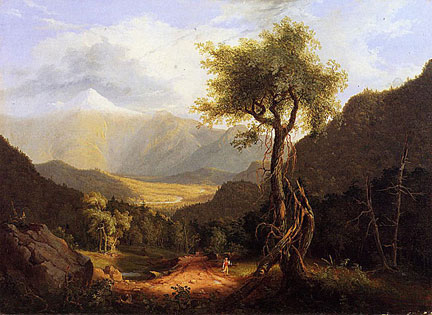
Thomas Cole, “View in the White Mountains” 1827


The origins of the Hudson River School traditionally are attributed to Thomas Cole, who was born in England and raised in Ohio before arriving in New York City in 1825. Cole was a more cerebral painter than his predecessors, and he used his art as a moral as well as aesthetic platform. Breaking from the traditional European taste for manicured pastoral views, Cole depicted the virginal, primeval wilderness of the American northeast. It was a paradise already lost, however, for Native Americans had been chased from their lands, white settlements had been long established, and tourism was beginning to boom.

Wadsworth introduced 17-year-old Hartford native and aspiring artist Frederic Church to Thomas Cole, who made Church his sole apprentice. Wadsworth then purchased Church's first mature painting, Hooker and Company Journeying Through the Wilderness from Plymouth to Hartford in 1636 (created in1846), for $130, acquiring it for the newly founded Wadsworth Atheneum. Church was then 20 years of age. Later, during the Civil War, Church advised Elizabeth Hart Jarvis Colt in assembling an impressive private picture gallery for her mansion, Armsmear, in Hartford. He introduced her to Albert Bierstadt, William Bradford, John Kensett, Sanford Gifford, and others, from whom she commissioned paintings.

Related article and images


Figure 1, Thomas Cole, Kaaterskill Falls, 1826. Oil on canvas; 251⁄4 x 365⁄16 in.
Bequest of Daniel Wadsworth, 1848.14


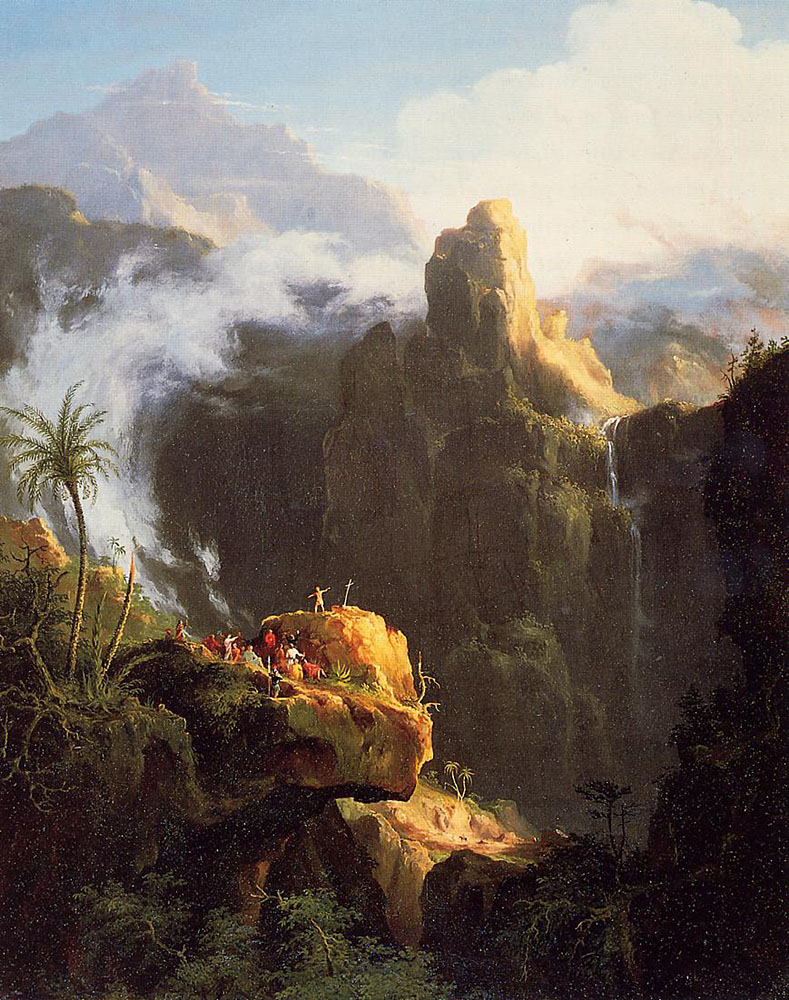
Figure 2, Thomas Cole, Landscape Composition, St. John in the
Wilderness, 1827. Oil on canvas; 36 x 29 in. Bequest of Daniel
Wadsworth, 1848.16


Figure 3, Thomas Cole, Scene from “The Last of the Mohicans”:
Cora Kneeling at the Feet of Tamenund, 1827. Oil on canvas,
253⁄8 x 35 in. The Wadsworth Atheneum Museum of Art
Bequest of Alfred Smith, 1868.3


Figure 4, Thomas Cole, View on Lake Winnipiseogee, 1828. Oil
on canvas; 193⁄4 x 261⁄8 in. Bequest of Daniel Wadsworth, 1848.13


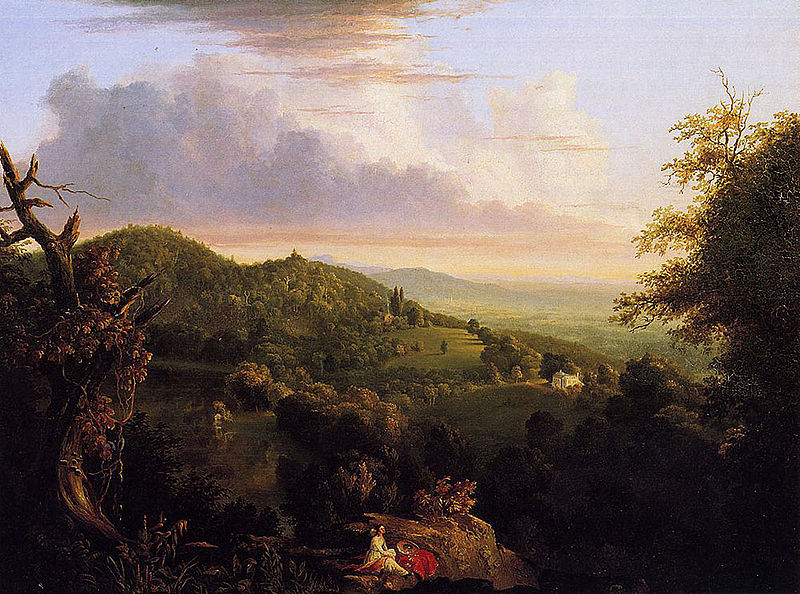
Figure 5, Thomas Cole, View of Monte Video, the Seat of Daniel
Wadsworth, Esq., 1828. Oil on canvas; 193⁄4 x 261⁄16 in. Bequest of
Daniel Wadsworth, 1848.14


Figure 6, Thomas Cole, Mount Etna from Taormina, 1843. Oil on canvas, 78 5⁄8 x 120 in.
The Wadsworth Atheneum Museum of Art. Museum Purchase, 1844.6


Figure 7, Frederic E. Church, Hooker and Company Traveling
through the Wilderness from Plymouth to Hartford, in 1636,
1846. Oil on canvas, 401⁄4 x 60 in. The Wadsworth Atheneum
Museum of Art, Museum Purchase, 1850.9


Figure 8, Frederic E. Church, Grand Manan Island, Bay of Fundy,
1852. Oil on canvas, 2113⁄16 x 31 in. The Wadsworth Atheneum
Museum of Art. Gallery Purchase Fund, 1898.6


Figure 9, Frederic E. Church, Coast Scene, Mount Desert, 1863.
Oil on canvas; 361⁄8 x 48 in. Bequest of Clara Hinton Gould,
1948.178


Figure 10, Frederic E. Church, Vale of St. Thomas, Jamaica, 1867.
Oil on canvas, 485⁄16 x 84 in. The Wadsworth Atheneum Museum of Art.
Bequest of Elizabeth Hart Jarvis Colt, 1905.21


Figure 11, Asher B. Durand, View Toward the Hudson River
Valley, 1851. Oil on canvas, 331⁄8 x 481⁄8 in. The Wadsworth
Atheneum Museum of Art. The Ella Gallup Sumner and Mary
Catlin Sumner Collection Fund, 1948.119


Figure 12, Albert Bierstadt. In the Mountains, 1867. Oil on
canvas, 363⁄16 x 50 in. The Wadsworth Atheneum Museum of Art.


Figure 13, Albert Bierstadt, Toward the Setting Sun, 1862. Oil on
canvas; 73⁄4 x 14 in. Gift of Mr. J. Harold Williams, in memory of
Edith Russell Wooley, 1977.74


Figure 14, John F. Kensett, Coast Scene With Figures (Beverly
Shore), 1869. Oil on canvas, 36 x 60 3⁄8 in. The Wadsworth
Atheneum Museum of Art. The Ella Gallup Sumner and Mary
Catlin Sumner Collection Fund, 1942.345
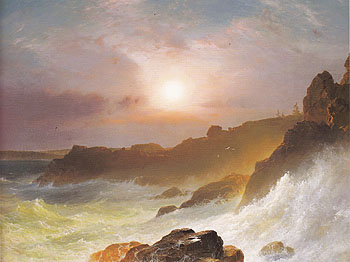
by Kensett’s Coast Scene


Catalogue


Hudson River School - Masterworks from the Wadsworth Atheneum Museum of Art
180 p., 9 1/2 x 12
34 b/w + 67 color illus.
ISBN: 9780300101164

* Introduction by Elizabeth Mankin Kornhauser; Catalogue by Elizabeth Mankin Kornhauser and Amy Ellis, with Maureen Miesmer

This book features fifty-seven major Hudson River School paintings from the collection of the Wadsworth Atheneum Museum of Art, recognized as the most extensive and finest in the world.

Gorgeously and amply illustrated, the book includes paintings by all the major figures of the Hudson River School. Each work is beautifully reproduced in full color and is accompanied by a concise description of its significance and historical background. The book also includes artists’ biographies and a brief introduction to American nineteenth-century landscape painting and the Wadsworth Atheneum’s unique role in collecting Hudson River pictures.


About the Wadsworth Atheneum Museum of Art:

The quality and range of fine and decorative arts at the Wadsworth Atheneum place it among the dozen greatest art museums in the United States. Its world-renowned collections include Old Master paintings, modernist masterpieces, 19th-century French and Impressionist paintings, Meissen and Sevres porcelains, costumes and textiles, American furniture and decorative arts of the Pilgrim Century through the Gilded Age, and the vanguard of contemporary art.

The Wadsworth Atheneum is named for its founder, the arts patron and philanthropist Daniel Wadsworth (1771–1848), and after the Athenaeum in Rome (itself named for Athena, the Greek goddess of wisdom). Established in 1842, the Wadsworth Atheneum is America's oldest public art museum, preceding the founding of The Metropolitan Museum of Art in New York and the Museum of Fine Arts in Boston by three decades. It was the first American museum to acquire works by Michelangelo Merisi da Caravaggio, Frederic Church, Salvador DalÌ, Joan Miro, Alexander Calder, Piet Mondrian, Joseph Cornell, and Max Ernst.

Saturday, June 1, 2013

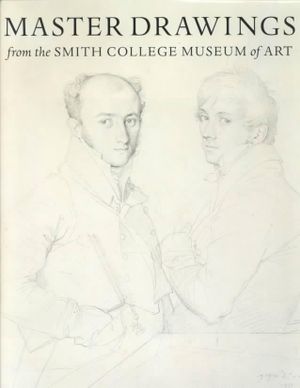
Master Drawings from the Smith College Museum of Art


Master Drawings from the Smith College Museum of Art was on view at The Frick Collection through August 12, 2001, before traveling to the Uffizi Gallery in Florence, where it was on view from October 16, 2001 through January 6, 2002. The exhibition was organized by the Smith College Museum of Art, Northampton, Massachusetts.

The Smith College Museum of Art in Northampton, Massachusetts, is widely acknowledged to have one of the most important college art collections in America, and one of its extraordinary strengths is its renowned collection of master drawings. New York audiences had the opportunity to view a superb selection of these works on paper - spanning some six centuries of draftsmanship - when Smith lent an important selection of these works to The Frick Collection, the only North American venue on an international tour.


Master Drawings from the Smith College Museum of Art

Images clockwise from the top left:

A Faun Carrying a Basket of Grapes. (1747). Natoire, Charles Joseph. red chalk heightened with white chalk on brown antique laid paper. 14 7/16 x 9 1/4 inches.

A Monumental Stair Hall. (c.1900s). Bibiena, Giuseppe Galli. pen and dark brown ink with brush and grey ink over black chalk. 11 1/2 x 7 9/16 inches.

Chrysanthemum. (c.1921-1925). Mondrian, Piet. black and brown chalks with stumping on gray laid paper. 24 3/4 x 15 1/8 inches.

The Commemoration (L’Anniversaire). (1886). Fantin-Latour, Ignace Henri. black crayon with white heightening, the composition bordered by a ruled framing line in black crayon, on beige tracing paper. 25 1/4 x 19 inches.


The exhibition featured sixty-eight sheets. Numerous European and American artists and subjects are represented, arranged chronologically from a late 15th-century Netherlandish silverpoint portrait attributed to Dieric Bouts to the mid-20th-century abstract watercolor "Echo" by American Mark Tobey. Media and degree of finish vary greatly, from the cursory graphite sketch of Jacques-Louis David's dramatic "The Sabine Women" (c.1795-96) to the exquisite contrast between colors and textures seen in James Jacques Joseph Tissot's highly finished gouache and watercolor "Young Woman in a Rocking Chair" (1873).

Among the other artists represented in the exhibition are Northern European masters Matthias Grünewald, Jan van Goyen, Adoph von Menzel, Piet Mondrian, and Paul Klee. Italian artists include Fra Bartolommeo, Rosso Fiorentino, Federico Barocci, Giovanni Battista Tiepolo, and Francesco Guardi. Represented are many artists who worked in France, among them Jean-Honoré Fragonard, François Boucher, Jacques-Louis David, Jean-Auguste-Dominique Ingres, Théodore Géricault, Edgar Degas, James Tissot, Pierre-August Renoir, Vincent van Gogh, Paul Cézanne, Georges Pierre Seurat, Paul Gauguin, Henri de Toulouse-Lautrec, Marc Chagall, and Henri Matisse. Featured English masters include Paul Sandby, Thomas Gainsborough, Aubrey Beardsley, and Henry Moore, while Elihu Vedder, Maurice Prendergast, Charles Burchfield, Arthur Dove, Willem de Kooning, and Barnett Newman are among the Americans.


Maurice Brazil Prendergast
St. John's, Newfoundland 1858-1924
New York South Boston Pier, 1896
18 1/4 x 14 (46 x 35.4 cm.)
Brush and watercolor and graphite on wove paper
Smith College Museum of Art,
Purchased, Charles B. Hoyt Fund, 1950
Photograph: Stephen Petegorsky


Smith College was founded in 1875 to instruct young women in various fields including the Useful and Fine Arts, as set forth in the will of Sophia Smith, the benefactor of the institution. Drawing was a cornerstone of art studies at Smith, and in keeping with standard art instruction practices of the day, students learned by copying from paintings and sculptures by the great masters. Most of the works of art procured early by the college were acquired for this specific purpose. Over the years, philosophies changed, and they began to be acquired for their own merits. Today, the collection contains substantial holdings of works on paper, with more than 1,700 drawings, 10,000 prints, and 5,800 photographs.


Catalogue


An exciting array of artistic styles awaits the reader in this impressive catalog of 86 selections from the Smith College collection. Smith curators Sievers, Muehlig (who edited the related catalog Masterworks of American Painting and Sculpture from the Smith College Museum of Art, LJ 2/15/00), and Rich have produced an extremely well-researched and illustrated publication.