Monday, June 24, 2013

An Impressionist Sensibility: The Halff Collection


An Impressionist Sensibility: The Halff Collection,” on view from Nov. 3, 2006 through Feb. 4, 2007 at the Smithsonian American Art Museum, presented iconic works by some of America’s most talented and cherished artists. These selected paintings were from Marie and Hugh Halff’s collection, one of the finest private collections of late 19th- and early 20th-century American art.

“An Impressionist Sensibility” featured 26 paintings by William Merritt Chase, Childe Hassam, Winslow Homer, John Singer Sargent and John Twachtman, among other internationally known artists.

The works range from Ernest Lawson’s celebration of modern urbanism in his


Flatiron Building (1906-07),

to the exoticism of


Harry Siddons Mowbray’s Two Women (1893-96),

and the harmonious plein-air geometry of


Theodore Robinson’s The Anchorage,Cos Cob(1894).

The Halff’s collection spans the period in American art known as ‘The Gilded Age’, when Ruskin’s credo of ‘truth to nature’ gave way to Whistler’s rallying cry of ‘art for art’s sake.’

Marie and Hugh Halff, who live in San Antonio, acquired these masterpieces during the past 20 years. In addition to reflecting the Halff’s keen eye for the finest artworks from this period, the collection also is noteworthy for illustrating the consistency of their vision. The paintings in the collection are linked through a shared sensibility about American cultural aspirations at the turn of the century.

“An Impressionist Sensibility” charted the development of a generation of artists, how they helped shape the aesthetic taste of the nation and how they responded to the beginnings of modernist impulses in art and society. The exhibition showcased the artists’ distinctly American interpretations of impressionism, which began in France in the early 1870s. Every one of the artists in the Halffs’ collection studied in France between the 1870s and the 1920s. Chase, Sargent and others crossed paths in Paris, London and Venice, drawn by a shared desire to learn from both old and new masters.

Impressionism as part of a modernist strategy is exemplified in


“The New York Bouquet” by Childe Hassam. He was fascinated with modern transportation, skyscrapers and a sense of innovation. This painting presents the modern face of a city embracing its new position in international commerce.

Similarly,


Hassam’s “Clearing Sunset (Corner of Berkeley Street and Columbus Avenue)”

shows a city under construction, bustling with new growth and full of promise.

John Singer Sargent’s Venetian paintings, such as
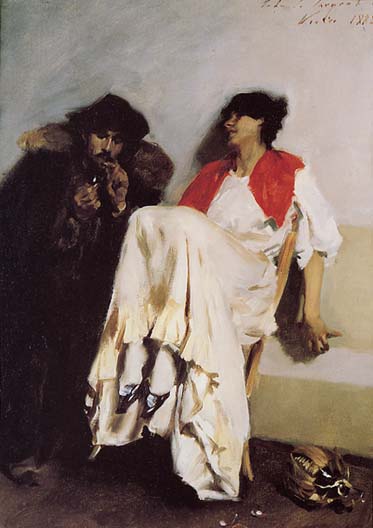


“The Sulfur Match”


and “Sortie de l’église,”

also touch upon these new modernist tendencies, both in the subject matter he paints and in his technique. Sargent explores the working-class street life of Venice in scenes that he captures with rapid brushstrokes that have the immediacy of plein-air paintings.

From Glasstire (images added but article best read in its entirety):

While many of the paintings are light and colorful, three of the best have a dark, Velazquez-like moodiness. Sargent evokes Velazquez with his image of three women emerging from a church. Sortie de l’eglise, Campo San Canciano, Venice, (above) dramatically blends midnight blacks, vivid touches of reds and stone-washed whites. Sargent’s The Sulphur Match (above) is also dark and romantic, featuring the almost obscured face of a man bending to light a match while a woman in a white dress and red shawl leans back in a chair, two lovers lounging in a bar.

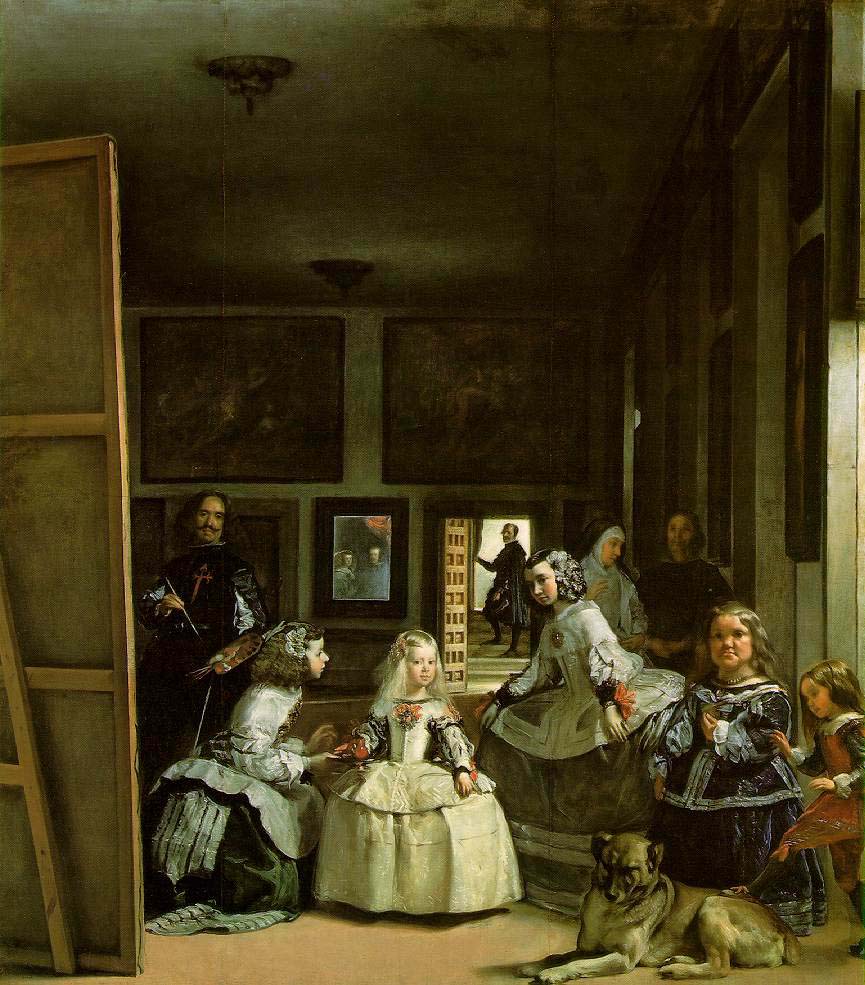
In the case of Chase, the artist was directly influenced by an iconic Velazquez work. He painted


Ring Toss, featuring three of his young daughters playing the game in his studio, after a trip to Spain where he made a copy of Velazquez’s


Las Meninas. The rich brown tones of the floor’s wood grain are contrasted with the murky black shadows of the background, almost forming a stage, with the girls pitching toward the viewer.

Chase, however, is primarily known as a landscape painter. His


Shinnecock Landscape with Figures

is a more characteristically sunny work. The scene is from Long Island, where Chas taught his famous summer classes.

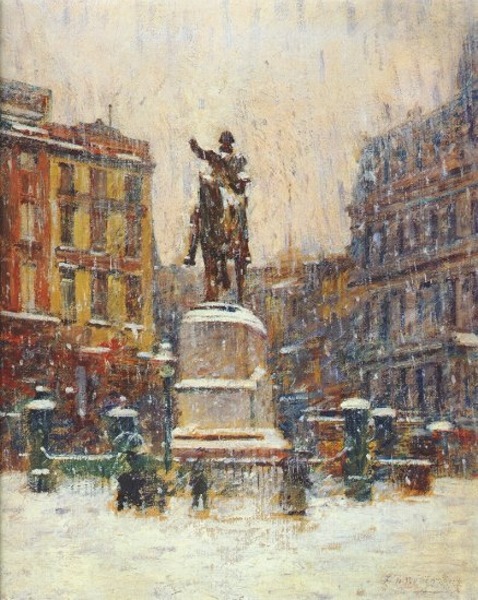
Theodore Robinson’s ragged brushstrokes evoke a blustery New York cold spell in


Union Square, Winter.

He and Hassam were among several artists who took advantage of cheap rents in apartments near the square. Another New York winter scene is Ernest Lawson‘s The Flatiron Building,(above) with its distinctive jutting, prow-like visage seen through snow-laden tree branches.

Two of the most interesting landscapes are by Twachtman,who painted the river views from the porch of the Holley House in Cos Cob, Connecticut,during the winter and spring. Fog hangs heavy over a snow-shrouded landscape in Bridge in Winter, with only a few straggly wisps of bare tree branches. But spring is clearly underway in


From the Holley House,

with blue water running in the river and leaves beginning to sprout from the tree branches.

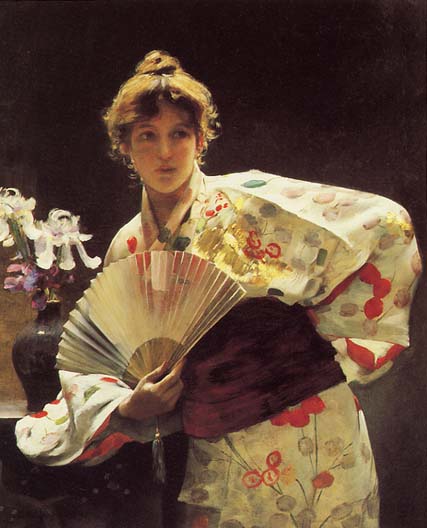
Images of women reflect the turn-of-the-20th-century fascination with Japan, or “japonisme," and the Middle and Far East, or “orientalism.” A woman wears a kimono in Charles Sprague Pearce’s


Lady with a Fan,

while the subjects of Harry Siddons Mowbray’s Two Women (Above)lounge like fantasies of a Near Eastern harem. Edmund Tarbell painted an American woman sitting on the floor, Japanese-style, while she cuts out kirigami patterns. Whistler began incorporating Japanesque elements into his work during the early 1860s, probably inspired by an exhibit of ukiyo-e prints by Hokusai at the London Exhibition of 1862.

William McGregor Paxton’s Vermeer-influenced portrait of a woman reading a newspaper is one of the most contemporary-looking paintings. But other female portraits reflect the influence of the romantic, soft-focus photography of the era known aspictorialism. In Robert Reid’s


Woman on a Porch with Flowers,

the woman’s dress seems to merge with the cut flowers and wildflowers in the scene.


Other paintings in the Halffs’ collection embrace the late 19th-century fascination with Japanese art and culture. A wave of Japanese influence swept across America and Europe in the 1860s with the rising popularity of mass-marketed decorative goods and exhibitions of prints in London, Paris and Boston. The impact of these works on American artists was fueled by James McNeill Whistler’s revolutionary approach to painting with his Asian-inspired subjects and compositions. Paintings by William McGregor Paxton, Charles Sprague Pearce and Edmund C. Tarbell embody this blending of elements from the East and the West often referred to as “japonisme.”

Works in the Halff collection were painted during a period of great change when American artists strove to create works that would be considered worthy of what would come to be called the “American Century.” These artists engaged in a conversation between old and new, tradition and innovation, and East and West, and their work served as a springboard for the next generation of American artists. The Halff collection is a powerful and intimate view into this transformative time.

An Impressionist Sensibility: The Halff Collection
, was also on view from February 3-May 9, 2010 at The McNay Art Museum in San Antonio, TX.

Frank Weston Benson’s Elisabeth and Anna,


Catalogue:


Treasures from the Smithsonian American Art Museum 2004-2005


On Feb. 27 2004 the Smithsonian American Art Museum opened "Treasures from the Smithsonian American Art Museum," an installation of some of its greatest paintings in the Grand Salon of its Renwick Gallery. This striking selection of more than 185 works were hung salon-style, one-atop-another and side-by-side to re-create the elegant setting of a 19th-century collector's picture gallery. This installation remained on view through 2005.

The works in this installation were selected from four strengths in the museum's permanent collection: Colonial and Federal artworks, American impressionism, Gilded Age treasures and art of the Western frontier including the Taos School.

The earliest paintings in this installation were from the time when the Colonies were transformed into a nation. These rare artworks by John Singleton Copley, John Trumbull and Charles Willson Peale displayed the growing self-awareness and optimism of the new nation. Other works included still lifes by Raphaelle Peale and Severin Roesen, and landscapes by Thomas Cole and Asher B. Durand. This section of the installation also included Robert Scott Duncanson's view of a peaceful rural paradise,


"Landscape with Rainbow" (1859),

and Frederic Edwin Church's dramatic landscape


"Aurora Borealis" (1865).

Impressionist artists included in this installation, such as Childe Hassam:


Improvisation (1899)

John Henry Twachtman, William Merritt Chase, and Thomas Wilmer and Maria Oakey Dewing, often worked outdoors to capture brilliant effects of light and color to create luminous paintings.

Other artists whose works were included in the Grand Salon and display the freedom and sparkling qualities of the new impressionist style are Theodore Robinson, Mary Cassatt, Willard Metcalf and Henry Ossawa Tanner, who borrowed the French painter Claude Monet's signature subject for his own


"Haystacks" (about 1930).

Artists who painted during the last quarter of the 19th century, dubbed the Gilded Age by Mark Twain in 1873, captured the brilliance of turn-of-the-century society and a new current of sophistication in America. Artworks by some of the most important artists of the day such as Winslow Homer:


High Cliff, Coast of Maine (1894)

John Singer Sargent (below)

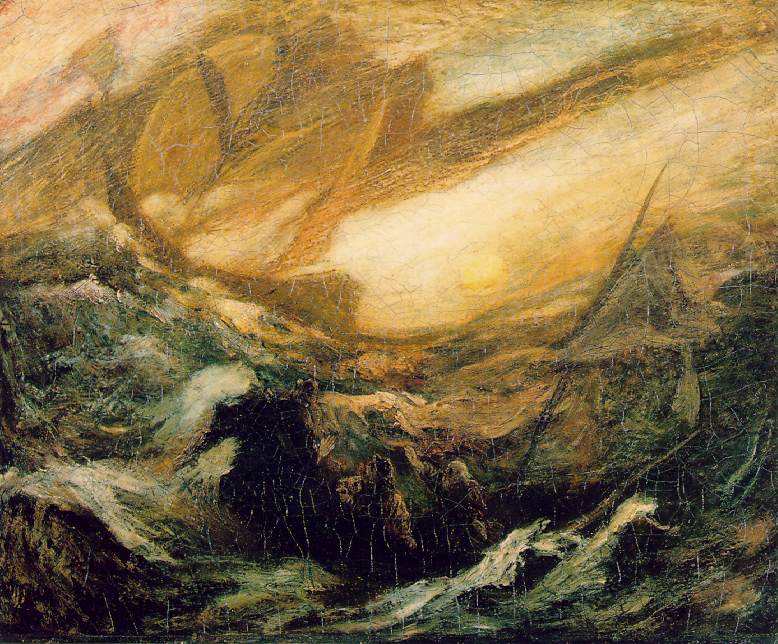
and Albert Pinkham Ryder:


The Flying Dutchman (about 1887)

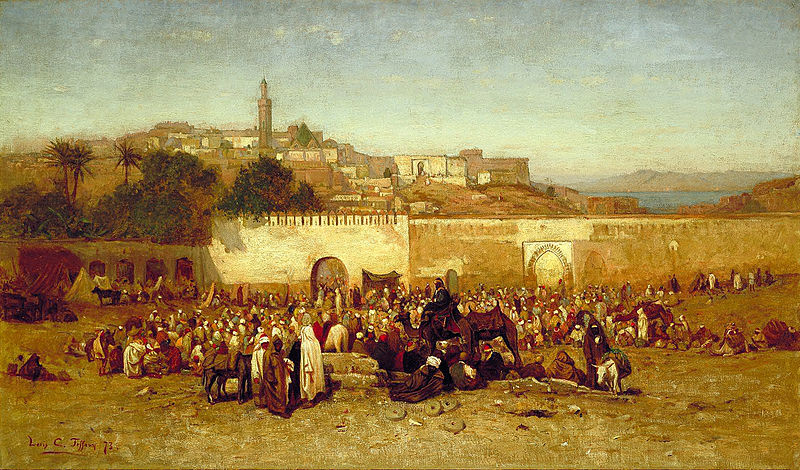
were in this installation. Artists at this time were fascinated with exotic cultures, as seen in


Louis Comfort Tiffany's "Market Day Outside the Walls of Tangiers, Morocco" (1873)


Frederick Arthur Bridgman's Oriental Interior (1884) and


and H. Siddons Mowbray's "Idle Hours" (1895).


Also on view was Abbott Handerson Thayer's ever-popular


"Angel" (1887).

The three monumental landscapes by Thomas Moran


"The Grand Canyon of the Yellowstone" (1872),


"The Chasm of the Colorado" (1873-1874)

and another view also titled


"The Grand Canyon of the Yellowstone" (1893-1901)

remained on view in the Grand Salon. The two earlier paintings were on long-term loan from the U. S. Department of the Interior. Moran's western landscapes inspired Congress to establish the National Park Service and set aside Yellowstone as the country's first national park in 1872.

Other Western works on view are 29 portraits of Native Americans and scenes of Plains Indian life by George Catlin, who followed the path of explorers Lewis and Clark, traveling up the Missouri River into the Dakota Territories in the 1830s.

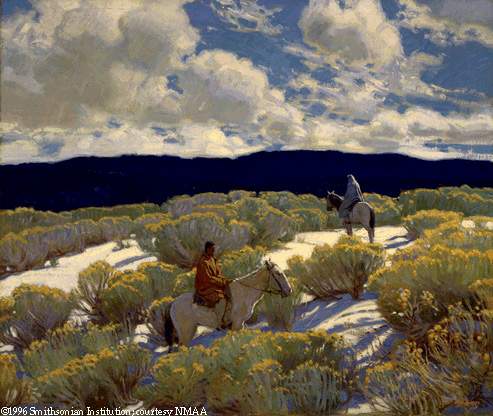
Victor Higgins, Joseph Henry Sharp, Ernest L. Blumenschein and several other artists in the installation were part of the Taos School, begun informally in the 1890s when artists visited the Southwest as an antidote to urban industry and the sophistication of Eastern cities during the Gilded Age. Their bold compositions, as seen in E. Martin Hennings's


"Riders at Sunset" (1935-1945),

used strong color and bright light to depict this region.

The nearby Octagon Room showcased works from the late 19th and early 20th century by artists such as Thomas Wilmer Dewing, Albert Pinkham Ryder, William Glackens, Maurice Prendergast and John Ferguson Weir that are also hung salon-style.

In the adjoining hallway,


John Singer Sargent's "Elizabeth Winthrop Chanler (Mrs. John Jay Chapman)" (1893),


Cecilia Beaux's "Man with the Cat (Henry Sturgis Drinker)" (1898)

and Robert Henri's "Portrait of Dorothy Wagstaff" (1911)

were among the portraits on view.

_________________________________________________________________
More from the Gilded Age::


The intimate world of women and children at home, seen in


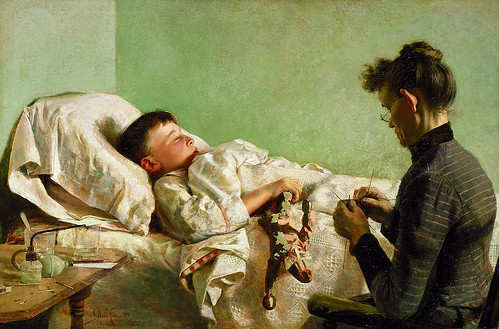
An Interlude (1907) by Sergeant Kendall, offered a comforting refuge. Yet danger could invade even the sanctuary of the home, as portrayed by


J. Bond Francisco in The Sick Child (1893),

in which a mother keeps watch as her son hovers between life and death.

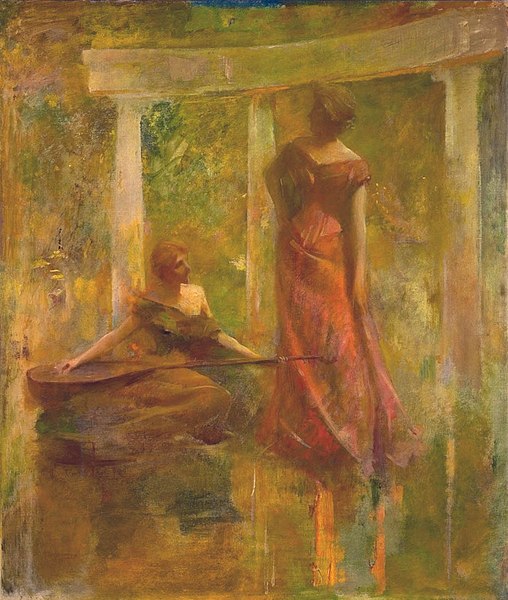
Artists and their patrons shared an ambition to present American civilization as having grown past its earlier provincialism to full maturity, equal to Europe's much-admired culture. Evocations of music abounded, as in


Thomas Dewing's allegory of Music (about 1895), where a prevailing gold palette evokes a musical tonality.

Barocci: Brilliance and Grace


From 27 February to 19 May 2013, the National Gallery in London presented Barocci: Brilliance and Grace, the first major monographic exhibition, dedicated to the art of Federico Barocci (1535-1612). The display assembles the majority of Barocci’s greatest altarpieces and paintings, together with sequences of dazzling preparatory drawings, allowing visitors to understand how each picture evolved. 'Barocci: Brilliance and Grace' showcased the remarkable fertility of Barocci’s imagination and the diversity of his working methods.

Highly revered by his patrons during his lifetime, Barocci combined the beauty of the High Renaissance with the dynamism of what was to become known as the Baroque, a genre he was instrumental in pioneering. From his earliest creations of the 1550s, he began to challenge pictorial convention by positioning his figures in dynamic spatial arrangements, anticipating by almost half a century the innovations of Baroque art. He was an incessant and even obsessive draughtsman, preparing every composition with prolific studies in every conceivable medium. Fascinated and inspired by people and animals, he infused his harmonious compositions with infectious charm and an unparalleled sensitivity to colour. Spiritually attuned by nature, Barocci was predominantly a painter of religious subjects, his approach epitomising the clarity and accessibility required by a Catholic church, then in crisis. Barocci’s unique warmth and humanity transformed familiar gospel stories and more unusual visions into transcendent archetypes with universal appeal.

Highlights of the exhibition included Barocci’s most spectacular altarpiece,


'The Entombment of Christ'

from the Marchigian seaside town of Senigallia


and 'Last Supper'

painted for Urbino Cathedral,

neither work ever having left Italy before.

Two other splendid late altarpieces for Roman churches, the


'Visitation' from the Chiesa Nuova


and the 'Institution of the Eucharist'

from Santa Maria sopra Minerva, were also displayed.

The exhibition also included Barocci’s finest portraits, smaller devotional paintings, his only secular narrative


('Aeneas Flight from Troy'),

and more than 65 preparatory drawings, pastel studies and oil sketches – the latter techniques pioneered by the ever experimental Barocci long before they became standard artistic practice.

Born in the Marchigian town of Urbino, Federico Barocci was one of the most talented and innovative artists of late 16th-century Italy. He flourished in a town that had become one of the great cultural centres of the Renaissance, and had also been the birthplace of his famous predecessor Raphael, by whom he was much influenced. He emerged as a promising young painter and, in the 1550s, moved to Rome for further study. During a second trip to Rome in the 1560s, Barocci lived and worked with a number of Rome’s leading painters. After participating in a fresco project for Pope Pius IV in the Vatican, he was allegedly poisoned by jealous rivals during a picnic. Suffering severely and in need of recuperation, Barocci returned to Urbino in 1563, where he remained for the rest of his career. When he died in 1612, he was not only among the highest paid painters in Italy, but also one of the most influential.

Many of Barocci’s most accomplished works remain in his home region of the Marches, Italy, on the altars for which they were made. Consequently, his name has not acquired the broad recognition of distinguished predecessors such as Raphael and Michelangelo, or successors such as Rubens, who, with other Baroque artists, drew inspiration from his sumptuous colour palette, expressive compositions and innovative techniques. Beloved by artists and art historians throughout the ages, those unfamiliar with Barocci’s art should prepare to be astonished by his brilliance and grace.

'Barocci: Brilliance and Grace'
was curated by Carol Plazzotta at the National Gallery. It was first shown in a different form in Saint Louis, where it was curated by Judith W. Mann and Babette Bohn.


Catalogue:


'Federico Barocci: Renaissance Master of Colour and Line'

Judith W. Mann and Babette Bohn with Carol Plazzotta


More images from the exhibition here and below:


‘Madonna of the Cat’, (detai) Federico Barocci, about 1575.


Barocci, Study for ‘Christ on the Cross’

Vermeer, Rembrandt, and Hals: Masterpieces of Dutch Painting from the Mauritshuis (15 works)


This fall and winter, The Frick Collection will be the final venue of an American tour of paintings from the Royal Picture Gallery Mauritshuis, The Hague. This prestigious Dutch museum, which has not lent a large body of works from its holdings in nearly thirty years, is undergoing an extensive two-year renovation that makes this opportunity possible. Vermeer, Rembrandt, and Hals: Masterpieces of Dutch Painting from the Mauritshuis will be on view in New York from October 22, 2013, through January 19, 2014. Among the paintings to be featured are:


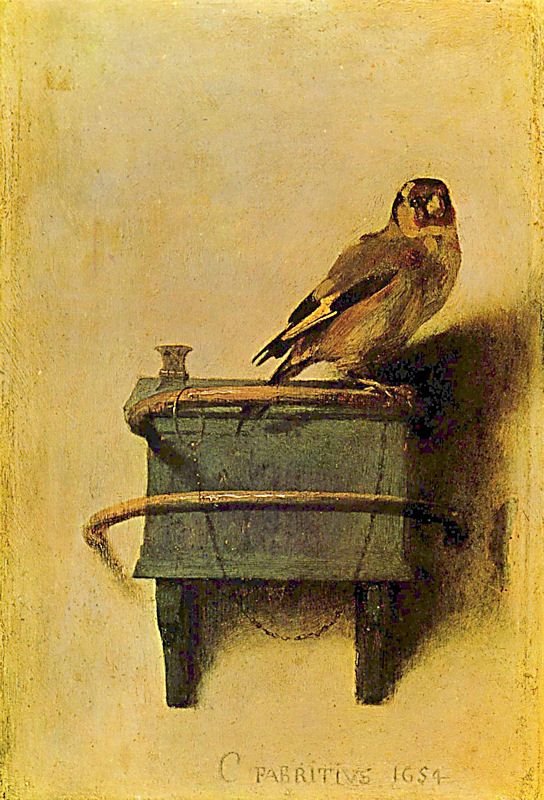
• Carel Fabritius, “Goldfinch,” 1654


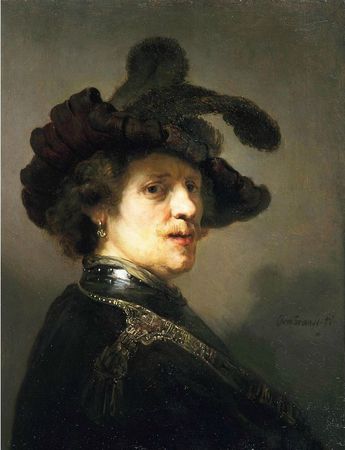
• Rembrandt van Rijn, “‘Tronie’ of a Man with a Feathered Beret,” ca. 1635


• Johannes Vermeer, “Girl with a Pearl Earring,” ca. 1665


• Jan Steen, “The Way You Hear It, Is The Way You Sing It,” ca. 1665


• Jacob van Ruisdael, “View of Haarlem with Bleaching Grounds,” 1670–1675


three more works by Rembrandt van Rijn:


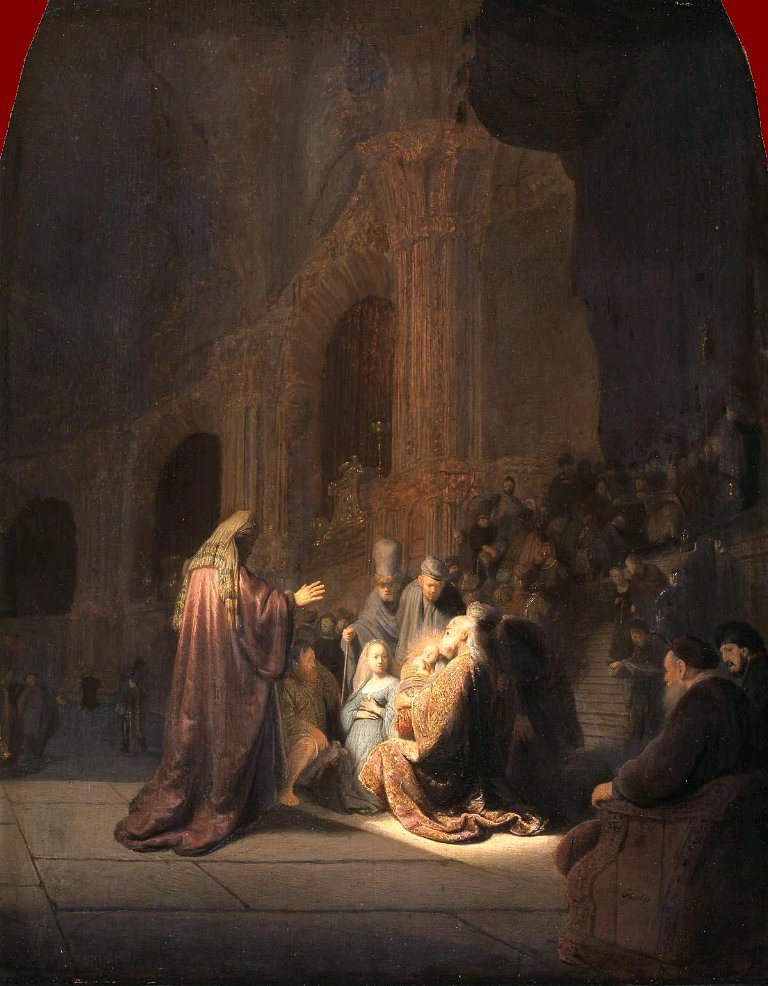
Simeon’s Song of Praise, 1631;


Susanna, 1636,


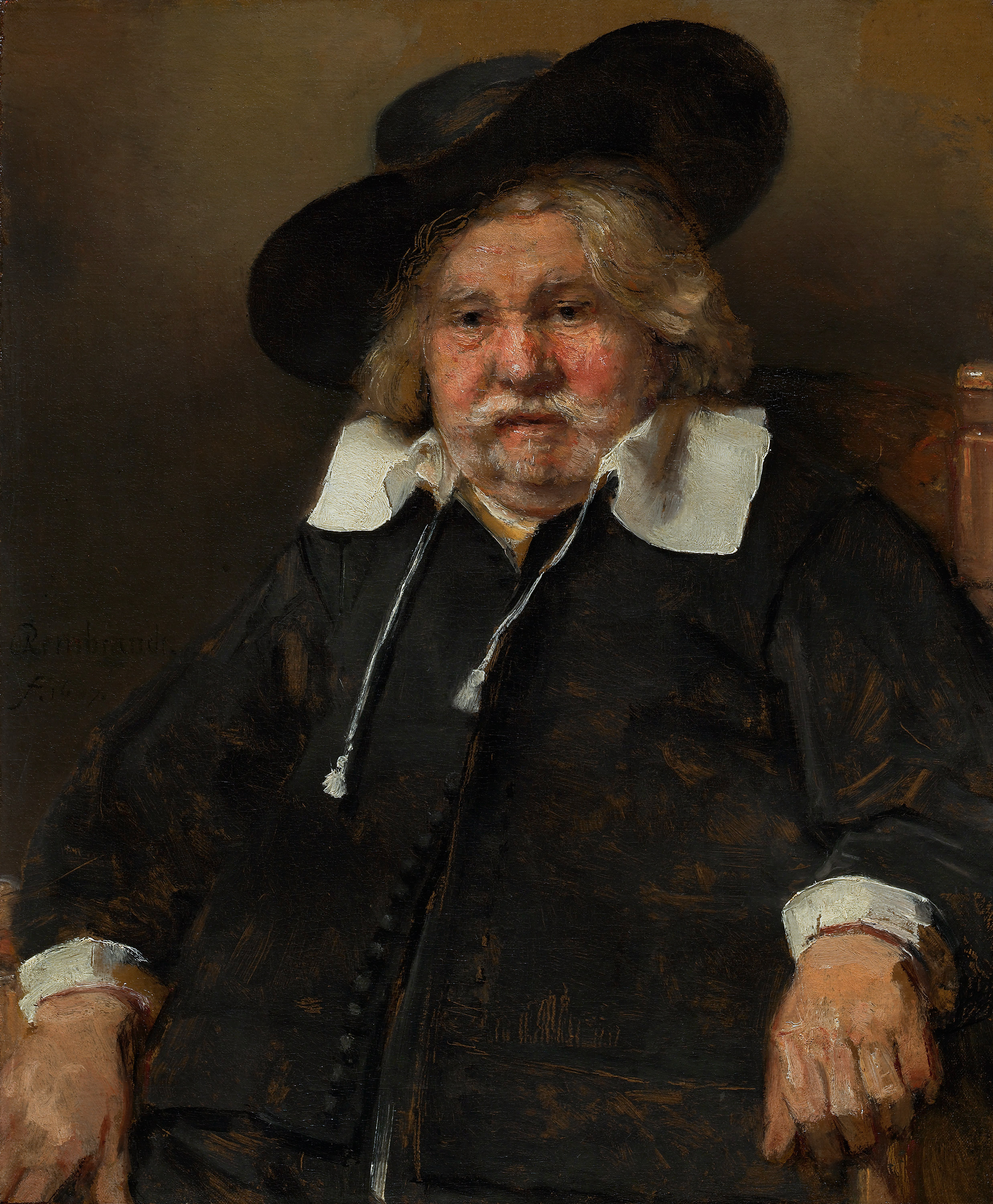
and Portrait of an Elderly Man, 1667;


Frans Hals’s pendant portraits of


Jacob Olycan (1596–1638)


and Aletta Hanemans (1606–1653),

both painted in 1625;


Pieter Claesz’s Vanitas Still Life, 1630;


Nicholas Maes’s Old Lacemaker, c. 1655;


Gerard ter Borch’s Woman Writing a Letter, c. 1655;


Jan Steen’s Girl Eating Oysters, c. 1658–60,


and ‘As the Old Sing, So Pipe the Young’, c. 1665;


and Adriaen Coorte’s Still Life with Five Apricots, 1704.3


Larger version of the exhibition:

de Young, Fine Arts Museums of San Francisco
DATES: January 26, 2013, through June 2, 2013
TITLE: Girl with a Pearl Earring: Dutch Paintings from the Mauritshuis (35 works)

High Museum of Art, Atlanta
DATES: June 22, 2013, through September 29, 2013
TITLE: Girl with a Pearl Earring: Dutch Paintings from the Mauritshuis (35 works)
The Frick Collection, New York
DATES: October 22, 2013, through January 19, 2014