NSU Art Museum Fort Lauderdale will present
Frank Stella: Experiment and Change,
an exhibition that spans the artist’s 60-year career from the late
1950’s to the present. The exhibition, composed of approximately 300
paintings, relief sculpture and drawings will offer insight into his
trajectory from minimalism (e.g. the geometry of the black paintings) to
maximalism (eg. the spatially complex constructionist and large
sculptures of the Moby Dick series.) Curated by
Bonnie Clearwater, Director and Chief Curator,
Experiment and Change leads the museum’s 60th anniversary celebration presented by AutoNation, and will be on view from
November 12, 2017 to July 8, 2018.
The exhibition juxtaposes works from various periods of Stella’s
career, revealing his aesthetic development and focusing on his “Working
Archive,” which contains material never exhibited before, such as
notes, sketches and maquettes that shed light on his growth as an
artist. Stella’s diverse interests include art history, architecture,
new materials (fluorescent pigment, carbon fiber, titanium, et al.) and
computer-aided modeling for rapid prototyping. His preparatory studies
show the ideas in his work that led to a notion about the enlargement of
pictorial space.
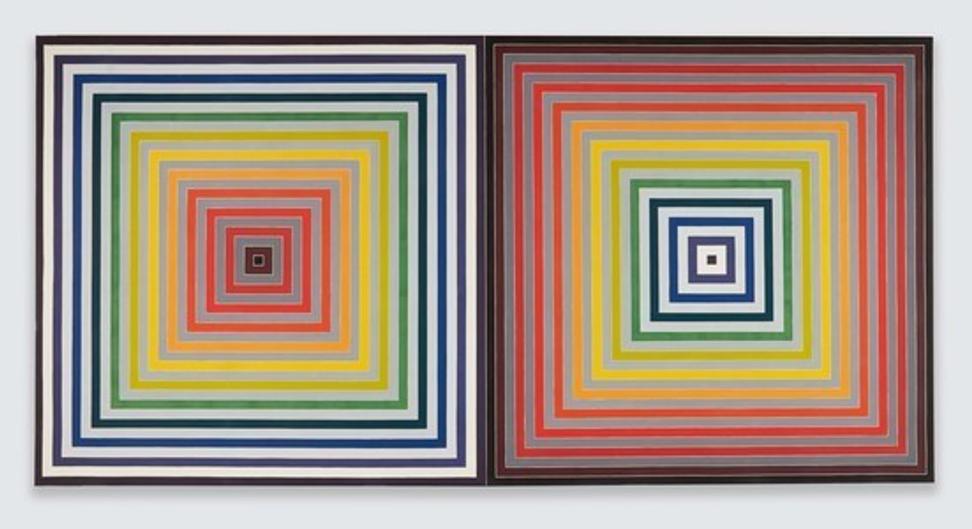
Included will be penciled color sequences for the larger concentric
square paintings (1973), flat foam-core cut-outs leading to the
emergence of a more generous “working space” and 3D printed models from
the 1990’s through the present outlining the use of digital technology.
Frank Stella (b. 1936) emerged as part of a generation of American
artists excited by, driven and challenged by Abstract Expressionism
. Frank Stella:
Experiment and Change
emphasizes the variety of expression found throughout his entire body
of work. The twists and turns of Stella’s career are illuminated by
insights that were discovered during the curatorial process. This
exhibition elaborates on the research Clearwater began for a previous
exhibition,
Frank Stella at 2000:
Changing the Rules, an in-depth exploration of the artist’s bold paintings, sculpture and architectural models from the 90’s.
Clearwater notes, “An initial spark of his artistic aspirations was
the experience of seeing Rogier van der Weyden’s early Netherlandish
Crucifixion Diptych (c. 1460) at the Philadelphia Museum of Art while an
undergraduate at Princeton University. Stella said that the sheer
visual impact of van der Weyden’s diptych appeared as a ready-made
definition of art. Rogier’s painting became a goal for him to hope to
live up to. Given the characterization of this moment I realized the
necessity to remap his career to show how this painting, rather than the
rules of formalist modernism, propelled his progress.
Clearwater further states “We can see the influence of van der Weyden
in the large number of diptych-like paintings divided into two equal
parts. A typical double concentric painting,
Paradoxe sur le comediene, (1974), and a mitered maze work such as
Fortin de las Flores support this view.
These paintings might also encourage us to speculate how Stella’s
attraction to the use of shallow pictorial space and bright fluorescent
pigments helped him to approach his goal, the absolute beauty of the
Netherlandish masterpiece."
One of the exhibition’s highlights is
Deauville (1970) a
45-foot long canvas shaped like a thoroughbred racetrack. As an
aficionado of racing of all kinds, he often imagines himself running
across the canvas. “While his contemporaries Donald Judd and Dan Flavin
created work that was machine-made, I see Stella as a modern day John
Henry, racing against the machine, brushing paint from one end of the
canvas to the other and back again, setting an admirable and competitive
pace.”
For Stella,
Deauville was the starting point for the
exhibition design at NSU Art Museum. The shape of the elongated oblong
painting complements the 83,000-square foot museum’s curved galleries
designed by leading modernist architect Edward Larrabee Barnes.
Architecture has played into Stella’s work throughout his career.
The Irregular Polygons
(1965-66) broke with the conventional rectangular format of easel
painting, as did the early 1960's notched aluminum paintings. This
departure was suggested by a view of European mural painting, which
noted the irregularity of the perimeter. The interruption of the
imagery by windows, doorways and other architectural features generated
irregular edging which in turn generated irregular and complicated
surfaces. This notion coupled with illustrations from intersecting
Kazmir Malevich’s planar geometry helped to establish the shaped canvas
as a format in its own right, one which Stella continues to exploit.
In the exhibition,
Deauville is shown adjacent to several Irregular Polygons and a large double concentric square
Parodoxe sur le comediene (1974),
and works from the Polish Village series (1971-74), which represent
Stella’s first constructed relief paintings, his attempt to build a
painting and then paint it. Among these works we find a full-scale
sketch, a 12-foot cartoon for
Suchowola, and a Polish Village
relief, drawing attention to Stella’s leap from a flat, two-dimensional
plane to the literal three-dimensional depth of these constructions.
Another project inspired by architectural space enlists Hooloomooloo
paintings (early 1990’s) made for the Kawamura Museum in Japan. The
entire series of these paintings will be exhibited at NSU Art Museum,
creating an almost continuous frieze on the second floor, starting on a
long curved wall and ending high above the atrium. The irregular shapes
of these paintings were determined by the architectural space of the
Japanese museum. Removed from their intended location, their arched
forms and cutout shapes appear arbitrary until the viewer imagines the
resulting negative space as doors, windows and arches.
“Stella believes that art offers at least the illusion of ultimate
freedom. In the context of the art world, he appears fearless and
indifferent to risk. Even works that initially looked like misfits to
him (and others) now appear revelatory in light of his most recent
pursuits,” explains Clearwater.
Frank Stella’s
Experiment and Change is
part of NSU Art Museum’s Regeneration Series, exhibitions designed to
explore the wide-ranging impact of World War II on artists in Europe and
the United States. It was launched in 2016 with
Anselm Kiefer from the Hall Collection.
Stella’s work is grounded in the post-war philosophical shift in which
the individual was to master his/her own existence as popularized
through the zeitgeist of existential philosophy, phenomenology and
gestalt psychology. When Stella stated in a 1964 radio interview, “What
you see is what you see,” not only was he suggesting that his
compositions were nothing more than their appearance, but he was also
pointing out that his work dealt with the psychology of perception and
could be rephrased as, “What you see is how you comprehend what you
see.”
Born in 1936 in Malden, Massachusetts, and based in New York, Frank
Stella is one of the most important artists working today. He first
studied art in high school at Phillips Academy in Andover, MA and
continued painting at Princeton University where he graduated with a
degree in history. Following his graduation in 1958, he moved to New
York and achieved fame before the age of 25. His
Black Stripe Paintings (1959),
comprised of a regulated sequence of stripes painted in enamel with the
broad strokes of a house painters brush, debuted in the
Sixteen Americans exhibition
at Museum of Modern Art in the same year. In 1962, Stella’s first solo
exhibition was presented by the Leo Castelli Gallery in New York. His
first retrospective was presented by the Museum of Modern Art in 1970
and he was honored with a second retrospective by the institution in
1987. His work has subsequently been the subject of retrospective
exhibitions throughout the United States, Europe, and Japan, including
the touring exhibition
Frank Stella: A Retrospective, which
originated at Whitney Museum of American Art in 2015. Among his numerous
honors, he received the National Medal of the Arts in 2009 and the
Lifetime Achievement Award in Contemporary Sculpture in 2011.