Thursday, January 9, 2020

German Expressionism. The Braglia and Johenning Collections


15.11.2019 - 20.04.2020

With the exhibition German Expressionism. The Braglia and Johenning Collections, the Leopold Museum is presenting a comprehensive selection of Expressionist works from two important European art collections. “Around 100 exhibits from the Fondazione Gabriele e Anna Braglia, Lugano, and the Foundation of Renate and Friedrich Johenning from North Rhine-Westphalia make for an impressive pas de deux of the two collections,” summarizes the Leopold Museum’s Director Hans-Peter Wipplinger. The selection is supplemented by works from the Nolde Foundation Seebüll, the Museum Abtei Liesborn, the Leopold Museum, as well as by paintings from private collections, including the Leopold, Private Collection.

This presentation is the first exhibition in Austria to showcase a selection of some 100 Expressionist works from two eminent European art collections, the Fondazione Gabriele e Anna Braglia, Lugano, as well as the Foundation of Renate and Friedrich Johenning from North Rhine-Westphalia. The exhibition additionally features around ten works from further collections, including the Nolde Foundation Seebüll, the Leopold Museum as well as the Leopold, Private Collection. The paths that led the two passionate collectors to German Expressionism were quite different. While Gabriele Braglia bought a work by the Futurist Mario Sironi already in 1950, he did not discover German Expressionism until the 1980s.

Paul Klee’s watercolor Remembering Romanshorn (1913) marked the beginning of Braglia’s Expressionist collection activities. Friedrich Johenning’s interest in this art movement was sparked in 1979, when he purchasedthe watercolor Cyclamens and Chrysanthemums (1952–1955) by Emil Nolde. Anna Braglia and Renate Johenning shared their husbands’ passion for decades. In both instances, the high quality of the collections is owed to the couples’ joint selection of artworks.

Emil Nolde, Portrait of a Family, 1947 © Renate und Friedrich Johenning Stiftung, Photo: Leopold Museum, Vienna/Manfred Thumberger © Nolde Stiftung Seebüll


EXPRESSIONISM – AN ART REBELLION
In the early 20th century, an emerging generation of artists embarked on a search for new means of expression. Opposing academic traditions and revolting against social norms, they fought for the freedom of artistic expression. They questioned the prevailing concept of beauty, stripped color of its representative function, preferred terse forms and painted in a quick and impulsive manner. They were no longer interested in a naturalistic depiction, but wanted to convey inner emotions. Initially misunderstood or ignored, the representatives of this new art movement fell victim to increasing defamation during the interwar period. The National Socialists seized their works and removed them from museums. In post-war Germany, Expressionism was deemed a wholly “unburdened” art movement, and as such became a symbol of democratic, humanist values. Today, the eminent international importance of Expressionist art is undisputed and the reason for artworks of this movement fetching record prices on the art market.

AN IMPRESSIONIST OVERTURE 
 
The progressive gallery owner Paul Cassirer advertized Lovis Corinth, Max Liebermann and Max Slevogt as the “Three Stars of Berlin Impressionism”. Corinth was among the pioneers of Expressionism. The artist Max Liebermann, who featured in Cassirer’s exhibition alongside Corinth and was a passionate collector of Impressionist art from France, became a founding member and the first president of the Berlin Secession in 1898. In 1910, a jury headed by him voted against exhibiting Expressionist works at the Secession. A polemic letter written by Emil Nolde against Liebermann led to Nolde’s exclusion from the artists’ association.

In response to the rejection they experienced, the young Expressionists founded the New Munich Secession, whose first presentation, entitled Art Exhibition of Rejects from the Berlin Secession, featured works by Erich Heckel, Ernst Ludwig Kirchner, Otto Mueller and Karl Schmidt-Rottluff. Max Pechstein acted as president of the New Secession, while members included Marianne von Werefkin and Franz Marc.

Owing to these conflicts, Liebermann resigned from his office in 1911. Lovis Corinth, the new president of the Secession, suffered a stroke that year. Likely as a result, he began to employ a free, impetuous brushstroke, making his oeuvre become increasingly expressive. During his time of convalescence, he created the work Still Life with Melons (1912). The recuperating artist found relaxation and inspiration especially on the Walchensee in Bavaria. The work Walchensee Landscape, which is presented in this exhibition, was created by Corinth in 1923.

THE BRÜCKE ARTISTS’ LANDSCAPES OF THE SOUL 
 
Aiming to embark on new paths, Ernst Ludwig Kirchner, Erich Heckel, Karl Schmidt-Rottluff and Fritz Bleyl founded the artists’ association Brücke in Dresden in 1905.

Ernst Ludwig Kirchner, Portrait of Emmi Frisch, 1908 © Leopold, Private Collection:

The 1908 work Portrait of Emmi Frisch by Ernst Ludwig Kirchner was still founded on an Impressionist way of seeing, but the artist soon arrived at an autonomous style.

Max Pechstein, who joined the Brücke artists in 1906, came into contact with the painting of Henri Matisse and the Fauves early on. He was the first Brücke artist to move to Berlin.
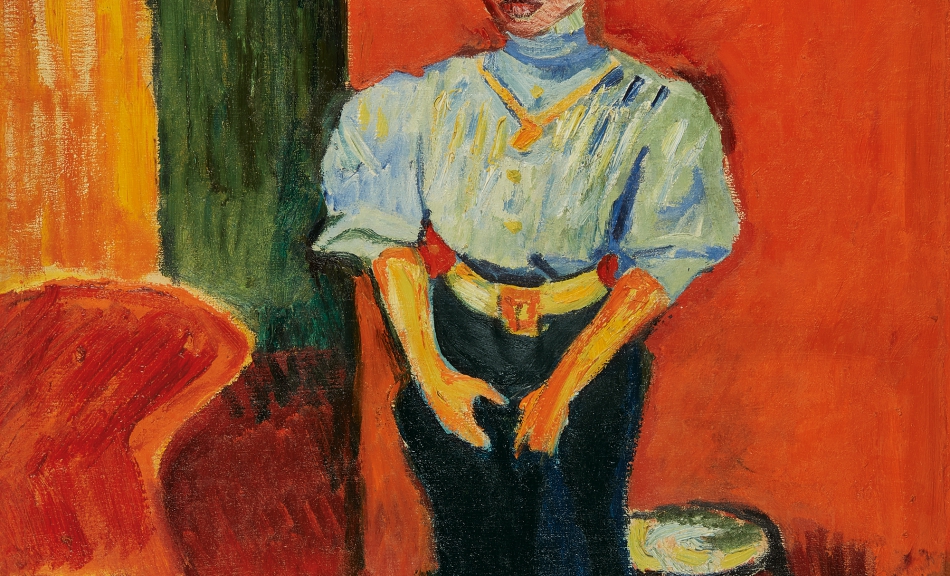
Image result for Max Pechstein,  Lady with a Feathered Hat

In 1910, he painted the work Young Lady with a Feathered Hat in eruptive colors. His later wife Lotte Kaprolat likely acted as his model for this painting.

From 1909 onwards, Pechstein repeatedly spent the summers in the fishing village of Nida in East Prussia, in 1911 and 1912 together with Lotte. The painting In the Evening (1911) shows female nudes amidst a paradisiac-exotic vegetation, and is reminiscent of Paul Gauguin’s Tahiti paintings, which Pechstein had seen that same year at the Galerie Paul Cassirer.

Erich Heckel also sought an earthly paradise in nature, for example in Osterholz on the Flensburg Fjord, where he created the work Fjord Shore – Bathers on the Fjord in 1913. Heckel’s drawings are populated by quickly jotted down nudes, outdoor figures and bathers.

Otto Mueller, another Brücke member, created an inimitable type of nude around 1910. His elongated figures are characterized by angular limbs, his heads by pointed chins and slanted eyes.

 Image result for Mueller Two Nudes in the Woods 1925
The 1925 work on paper Two Nudes in the Woods presents nude female figures as creatures living in harmony with nature.

Along with nudes in the great outdoors, these artists were also interested in landscape constellations.

 Image result for Karl Schmidt-Rottluff  House at the Bend in the Road,

Karl Schmidt-Rottluff likely painted the watercolor House at the Bend in the Road, characterized by energetic gestures, during his vacation in Dangast on the North Sea in the summer of 1911.

BROWN STAINS IN THE FLOWER GARDEN
 
In 1913/14, Emil Nolde and his wife Ada took part in an expedition to German New Guinea. Nolde captured the impressions of this journey, which led via Russia and China, in numerous watercolors. The work on paper Junk and Small Ship was created in 1913 during a river journey on the Yangtze Kiang.

From 1916, the Noldes lived in a farm house in Schleswig-Holstein. The harsh climate, abrupt changes in weather conditions, the effects of light, the transition from land to water, as well as low clouds were themes Nolde was interested in all his life. In the late 1920s, he had a home and studio built in the North Frisian town of Seebüll. There, the Noldes laid out a flower garden which furnished the artist with countless ideas for his paintings. Adolf Hitler, who was rigorous in his rejection of Expressionism, insisted on defaming his oeuvre as “degenerate”, despite the intervention of high-ranking advocates of Nolde’s art. It is all the more surprising, therefore, that from 1934, the artist was a party member of the NSDAP and made Anti-Semitic remarks. In 1937, Nolde’s works featured prominently in the Munich exhibition Degenerate Art. However, his hopes of establishing himself as a state artist remained unbroken. The small-scale watercolor Summer Guests, created between 1938 and 1945, is among the artist’s works known as “Unpainted Pictures”, which the artist allegedly executed in secret during the years of his employment ban. In actual fact, they are small-scale watercolors the likes of which Nolde created already in 1918/19 as templates for paintings to be executed in oil. After the War, Nolde staged himself as a victim of the National Socialist regime. The artist’s problematic role during National Socialism is the topic of a panel discussion to take place at the Leopold Museum the day after the exhibition opening.

CHILD DEPICTIONS FROM WORPSWEDE 
 
Paula Modersohn-Becker lived and worked with her husband Otto Modersohn in the artists’ colony Worpswede near Bremen. She increasingly emancipated herself from her artistic environment and created unadorned child depictions, such as the painting Three Children in Front of a Tree in the Landscape (1901). That same year, she created the work Bust Portrait of Elsbeth Holding a Flower in Front of a Landscape – a loving portrait of her stepdaughter from Otto Modersohn’s first marriage. While her husband supported her career, he was also amongst her harshest critics, which led to the couple’s alienation. Paula Modersohn-Becker died in 1907, only a few weeks after giving birth to her daughter Mathilde, at the age of 31.

A RUSSIAN ARTISTS’ COUPLE – MURNAU – LANDSCAPE DEPICTIONS
 
In 1906, Alexej von Jawlensky embarked on a trip to France together with his partner and promoter Marianne von Werefkin. Inspired by Neo-Impressionism and the works of Paul Cézanne, the Russian artists’ couple discovered planar painting.
Still LIfe with Apples, Blue Bowl and Coffee Pot, 1907 by Alexej Georgewitsch Von Jawlensky (1864-1941, Russia) | Reproductions Alexej Georgewitsch Von Jawlensky | WahooArt.com

Jawlensky processed these impressions in the work Still Life with Apples, Blue Bowl and Coffee Pot (1907).
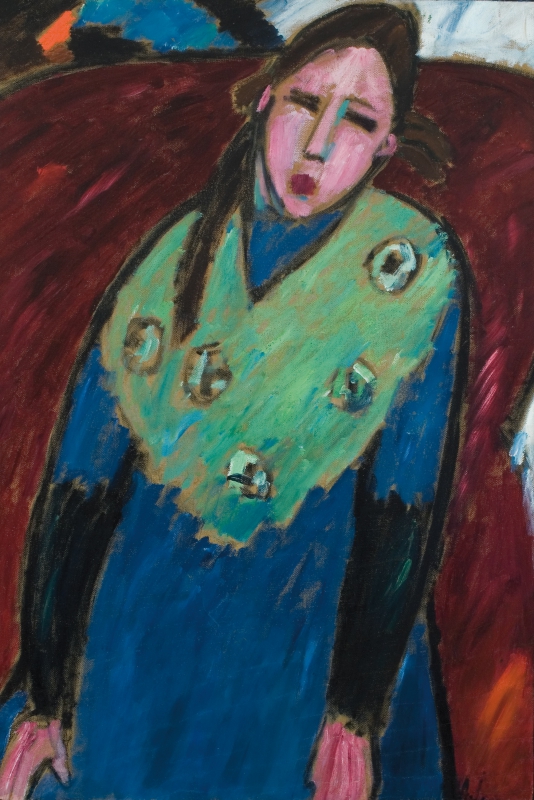
Image result for Jawlensky Girl with Green Stole (1909)

The painting Girl with Green Stole (1909) marked the beginning of the artist’s intense exploration of the human face. Already in 1905, Jawlensky and Werefkin had discovered the Upper Bavarian town of Murnau am Staffelsee. In the summer of 1908, they invited Wassily Kandinsky and Gabriele Münter to join them there for their holidays. In 1909, Münter purchased a country house in Murnau, which became her main place of residence. It soon established itself as a meeting place for artists surrounding Der Blaue Reiter, for the members of the artists’ association Neue Künstlervereinigung München (N.K.V.M.), founded by Jawlensky in 1909, as well as for art critics, collectors and musicians, including the composer Arnold Schönberg.


Wassily Kandinsky, Murnau – Zwei Häuser, 1908, Oil on board, 32.5 x 44.5 cm, Courtesy Fondazione Gabriele e Anna Braglia, Lugano. Photo: © Christoph Münstermann


In 1909 Kandinsky created his work Murnau – Two Houses, a painting in which optical reality now served as no more than a point of departure.

Exposure to the works of Werefkin and Jawlensky rang in a completely new phase in Gabriele Münter’s oeuvre.

The outbreak of World War I brought an abrupt end to the Murnau community. “Enemy aliens” were forced to leave Germany within 24 hours. Kandinsky fled with Münter to Switzerland, and subsequently returned to Russia when their relationship ended. Werefkin and Jawlensky moved to Lake Geneva following the outbreak of the War. There, Jawlensky focused on landscape depictions, for example in his 1916 work Thundery Atmosphere, which already shows a high degree of abstraction. In the autumn of that year, the artists’ couple moved to the Swiss capital. Jawlensky started working on serial portraits, including his Mystical Heads and Saviour’s Faces. The 1922 work Saviour’s Face: Spiritual Melody has become an icon of Modernism.

SUBJECTIVE FEELING – DER BLAUE REITER
Around 1910, the pioneers of Modernism were no longer satisfied with the paths explored by the Impressionists. Instead, they placed their main emphasis on the power of subjective feeling. Detached, as it were, from the object, color became an essential part of the pictorial dramaturgy. In the environs of the artists’ associations N.K.V.M and Der Blaue Reiter, founded in Munich in 1911, artists strove towards a synthesis of instinctive and spiritual aspects. The promoters of Der Blaue Reiter, Wassily Kandinsky and Franz Marc, organized two exhibitions in Munich in 1911 and 1912 which were to verify their art-theoretical notions. The two artists were also the editors of the almanac Der Blaue Reiter, published in 1912, whose importance for the modern understanding of art cannot be overestimated.

LESSONS FROM THE ANIMAL KINGDOM – A LONGING FOR PURE SOUNDS
Franz Marc focused on animal depictions. In 1910, he wrote to the publisher Reinhard Piper: “My goals do not relate to special animal painting. I am striving towards a good, pure and clear style, in which at least a part of what we modern painters will have to say can come to complete fruition.” In 1913, he created the watercolor Sitting Tiger which shows an influence of Far Eastern art. During World War I, about a year before his death on the front near Verdun, Marc wrote to his wife Maria: “Very early on, I found man to be ‘ugly’; animals seemed to me more beautiful, purer; but in animals, too, I discovered so much unfeelingness, so much ugliness, so that my renderings instinctively […] became increasingly schematic and abstract. […] Perhaps our European eye has poisoned and distorted the world; that is why I am dreaming of a new Europe.”

August Macke, who would become close friends with Marc, immortalized his cousin in the 1907 work Portrait of Mathilde Macke and in 1910 his wife Elisabeth with their son Walter in Mother and Child in a Red Chair. While both works are inspired by Impressionism, the summary treatment of planes and the clear contours indicate that he was in the process of overcoming light painting. In the work Reading Girl on the Balcony, which Macke created that same year, the artist dispensed with details. He now focused on the color composition, or – as he put it – on the “longing for pure sounds without gray and mishmash”. Macke’s painting Women in the Park (with White Umbrella), created in 1913 on the Swiss Lake Thun, reveals the influence of the French Orphist Robert Delaunay, for whom Der Blaue Reiter had organized an exhibition in Munich in 1911.

“PROJECTED SELF” AND FIGURES FROM THE BEYOND
Paul Klee was in close contact with the editors of the almanac Der Blaue Reiter. In 1911, he thoroughly explored the theme of line and contour. In 1913, he painted gloomy watercolors such as the aforementioned work Remembering Romanshorn. Klee captured the houses on the shore of Lake Constance using prismatic, crystalline structures. In the work on paper Two Little Girls, he placed the figures into a mesh of circles and conic sections. In Mother and Child, he transformed an intimate, domestic motif into an eerie portrait of two jointed dolls. In 1914, Klee traveled to Tunisia with Macke and Louis Moilliet, and noted in his diary: “I can now abandon work. It penetrates so deeply and so gently into me, I feel it and it gives me confidence in myself without effort. Color possesses me. […] It will possess me always, I know it.”

RHYTHMICAL COMPOSITIONS AND SURREAL SYNTHESES
Lyonel Feininger, the son of German musicians who had moved to the US, returned to Europe following his first trip to Germany in 1887. After studies in Berlin and Paris, he moved back to the German capital in 1893. He processed influences of Cubism, and met the Brücke artists in 1912. In 1913, he participated in the First German Autumn Salon at the Berlin “SturmGalerie”. Feininger’s work is rooted in caricature. In the 1912 gouache 44 Elegant Gentlemen with Top Hats and Umbrellas [the German word “Schirmherren” denoting both men with umbrellas and patrons] he leveled humorous and subtle criticism against society, starting with the “bureaucratizing undertone of the work’s title” (Ivan Ristić). The mystical landscape Man in Front of Tall Rocks of 1912 shows a competition of image planes. Feininger shaped a “crystallized fabric of man, rock formations and architecture” (Ivan Ristić). Heinrich Campendonk also participated in the exhibitions of Der Blaue Reiter. His work Child with Balloon, created in 1919 in mixed technique on wood, has an unusual oval format. The multi- layered painting, which incorporates an overpainted composition, is regarded by curator Ivan Ristić as a “surreal synthesis of past, present and possibility”.

Francis Bacon: Books and painting


 Centre Pompidou
 11 september 2019 - 20 january 2020  

After the exhibitions showcasing Marcel Duchamp, René Magritte, André Derain and Henri Matisse, the Centre Pompidou continues its re-examination of key 20th century works by devoting a major exhibition to Francis Bacon. The last major French exhibition of this artist’s work was held in 1996 at the Centre Pompidou. More than twenty years later, Bacon : Books and Painting presents paintings dating from 1971, the year of the retrospective event at the national galleries of the Grand Palais, to his final works in 1992. Didier Ottinger is the curator of this innovative exploration of the influence of literature in Francis Bacon’s painting. 

Exhibition Francis Bacon: Books and Painting + Museum 
“Portrait of George Dyer in a Mirror” (1968) shows Francis Bacon’s lover, who died of a drug and alcohol overdose in 1971.Credit...The Estate of Francis Bacon; ADAGP, Paris and DACS, London/Artists Rights Society (ARS), New York; Artimage; Collection Agnelli, Londres

The exhibition includes six rooms along the gallery, placing literature at the heart of the exhibition. These rooms play readings of excerpts of texts taken from Francis Bacon’s library. Mathieu Amalric, Jean-Marc Barr, Carlo Brandt, Val.rie Dreville, Hippolyte Girardot, Dominique Reymond and Andr. Wilms read from Aeschylus, Nietzsche, Bataille, Leiris, Conrad and Eliot. Not only did these authors inspire Bacon’s work and motifs directly, they also shared a poetic world, forming a ‘spiritual family’ the artist identified with. Each writer expressed a form of ‘atheology’, a distrust of any values (abstract beauty, historical teleology or deity, etc.) likely to dictate the form and meaning of ways of thinking or of an art work. From Nietzsche’s fight against the ‘Backworlds’ to Bataille’s ‘Base materialism’, Eliot’s fragmentation, Aeschylus’ tragedy, Conrad’s ‘regressionism’ and Leiries’ ‘sacred’, these authors shared the same amoral and realist vision of the world, a concept of art and its forms liberated from the a priori of idealism. 


 The inventory of Francis Bacon’s library, undertaken by the Department of History of Art and Architecture at Trinity College Dublin, lists more than a thousand works. While denying any ‘narrative’ exegesis in his work, Francis Bacon, nevertheless admitted that literature represented a powerful stimulus for his imagination. Rather than giving shape to a story, poetry, novels and philosophy inspired a ‘general atmosphere’ ; ‘images’ which emerged like the Furies in his paintings. Bacon confided to David Sylvester his interest in the works of Eliot or Aeschylus, which he claimed to ‘know by heart’, adding that he only ever really read texts which evoked ‘immediate images’ for him. These images owed more to the poetic world, existential philosophy or form of literature that he chose, rather than to the stories they told. Three Studies for Figures at the Base of a Crucifixion, dating from 1944, testifies to the impact of Aeschylus’ tragedy on his work. In 1981, Bacon produced a triptych which was explicitly inspired by the Oresteia. In addition to his own motifs, Bacon drew on the T.S. Eliot poem The Waste Land for its fragmented construction and its ‘collage’ of languages and multiple tales. (Triptych Inspired by T.S. Eliot’s Poem «Sweeney Agonistes», 1967 Hirshhorn Museum, Washington.) 


Among his contemporaries, Michel Leiris was the writer who was closest to Francis Bacon. He was the French translator of the painter’s interviews with David Sylvester, and was the only artist with whom the painter envisaged creating an illustrated publication (Miroir de la Tauromachie, published in 1990). The exhibition at the Centre Pompidou focuses on works produced by Bacon in the last two decades of his career. It consists of sixty paintings (including 12 triptychs, in addition to a series of portraits and self-portraits) from major private and public collections. From 1971 to 1992 (the year of the artist’s death), his painting style was marked by its simplification and intensification. His colours acquired new depth, drawn from a unique chromatic register of yellow, pink and saturated orange. 

Exhibition Francis Bacon: Books and Painting + Museum

1971 was a turning point for Bacon. The exhibition at the Grand Palais earned him international acclaim, while the tragic death of his partner, just a few days before the exhibition opened, gave way to a period marked by guilt and represented by a proliferation of the symbolic and mythological form of the Erinyes (the Furies of Greek mythology) in his work. 
 Exhibition Francis Bacon: Books and Painting + Museum

The ‘Black’ Triptychs painted in memory of his deceased friend (In Memory of George Dyer, 1971, Triptych–August 1972 and Triptych, May–June 1973), all presented at the exhibition, commemorate this loss.

Excellent review 

Swann to Auction Art Collection of Ebony and Jet Publishers


Swann Galleries will open the new decade in style, with a sale of African-American Art from the Johnson Publishing Company on Thursday, January 30. The collection—which hung in the publishing house’s historic offices on 820 S. Michigan Avenue in Chicago—will feature paintings, sculpture and works on paper from diverse periods over the last century, with 75 artists represented. Hung together in a single exhibition for the first time, the Johnson Publishing Company’s art collection makes a powerful statement, demonstrating the company’s longstanding recognition and support of visual artists.
 

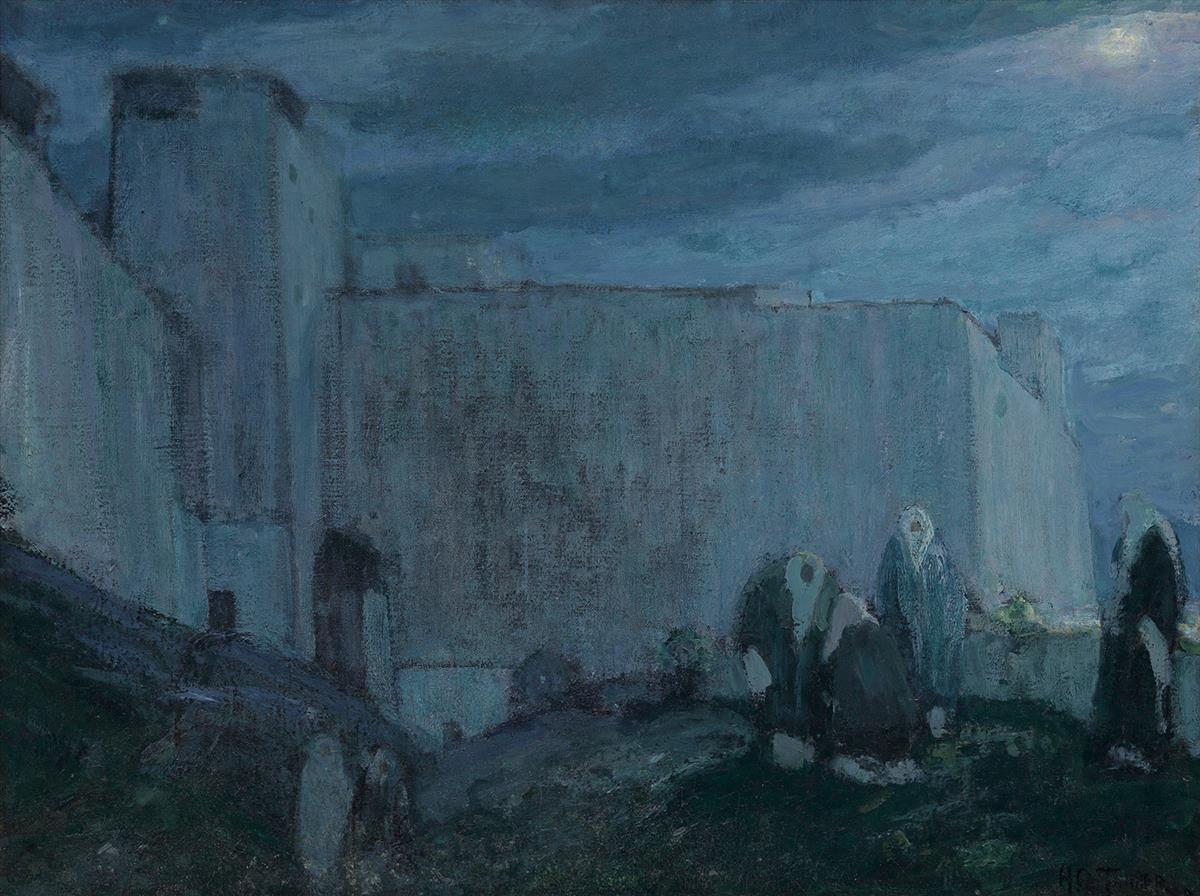
The earliest work in the sale comes from 1912: Henry Ossawa Tanner’s beautiful oil-on-canvas Moonrise by Kasbah (Morocco) depicts figures outside the stark, steep exterior walls of a Moroccan Kasbah. The significant midcareer painting carries the highest estimate of the collection, at $150,000 to $250,000.

A suite of seven framed photographs with etched glass, 1996-97, by Carrie Mae Weems, commissioned by the City of Chicago Public Art Program marks a high-point of the offering. One of an edition of only three, the suite comes block estimated at $100,000 to $150,000. Further contemporary works include Richard Mayhew’s 2006 oil-on-canvas Departure, a large landscape with saturated colors ($50,000-75,000).

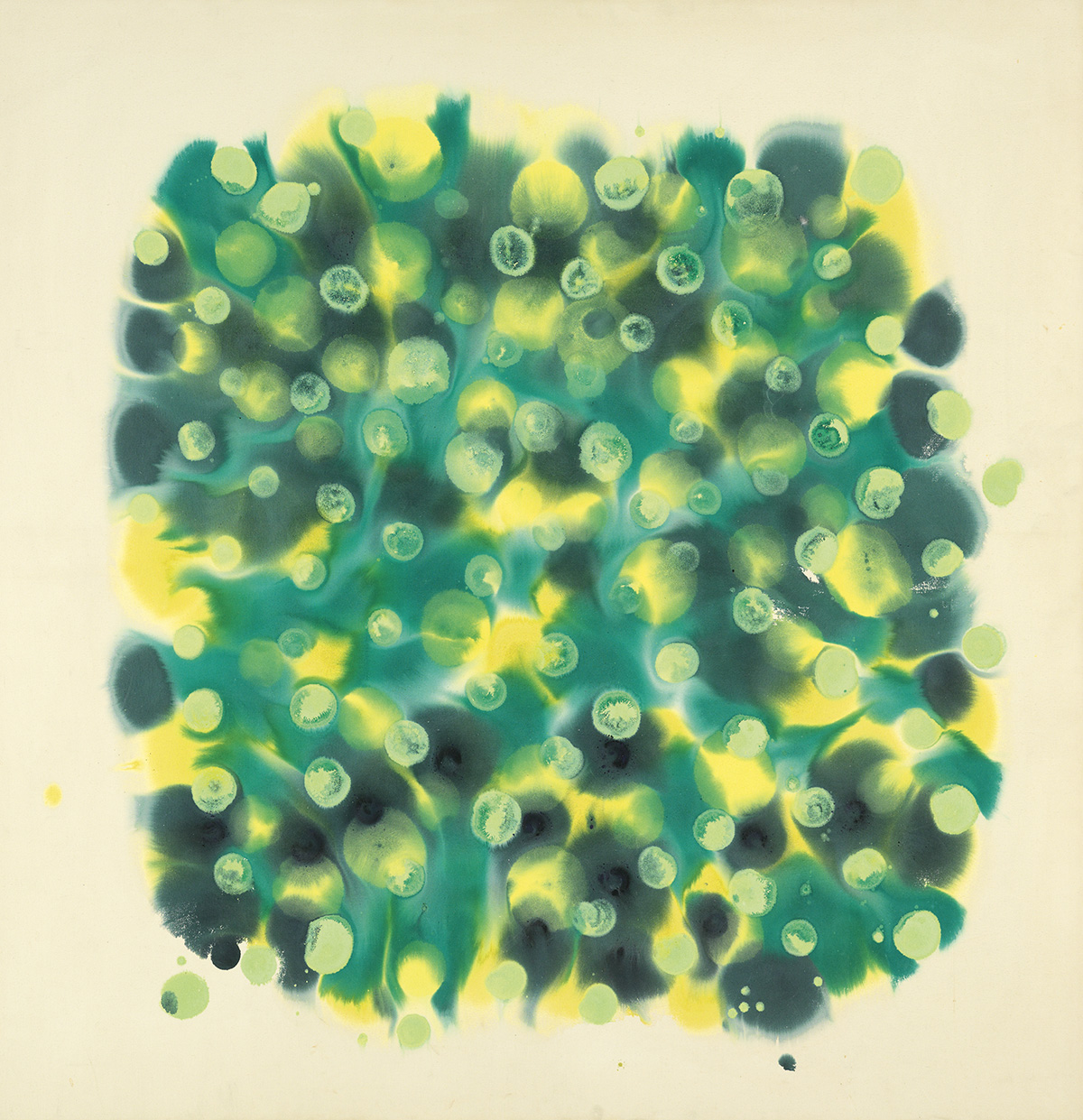
The cover lot of the sale is The Last Farewell, a significant 1970 oil on canvas painting by Dindga McCannon, made as she first began to define her aesthetic ($30,000-40,000). Additional abstract works from the 1970s include Kenneth Victor Young’s color field painting in greens and yellows, Upper Egypt, 1971, ($80,000-120,000) and Francis A. Sprout’s Azo, 1971, from the artist’s Moslem Tile Patterns series ($15,000-25,000).

Richmond Barthé and Elizabeth Catlett lead a remarkable run of sculpture with two cast bronze works: Barthé’s 1944 The Negro Looks Ahead and Catlett’s 1973 Sister are expected to bring $50,000 to $75,000 each. Also of note are Homage to Marion Perkins, a circa 1961-63 carved granite work by Margaret Burroughs as a tribute to her fellow Chicago artist and friend ($8,000-12,000) and Rufus, a circa 1961 cast “Montizini” plastic by Valerie J. Maynard ($3,000-5,000).

The collection features a strong selection of landscapes, as well as images of day-to-day life. Walter H. Williams’s oil on canvas White Butterfly, 1969, from his Southern Landscape series, depicts a pensive young girl picking wildflowers in a field ($30,000-40,000), while William Edouard Scott’s 1929 impressionist-style oil on canvas features a young boy picking a pumpkin ($15,000-25,000). Also of note is The Builders (The Family), a 1974 color screenprint by Jacob Lawrence, available at $5,000 to $7,000, and Barbara Johnson Zuber’s circa 1970 oil on canvas Jump Rope, which depicts a group of girls with red bows in their braids playing Double Dutch, expected to bring $1,000 to $1,500.

An offering of oil on canvas works by Loïs Mailou Jones includes Bazar Du Quai, Port Au Prince, Haiti, 1961 ($20,000-30,000), Vielle Rue, Montmartre (Rue Pinteau), 1965 ($15,000-25,000), and Boats at Théoule, 1965 ($10,000-15,000).

Exhibition opening in New York City January 25. The complete catalogue and bidding information is available at swanngalleries.com and on the Swann Galleries App.
Additional highlights can be found here.


Henry Ossawa Tanner, Moorise by Kasbah Morocco), oil on canvas, 1912. From the collection of the Johnson Publishing Company. Estimate $150,000 to $250,000.
 
Lot 85: Carrie Mae Weems, Untitled, detail, seven panels of framed chromogenic prints and sandblasted text on glass, 1996-97. From the collection of the Johnson Publishing Company. Estimate $100,000 to $150,000.


Lot 55: Kenneth Victor Young, Upper Egypt, acrylic on canvas, 1971. From the collection of the Johnson Publishing Company. Estimate $80,000 to $120,000.
Lot 77: Elizabeth Catlett, Sister, cast bronze, with brushed patina & white inlaid eyes, mounted on a wooden base, 1973. From the collection of the Johnson Publishing Company. Estimate $50,000 to $75,000.


Monday, January 6, 2020

Rufino Tamayo: Innovation and Experimentation

December 21 , 2019 –July 11 , 20 20  | Saturdays, 1 –4 pm Location:  Charles White Elementary School | 2401 Wilshire Boulevard, Los Angeles, C A 90057 The Los Angeles County Museum of Art ( LACMA )


Rufino Tamayo, Man with Tall Hat (Hombre con sombrero alto), c. 1930, Los Angeles County Museum of Art, The Bernard and Edith Lewin Collection of Mexican Art, Art © Tamayo Heirs/Mexico/Licensed by VAGA, New York, NY, photo © Museum Associates/LACMA.

The Los Angeles County Museum of Art presents Rufino Tamayo: Innovation and Experimentation. Rufino Tamayo (1899–1991) was a leading Mexican artist of the 20th century who achieved international acclaim. Though he was known primarily for his paintings and murals, he also created a robust body of works on paper, which provided an important avenue for formal and technical innovation. Drawn exclusively from LACMA’s holdings, the exhibition highlights Tamayo’s engagement with printmaking and also includes a selection of Mesoamerican sculpture (an important source of inspiration for the artist) from the museum’s collection. 

 Rufino Tamayo (1899 –1991) was a leading  Mexican artist of the 20th century who achieved international acclaim. Though he  was  known primarily for his paintings and murals, he  also created a robust body of  works on paper, which provided an important avenue for formal and technical  innovation. Drawn exclusively from LACMA’s holdings, th e exhibition highlights  Tamayo’s  engagement with printmaking and also includes a selection of  Mesoamerican sculpture (an important source of inspiration for the artist)  from the  museum’s collection. 

About  the Exhibition 

Tamayo  is perhaps best known as a painter and muralist; however, he was also  deeply interested in experimenting with prints and finding a way to add volume and  texture to a traditionally two -dimensional medium.  A unifying thread i n the exhi bition  is Tamayo’s depictions of the human figure, which became progressively more  abstract as he developed what he described as a universal art. Drawn exclusively  from LACMA’s collection, the exhibition features 20 works on paper by Tamayo — including  two  watercolors and 18 prints —and  five  Mesoamerican sculptures. Tamayo  actively collected art from the ancient Americas. He amassed more than  1,300 Mesoamerican works, which now belong to the Museo de Arte Prehispánico  de México Rufino Tamayo in Oaxaca. 

The exhibition features  five  comparable objects from LACMA’s  collection , demonstrating the artist’s  fascination with this material  throughout his long career. An introductory  gallery provides a brief overview of Tamayo’s career, beginning with early wood cuts from the 1920s  and extending  to his large mural size print   

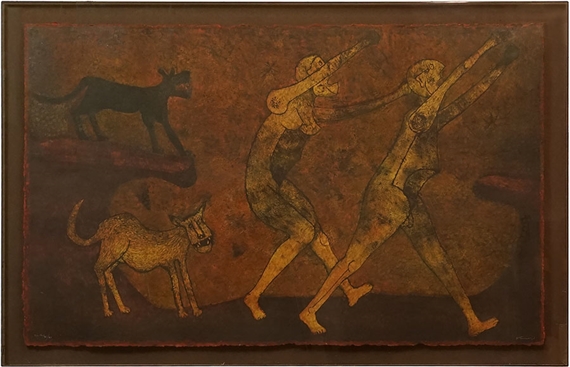
 Artwork by Rufino Tamayo, Two Characters Attacked by Dogs, Made of mixograph in colors on handmade paper

Two  Personages Attacked by Dogs  (1983) . The w orks in this section  highlight his  relationship with the Mexican mural movement, his Zapotec heritage, and his initial  engagement with printmaking.  A small selection of Mesoamerican figurines, similar to  those that were a source of formal inspiration for Tamayo’s art, are also featured. The  following galleries  feature etchings , lithographs , and Mixografía prints  (a new  mixed process that allowed the artist to introduce volume and texture to his prints)  created in the 1960s –80s . 

Throughout his career, Tamayo created over 350 prints,  collaborating with workshops in the United States, Mexico, and Europe as he  achie ved increasing international acclaim. H e developed a relationship  with  Los  Angeles, first through a residency at Tamarind Lithography Workshop and later  through  the  Taller de Gráfica Mexicana, which relocated  from Mexico City to Los  Angeles as the  Mixograf ía  Workshop Gallery in the early 1980s.  Works in  these  galleries  focus  on  his exploration of various print processes, leading to his  collaboration with the Taller de Gráfica Mexicana and the development of  the Mixografía  technique . Digital photographs and a video projection  provide a behind- the -scenes look at the making of Tamayo’s Mixografía prints.  A final gallery will be dedicated to  the  student installation creat ed in collaboration  between  Char les White Elementary School students  and  Raul Baltazar.    
 

Spanning over 60 years of his prolific career, Rufino Tamayo: Innovation and Experimentation focuses on Tamayo’s

Goya: Avant-Garde Genius, the Master and His School


Musée des Beaux-Arts, Agen, 
8 November 2019 — 10 February 2020


Francisco José de Goya y Lucientes, Woman with a Fan, detail, ca. 1805–10
(Paris: Musée du Louvre)

Curated by Adrien Enfedaque, Juliet Wilson-Bareau, and Bruno Mottin
The City of Agen and its Fine Arts Museum, located between Bordeaux and Toulouse in the southwest of France, will present, over the winter of 2019–2020, an outstanding exhibition with a fresh and unexpected view on Francisco de Goya y Lucientes (1746–1828) and his work. Through a selection of works in several media (paintings, drawings, engravings), the exhibition will demonstrate the essential characteristics that remain constant in Goya’s work and reveal the role played by his collaborators in his studio.


The Museum’s scientific team is assisted in this project by one of the specialists of Goya’s work Juliet Wilson-Bareau and the event has received personal support from the French Minister of Culture. Nearly 90 works loaned by museums and private collections around the world (France, Germany, Hungary, Spain, Switzerland, UK, USA) will be on display in the Jacobins’ Church (Église des Jacobins), an Agen architectural jewel and an emblematic place for the Museum’s temporary exhibitions.
In the late nineteenth-century, Count Damase de Chaudordy (1826–1889) bequeathed a substantial collection to his birthplace Agen. As French ambassador to the court of Madrid, he bought many works, such as five of six paintings by Goya from the private collection of Federico de Madrazo, former first painter of the queen and director of the Prado Museum. These paintings had already been catalogued by Charles Yriarte in 1867 and came directly from the collections of Goya’s son Don Xavier (1784–1854) and grandson Don Mariano (1806–1874) Marquis of Espinar.
This ambitious project is reminiscent of the blockbuster exhibition organized in 1993 From Fortuny to Picasso, which attracted more than 25,000 visitors. It was the first major exhibition at the Jacobins’ church and the result of a collaboration with the Prado Museum in Madrid. It has been the origin of precursory research on Spanish painters of the 19th century. The curator at the time, Yannick Lintz, now Head of the Department of Islamic Arts at the Louvre museum, keeps a benevolent eye on Agen’s projects and supports this exhibition.
As part of the Catalog of Desires, a device set up by the Ministry of Culture to facilitate the circulation in France of iconic works of national collections, the Agen Museum has been designated as a pilot museum. It has the honour to present to the public Woman with a Fan, a famous painting by Goya which has been on loan from the Louvre since April 27, 2019. In the picture, the artist depicts a buxom young woman with great subtlety. The minimalist shades of gray, celadon greens, and whites are remarkable, especially in the delicate work of the long mittens. The identity of the young woman remains uncertain today. The painting is original in its intimate approach focusing on the character’s psychology.
Goya: Avant-Garde Genius, the Master and His School is based on research from the Louvre and the Research and Restoration Centre of the Museums of France (C2RMF). The exhibition benefits from the technical and scientific advice of this latter institution, where two paintings of Goya’s followers (Goyesques) from the Museum of Agen are currently being studied and restored for the exhibition. It is a new approach to Goya’s work that will be proposed to better underline the singularity of his art and his way of working, from drawing to painting. This project could, in the long term, better define the artistic approach of Goya and the implication of the collaborators in his workshop. The aim of the exhibition is to provide both the large public and the painting connoisseurs with a unique opportunity to enjoy and admire many masterpieces that will also be analyzed in detail (through documentation and technical analysis).
General Commission
Adrien Enfedaque (Curator of the Museum of Fine Arts)
Scientific Advisers
Juliet Wilson-Bareau (Art Historian, London)
Bruno Mottin (Chief Curator of Heritage, Research and Restoration Centre of the Museums of France)
Goya: Génie d’avant-garde, le maître et son école (Paris: Snoeck Édition, 2020), 224 pages, ISBN: 978-9461615602, 25€.
For additional coverage, see Dalya Alberge’s article from The Observer (28 December 2019), available here»

Christie's Old Master & British Drawings New York 28 January


Old Master & British Drawings offers a wide variety of works on paper covering over five hundred years of design and European creativity from around 1480 to the mid-19th Century. Featured collections include properties from Jean Bonna, Terry Allen Kramer, James and Marilynn Alsdorf, Luisa Vertova Nicolson, Brooke Astor, Michael Hall and Eric Stanley. Amongst the highlights from the Italian section are masterpieces of the High Renaissance by Perugino, Luca Signorelli, Parmigianino, and exceptional Baroque drawings by Annibale Carracci, Gian Lorenzo Bernini and Elisabetta Sirani. Two great Venetian artists are featured with two top lots: Giovanni Battista Tiepolo’s rare Study for three donkeys from the collection of the late Brooke Astor, and Canaletto’s exceptionally large View of Warwick Castle. A group of drawings from the Collections of Michael Hall attests the enduring legacy of Rembrandt as a draftsman, while Boucher and Tiepolo are the highlights of the Chicago-based Alsdorf Collection. Masterwork by Ingres, Géricault and Bouguereau are the highlights of the French section, while the sale concludes with four exceptional watercolors by Turner, covering the entire arch of the great British artist’s career. A very substantial sale of 129 lots, the auction presents an opportunity to acquire some of the most celebrated and dramatic images of western art, with estimates ranging from $2,000 to $800,000.
Sale highlights 


Francois Boucher, A nude woman playing a flute, seen from behind. Black, red and white chalk with pastel on blue paper, 9 1/2 x 14 in. (24 x 36 cm) Estimate: $20,000-30,000. © Christie's Images Ltd 2019.


Parmigianino, Daniel in the lions' den (detail). Red chalk, 3 ½ x 5 7/8 in. (9 x 15 cm). Estimate: $60,000-80,000. © Christie's Images Ltd 2019.
  • Florentine school, 15th Century Head of a veiled woman
    Estimate USD 15,000 - USD 20,000
    Lot 7
  • Pietro di Cristoforo Vannucci, called Perugino (Città della Pieve ca. 1450-1523 Fontignano) Head of a bearded man
    Estimate USD 200,000 - USD 300,000
    Lot 12
  • Luca Signorelli (Cortona ca. 1450-1523) A young man seen from behind, cloaked, with a study of a young woman resting on her hand
    Estimate USD 50,000 - USD 70,000
    Lot 16
  • Girolamo Francesco Mazzola, il Parmigianino (Parma 1503-1540 Casalmaggiore) Daniel in the lions' den
    Estimate USD 60,000 - USD 80,000
    Lot 20
  • Annibale Carracci (Bologna 1560-1609 Rome) Head of a young man wearing a hat, in profile to the left
    Estimate USD 30,000 - USD 50,000
    Lot 26
  • Gian Lorenzo Bernini (Naples 1598-1680 Rome) Design for a funerary medallion with Death standing by a sarcophagus
    Estimate USD 60,000 - USD 80,000
    Lot 32
  • Hendrick Barentsz. Avercamp (Amsterdam 1585-1634 Kampen) A landscape with a frozen river and figures drawing sleds
    Estimate USD 150,000 - USD 250,000
    Lot 54
  • Jacob de Wit (Amsterdam 1695-1754) Allegory of Autumn
    Estimate USD 18,000 - USD 25,000
    Lot 66
  • Giovanni Battista Tiepolo (Venice 1696-1770 Madrid) Three studies of a donkey
    Estimate USD 250,000 - USD 350,000
    Lot 70
  • Giovanni Antonio Canal, Il Canaletto (Venice 1697-1768) View of the South front of Warwick Castle
    Estimate USD 800,000 - USD 1,200,000
    Lot 75
  • François Boucher (Paris 1703-1770) A nude woman playing a flute, seen from behind
    Estimate USD 20,000 - USD 30,000
    Lot 76
  • Baron François-Pascal-Simon Gérard, called Baron Gérard (Rome 1770-1837 Paris) The Death of Malvina
    Estimate USD 30,000 - USD 40,000
    Lot 94
  • Jean-Auguste-Dominique Ingres (Montauban 1780-1867 Paris) Portrait of Princess Louise Murat
    Estimate USD 100,000 - USD 150,000
    Lot 97
  • Jean-Louis-André-Théodore Géricault (Rouen 1791-1824 Paris) The coal wagon (recto); Study of a horse, with a second study of a horse (verso)
    Estimate USD 200,000 - USD 300,000
    Lot 102
  • Joseph Mallord William Turner, R.A. (London 1775-1851) Mont Blanc from the Bridge of St Martin, Sallanches
    Estimate USD 200,000 - USD 300,000
    Lot 126
  • Joseph Mallord William Turner, R.A. (London 1775-1851) Launceston, Cornwall
    Estimate USD 400,000 - USD 600,000
    Lot 127
  • Joseph Mallord William Turner, R.A. (London 1775-1851) Mont-Blanc and the Allée Blanche from near the Col de la Seigne, France
    Estimate USD 400,000 - USD 600,000
    Lot 128
  • Joseph Mallord William Turner, R.A. (London 1775-1851) The Domleschg Valley looking North, Switzerland
    Estimate USD 300,000 - USD 500,000

Master, Pupil, Follower: 16th- to 18th-Century Italian Works on Paper


Georgia Museum of Art at the University of Georgia 
December 21, 2019 - March 8, 2020

https://georgiamuseum.org/wp-content/uploads/2019/04/Allegrini-D-I-111-scaled.jpg

When we think of Renaissance art, we usually think of paintings, but from the 16th century on Italian artists focused on drawing just as much if not more so. Giorgio Vasari, an influential Italian painter, architect and historian, regarded disegno (which means “drawing” or “design”) as the foundation of visual art. Disegno was considered the basis of an artist’s training and an essential tool for capturing nature and the beauty of life. Drawing was at the core of all workshop practices and teaching academies, used to develop an artist’s skill through the diligent copying of antiquities and masters’ works. Drawing and printmaking also became the most inventive forms of expression and experimentation.


  • Feature Image
    https://news.uga.edu/wp-content/uploads/2019/12/Adoration-of-the-Magi-Maffei-.jpg
  • Follower of Bartolomeo Passarotti (Bologna, 1529–1592), head of Laocoön. Pen, dark brown ink over black chalk with some wash on off-white paper with black chalk marks at the bottom, 7 9/16 × 4 15/16 inches. Georgia Museum of Art, University of Georgia; Extended loan from the collection of Giuliano Ceseri. GMOA 1995.315E.
    get_appDownload File
  • Circle of the Gandolfi, standing academic male nude, seen from the rear, ca. 1775. Charcoal on white paper with some foxing and repairs, 17 × 12 inches. Georgia Museum of Art, University of Georgia; Extended loan from the collection of Giuliano Ceseri. GMOA 1995.184E.
    get_appDownload File
  • Pietro Giacomo Palmieri (b. Bologna, 1737; d. Turin, 1804), two figures in a landscape. Red chalk on cream paper, 18 × 23 15/16 inches. Collection of Jeffrey E. Horvitz, Boston, inv. no. D-I-43.
    get_appDownload File
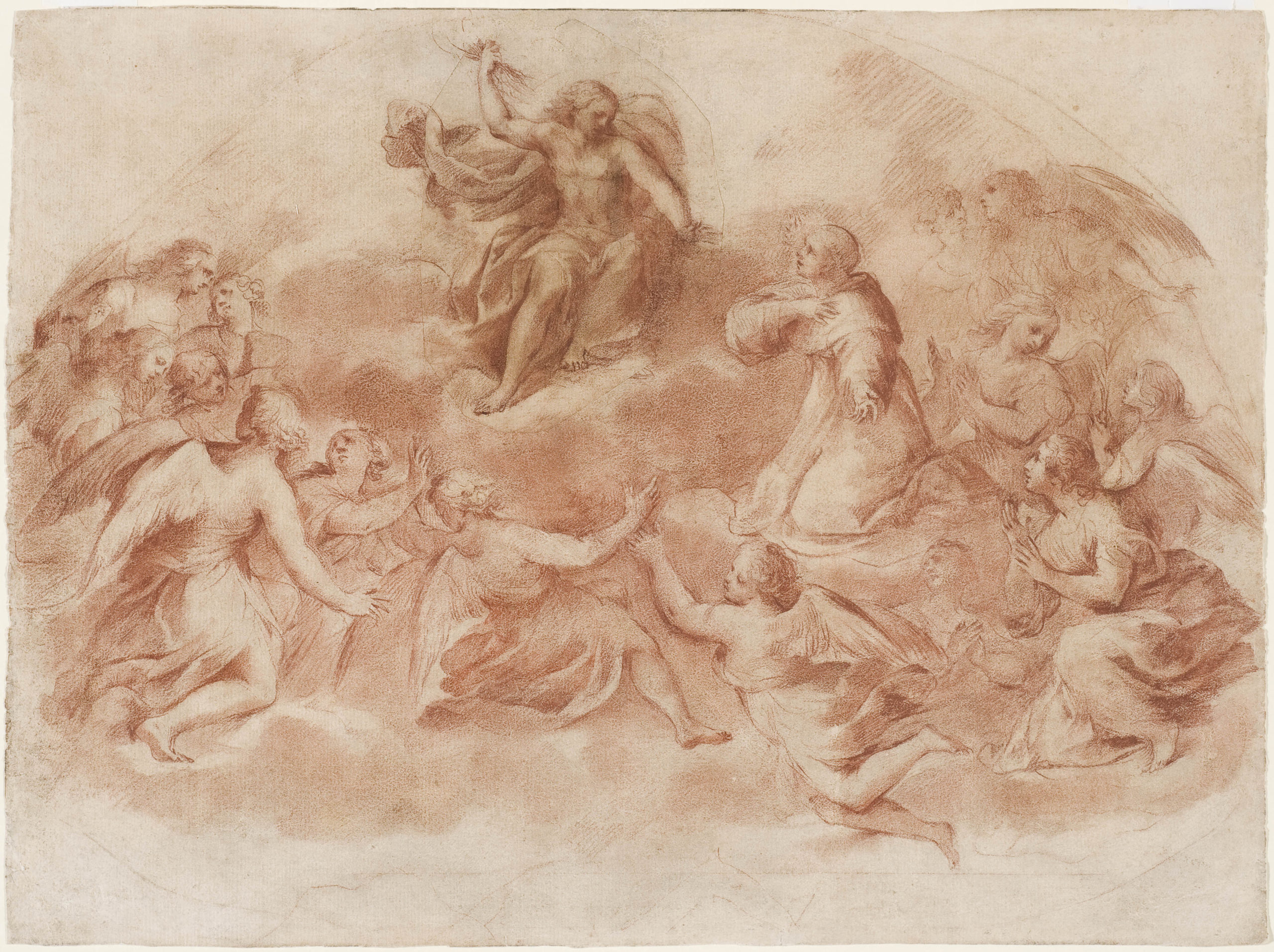
  • Francesco Allegrini (Rome, 1624–1684), Christ in glory with angels and a saint kneeling in adoration, ca. 1665. Red chalk on light tan paper (artist’s correction for the figure of Christ, redrawn on an attached piece of light tan laid paper), 14 1/2 × 19 5/8 inches. The Jeffrey E. Horvitz Collection, Boston, Inv. D-I-111.
    get_appDownload File
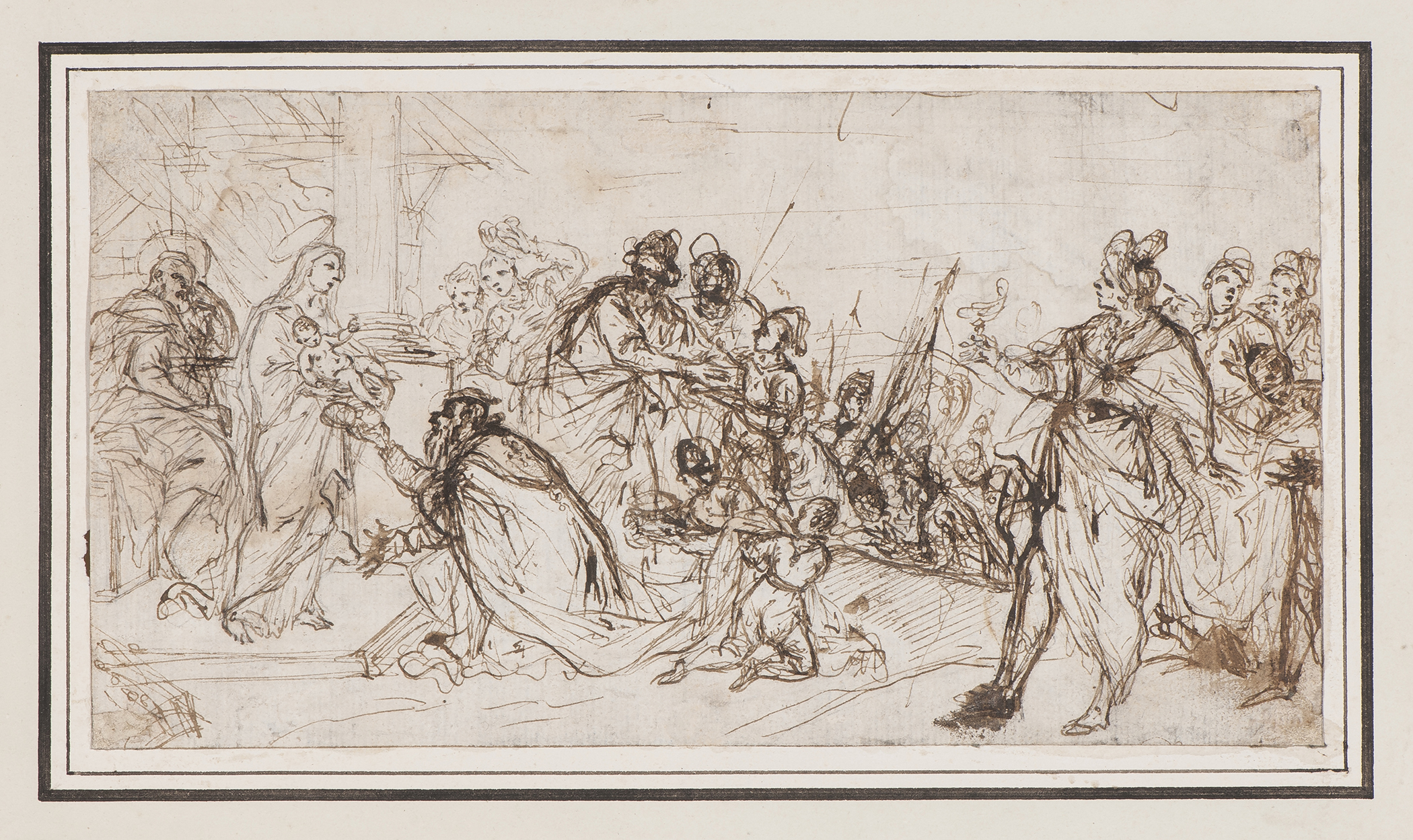
  • Unidentified artist (active Venice, 17th century), Adoration of the Magi, first half of the 17th century. Pen and brown ink on off-white paper, pasted down on partially removed primary support, pasted down on a secondary blue paper support, 5 1/8 × 9 1/2 inches. Georgia Museum of Art, University of Georgia; Extended loan from the collection of Giuliano Ceseri. GMOA 2001.20E.

The exhibition “Master, Pupil, Follower: 16th- to 18th-Century Italian Works on Paper,” organized by the Georgia Museum of Art at the University of Georgia and on view from December 21, 2019, through March 8, 2020, features drawings and prints from this prolific period. Artists include Giulio Benso, Giovanni Battista Tiepolo, Stefano della Bella, Giovanni Benedetto Castiglione, Salvatore Rosa and Guercino as well as followers of Veronese, Tintoretto and other prominent artists. The works come from the museum’s permanent collection and from the private collections of Giuliano Ceseri (Louisiana) and Jeffrey E. Horvitz (Massachusetts). With 28 drawings and four prints, the result is a well-rounded selection of works by artists who trained in or traveled to Italy, establishing, upholding and transmitting a long-lasting tradition of excellence in the graphic arts.
These works depict a wide variety of subjects, from landscapes to mythological and classical episodes and religious scenes. Organized by region, the exhibition and catalogue illustrate how each area of Italy — from the Veneto to Tuscany — developed its own artistic style, encouraged by a flourishing system of workshops where teachers imparted their approaches and methods to their students.
Organized by Robert Randolf Coleman, professor emeritus, Renaissance and Baroque art history, University of Notre Dame; Nelda Damiano, Pierre Daura Curator of European Art, Georgia Museum of Art; and Benedetta Spadaccini, Biblioteca Ambrosiana, Milano, the exhibition highlights varying drawing techniques and materials, such as pen, ink, chalk, gouache, charcoal, and colored paper. Coleman, Damiano and Spadaccini also collaborated on the accompanying exhibition catalogue that the museum will publish, with independent curator Sonia Couturier contributing an entry as well. The catalogue publishes many drawings for the first time, reattributing some of the works and presenting new scholarship.
Damiano adds, “The exhibition is a welcome opportunity to underscore the contribution and support of important donors and patrons of the museum, showcase wonderful examples of Italian drawing and advance scholarship.”