Friday, May 31, 2013

Carleton Watkins: America's greatest landscape photographer


An exhibition of 98 images by Carleton Watkins (1829-1916), America's greatest landscape photographer, was on view at The Metropolitan Museum of Art October 5, 1999 - January 9, 2000 in Carleton Watkins: The Art of Perception. The first large-scale examination of an often under-recognized artist, the exhibition included more than 85 mammoth prints, including work from his famous series of the pristine and then virtually unknown Yosemite Valley, as well as many other lyrical views of the American West.

Carleton Watkins: The Art of Perception
was organized by the San Francisco Museum of Modern Art, in association with The Metropolitan Museum of Art, New York, and with special cooperation from the Huntington Library and Art Gallery, San Marino, California.

At the height of his career, Watkins was a leader in his field. His photographs helped convince Abraham Lincoln to sign the Yosemite Bill in 1864 — a tacit recognition of the necessity of natural conservancy in a climate of rampant development, and an important precedent in establishing the present system of national parks. The photographs were exhibited at the 1867 Paris International Exposition, where they were awarded a first-prize medal, and were later seen by Napoleon III. More than a century later, his images still create a visceral impact, effectively pulling the viewer into the scene by means of artistic devices such as radical framing, deep-space perspective, and intruding foreground objects — the same devices used contemporaneously by modernist painters such as Edgar Degas and Paul Cézanne.

The photographs in the exhibition were drawn from museum, corporate, and private collections throughout North America. In addition to Watkins's large-format prints, the exhibition included several immense panoramic pictures — works made of large prints placed side-by-side to orchestrate a vast sweep of visual terrain — and many stereo views. Stereographs — two small photographs mounted together that, when placed in a special binocular view, give the illusion of three-dimensional depth — were displayed in the exhibition not only in original Victorian-era stereoscopes, but also and more extensively in a novel interactive computer presentation.

More about Carleton Watkins

Born and raised in Oneonta, New York, Carleton Watkins settled in San Francisco at the height of the Gold Rush, taking up the still-new medium of photography in the mid-1850s. On the East Coast, reports of the massive California landscape had taken on mythic proportions, and accounts of colossal mountains, giant trees, expansive deserts, and a vast ocean were considered improbable by many. Watkins himself was struck by the immensity of the Western landscape, and aspired to capture the vastness and grandeur of its space and scale. As confirmation of stories emerging from the West — and to help render comprehensible the size and proportions of the trees, rock formations, mountains, and waterfalls in his photographs — statistical measurements of these natural wonders often accompanied his images or were included in their titles.

In the early 1860s, Colonel John Frémont, the explorer who mapped the American West with his friend Kit Carson, enlisted Watkins to photograph his land and mines. It was this association with Frémont that first led Watkins to photograph Yosemite, resulting in some of his most famous work. Recognizing that the scale of the valley required exceptional preparations, Watkins had a cabinetmaker fashion a huge camera capable of holding negatives 18 by 22 inches in size. The resulting pictures were lush in detail, visually coherent, and psychologically compelling. By December 1862 the views were the talk of New York. There, and in San Francisco, they were displayed in galleries and collected by scientists, investors, mining engineers, homesteaders, and tourists.


Carleton Watkins, Yosemite Falls (River View), 1861
Albumen print from wet-collodion negative
Private Collection, Montecito, California


Three Brothers, Yosemite National Park


Half Dome, 4967 feet, Yosemite


View from Camp Grove, Yosemite, 1861, Vintage Albumen Print, 15-¼ x 20-¾", The Nelson-Atkins Museum of Art, Kansas City, Missouri. Gift of Hallmark Cards, Inc.


In 1867 the photographer traveled to Portland, Oregon, and up the Columbia River, making several images that have since become icons of Western landscape photography. Views such as Cape Horn near Celilo (1867) express the faith of Watkins's generation of Americans in the continuing westward advance of civilization. More than just an illustration of Manifest Destiny of the local railroad's route, it achieves an artful balance between the valley etched by the river and the railroad laid down alongside it, recognizing the providential harmony of nature and man in this particular place.

Through his childhood friend Collis Huntington, he became the unofficial photographer for the Central Pacific and Southern Pacific Railroads in the 1870s and 1880s and was allowed to travel free along their lines. As the rampant laying of railroad tracks penetrated the continent, Watkins aligned his photography with the changing perceptions the train brought to the landscape.

With increased competition and the economic crash of the mid 1870s, Watkins's financial fortunes turned. In the wake of his bankruptcy he spent long periods on assignment out of San Francisco, traveling to Arizona, Idaho, Montana, Oregon, Washington, and British Columbia. Agricultural assignments in Sonoma, the San Gabriel Valley, and Kern County resulted in such memorable images as Arbutus Menziesii Pursh (1872-78) and Late George Cling Peaches (ca. 1887-88), both of which document the thriving new industry made possible by irrigation farming in areas serviced by new rail lines.

He continued to expand the range of his activity in the 1880s, and his abstract vision found new, unconventional subjects for a broadening audience. One of his last commercial projects involved documenting the new dams and waterways of the Golden Gate and Golden Feather mines in Butte County, California, in 1891. For these final images he returned to his trademark mammoth camera and wet-plate negatives.


Golden Feather Mining Claim, No. 12; Feather River, Butte County, Cal.

One of the views stands out as a remarkable symbol of the intrepid Watkins: at the foreground of


Gold Feather Mining Claim, No. 9 (1891),

silhouetted by the bright sun, is the shadow of the photographer himself in a rare self-portrait with his giant camera.

Carleton Watkins: The Art of Perception was curated by Douglas R. Nickel and Maria Morris Hambourg.


Publication

Carleton Watkins: The Art of Perception was accompanied by a catalogue featuring over 100 tritone plates — including four gatefolds illustrating Watkins's rarely reproduced panoramas — and 20 duotone illustrations. An introduction by Maria Morris Hambourg, a scholarly essay by Douglas R. Nickel, Associate Curator of Photography at the San Francisco Museum of Modern Art, and biographical material by Peter E. Palmquist, an independent scholar and Watkins biographer, are included.

The exhibition originated at the San Francisco Museum of Modern Art and subsequent to its New York viewing was shown at the National Gallery of Art in Washington, D.C., from February 6 through April 30, 2000.
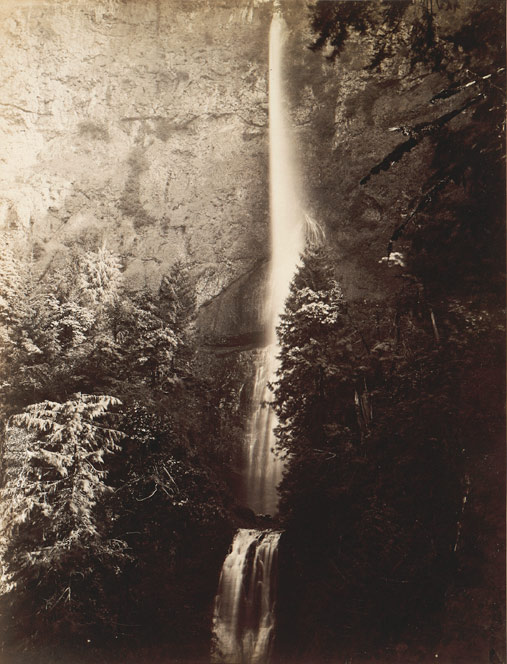


Multnomah Falls Cascade, Columbia River, 1867
Carleton E. Watkins (American, 1829–1916)
Albumen silver print from glass negative


View on the Columbia, Cascades, 1867

Carleton E. Watkins (American, 1829–1916)
Albumen silver print from glass negative

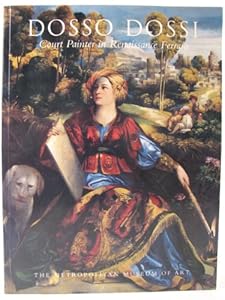
Dosso Dossi, Court Painter in Renaissance Ferrara


The first monographic survey of Dosso Dossi's work included some 60 paintings carefully chosen to reflect the richness and quality of the artist's achievement. On view January 14 through March 28, 1999 at The Metropolitan Museum of Art, Dosso Dossi, Court Painter in Renaissance Ferrara featured rarely lent masterpieces from collections in America and Europe — above all, the Borghese Gallery in Rome — and offered a unique opportunity to experience the full scope of Dosso's work, not seen since the dispersal of Ferrara's artistic treasures following the end of Este rule in the late 16th century.

The exhibition was organized by The Metropolitan Museum of Art, the Ministero per i Beni Culturali e Ambientali (Gallerie Nazionali di Ferrara, Bologna e Modena), the Comune di Ferrara/Civiche Gallerie d'Arte Moderna e Contemporanea, and The J. Paul Getty Museum.

More About the Artist

Dosso Dossi's exquisite depictions of religious subjects, allegories, and mythological scenes exemplify 16th-century court painting in its highest form. Consummate expressions of aesthetic poetry and artistic eccentricity, these paintings are also records of the refined taste and style of one of the great centers of Renaissance Italy.

In Orlando Furioso — the most widely read epic poem of the 16th century — Dosso is listed alongside Leonardo da Vinci, Raphael, and Titian as one of the great figures of his age by the renowned Renaissance poet Ludovico Ariosto, who likely admired Dosso's poetic and subtle — indeed enigmatic — representations of myth and allegory. Dosso's paintings have long been appreciated as celebrations of pictorial freedom and artistic invention, characterized by a rich palette, brilliant contrasts of light and shadow, and by the enduring echoes of joyousness, wit, and sensual delight. With the devolution of the Ferrarese court into the papal states in 1598, virtually all of Dosso's oil paintings were dispersed to collections in Rome and Modena, removing them from the elaborate context for which they were created. In this exhibition, they are reunited after 400 years and their original context newly reinterpreted.

An extraordinarily accomplished painter of nature, Dosso set most of his compositions outdoors, incorporating vibrant depictions of forests, flowers, and animals into verdant and exotic landscape vistas. Although he painted exceptionally powerful altarpieces and other religious works, his most remarkable canvases are the secular scenes painted to amuse, inspire, and delight the highly refined sensibilities of his patrons at the ducal court. Combining literary allusion, humor, and fantasy with lush color, dramatic atmospheric effects, and expressive brushwork, Dosso created beguiling visions of poetry in paint.

More About the Exhibition

Dosso Dossi, Court Painter in Renaissance Ferrara included many of the artist's masterpieces. Among the highlights of the exhibition were the Metropolitan's own


The Three Ages of Man (ca. 1514-15),


the lyrically beautiful Jupiter, Mercury, and Virtue (ca. 1523-24, Kunsthistorisches Museum, Vienna),


as well as the sophisticated Allegory with Pan (ca. 1529-32, The J. Paul Getty Museum, Los Angeles).

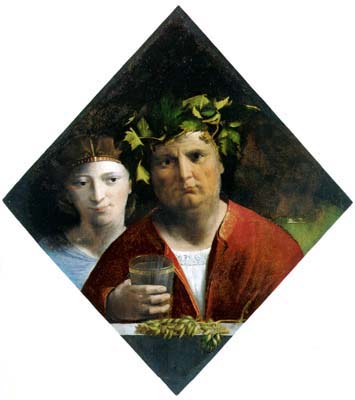
Seven rhomboid-shaped panels painted for Duke Alfonso's bedroom depict such allegories as


Anger (ca. 1515-16, Palazzo Cini, Venice),


Drunkenness (ca. 1521-22, Galleria Estense, Modena),

Love (ca. 1525-26, Estense), and Seduction (ca. 1525-28, Estense)
with characteristic insight and wit.


Melissa (ca. 1515-16), a splendid work on loan from the Borghese Gallery in Rome, is thought to portray Ariosto's benevolent enchantress undoing the spell cast by the evil Alcina, by turning a beautifully rendered dog back into a knight, whose armor lies nearby. With its heroically scaled figure, luminous palette, and wonderful sensitivity to the play of light on metal, fabric, and foliage, this is one of the artist's most memorable images.

The exhibition featured several canvases —


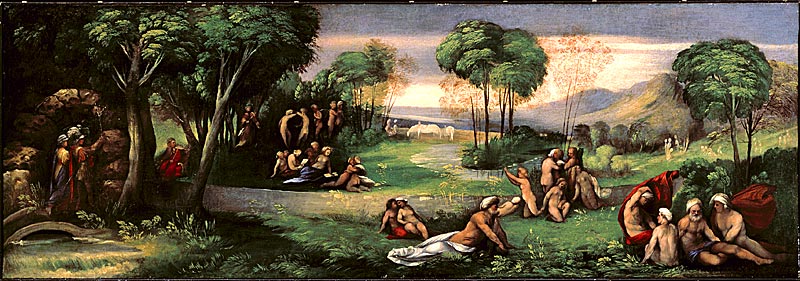
Aeneas in the Elysian Fields (ca. 1522, National Gallery of Canada, Ottawa),


The Sicilian Games (ca. 1522, Barber Institute of Fine Arts, University of Birmingham, England),


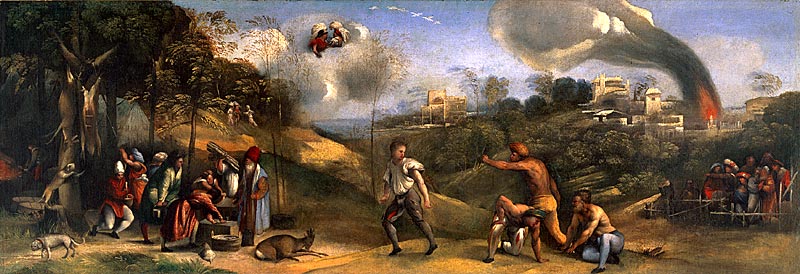
Scene from a Legend (Aeneas and Achates on the Libyan Coast) (ca. 1517-18, National Gallery of Art, Washington, D.C.)


commissioned for Alfonso's camerino, or private quarters within the castle. Among the most renowned commissions of the Renaissance, the camerino was undertaken by Alfonso to rival the great art collections of other rulers, including his sister Isabella d'Este in Mantua. Originally meant to include works by the most celebrated artists from various artistic centers, it eventually became a showcase for Venetian art by Bellini, Titian, and Dosso.

After Alfonso's death in 1534, Dosso continued to work for his son, Duke Ercole II, albeit on a diminished scale and often in collaboration with his brother and chief assistant, Battista Dossi. A section of the exhibition was devoted to these collaborative works as well as those by Battista alone.

Born near Mantua about 1486, Dosso's early style was formed in Venice, under the spell of Giorgione's poetic vision. Like Giorgione, Dosso was among the first painters to improvise on canvas. Rather than following careful preparatory drawings, he composed and recomposed as he painted — a remarkably free process that is revealed in new x-ray and infrared photographs, taken as part of a major technical study of Dosso's oeuvre conducted for this exhibition. Dosso worked alongside Titian on important commissions in Ferrara, is mentioned in Raphael's correspondence, and studied Michelangelo's work in Rome. While his work shows his appreciation of their prodigious talents, their influence is always reinterpreted to create something that is uniquely Dosso's.

By the time Dosso Dossi arrived in Ferrara in 1513, the city already had a long history of court painting in which artistic imagination and individuality were highly prized. Almost immediately, Dosso became court painter to Duke Alfonso I, frescoing in his beloved villas, known as "delizie", and designing theater sets, tapestries, ephemeral works. In a period that is noted for both the cultural refinement and political audacity of its leaders, Duke Alfonso I was one of the most colorful figures. He took an enormous interest in the artistic endeavors of his court and often participated in them — creating his own ceramics, musical instruments, and artillery. That so legendary a patron, whose family's collection included works by Mantegna, Bellini, and Titian, as well as Northern European artists such as Rogier van der Weyden, would choose Dosso Dossi as his principal painter is an indication of the esteem in which the artist's vision and style were held.

Publication


The exhibition was accompanied by an illustrated catalogue published by The Metropolitan Museum of Art. The 328-page catalogue features 103 color plates and 105 black-and-white illustrations and includes essays on the artist's life and work, as well as technical observations on each painting derived from the recently conducted research. Also included in the publication are a chronology and bibliography.

A major component of the catalogue reports on the extensive technical research into Dosso's painting technique and materials that was conducted over the past three years and has resulted in a critical reassessment of much of the artist's oeuvre. Some 90 works attributed to Dosso have been carefully studied and have revealed the artist's unique working method, in which the compositions of his paintings were often thought out directly on the canvas. In a large number of the artist's works, major compositional changes can be seen in the successive layers of paint. X-ray photographs of both Melissa and Allegory with Pan reveal that figures were added and subtracted, drastically altering the final look and content of the paintings from their initial conceptions. This research — presented here for the first time — has also assisted scholars in resolving issues of authorship for several problematic works previously attributed to Dosso.

Prior to the Metropolitan's presentation, the exhibition was on view in Ferrara at the Palazzo dei Diamanti. It was on view at The J. Paul Getty Museum in Los Angeles from April 27 through July 11, 1999.

Thursday, May 30, 2013

Picasso and Portraiture: Representation and Transformation


The first comprehensive survey ever assembled of the portraiture of Pablo Picasso opened at The Museum of Modern Art on April 28, 1996. Picasso and Portraiture: Representation and Transformation was the first exhibition to study Picasso's career solely from the perspective of his portraits. Comprising 130 paintings and some 100 works on paper, the exhibition traces Picasso's life through his development of the modernist portrait. Intimate portrayals of his family, lovers, friends, and colleagues illuminate the remarkable range of the artist's styles and reveal the connection between his personal relationships and his work.

Drawn from public and private collections throughout the world, as well as from the Museum's own extensive holdings, the exhibition included many works that have never been shown in the United States and a substantial number that have never been exhibited publicly. The exhibition was organized by William Rubin, Director Emeritus, Department of Painting and Sculpture, The Museum of Modern Art, in dialogue with Hélène Seckel, Chief Curator, the Musée Picasso, Paris, and in collaboration with the Réunion des Musées Nationaux, Paris. The exhibition had its only United States showing at MoMA; a smaller version opened at the Grand Palais, Paris, in October, 1996.

Mr. Rubin, who also organized Pablo Picasso: A Retrospective, the Museum's unprecedented 1980 exhibition of approximately 1,000 works, commented, "Understanding Picasso is fundamental to the understanding of twentieth-century art in general. The current exhibition focuses on a relatively unstudied aspect of his enormous oeuvre, enabling us to explore the rich panorama of invention, symbolism, and emotion that drove this artistic genius. The assembled works demonstrate that Picasso redefined the parameters and possibilities of portraiture more than any other painter in the modern era." He continued, "Picasso took the genre to a new level, redefining the portrait as the artist's personal response to the subject. He transformed the portrait from what had long been considered a primarily objective document into a frankly subjective one."

The Exhibition

Picasso and Portraiture focused on the multiple portrayals of the people central to Picasso's life and concludes with a survey of self-portraits from his adolescence through his last years. Because Picasso's view of his subjects was invariably filtered through his personal associations with them, his portrayal of a particular sitter could change radically during the extent of their relationship, ranging in style from primitivist, Surrealist, and Cubist to Neoclassical, among others. In order to fully illustrate the transformations applied to each subject, Picasso and Portraiture was, in effect, organized as a series of miniexhibitions, in which works are grouped according to sitter, as opposed to a purely chronological arrangement. Photographs (often by prominent artists such as Man Ray) and brief biographies of the major subjects accompanied the different portrait groups. In addition, new research revealed the identities of some subjects who were unknown or thought to have been invented.

The exhibition opened with Picasso's early portraits of his family and a series of portraits painted of his childhood friend and later secretary Jaime Sabartés. From there, it explored two early groups of portraits in which the artist began to develop a schematic, sculpturally precise, conceptual style influenced in part by the simplification of features in ancient Iberian sculptures. This style is exemplified in the head of


Woman Plaiting Her Hair (1906), a portrait of Picasso's first love, Fernande,

and in the reworked face in


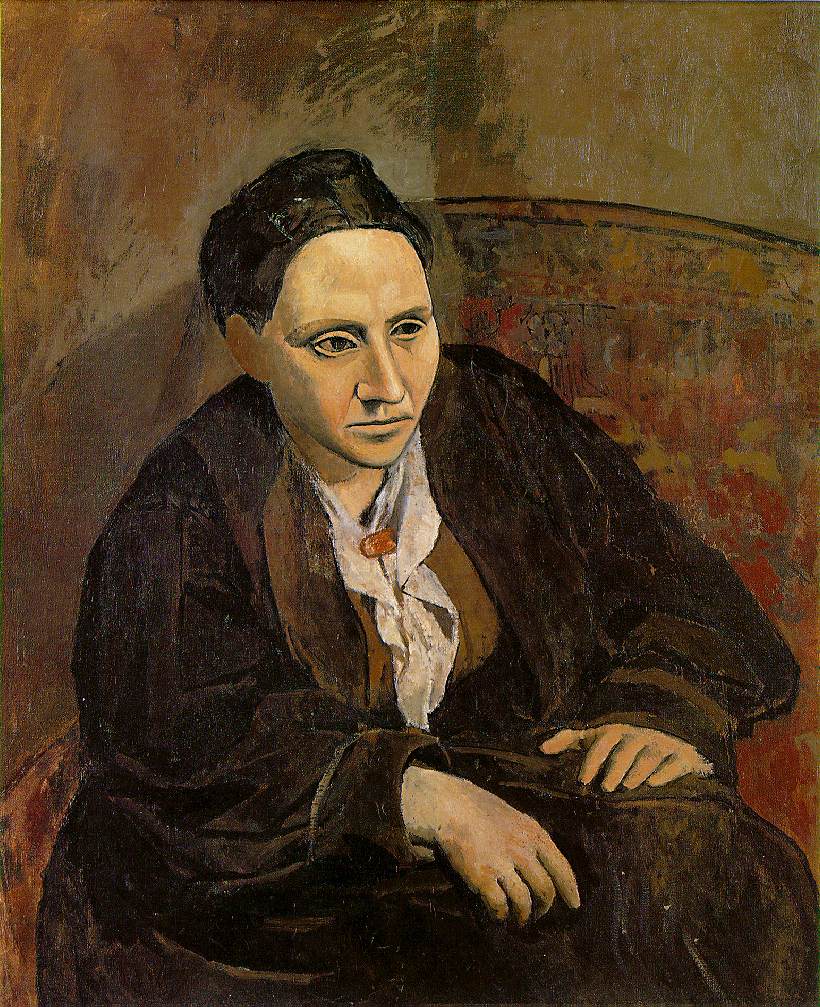
Portrait of Gertrude Stein (1906).

Olga Khokhlova, the Russian ballerina who was Picasso's first wife, was the inspiration for many of his paintings from 1917 through the 1920s, a period when the artist began to counterpoint his abstract Cubist representations with more realistic Neoclassical images. The complex relationship between the two styles was revealed in the highly abstract 1920 painting


Woman in an Armchair.

Confirming Mr. Rubin's research, an infrared scan of the painting performed in The Museum of Modern Art's conservation laboratory uncovered a Neoclassical painting of Olga in the same position underneath; many of the contours of the finished Cubist work were carried over directly from the Neoclassical under-painting, including the curve of Olga's chin, her right shoulder and arm, and almost the entire outline of the chair.

In the early years of the artist's relationship with Olga, the portraits of her are gentle—the colors subdued and the drawing graceful. As the marriage deteriorated, Picasso's portrayals of Olga became harsher and more transformed. In the cold, monochromatic


Seated Bather (1930), for example, a Surrealist figure inspired by Olga is made up of largely angular, hard, and unyielding forms, and has a head with a sawtooth, steel-trap mouth.

In stark contrast to Seated Bather,


Bather with Beach Ball (1932), a Surrealist portrayal of Picasso's then secret companion Marie-Thérèse, depicts a carefree, soft, rounded, seemingly weightless figure frolicking with a beach ball.

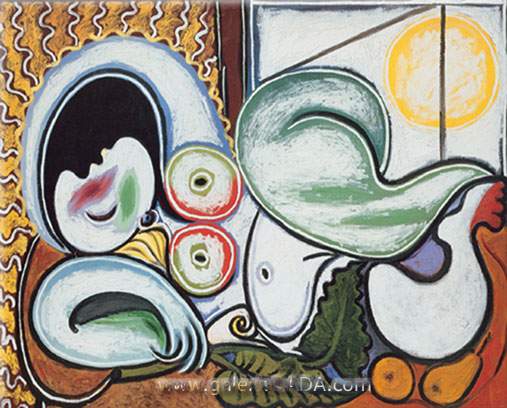
Picasso's long, intense relationship with Marie-Thérèse, who is now recognized as the primary subject in the artist's work of the 1930s, inspired his most erotic style of painting, exemplified by a group of sumptuous nudes including


The Mirror and


Sleeping Nude, both of 1932.


Still Life on a Pedestal Table (1931), although not a portrait in any traditional sense, envisions her poetically through the metaphor of still life. It contains sexually suggestive forms that allude to Marie-Thérèse as the subject: the curved contour of the pitcher is associated with the representation of her breasts and torso from earlier works.

Picasso's relationship with Marie-Thérèse overlapped with his involvement with the Surrealist painter-photographer Dora Maar, which began late in 1936. Portraits of the two women in similar reclining positions, both painted from memory on the same day, in the same setting, and on canvases of the same shape and size, reveal Picasso's different and complex feelings toward them. Marie-Thérèse is depicted in sympathetic terms, her large blue eyes dominating the soft curves of her naturalistically colored face. Dora's portrait reveals a more conflicted visage in which her boldly colored angular figure is set against a background of varying patterns and colors, expressing Dora's energy and passion.

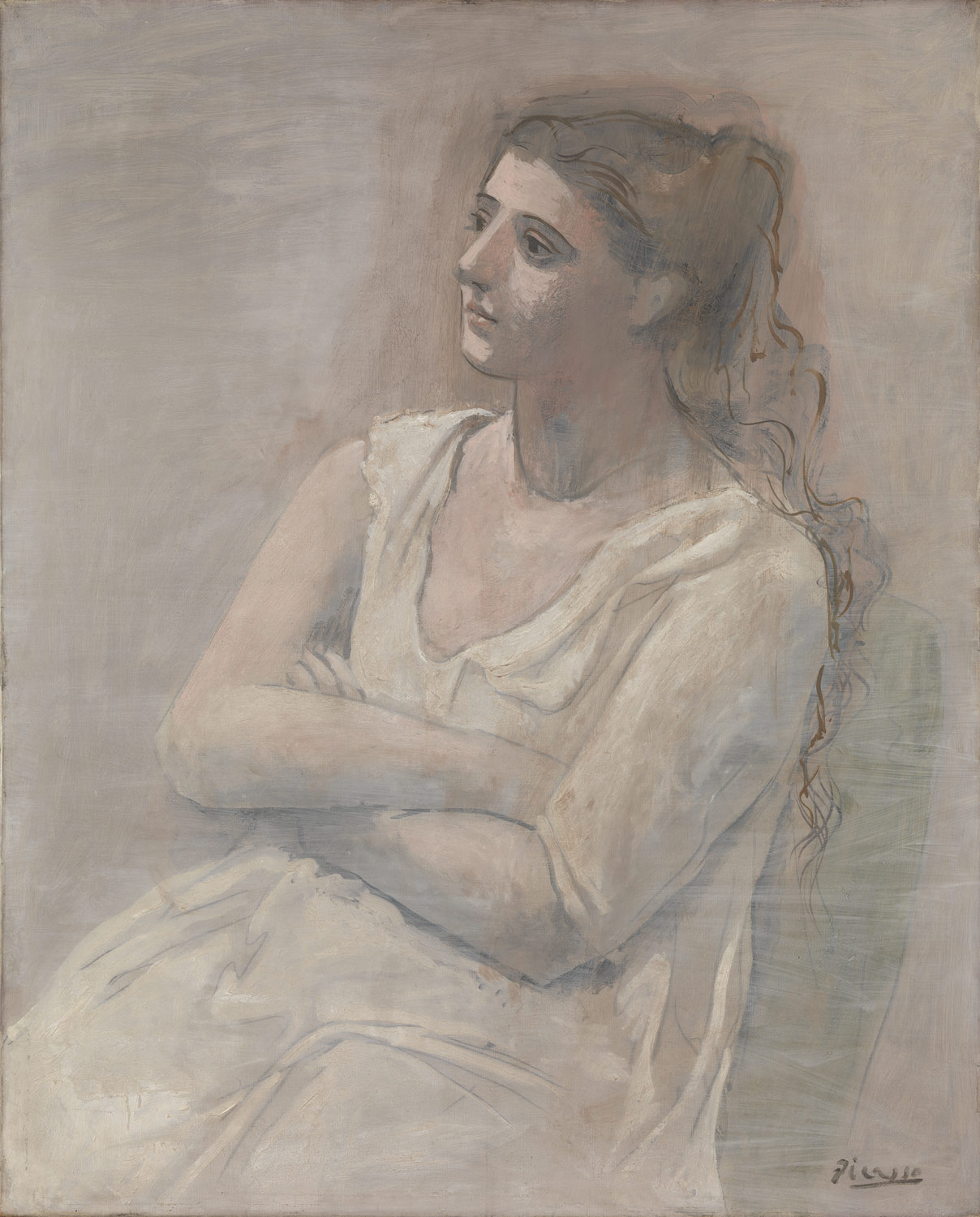
Exhibited together for the first time were a series of Neoclassical portraits from 1923 that had long been thought to be a generic depiction of classical beauty. Mr. Rubin has recently revealed that the portraits depict an actual person—the wealthy American socialite Sara Murphy, whom F. Scott Fitzgerald used as the model for his heroine in Tender Is the Night. Picasso fell in love with Sara in 1923, although it is not known how deeply they were involved. Her countenance is visible in several works in which the artist insinuated her features and hairstyle into portraits of Olga. Sara has also been identified as the subject of many drawings and three portraits on sand from the summer of 1923, which culminated in the celebrated


Woman in White (1923).

Picasso and Portraiture
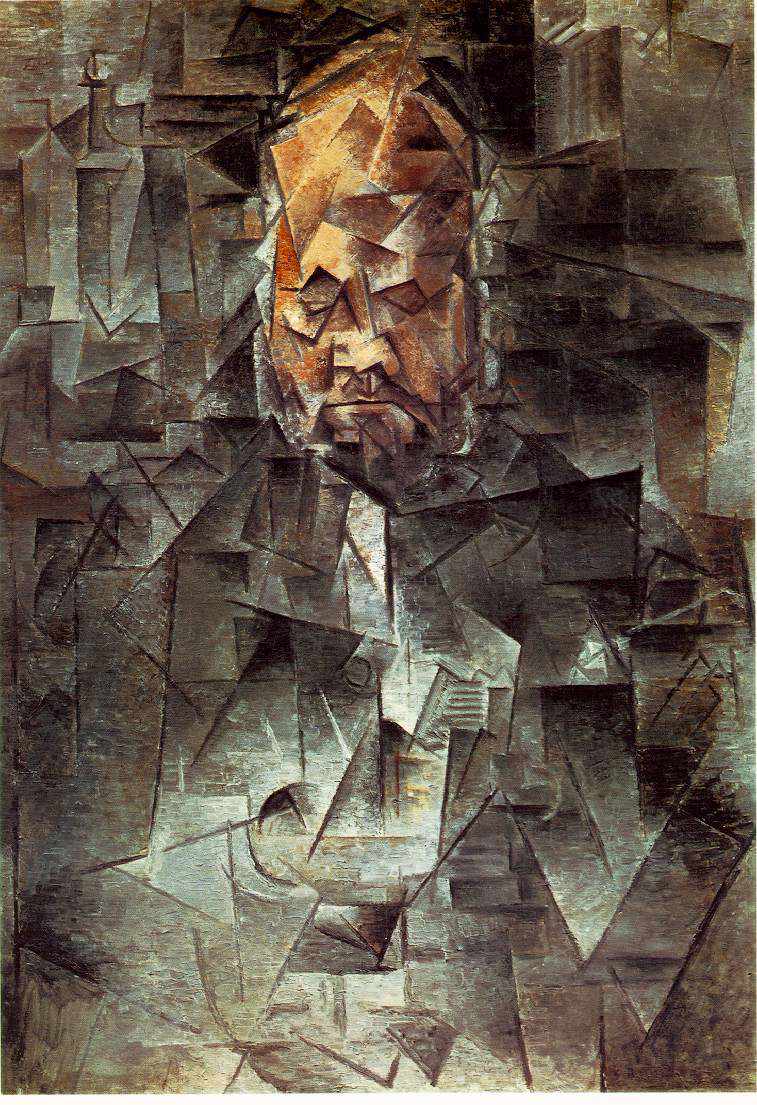
featured an exceptionally rich group of some twenty-one works of Picasso's last wife, Jacqueline Roque, whom he met in 1952. The Jacqueline portraits constitute the largest single group within his portraiture and dominate the artist's work in his seventies and eighties. Ranging from very large-scale oils in one gallery to linoleum prints and charcoal sketches in others, the Jacqueline portraits show the most stylistic variety and the widest range of mediums in any group. Some of the other subjects included in the exhibition were Picasso's art dealers


Ambroise Vollard,


Wilhelm Uhde,


and Daniel-Henry Kahnweiler;


the poets


Max Jacob,

André Salmon, and Guillaume Apollinaire; and his children Paolo, Paloma, Claude, and Maya.

The exhibition concluded with a striking selection of self-portraits representing a period of more than eighty years. Included are the brooding, soulful


1901 self-portrait from the Blue Period; the Iberianstyle


Self-Portrait with Palette (1906), a raw image of the man as the lone worker-painter; and several self-portraits executed in 1972 shortly before Picasso's death at age ninety-one:


Publication


The first book ever published on the subject of Picasso's portraiture accompanied the exhibition. Picasso and Portraiture: Representation and Transformation was edited by William Rubin, who has also written the introductory essay and a chapter exploring the Jacqueline portraits. Other scholars and curators who have contributed essays to the lavishly illustrated volume are Kirk Varnedoe, Chief Curator, Department of Painting and Sculpture, The Museum of Modern Art; Anne Baldassari and Brigitte Léal, Curators, and Hélène Seckel, Chief Curator, Musée Picasso, Paris; Pierre Daix; Michael C. FitzGerald; Marilyn McCully; and Robert Rosenblum. Published by The Museum of Modern Art, New York, it contains 496 pages, 216 color illustrations, and 541 black-and-white illustrations. _


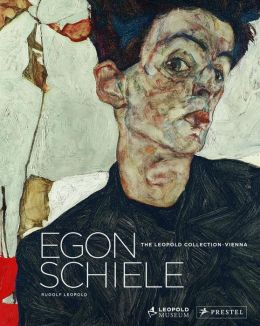
Egon Schiele: The Leopold Collection, Vienna


October 12, 1997 to January 4, 1998

The emotionally charged art of Egon Schiele (1890-1918), the iconoclastic Austrian Expressionist whose innovative drawing style spawned a radical new pictorial form, was examined in an exhibition at The Museum of Modern Art from October 12, 1997 through January 4, 1998. Comprising some 150 worksmost never before seen in the United States—Egon Schiele: The Leopold Collection, Vienna, traced the artist's brief but remarkably prolific career, from a tormented youth in search of artistic identity to a celebrated and influential artist at the time of his death at age 28.

Schiele's legacy, and his significance to contemporary artists, is an intensely personal figurative art that rejects conventional concepts of beauty in favor of exploring the psychological complexity of his sitters.

Part of the extensive collection of Dr. Rudolf Leopold, a prominent Austrian ophthalmologist who has devoted over four decades to amassing the world's finest private collection of the artist, the works in Egon Schiele: The Leopold Collection, Vienna were not on view again until the year 2002, when they were installed in the yet-to-be-completed Leopold Museum, part of the Museum Quarter in Vienna.

Organized by Magdalena Dabrowski, Senior Curator, Department of Drawings, the exhibition included oils, gouaches, watercolors, and drawings that represent all phases of Schiele's creative output—from the decorative
Self-Portrait with a Palette (1905), produced when he was 15 years old, to the moving


Edith Schiele on Her Deathbed (1918),

a portrait of his wife completed only four days before the artist's own death from the same influenza epidemic.

Much of the artist's oeuvre is autobiographical and self revelatory. Probing self-portraits dominate his work and his subjects include the people closest to him as well as landscapes that were a part of family history and personal experience. Death was a constant presence. Three of his siblings died before Schiele was born, a fourth when he was three years old, all victims of their father's syphilis. In 1904, when Schiele was only 14, his father succumbed to his untreated disease.

As a student, Schiele's early drawing style was skilled but unexceptional, as is evident in Portrait of a Young Girl (1906). In 1907 he met Gustav Klimt, the senior statesman of the Viennese art world who would become the younger man's mentor. Nude Boy Lying on a Patterned Coverlet (1908), with its ornamented drapery, clearly shows Klimt's influence.

The great change in the young artist's work came around 1909, when he began assimilating Auguste Rodin's special manner of "continuous drawing," newly developed near the end of the century. This technique, in which the artist draws without taking his eyes off the model, provided Schiele with the lively line, more emphatic than simple contour, that was to become his hallmark.

Schiele's most startling and evocative images—most often of male and female nudes in unabashedly erotic and contorted poses—challenged established conceptions of portraiture, and even the nature of beauty itself. These complex portraits were a marked departure from Art Nouveau, Jugendstil, and their Viennese counterpart, the Secessionist style, which emphasized the representation of the superficial aspects of beauty. He favored contorted bodies, strange, theatrical poses, and nervous, often jagged contours together with unusual color combinations.

"Schiele is, first and foremost, an exceptionally talented draftsman," remarks Ms. Dabrowski in her catalogue essay. "Even in his paintings the primary emphasis remains the structural element of the composition. His use of color is not for the purpose of modeling, but for the expressiveness."

While less well known than his drawings, Schiele's paintings and landscapes also reflect his own inner conflicts.


In Dead Mother I (1910),

for example, created after a vacation in Krumau, his mother's birthplace, darkness surrounds both the skeletal mother and an infant whose blood-red hands and lips betray Schiele's notion that birth was often synonymous with death.

His landscapes, also set in Krumau, are remarkable for their sober, yet highly expressive quality, in which a lack of color often conveys a bleak, nostalgic mood.

Schiele's most important creative years were between 1910 and 1915. His earlier work of this period includes drawings of the street children who visited his studio and provocative adolescent nudes. This era was dominated, however, by narcissistic and angst filled self-exploration, characterized by portraits of himself, sometimes masturbating.

The diversity of moods inherent in the self-portraits is represented in several examples from the Leopold Collection:


Kneeling Male Nude (Self- Portrait) (1910) is an almost grotesque depiction of an emaciated youth;


Grimacing Self-Portrait (1910) depicts an angry, unkempt, almost depraved visage;


Self Portrait in Shirt (1910) explores the more gentle side of his personality.

The death of Schiele's father and the rejection by his uncle resulted in the creation of double portraits, such as


Self-Seer II (1911) in which Schiele provides a second self—doppelgänger—in the guise of a protector or imaginary companion.

The years 1911-12 saw the creation of some of the most provocative female nudes, such as


Black-Haired Girl with Raised Skirt (1911). This period of liberated eroticism coincided with the start of his relationship with a sexually experienced young woman named Valerie Neuzil ("Wally"), who would be his companion and primary model until his marriage in 1915.

The artist's fascination with sex, sexuality, and their repression reveals more of the character of turn-of-the-century bourgeois Vienna than of any personal deviance or perversion. Ms. Dabrowski notes, "Schiele's probing of his psyche situated itself within a more general context of Viennese society's preoccupation with sex, the self, and with his own psychological state as it related to the current Freudian theories of psychoanalysis." His powerful nudes, whose explicit poses suggest sexual invitation and arousal, also spoke to the hypocrisy and censorship that were pervasive in the Viennese establishment.

By 1914 Schiele's fortunes started to change for the better. Professionally, he gained both collectors and commissions. Personally, after his marriage in 1915, his works began to feature more mature, fullbodied women, typified by his wife, Edith. Less erotically aggressive, these models exhibit a new tenderness. Manipulation of the body, however, remains the primary expressive technique, visible in such drawings as Lovers (1914), in which the two figures are almost painfully intertwined.

Despite his short career, Schiele has particular resonance for the contemporary viewer. According to Ms. Dabrowski, "His was an art of individuality and creative originality, focused on communicating the depth of human emotions and the force of human experience. The radicality of his art and his rebellion against the traditional attitudes toward such taboos as sex and sexuality make his art relevant to and appreciated by today's young artists and the public at large."

Publication


Egon Schiele: The Leopold Collection, Vienna, by Magdalena Dabrowski and Rudolf Leopold. 364 pages, 152 color plates, 45 black-and-white illustrations. This is an expanded English language version of a book on the subject. Published by DuMont Buchverlag in association with The Museum of Modern Art


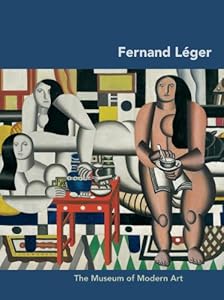
Fernand Léger


February 15-May 12, 1998

The first major retrospective of the work of French master Fernand Léger (1881-1955) to be shown in New York in more than four decades opened at The Museum of Modern Art on February 15, 1998.

Comprising over 60 paintings and some 20 related drawings spanning the artist's entire career, this exhibition challenged stereotypical notions of Léger as a painter of circumscribed technique and reveals the true richness and diversity of his achievement as one of the century's greatest artists. Beginning with his first mature work of 1911 to his last paintings of construction workers done in the years just before his death, Léger confronted the burning aesthetic issues of his time with a unique directness and consistency, through a range of subjects from the industrial to the bucolic. The only major modern artist to choose modernity itself as his subject, Léger's unique ability to capture the epic quality of everyday experience has earned him recognition as the painter of the "heroism of modern life."

Organized for The Museum of Modern Art by Carolyn Lanchner, Curator, Department of Painting and Sculpture, Fernand Léger was a collaboration between MoMA and the Musée national d'art moderne-Centre de création industrielle, Centre Georges Pompidou, Paris. The exhibition opened in Paris and traveled to the Museo Nacional Centro de Arte Reina Sofía, Madrid, before coming to The Museum of Modern Art, its final venue. MoMA's showing differed from those of the other two venues in its greater selectivity.

The series Contrastes de formes (Contrasts of forms) of 1913-14 exemplifies Léger's pictorial strategies and demonstrates his vigor in addressing a central issue of modernism: the debate between abstraction and figuration. The earliest, executed in 1913, are secured in history as the first wholly abstract paintings to emerge from Cubism; although devoid of recognizable imagery, these paintings have the curious effect of soliciting the viewer to find representational readings.


Paradoxically, the paintings of the following year devoted to the traditional genres of still life, landscape, and the human form appear nearly abstract. This shifting relationship between realism and abstraction is largely generated by the artist's finesse in accommodating volumetric forms to a flattened surface. Although his methods were to change, the play between figuration and nonfiguration, planarity and depth announced in these paintings remained at the heart of his constructive tactics during his entire career.

In addition to defining Léger's concerns with illusionism and abstraction most explicitly, the canvases of the Contrastes de formes with their rough grounds and passages of painterly bravura most obviously illustrate a romance with paint that never lost its zest. Contrary to critical and popular opinion which has seen the post-1914 Léger as a painter of hard, precisely drawn contours and of smooth slick surfaces that conceal the trace of the brush, the canvases themselves belie this impression. "Léger was a painter in love with paint and almost every canvas exhibits his enjoyment of it," writes Ms. Lanchner in the catalogue accompanying the MoMA retrospective.


For example, in one of Léger's masterpieces, La Ville (The city) , 1919, which incorporates billboards, bright colors, simple signs and geometric human forms, instances of deliberate pentimenti (pictorial elements visible beneath the artist's overpainting) are multiple -- perhaps most immediately observable in the over-painting surrounding what seems to be a fragment of scaffolding in the upper right.

In a smaller painting from the same year L'Homme à la roue (Man with wheel) , scintillating color punctuated by small areas of shadowed hues is found with a thickly charged, roughly brushed yellow plane at the right. Léger had a sensualist's love of the world, of its tactility, light, and color; his pictures, as he never tired of saying, do not copy visible things, but exist as their physical equivalents in paint.

Léger's lifelong subject was the pulse and dynamism of contemporary life. "He believed that most people were caught in outworn prejudices that blinded them to the glories of the modern spectacle, and that his role was to enlist the power of art to reveal the beauty of the mechanized environment," writes Ms. Lanchner. As he increasingly felt the need for an art that would address the general public, he extended the formal language of modernism to such subjects as construction workers and popular recreation.


The artist's last great masterpiece, La Grande Parade, état définitif (The great parade, final state), 1954, shows circus performers moving in and out of free-floating arcs of green, red, and blue--derived from a theory of color inspired by the flashing lights of Broadway.

For Léger painting was open-ended, its competence as an expressive means without limits. More than any of his peers, he welcomed elements into his work from a wide range of the century's artistic movements from Fauvism to Social Realism, yet his work remained independent, indelibly his own. In 1954, at the end of his life, Léger declared, "My era was one of great contrasts, and I am the one who made the most of it. I am the witness of my time."

Publication


Fernand Léger, edited by Carolyn Lanchner,
with essays by Ms. Lanchner, Jodi Hauptman, and Matthew Affron and contributions by Beth Handler and Kristen Erickson. 304 pages, 67 full color, 150 black-and-white illustrations. Published by The Museum of Modern Art.