Wednesday, September 7, 2016

HANS MEMLING’S TRIPTYCH OF JAN CRABBE REUNITED IN LANDMARK EXHIBITION AT THE MORGAN


Hans Memling: Portraiture, Piety, and a Reunited Altarpiece 
September 2, 2016 through January 8, 2017 

Completed around 1470 in Bruges, Hans Memling’s extraordinary Triptych of Jan Crabbe  was dismantled centuries ago and the parts were scattered.  The inner wings from the altarpiece are among the finest paintings owned by the Morgan Library  & Museum, where they have long been on permanent view in museum founder Pierpont  Morgan’s study. 

Hans Memling: Portraiture, Piety, and a Reunited Altarpiece , opening on  September 2, reunites the Morgan panels with t he other elements of the famous triptych: the  central panel from the Musei Civici in Vicenza, Italy, and the outer wings from the  Groeningemuseum in Bruges, Belgium.  
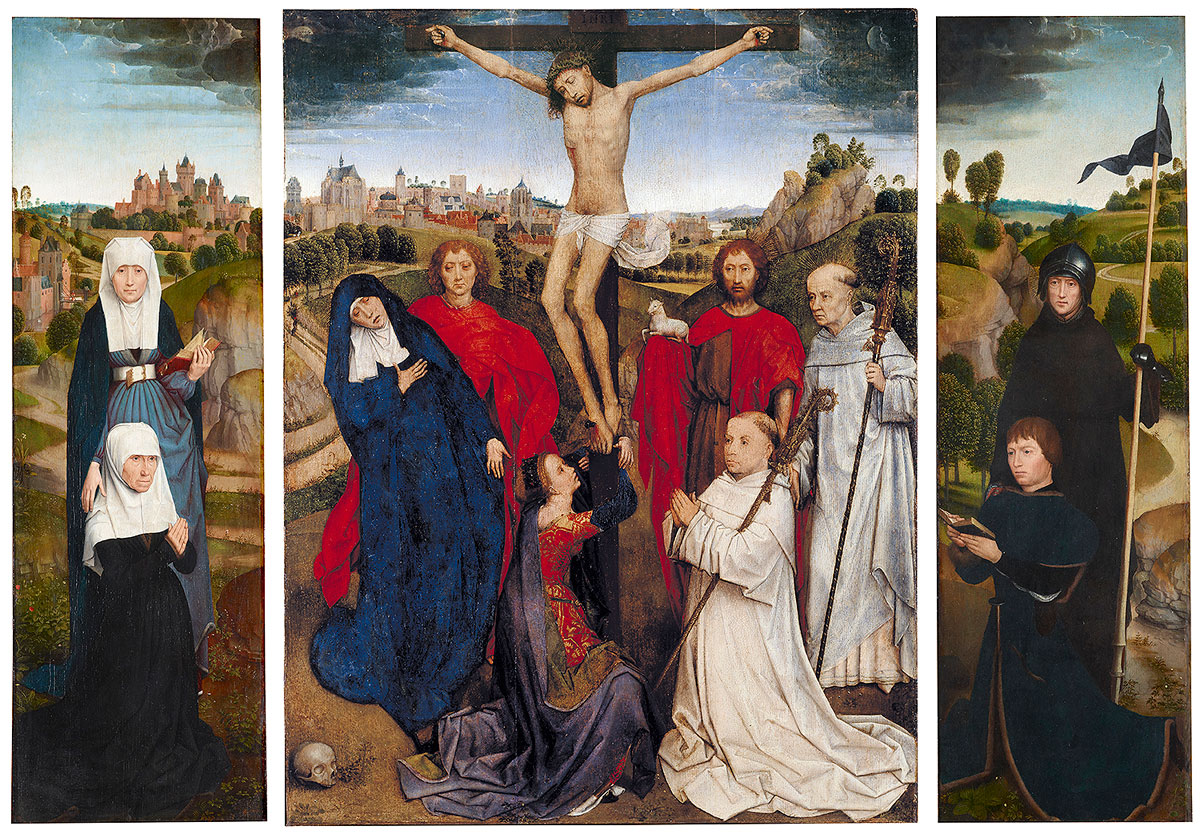

The Triptych of Jan Crabbe , ca. 1467-70. Oil on panel. Cent er panel: Image courtesy of  Pinacoteca Civica di Palazzo Chiericati, Vicenza. Left and righ t panels: © The Morgan Library & Museum, Photography by Graham S. Haber.

This exhibition—on view through January 8,  2017—is the first to explore the reconstructed  masterpiece in context. The altarpiece will be su rrounded by other paintings by Memling and his contemporaries, by a choice selection of illumi nated manuscripts from Bruges, and by a group of  Early Netherlandish drawings.

Aside from the t iptych fragments from Italy and Belgium, loans  from the Metropolitan Museum of Art, the Fr ick Collection, and a private collection will  complement a range of works fr om the Morgan’s own holdings. 

The Crabbe triptych is a masterpiece of the  first order and shows a relatively young Memli ng demonstrating many of  the characteristic  elements of his work—crystalline  realism, spatial sophistication,  and the ability to capture the  humanity and individuality of his subjects.

THE EXHIBITION

Triptych of Jan Crabbe 

Morgan acquired the triptych’s inner wings in 1907.  They were part of an altarpiece commissioned by Jan  Crabbe, Abbot of the Cistercian monastery of Ten  Duinen, near Bruges, Belgium. On the central panel,  Memling depicted the crucifixion of Christ, with the  Virgin Mary, St. John the Evangelist, and St. Mary  Magdalene to the left of the cross. Kneeling to the  right of the cross is Jan  Crabbe, accompanied by his  name-saint St. John the Baptist and St. Bernard of  Clairvaux, the founder of the Cistercian order. The two  inner wings depict members  of the patron’s family: his  mother Anna Willemzoon with St. Anne on the left,  and his much younger half-brother Willem de Winter  with St. William on the right. The outer wings, originally visible only when the panels are closed,  feature an Annunciation scene with the Angel Gabriel  and the Virgin Mary. It is not known precisely when or why the work was dismantled, though it was not unus ual for composite pieces such as triptychs to suffer this fate. 

The Triptych of Jan Crabbe  is a fine demonstration of Memling’s extraordinary ability to capture  the essence of the human face. In particular, the left panel portrait of Anna Willemzoon is one of  the most frank and extraordinary depictions of old age from the Renaissance.   Indeed, in later years, Memling’s portraiture wo uld come to revolutionize the genre across Europe. Similarly transformative, the Annunciation scene features Gabriel and the Virgin Mary clad in white drapery and set on pedestals in niches like sculptures, but with rosy flesh tones in  their heads and hands, making them one of the earliest examples of the technique of demi-grisaille in Flemish painting.  

Triptych of Jan Crabbe in Context  

Paintings by Memling and his Contemporaries 

Several independent portrait paintings from Memling’s early and late career offer further evidence  of Memling’s extraordinary talent as a portraitist. Although Memling’s painterly style developed as he grew older, his ability to capture the essenc e of his sitters’ personalities never changed.   Memling did not work in isolation, and a painting representing the Virgin and Child with St. Anne  by a contemporary artist known as the Master of the Saint Ursula Legend provides an ideal  counterpart to the triptych with its broad  landscape and similar iconography. It shows how Memling’s production fits alongside that of other painters in Bruges, while also highlighting how his technical abilities surpassed most others. 

Manuscript Illumination in Bruges 

n the fifteenth century, Bruges was an important center for  manuscript illumination. Mem ling’s development of the demi-grisaille technique has generally been traced to his time spent in Cologne, but in fact, varieties of grisaille and demi-grisaille were  regularly used in Bruges manuscript illumination in the decades  prior to the painting of the Crabbe triptych, as will be shown with  a selection of Books of Hours from the Morgan’s rich holdings.  Conversely, the radical naturalism of Memling’s painting seems to have served as an inspiration to the manuscript painters.  Superb manuscripts from the Morgan’s collection will show that reflections of Memling’s painting technique began to appear in manuscript painting towards the  end of the fifteenth century.
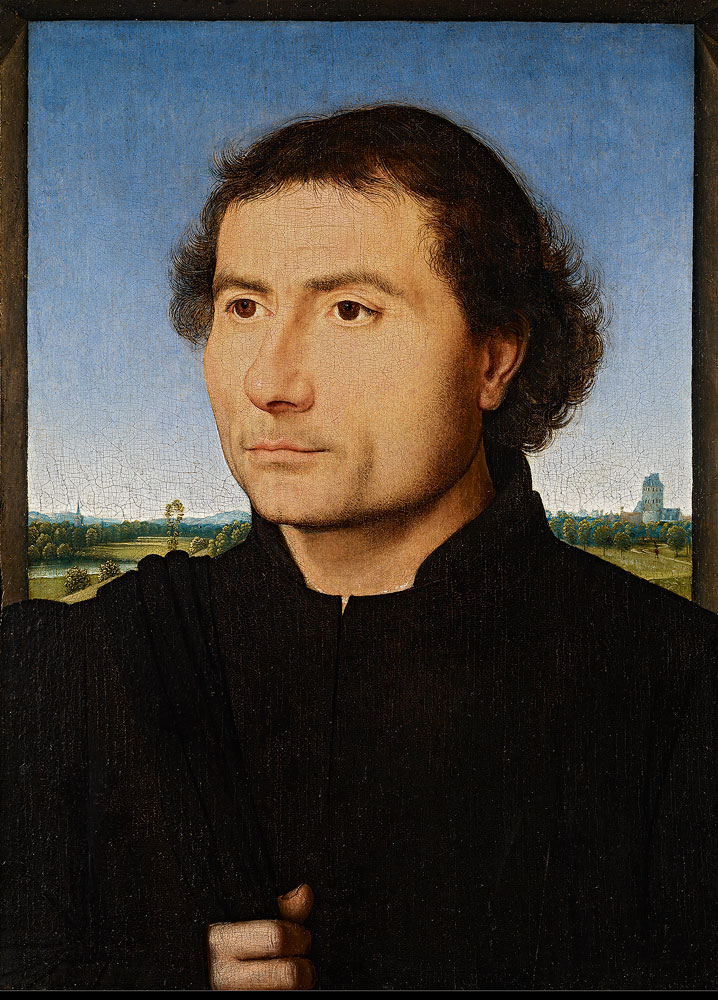


Hans Memling (Flemish, ca. 1440–1494),  Portrait of a Man , ca. 1470, Oil on panel. © The Frick Collection. 


Master of  the Saint Ursula Legend (Flemish, active late 15 th  century),  Virgin and Child with St. Anne presenting Anna van Nieuwenhove , ca.  1479-83. Oil on panel. © Metropolitan Museum of Art, Robert Lehman Collection.  

Tuesday, August 30, 2016

J. PAUL GETTY MUSEUM ANNOUNCES INTENT TO ACQUIRE RENAISSANCE MASTERPIECE BY RENOWNED ITALIAN PAINTER PARMIGIANINO


The J. Paul Getty Museum plans to acquire Virgin with Child, St. John the Baptist, and Mary Magdalene (about 1530-40) by Parmigianino (Italian, 1503-1540), one of the most celebrated painters of the Italian Renaissance. Extremely well-preserved, the painting is a supreme example of the artist’s mature Mannerist style and represents sixteenth-century painting at its finest.

Francesco Mazzola, better known as Parmigianino—a nickname derived from his native town of Parma—is one of the greatest Italian painters, draughtsman, and printmakers of the sixteenth century. During a career that lasted only two decades, he executed a wide range of work, from small panels for private devotion, to large-scale altarpieces and frescoes, to brilliantly executed portraits. Few painters had a greater influence on the art of their century, and his intellectual and elegant style spread far and wide, despite his very brief life.

The unconventional iconography of this painting typifies Parmigianino’s innovative work: the Christ Child turns from the Virgin Mary to embrace his young cousin, John the Baptist, whose hands are joined in prayer. Mary Magdalene holds the Christ Child under his arms while looking back at the Virgin. Intended for private devotion, the intimate religious subject exhibits Parmigianino’s characteristic polished and enamel-like paint surface and exquisitely rendered details; the lush landscape, elaborate hairstyles of the two women, interplay of hands, and still life with the jewels of Mary Magdalene enhance the transcendent beauty of the composition. Parmigianino executed the painting on paper laid down on panel, a unique feature in his surviving work, and one which reflects his accomplishment as a draughtsman.

“Pope Clement VII hailed Parmigianino as ‘Raphael reborn,’ and his style was extremely influential during the course of the sixteenth century,” says Davide Gasparotto, senior curator of paintings at the J. Paul Getty Museum. “This painting, with its impeccable provenance and exceptional state of preservation, shows the artist at the peak of his maturity.”

The painting complements a number of the Getty’s existing Italian Renaissance paintings, including


Head of Christ (about 1530) by Correggio (about 1489-1534),


The Rest on the Flight into Egypt with St. John the Baptist (about 1509) by Fra Bartolomeo (1472-1517) and works by Giulio Romano (before 1499 – 1546), Sebastiano del Piombo (1485-1547) and Jacopo Pontormo (1494-1557).

Friday, August 26, 2016

Realm of the Spirit: Marc Chagall, Vasily Kandinsky and Pablo Picasso,


Charleston is home to many firsts, but it’s a little-known fact that the historic city was home to the first formal exhibition of Solomon R. Guggenheim’s modern art collection. The exhibition was presented at the Gibbes Museum of Art, the South’s oldest art museum building, in 1936 and again in 1938, 21 years before Guggenheim’s collection found a permanent home in today’s renowned museum designed by Frank Lloyd Wright.

This fall, 80 years later, the Gibbes will present a special exhibition titled Realm of the Spirit: Solomon R. Guggenheim Collection and the Gibbes Museum of Art from October 22, 2016 to January 15, 2017. Organized by The Solomon R. Guggenheim Foundation, New York and featuring 35 works by celebrated modern artists including Marc Chagall, Vasily Kandinsky and Pablo Picasso, Realm of the Spirit revisits the Guggenheim’s fascinating – and largely unknown – history with the Lowcountry.

“We are honored to share much of the art featured in the original exhibitions with visitors to the Gibbes today in Realm of the Spirit. Through both figurative and abstract works, this selection from the Guggenheim collection emphasizes the timeless founding vision of the museum and the belief that non-objective art conveys the spiritual joy of creation” said Richard Armstrong, Director, Solomon R. Guggenheim Museum and Foundation. 

Guggenheim’s ties to the Lowcountry

After purchasing a home along the Charleston Battery and a property in nearby Yemassee in the 1920s, Solomon and Irene Guggenheim quickly became prominent figures in the Charleston community. Before becoming the first director of the Guggenheim Museum, art advisor Hilla Rebay curated the 1936 and 1938 exhibitions, bringing international attention to Charleston and record attendance levels for the Gibbes Museum of Art. Preserving the character of the exhibitions, Realm of the Spirit occupies the exact building of the original showing, and adopts their specified arrangement by dividing the works into “non-objective paintings” – abstract art that had no ties to the visible world – and “paintings with an object.”

“With Realm of the Spirit, the Guggenheim and the Gibbes revisit the important intersection of our institutional histories,” said Angela Mack, executive director of the Gibbes Museum of Art. “This exhibit is truly a once-in-a-lifetime opportunity and offers visitors an authentic viewing experience that wouldn’t be possible without the major restoration work that has taken place at the Gibbes.”

The Gibbes recently reopened to the public after a two-year, $14 million renovation to restore the 111-year-old building to its original 1905 layout and programming. In addition to the 35 paintings and works on paper from the Guggenheim founding collection, the exhibition will feature archival materials and historic photographs that document the significant history of the Gibbes-Guggenheim connection, as well as a fully illustrated exhibition catalog.


Rudolf Bauer (1889-1953)
Space, 1932
Ink, watercolor, pastel, and graphite on paper
16 x 19 inches (40.6 x 48.3 cm)
Solomon R. Guggenheim Museum, New York
Solomon R. Guggenheim Founding Collection, By gift
41.146


Marc Chagall (1887-1985)
Paris Through the Window, 1913
Paris par la fenêtre
Oil on canvas
53 9/16 x 55 7/8 inches (136 x 141.9 cm)
Solomon R. Guggenheim Museum, New York
Solomon R. Guggenheim Founding Collection, By gift
37.438


Albert Gleizes (1881-1953)
On Brooklyn Bridge, 1917
Sur Brooklyn Bridge
Oil on canvas
63 3/4 x 51 inches (161.8 x 129.5 cm)
Solomon R. Guggenheim Museum, New York
Solomon R. Guggenheim Founding Collection
37.489


Vasily Kandinsky (1866-1944)
Composition 8, July 1923
Komposition 8
Oil on canvas
55 1/8 x 79 1/8 inches (140 x 201 cm)
Solomon R. Guggenheim Museum, New York
Solomon R. Guggenheim Founding Collection, By gift
37.262


Pablo Picasso (1881-1973)
Accordionist, Céret, summer 1911
L'accordéoniste
Oil on canvas
51 1/4 x 35 1/4 inches (130.2 x 89.5 cm)
Solomon R. Guggenheim Museum, New York
Solomon R. Guggenheim Founding Collection, By gift
37.537
5/19/2016


Hilla Rebay (1890-1967)
Improvisation, 1918
Paper collage, colored pencil, and watercolor on paper, mounted on
newspaper
sheet: 11 3/8 x 8 3/4 inches (28.9 x 22.2 cm); mount: 12 5/16 x 9 5/8 inches
(31.3 x 24.4 cm)
Solomon R. Guggenheim Museum, New York
Solomon R. Guggenheim Founding Collection, By gift
37.381

Monday, August 15, 2016

Abstract Expressionism

Royal Academy of Arts, London
24 September 2016 – 2 January 2017
Guggenheim Museum, Bilbao 
3 February –4 June 2017 

In September 2016, the Royal Academy of Arts will present the first major exhibition of Abstract Expressionism to be held in the UK in almost six decades. With over 150 paintings, sculptures and photographs from public and private collections across the world, this ambitious exhibition encompasses masterpieces by the most acclaimed American artists associated with the movement – among them, Willem de Kooning, Arshile Gorky, Phillip Guston, Franz Kline, Joan Mitchell, Robert Motherwell, Barnett Newman, Jackson Pollock, Mark Rothko, Aaron Siskind, David Smith and Clyfford Still, as well as lesser-known but no less vital artists.

The selection aims to re-evaluate Abstract Expressionism, recognising that though the subject is often perceived to be unified, in reality it was a highly complex, fluid and many-sided phenomenon. Likewise, it will revise the notion of Abstract Expressionism as based solely in New York City by addressing such figures on the West Coast as Sam Francis, Mark Tobey and Minor White.

To ensure an exhibition for the 21st century, informed by new thinking, Abstract Expressionism will reexamine the two main strands into which these artists have often been grouped in the past. Namely, the so-called ‘colour-field’ painters, such as Rothko and Newman, versus the ‘gesture’ or ‘action painters’, epitomised by de Kooning and Pollock. The art of the former has been held to focus on the contemplative or sublime use of colour, whereas the latter supposedly demonstrated spontaneity and improvisation in their work through bold gestural mark-making.

Yet these categories are simplistic, belying the deeper concerns that linked many of the artists. For example, various Abstract Expressionists developed the ‘all-over composition’ by rejecting the formal concept of an image with a single or central focus. Instead, they thought in terms of energised fields, whether of vibrant colour or linear dynamism.

Concerns such as myth-making, the sublime, monochrome and an urge to stress the human presence even in abstraction also connected the artists. Similarly, their creations challenged conventional notions of scale with dimensions that ranged from minute intimacy to epic grandeur – dramatic innovations that the exhibition will highlight.

For the first time, the Clyfford Still Museum in Denver, which holds 95% of the artist’s work, will loan nine major paintings to the exhibition, establishing the artist at the very forefront of Abstract Expressionism. The paintings by Clyfford Still will be presented in a dedicated gallery within the exhibition.


Jackson Pollock’s monumental Mural, 1943 (University of Iowa Museum of Art, Iowa)


and Blue Poles, 1952 (National Gallery of Australia, Canberra © The Pollock-Krasner Foundation ARS, NY and DACS, London 2016;)
will be displayed in the same gallery for the first time, a juxtaposition unlikely to ever be repeated. 


Further highlights will include Arshile Gorky’s Water of the Flowery Mill, 1944 (The Metropolitan Museum of Art, New York);


Willem de Kooning’s Woman II, 1952 (The Museum of Modern Art, New York);


Franz Kline’s Vawdavitch, 1955 (Museum of Contemporary Art Chicago© ARS, NY and DACS, London 2016. Photo: Joe Ziolkowski);


Mark Rothko’s No. 15, 1957 (Private Collection © 1998 Kate Rothko Prizel &
Christopher Rothko ARS, NY and DACS, London.); 


Lee Krasner’s The Eye is the First Circle, 1960 (Courtesy Robert Miller Gallery, New York  © ARS, NY and DACS, London 2016);


and David Smith’s Hudson River Landscape, 1951 (Whitney Museum of American Art, New York).

Works by artists such as Helen Frankenthaler, Adolph Gottlieb, Hans Hofmann, Lee Krasner and Ad Reinhardt will also feature amongst others. In addition to Aaron Siskind and Minor White, the photographers will include Harry Callahan, Herbert Matter and Barbara Morgan.


Clyfford Still,
PH-950, 1950. Oil on canvas, 233.7 x 177.8 cm. Clyfford Still Museum, Denver © City
and County of Denver / DACS 2016. Photo courtesy the Clyfford Still Museum, Denver, CO;


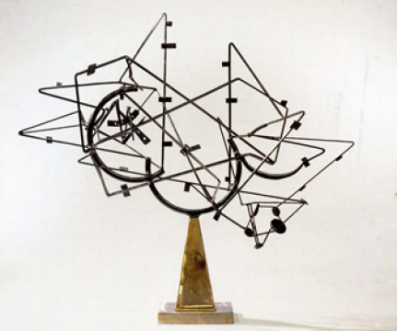
David Smith,
Star Cage
1950. Painted and brushed steel, 114 x 130.2 x 65.4 cm. Lent by the Frederick R. Weisman Art Museum, University of
Minnesota, Minneapolis. The John Rood Sculpture Collection. © Estate of David Smith/DACS, London/VAGA, New
York 2016;

Dr David Anfam, co-curator of Abstract Expressionism said: “Abstract Expressionism will explore this vast phenomenon in depth and across different media, revealing both its diversity and continuities as it constantly pushed towards extremes. It will bring together some of the most iconic works from around the world in a display that is unlikely to be repeated in our lifetime.”

Abstract Expressionism has been organised by the Royal Academy of Arts, London with the collaboration of the Guggenheim Museum Bilbao. The exhibition is curated by the independent art historian, David Anfam, alongside Edith Devaney, Contemporary Curator at the Royal Academy of Arts. Dr Anfam is the preeminent authority on Abstract Expressionism, the author of the catalogue raisonné of Mark Rothko’s paintings and Senior Consulting Curator at the Clyfford Still Museum, Denver. 

Abstract Expressionism will be accompanied by a fully illustrated catalogue. Authors include David Anfam, author of the now-standard textbook Abstract Expressionism (1990); Susan Davidson, Senior Curator, Collections and Exhibitions, at the Solomon R. Guggenheim Museum, New York; Edith Devaney, Curator of Contemporary Projects, Royal Academy of Arts; Jeremy Lewison, former Director of Collections at Tate; Carter Ratcliff author of Fate of a Gesture: Jackson Pollock and Postwar American Art (1996) and Christian Wurst, researcher on The Catalogue Raisonné of the Drawings of Jasper Johns (forthcoming).


COLOUR: The Art and Science of Illuminated Manuscripts


Through 30 December 2016 

Fitzwilliam Museum, Cambridge, UK


Dazzling treasures combining gold and precious pigments-some of the finest illuminated manuscripts in the world-are on display in celebration of the Fitzwilliam Museum’s bicentenary.

The majority of the exhibits are from the Museum’s own rich collections, and those from the founding bequest of Viscount Fitzwilliam in 1816 can never leave the building and can only be seen at the Museum. For the first time, the secrets of master illuminators and the sketches hidden beneath the paintings are revealed in a major exhibition presenting new art historical and scientific research.

Spanning the 8th to the 17th centuries, the 150 manuscripts and fragments in COLOUR: The Art andScience of Illuminated Manuscripts guide us on a journey through time, stopping at leading artisticcentres of medieval and Renaissance Europe. Exhibits highlight the incredible diversity of the Fitzwilliam’s collection: including local treasures, such as the Macclesfield Psalter made in East Anglia c.1330-1340, a leaf with a self-portrait made by the Oxford illuminator William de Brailes c.1230-1250, and a medieval encyclopaedia made in Parisc.1414 for the Duke of Savoy.

Four years of cutting-edge scientific analysis and discoveries made at the Fitzwilliam have traced the creative process from the illuminators’ original ideas through their choice of pigments and painting techniques to the completed masterpieces.


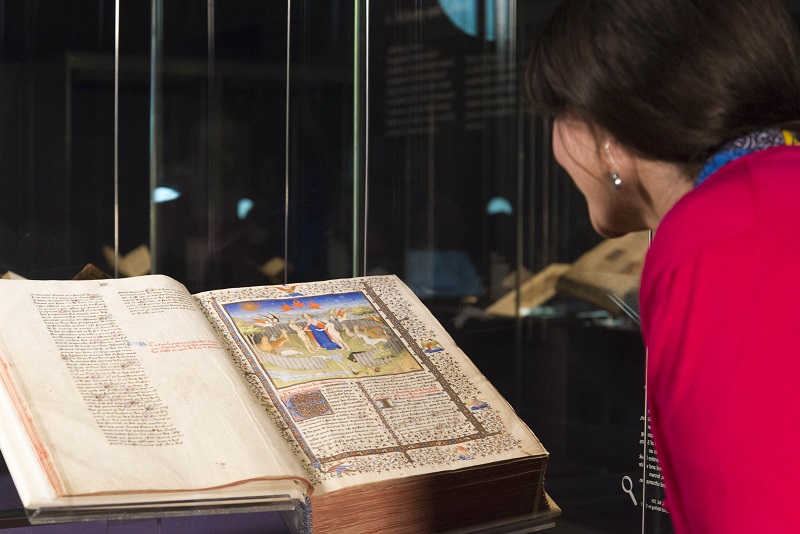
 Detail: Jean Corbechon, Livre des proprietés des choses, Adam and Eve in the Garden of Eden, France, Paris, 1414, Master of the Mazarine Hours (act. c.1400-1415) 

Leading artists of the Middle Ages and early Renaissance did not think of art and science as opposing disciplines,” says curator, Dr Stella Panayotova, Keeper of Manuscripts and Printed Books. “Instead,drawing on diverse sources of knowledge, they conducted experiments with materials and techniques to create beautiful works that still fascinate us today.”

Merging art and science, COLOUR shares the research of MINIARE (Manuscript Illumination: Non-Invasive Analysis, Research and Expertise), an innovative project based at the Fitzwilliam. Collaborating with scholars from the University of Cambridge and international experts, the Museum’s curators,scientists and conservators have employed pioneering analytical techniques to identify the materials and methods used by illuminators.

A popular misconception is that all manuscripts were made by monks and contained religious texts, but from the 11thcentury onwards professional scribes and artists were increasingly involved in a thriving book trade, producing both religious and secular texts. Scientific examination has revealed that illuminators sometimes made use of materials associated with other media, such as egg yolk, which was traditionally used as a binder by panel painters.

Other discoveries include pigments rarely associated with manuscript illumination– such as the first ever example of smalt detected in a Venetian manuscript. Smalt, obtained by grinding blue glass, was found in a Venetian illumination book made c.1420. Evidently, the artist who painted it had close links with the famed glassmakers of Murano. This example predates by half a century the documented use of smalt in Venetian easel paintings.

Analyses of sketches lying beneath the paint surfaces, and of later additions and changes to paintings help to shed light on manuscripts and their owners. One French prayer book, made c.1430, was adapted over three generations to reflect the personal circumstances and dynastic anxieties of a succession of aristocratic women. Adam and Eve were originally shown naked in an ABC commissioned c.1505 by the French Queen,Anne of Brittany (1476-1514) for her five-year-old daughter. However, a later owner, offended by the nudity, gave Eve a veil and Adam a skirt. Infrared imaging techniques and mathematical modelling have made it possible to reconstruct the original composition without harming the manuscript.

The Museum’s treasures will be displayed alongside carefully selected loans —celebrated manuscripts from Cambridge libraries as well as other institutions in the UK and overseas. These include an 8th century Gospel Book from Corpus Christi College, the University Library’s famous Life of Edward the Confessor, magnificent Apocalypses from Trinity College and Lambeth Palace, London, and a unique model book from Göttingen University.

Catalogue entries and essays by leading experts offer readers insight into all aspects of colour from the practical application of pigments to its symbolic meaning.


 Detail:The Macclesfield Psalter


From The Arts Desk Ltd:

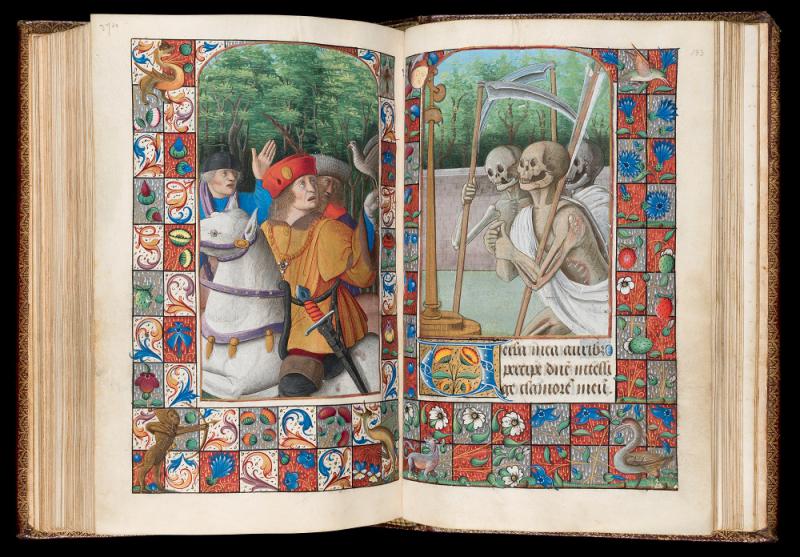
Book of Hours, Use of Rome, 'The Three Living and the Three Dead', Western France, c. 1490-1510All images © The Fitzwilliam Museum, Cambridge
 
It is sobering to think that the medieval and Renaissance paintings that fill our galleries represent just a fraction of the artistic output of that period. Panel paintings – not to mention exquisitely fragile wall paintings – have for the most part succumbed to the ravages of time, and those not destroyed by fire or flood, acts of war or vandalism, or abortive attempts at restoration have simply faded, darkened or discoloured.

Safely tucked away in libraries, illuminated manuscripts have survived in far greater numbers and, as such, form the most substantial, if most easily overlooked, legacy of medieval and Renaissance visual culture. The bland anonymity of a bound volume shelved amongst thousands was not much of a draw for the vandals and looters of the past, and served to shield the richly decorated pages from light and the elements.
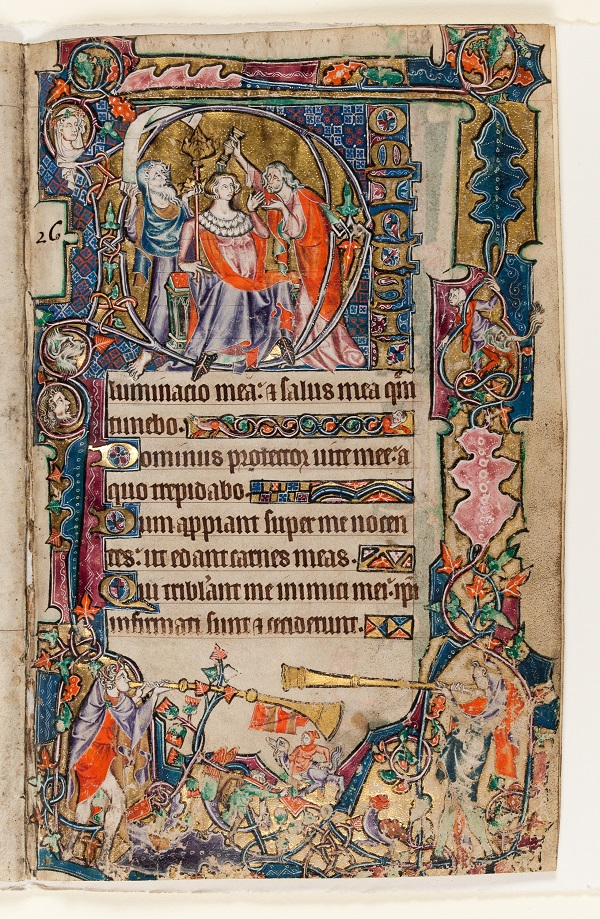
7. The Macclesfield Psalter, The Anointing of David, England, East Anglia, probably Norwich, c.1330-1340

Of the world’s many illuminated manuscript collections, that of the Fitzwilliam Museum in Cambridge is reputedly the finest, the books cocooned in fenland isolation, the terms of the founder’s bequest ensuring that much of the collection remains forever inside the museum (pictured above: The Macclesfield Psalter, c.1330-1340).

In this spellbound state, the Fitzwilliam perpetuates the conditions that have kept these books safe for centuries, and the knowledge of this makes looking at them a strangely timeless experience. In galleries darkened to protect light-sensitive pigments, pages embellished with gold and silver leaf twinkle convincingly, just as they must have done when seen by candlelight...


 Jean Corbechon, Livre  des proprietés des choses, Adam and Eve in the Garden of Eden, France,  Paris, 1414, Master of the Mazarine Hours (act. c.1400 -1415)
In another beguiling example, an eagle marks the beginning of an eighth-century St John’s Gospel, the intricate but spare design with large areas of blank parchment typical of manuscripts made at Lindisfarne. We are told that the organic purple used to colour the eagle’s head is derived from a lichen found locally, over which yellow orpiment has been applied in dots. The contrast between the local purple, and the rare, imported yellow is evocative, and shows that for all its isolation Lindisfarne was part of an international trade network. But it also shows the technical expertise of the Lindisfarne illuminators, who knew that the organic purple base would prevent the deterioration of the orpiment, an unstable pigment that would otherwise tend to turn black....


Wednesday, August 10, 2016

Icon of Modernism: Representing the Brooklyn Bridge, 1883–1950


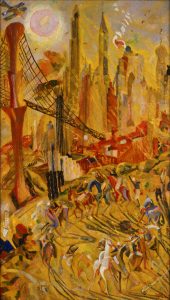
The Georgia Museum of Art at the University of Georgia will present the exhibition “Icon of Modernism: Representing the Brooklyn Bridge, 1883–1950,” from Sept. 17 to Dec. 11, 2016.

“Icon of Modernism” includes 42 paintings, watercolors, works on paper and photographs that all take the Brooklyn Bridge as a subject. Sarah Kate Gillespie, the museum’s curator of American art, chose works of art created between the completion of the bridge (1883) and the mid-20th century to show how artistic representations of it changed over time, even as it symbolized modernity for different generations. From American impressionism to abstract expressionism, the details of how artists presented the bridge changed, but its ability to stand for the modern era remained.

“When it opened, the Brooklyn Bridge was a phenomenon, and many commemorative objects featuring the bridge were produced. Other museums have shown the wide variety of these objects, but we decided to focus on the aesthetic portion alone,” explains Gillespie, who was tasked with organizing the exhibition when the museum hired her in 2014.

Although it may seem strange for Athens, Georgia, to host an exhibition on a structure so tied to New York City, descendants of John A. Roebling, who designed the bridge, lived in Athens for many years.

In the words of scholar Alan Trachtenberg, “the Brooklyn Bridge symbolized and enhanced modern America.” From its opening in 1883 to the present day, artists have repeatedly depicted the bridge as a stand-in for both the city of New York and for the idea of modernity as defined by that city’s urban life. Such representation was particularly true during the period this exhibition treats, when artists were engaging with new forms of visual representation such as Impressionism, Cubism and Precisionism. Artists utilized newly built structures such as the bridge, the Woolworth building and the Flatiron building in conjunction with these innovative formal techniques to underscore the contemporary nature of their artistic production. By compiling a selection of works in varying media that feature the Brooklyn Bridge from artists on both sides of the Atlantic, this exhibition examines these modes of representation and how artists grappled with a particularly American brand of modernity as both positive and negative from U.S. and European perspectives.

This show will feature approximately 40 paintings, works on paper and photographs by major American and European artists. Four works in the exhibition come from the museum’s own collection, but the remainder are on loan from museums, corporate collections and private collections across the country.Artists include Edward Steichen, Joseph Stella, George Luks, Jonas Lie, William Louis Sonntag Jr., Reginald Marsh, Louis Lozowick, John Marin, Childe Hassam, Ernest Lawson and Samuel Halpert, among others.


Jonas Lie (American, b. Norway, 1880–1940), Bridge and Tugs, 1911–15. Oil on canvas, 34½ x 41½ inches. Georgia Museum of Art, University of Georgia; Museum purchase with funds provided by
C. L. Morehead Jr., GMOA 2001.179.


Millard Sheets (American, 1907–1989), Brooklyn Bridge, 1933. Watercolor on paper, 15¾ x 22¾ inches. Georgia Museum of Art, University of Georgia; Extended loan from the collection of Jason Schoen, GMOA 2005.123E.


Joseph Stella (American, b. Italy, 1877–1946), Study for New York Interpreted: The Bridge, 1917–22.
Watercolor and pencil on paper, 24 x 18 inches. Hirshhorn Museum and Sculpture Garden, Smithsonian Institution, Washington, DC, 85.22


Joseph Stella (American, b. Italy, 1877–1946), Study for New York Interpreted: Brooklyn Bridge, 1920–22. Watercolor and ink on paper, 13 15/16 x 9 15/16”. Hirshhorn Museum and Sculpture Garden, Smithsonian Institution, Washington, DC, 66.4775.

TF121

Yun Gee Wheels: Industrial New York
1932
oil on canvas
84 x 48 inches
Private Collection


O. Louis Guglielmi American, b. Egypt, 1906–1956 The Bridge 1942 Oil on canvas Canvas: 34 × 26 in. (86.4 × 66 cm) Collection Museum of Contemporary Art Chicago Gift of Mary and Earle Ludgin Collection 1981.35 Photo © MCA Chicago


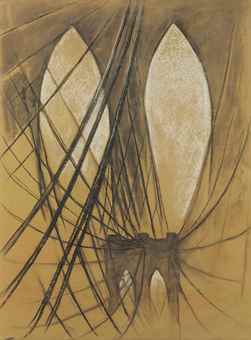
Georgia O'Keeffe (1887-1986)
Brooklyn Bridge
charcoal and chalk on paper
39 7/8 x 29 ½ in. (101.3 x 74.9 cm.)
Executed in 1949.

Elie Hirschfeldprivate art collection


"Brooklyn Bridge," Ernest Lawson, 1917-20


An illustrated catalogue published by the museum will accompany “Icon of Modernism,” with scholarly essays by Gillespie, Janice Simon (Josiah Meigs Distinguished Teaching Associate Professor of Art History in the Lamar Dodd School of Art, UGA), Meredith Ward and Kimberly Orcutt.

Tuesday, August 9, 2016

Major Series of Paintings by Spanish Master Francesco de Zurbarán

Coming to the United States for the First Time in 2017 and 2018


In conjunction with The Meadows Museum, Dallas, Texas, and the Auckland Castle Trust, County Durham, England, The Frick Collection is co-organizing an exhibition of Jacob and His Twelve Sons, an ambitious series of thirteen life-size paintings that depict the Old Testament figures. On loan from Auckland Castle, the works by the Spanish Golden Age master Francisco de Zurbarán (1598–1664) have never travelled outside Europe. 

They will be on view first in Dallas from September 17, 2017, through January 7, 2018, after which they will be shown in New York at The Frick Collection from January 31 through April 22, 2018. 

In preparation for this unprecedented U.S. tour, these important seventeenth-century Spanish paintings will undergo an in-depth technical analysis at the Kimbell Art Museum, Fort Worth. The project includes art historical and technical research, an exhibition, and publication. This international collaboration will offer the most extensive study related to Zurbarán’s series. For its New York showing in 2018, the exhibition will be organized by The Frick Collection’s Senior Curator, Susan Grace Galassi.

About the Series of Paintings

The iconography of Zurbarán’s remarkable series—which was painted between 1640 and 1644—is derived from the Book of Genesis, Chapter 49. On his deathbed, Jacob called together his twelve sons, who would become the founders of the twelve tribes of Israel, which, essentially, represents the beginning of the Jewish faith. He bestowed on each a blessing, which foretold their destinies and those of their tribes. Jacob’s prophesies provide the basis for the manner in which the figures are represented in Zurbaran’s series. The story also has significance to Christians and Muslims.

The series is believed to have originally been destined for the New World, where in the seventeenth century it was commonly believed that indigenous inhabitants of the Americas were descended from the dispersal of the so-called “lost tribes of Israel.” The works were purchased by Richard Trevor, Bishop of Durham, at auction in 1756 from the collection of a Jewish merchant named Benjamin Mendez. Trevor redesigned Auckland Castle’s Long Dining Room to house the series, which constitutes one of the most significant public collections of Zurbarán’s work outside Spain. The upcoming restoration of Auckland Castle—which involves the temporary deinstallation of the series from the room where it has hung for more than 250 years—presents this extraordinary study and exhibition opportunity.

Comments Frick Director Ian Wardropper, “We are thrilled to collaborate with Auckland Castle and the Meadows Museum on the first North American showing of Francisco de Zurbarán’s extraordinary series Jacob and his Twelve Sons. The technical analysis to be carried out at the Kimbell will greatly enrich our understanding of the master’s methods, while other catalogue essays commissioned for the show will explore the works in historical, cultural, and religious contexts. The sheer visual power and rich narrative content of this series will draw visitors in and will be beautifully complemented by the Frick’s strong holdings in Spanish art, which include paintings by Velázquez and Murillo—Zurbarán’s Sevillian contemporaries—as well as by El Greco and Goya.”


Francisco de Zurbarán (Spanish, 1598–1664)
Jacob, ca 1640–45
Oil on canvas, 77 15/16 × 40 3/16 inches (198 × 102 cm)
Photo credit: Colin Davison, courtesy of Auckland Castle


Francisco de Zurbarán (Spanish, 1598–1664)
Reuben, ca. 1640–45
Oil on canvas, 77 15/16 × 40 3/16 inches (198 × 102 cm)
Photo credit: Colin Davison, courtesy of Auckland Castle


Francisco de Zurbarán (Spanish, 1598–1664)
Simeon, ca. 1640–45
Oil on canvas, 77 15/16 × 40 3/16 inches (198 × 102 cm)
Photo credit: Colin Davison, courtesy of Auckland Castle


Francisco de Zurbarán (Spanish, 1598–1664)
Levi, ca. 1640–45
Oil on canvas, 77 15/16 × 40 3/16 inches (198 × 102 cm)
Photo credit: Colin Davison, courtesy of Auckland Castle


Francisco de Zurbarán (Spanish, 1598–1664)
Judah, ca. 1640–45
Oil on canvas, 77 15/16 × 40 3/16 inches (198 × 102 cm)
Photo credit: Colin Davison, courtesy of Auckland Castle


Francisco de Zurbarán (Spanish, 1598–1664)
Zebulun, ca. 1640–45
Oil on canvas, 77 15/16 × 40 3/16 inches (198 × 102 cm)
Photo credit: Colin Davison, courtesy of Auckland Castle


Francisco de Zurbarán (Spanish, 1598–1664)
Issachar, ca. 1640–45
Oil on canvas, 77 15/16 × 40 3/16 inches (198 × 102 cm)
Photo credit: Colin Davison, courtesy of Auckland Castle


Francisco de Zurbarán (Spanish, 1598–1664)
Dan, ca. 1640–45
Oil on canvas, 77 15/16 × 40 3/16 inches (198 × 102 cm)
Photo credit: Colin Davison, courtesy of Auckland Castle


Francisco de Zurbarán (Spanish, 1598–1664)
Gad, ca. 1640–45
Oil on canvas, 77 15/16 × 40 3/16 inches (198 × 102 cm)
Photo credit: Colin Davison, courtesy of Auckland Castle


Francisco de Zurbarán (Spanish, 1598–1664)
Asher, ca. 1640–45
Oil on canvas, 77 15/16 × 40 3/16 inches (198 × 102 cm)
Photo credit: Colin Davison, courtesy of Auckland Castle


Francisco de Zurbarán
(Spanish, 1598–1664)
Naphtali, ca. 1640–45
Oil on canvas, 77 15/16 × 40 3/16 inches (198 × 102 cm)
Photo credit: Colin Davison, courtesy of Auckland Castle


Francisco de Zurbarán (Spanish, 1598–1664)
Joseph, ca. 1640–45
Oil on canvas, 77 15/16 × 40 3/
16 inches (198 × 102 cm)
Photo credit: Colin Davison, courtesy of Auckland Castle