Monday, January 7, 2013

Triumph of the Winter Queen February 14 - July 21, 2013 Museum of Fine Arts, Boston


On Valentine’s Day, the wedding anniversary of the Winter King and Queen, Gerrit van Honthorst’s (Dutch, 1590–1656) Triumph of the Winter Queen (1636) will be unveiled at the Museum of Fine Arts, Boston.


This recently conserved painting, measuring almost 10’ by 15’, depicts Elizabeth Stuart, Queen of Bohemia (the Winter Queen), seated on a chariot drawn by three lions and surrounded by her numerous children. Her beloved husband, Frederick V, Elector of the Palatinate (the Winter King), and her oldest son, Frederick Henry, both deceased when the artist painted this work, are bathed in a golden celestial light. Neptune, Envy, and Death are shown trampled by the chariot's spiked wheels.


By means of an innovative media experience, as well as graphic panels, the exhibition will explore the political and personal history of the figures in the painting—stories of warfare, exile, separation, and loss—which will aid in understanding the elaborate allegory, the artist’s production, and the age in which it was created.


IMAGE: Detail from Triumph of the Winter Queen, 1636, Gerrit van Honthorst. Museum of Fine Arts, Boston.

Saturday, January 5, 2013

Treasures of the Alfred Stieglitz Center: Photographs from the Permanent Collection


Philadelphia Museum of Art
December 22, 2012–April 7, 2013

This exhibition presents a survey of photographs from the permanent collection and includes an important group of works by Dorothy Norman and her mentor Alfred Stieglitz, one of the greatest figures in twentieth-century American art. There are also early masterworks by


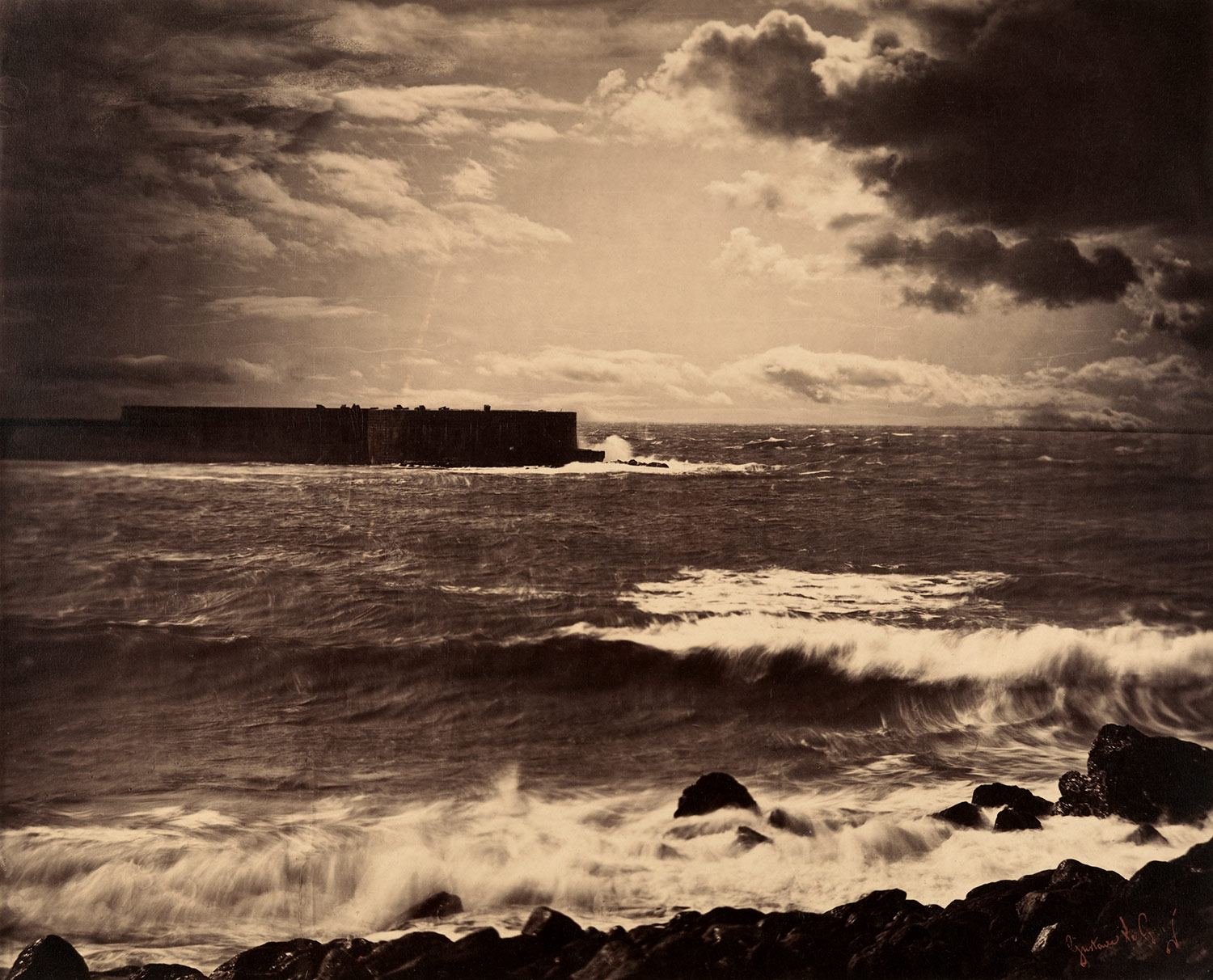
Gustave Le Gray, whose images of light and motion inspired the Impressionists;


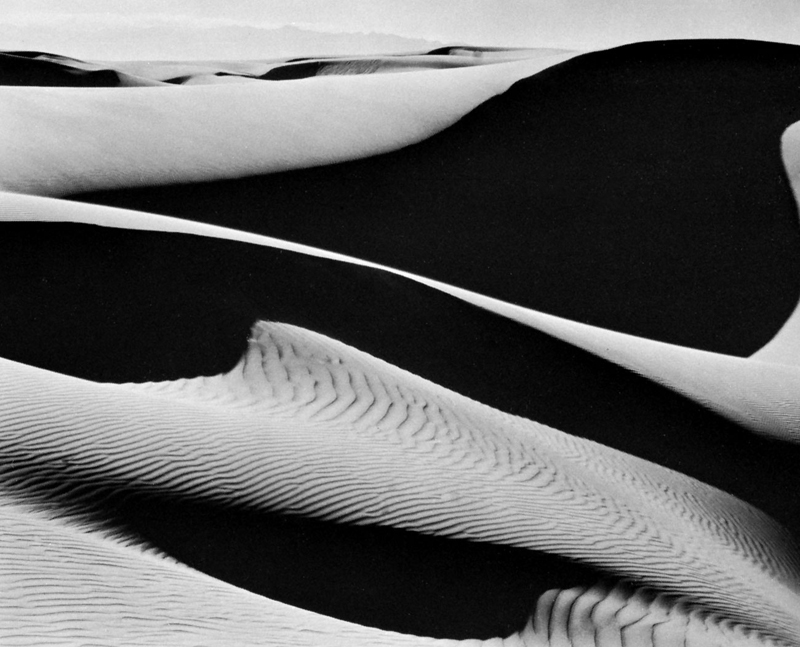
Edward Weston;


Julia Margaret Cameron; and Charles Aubry.

These striking images are complemented by an array of modern and contemporary works that trace the medium’s history as a visual art form, including recent acquisitions by artists such as Florence Henri, Roy DeCarava, and Hiroh Kikai, many on view for the first time in Philadelphia.

The mainly black-and-white photographs reflect the strengths of the Museum’s photography collection, ranging from the 1840s to 2005. Nineteenth-century photographs include works by William Henry Fox Talbot, an early inventor of photography; a group of views from Felice Beato’s 1860 album China; and


Rue des Prêtres Saint‑Étienne, de la rue Descartes by Charles Marville, who documented the narrow quarters of nineteenth-century Paris.

Post-World War II American and Japanese photography is seen through a number of works by


Robert Frank including Jehovah’s Witness, Los Angeles (1955),


Diane Arbus’s Untitled (6) (1970–71),


and Masahisa Fukase’s Untitled (1976).


The exhibition continues with contemporary photography by a broad range of international artists, including Joachim Koester’s Room of Nightmares #1 (2005) and Gerhard Richter’s Guildenstern (Rhombus II) (1998), a cunning investigation of the shared terrain between painting and photography.

The works by Norman and Stieglitz were made during the years of their creative exchange, from 1929 until Stieglitz’s death in 1946. These include a number of portraits, such as


Norman’s cropped close-up Alfred Stieglitz IX, New York (1933);

cityscapes and landscapes, as seen in


Stieglitz’s New York from the Shelton (1935), showing the interplay of light and shadow on the skyscrapers of a changing New York skyline;

and Norman’s Harbor II, Osterville, Cape Cod (1930s), a study in line and composition.

These images are complemented by photographs made by their contemporaries, including


Man Ray’s surrealist Marquise Casati (1922)


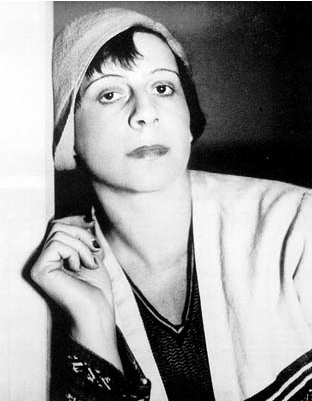
and Florence Henri’s Portrait (c. 1930).

Wednesday, January 2, 2013

J.M.W. Turner at the National Gallery of Australia


Exhibition will be on view 1 June 2013 – 8 September 2013.


J. M. W. Turner (1775–1851) is one of Britain’s greatest artists, a key figure of the Romantic generation. He is celebrated as a highly modern painter, his work much admired for its experimental character.

Turner’s paintings and watercolours are highly coveted by museums and collectors, and widely dispersed internationally. Only at the Tate can we gain a full sense of Turner’s aims and achievements. The artist’s gift to the British nation was originally limited to the finished paintings exhibited in his lifetime, many of which he retained or re-acquired with a view to his donation to the national collection. The larger settlement, after the artist’s death, meant these paintings were supplemented by the contents of his house and studio.

Turner from the Tate reflects the diversity of this unique collection. It provides a comprehensive overview of Turner and his artistic development, while offering extraordinary insights into his working life and practices. The exhibition consists of 40 oils complemented by 70 works on paper, from large watercolours to intimate sketches. It includes ambitious early works such as


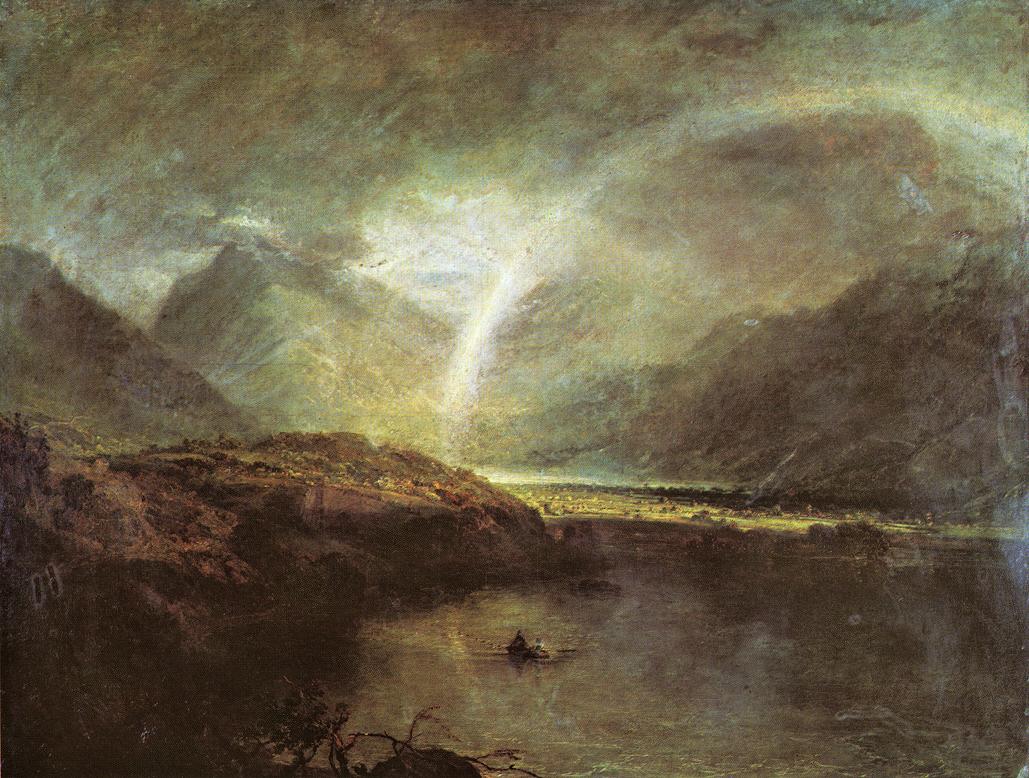
Buttermere Lake, with part of Cromackwater 1798


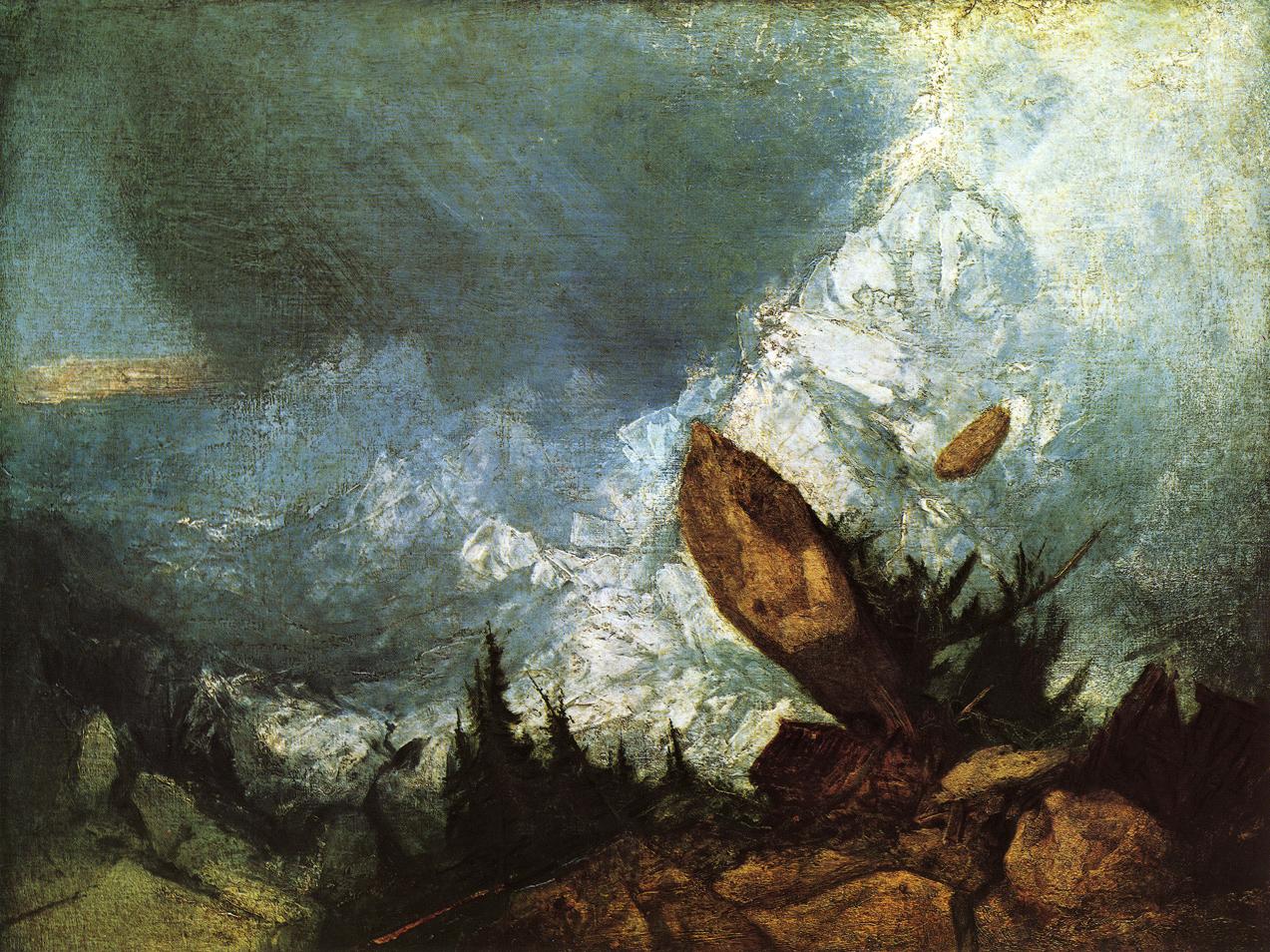
and the spectacular The fall of an avalanche in the Grisons 1810.

Elsewhere in the exhibition we see how Turner set himself up as the heir to the European landscape tradition. Turner from the Tate also features remarkable paintings of Turner’s late career including the exquisite Venice, the Bridge of Sighs 1840. The exhibition culminates with powerful seascapes:


A disaster at sea c.1835, for example, shows a notorious shipwreck of a convict ship bound for NSW in which many women drowned.


The nearly monochrome Peace – Burial at sea 1842


and its striking companion, War. The exile and the rock limpet 1842, provide a dramatic final note.

As well as many of Turner’s most famous paintings, Turner from the Tate highlights works never shown previously. The exhibition offers fresh perspectives on an artist who was valued as a master in his own time and whose impact was felt as far away as Australia.

Turner from the Tate
is organised by Art Exhibitions Australia, and presented by the Tate in association with the Art Gallery of South Australia, Adelaide, and the National Gallery of Australia, Canberra. –

J M W Turner watercolors at the Scottish National Gallery


J.M.W. Turner, The Piazzetta, Venice, 1840. Watercolour and gouache and pen and ink, with scraping out on paper, 22.1 x 32.1 cm. Scottish National Gallery.

In keeping with a century-old tradition, New Year’s Day at the Scottish National Gallery will be marked by the opening of the annual exhibition of watercolours by J M W Turner (1775–1851). In his 1900 bequest to the gallery, Henry Vaughan, a London art collector who amassed an outstanding group of watercolours by the British painter, stipulated that the Turner watercolours must not be subjected to permanent display, since continual exposure to light would result in their fading.

The annual exhibition of thirty-eight works on paper has become a much-loved tradition at the Scottish National Gallery. The display runs throughout January, providing a thoughtful counterpoint to the more energetic celebrations of Edinburgh’s Hogmanay, and a welcome injection of light and colour during the darkest month of the year.

Recognised as perhaps the greatest of all British artists, Turner was a master of watercolour painting, using the medium to create stunning land and seascapes, topographical views and designs for book illustrations. Vaughan acquired examples from every period of the artist’s career, and chose each with a connoisseur’s eye for quality. The exquisite works in his bequest range from early wash drawings of the 1790s, to colourful and atmospheric watercolour sketches of Continental Europe, executed in the 1830s and 1840s.

For Turner, as for many artists and writers at the end of the eighteenth century, the vastness and violence of nature inspired a sense of awe, or even a terror, which was described as an experience of the ‘Sublime’. It was the opportunity to express these emotions through landscape painting which attracted Turner repeatedly to the mountains of Britain and Europe, and to paint the savage elemental forces seen in avalanches, storms and mountainous seas.

These experiences can be seen in works such as


Loch Coruisk, Skye which was painted after one of the artist’s trips to the Scottish Highlands, in 1831, and


Sion, Capital of the Canton Valais, which was created following one of his many journeys to the Swiss Alps.

Turner also visited Venice on three occasions, in 1819, 1833 and 1840, and the Vaughan Bequest features six of the artist’s stunning views of the city. In The Piazzetta, Venice, one of Turner’s most spectacular Venetian studies, a bolt of lightning dramatically illuminates the Doge’s Palace and St. Mark’s Basilica. Turner created such effects by scratching away to reveal the paper once he had painted on it: he sometimes used his thumbnail, which he is reputed to have grown like an ‘eagle-claw’, for such a purpose.

Other works, such as


The Grand Canal by the Salute, Venice, and


The Sun of Venice,which were made in the city in 1840, demonstrate Turner’s consummate mastery of atmospheric lighting effects. In these watercolours, light itself seems to have become the main subject.

For much of his career, Turner was engaged in commissions to provide illustrations for books, and many of his trips were undertaken with a specific publishing project in mind. The artist’s prolific activities as an illustrator are represented here by a number of images, including scenes painted for Robert Cadell’s collected editions of the Poetical and Prose Works of Sir Walter Scott.


J.M.W. Turner, Heidelberg, c.1846. Watercolour, gouache and pen and ink, with scraping out on paper, 37.4 x 5.3 cm. Scottish National Gallery.

Lichtenstein: A Retrospective - Tate - 21 February to 27 May 2013


In spring 2013, Tate Modern will stage the most comprehensive exhibition ever devoted to foremost Pop artist Roy Lichtenstein. Co-organised by The Art Institute of Chicago and Tate Modern, this will be the first major Lichtenstein retrospective for twenty years, bringing together 125 of the artist’s most definitive paintings and sculptures. Built on new research and scholarship, the exhibition will reassess Lichtenstein’s work and his enduring legacy.


Roy Lichtenstein
Whaam! 1963
Acrylic and oil on canvas
support: 1727 x 4064 mm frame: 1747 x 4084 x 60 mm
Purchased 1966© Estate of Roy Lichtenstein


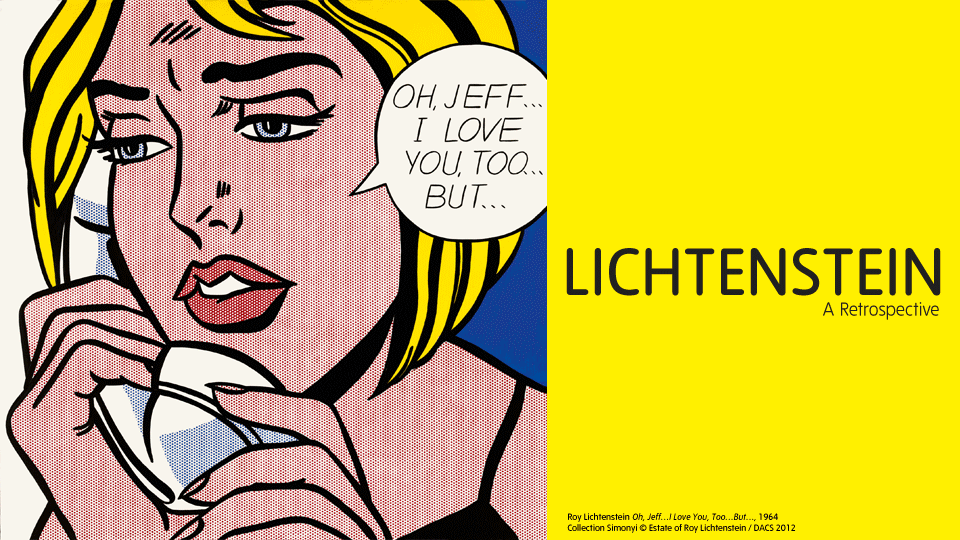
Roy Lichtenstein (1923-1997) is one of the central figures of American Pop Art. In the early 1960s he pioneered a new style of painting, executed by hand but inspired by industrial printing processes. He became renowned for works based on comic strips and advertising imagery, coloured with his signature hand-painted Benday dots, as an ongoing examination of representation and originality in mass media culture. This exhibition will showcase such key paintings as


Look Mickey 1961 (National Gallery of Art, Washington),

Whaam! 1963 (Tate),


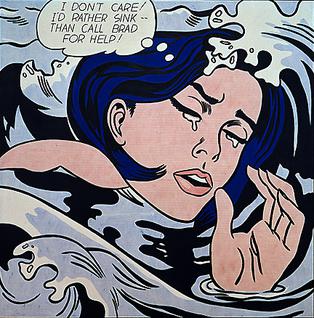
Drowning Girl 1963 (Museum of Modern Art, New York)


and his monumental Artist’s Studio series of 1973-4. The artist’s rich and expansive practice will be represented by a wide range of materials, including paintings using Rowlux and steel, as well as sculptures in ceramic and brass and a selection of previously unseen drawings, collages and works on paper.

Alongside classic paintings of romantic heroines and scenes of war for which Lichtenstein is well known, the exhibition will show other early Pop works, such as images of everyday objects in black and white. Also on display will be the full scope of Lichtenstein’s artistic explorations depicting landscapes, mirrors and so-called ‘perfect’ and ‘imperfect’ paintings.

It will also highlight Lichtenstein’s engagement with art history, revealing his lesser-known responses to Futurism, Surrealism and German Expressionism. In the final years of his life, the artist went on to create a series of huge female nudes and sublime Chinese landscapes, neither of which have previously been shown within the wider context of his oeuvre.

Roy Lichtenstein was born in New York in 1923, where he lived and worked for most of his life. After studying art at Ohio State University, he taught in New York and New Jersey before rising to prominence with a solo show at Castelli Gallery in 1962. He died in 1997 aged 73. His works are held in major public collections around the world, including the Museum of Modern Art, New York; Museum Ludwig, Cologne and the Museum of Contemporary Art, Los Angeles.

Lichtenstein: A Retrospective
is curated at Tate Modern by Sheena Wagstaff, Chairman of the Modern and Contemporary Art Department, The Metropolitan Museum of Art, New York, and Iria Candela, Assistant Curator, Tate Modern. The exhibition opened at The Art Institute of Chicago in May 2012 and traveled to The National Gallery of Art, Washington in October 2012 and then goes to the Centre Pompidou, Paris in July 2013. Bank of America Merrill Lynch is global sponsor of the exhibition.


A fully illustrated catalogue has been published by The Art Institute of Chicago and distributed by Yale University Press.

Pre-Raphaelites: Victorian Avant-Garde


Tate Britain: 12 September 2012 – 13 January 2013


Dante Gabriel Rossetti
The Beloved ('The Bride') 1865-6
Oil on canvas
support: 825 x 762 mm frame: 1220 x 1110 x 83 mm
Purchased with assistance from Sir Arthur Du Cros Bt and Sir Otto Beit KCMG through the Art Fund 1916


Combining rebellion and revivalism, scientific precision and imaginative grandeur, the Pre-Raphaelite Brotherhood shook the art world of mid-nineteenth-century Britain. This autumn, Tate Britain stages the largest survey of the group since 1984, offering a rare chance to see around 180 works brought together. Exploring their revolutionary ideas about art and society, this exhibition sets out to show that the Pre-Raphaelites were Britain’s first modern art movement. It includes famous and less familiar Pre-Raphaelite paintings as well as sculpture, photography and the applied arts.

Led by Dante Gabriel Rossetti, William Holman Hunt and John Everett Millais, the Pre-Raphaelites rebelled against the art establishment of their day. Their unflinchingly radical style, inspired by the purity of early Renaissance painting, defied convention, provoked critics and entranced audiences.

Today, renowned for their exquisitely detailed, vividly coloured style, the works of the Pre-Raphaelites are among the best known of all English paintings. This exhibition traces developments from their formation in 1848 through to their late Symbolist creations of the 1890s. It shows that whether their subjects were taken from modern life or literature, the New Testament or classical mythology, the Pre-Raphaelites were committed to the idea of art’s potential to change society. In pieces such as


Madox Brown’s The Last of England 1852-5 (Birmingham Museums and Art Gallery) they served this aim by representing topical social issues and challenging prevailing attitudes. Other artworks, including


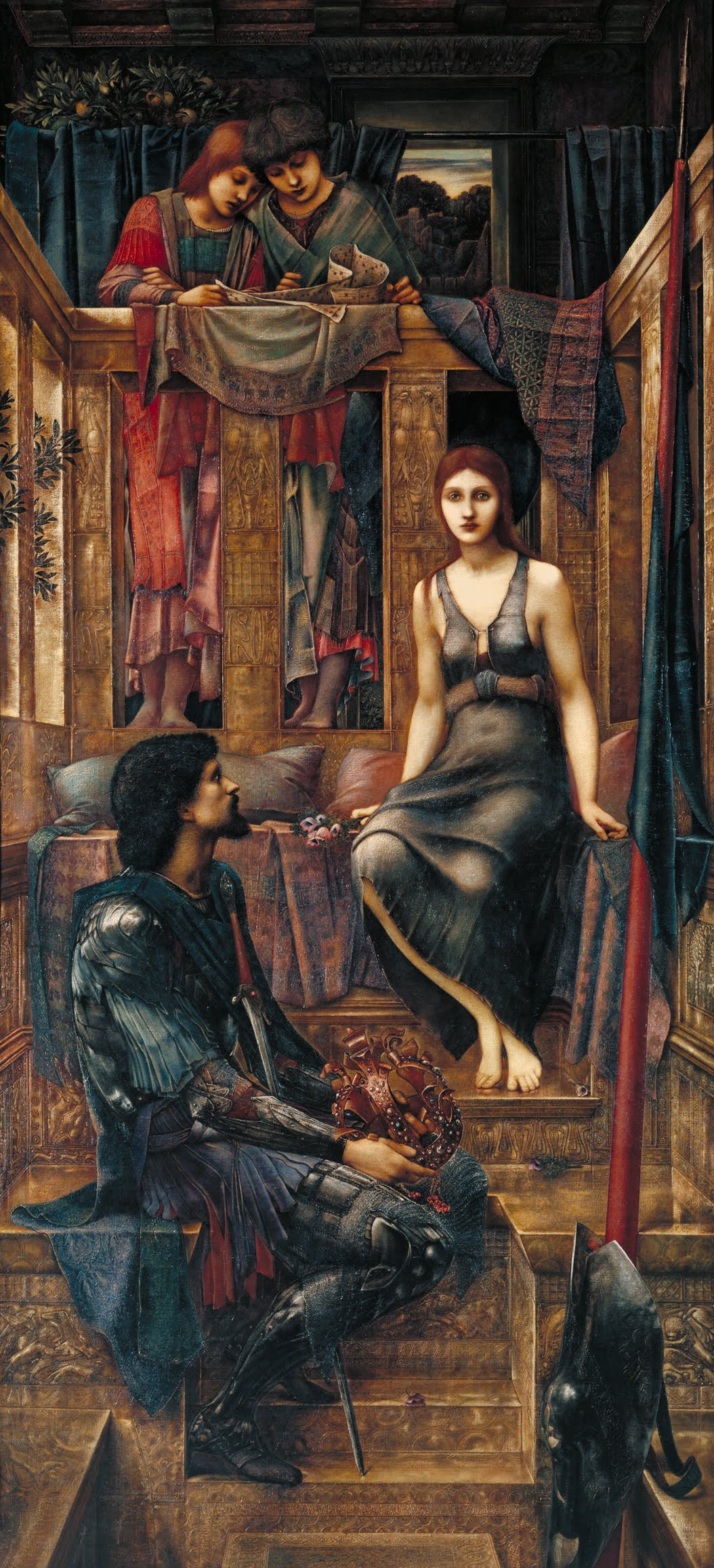
Burne-Jones’s King Cophetua and the Beggar Maid 1884 (Tate), took a different approach, embracing beauty and ornamentation as a resistance to an increasingly industrialised society.

Pre-Raphaelites: Victorian Avant-Garde
offers the chance to see well-known paintings such as


Ophelia 1851-2 (Tate) by John Everett Millais (1829-1896)


and The Scapegoat 1854-5 (National Museums Liverpool) by William Holman Hunt (1827-1910).

Highlights include masterpieces rarely seen in the UK such as


Rossetti’s Found 1854-5/1859-81 (Delaware Art Museum, USA),


Burne-Jones’s Perseus series (Staatsgalerie, Stuttgart) (seen here) and


Holman Hunt’s psychedelic The Lady of Shalott1886-1905 (Wadsworth Atheneum, Connecticut).

Spectacular late works by Hunt, Millais, Rossetti and Madox Brown are also united for the exhibition.


Lady Lilith by Dante Gabriel Rossetti

In contrast to previous Pre-Raphaelite surveys, this exhibition juxtaposes paintings with works in other media including textiles, stained glass and furniture, showing the influence of Pre-Raphaelitism in the early development of the Arts and Crafts movement and the socialist ideas of the poet, designer and theorist, William Morris (1834-1896). Bringing together furniture and objects designed by Morris‘s firm, of which many Pre-Raphaelite artists were part, it demonstrates how Morris’s iconography for British socialism ultimately evolved out of Pre-Raphaelitism. Highlights include Philip Webb and Burne-Jones’s The Prioress’s Tale wardrobe 1858 and the embroideries made by Jane and May Morris for William Morris’s bed at Kelmscott Manor c1891.


Pre-Raphaelites: Victorian Avant-Garde
is curated by Tim Barringer, Paul Mellon Professor of the History of Art, Yale University; Jason Rosenfeld, Distinguished Chair and Professor of Art History at Marymount Manhattan College, New York; Alison Smith, Lead Curator, 19th Century British Art at Tate Britain.


It is accompanied by a catalogue from Tate Publishing.

The exhibition will tour to the National Gallery of Art, Washington DC (17 February - 19 May 2013), The Pushkin State Museum of Fine Arts, Moscow (Summer 2013) and the Mori Art Center, Tokyo (Spring 2014).

American Impressionism: Hassam, Sloan


An exhibition on view through April 7, 2013 at the Huntington Museum of Art.


The first group exhibit of works by the French Impressionists took place in Paris, France, in 1874. Ironically, few of the American artists who later became known as American Impressionists took much notice of these exhibits while studying art in Paris. It seems hard to believe that this now famous group of artists which includes Claude Monet, Edgar Degas, Pierre-Auguste Renoir, Édouard Manet, Mary Cassatt, Berthe Morisot, Alfred Sisley, Camille Pissarro and Gustave Caillebotte exhibited together only eight times, until 1886, but their painting style had a marked influence on artists around the world – and on the history of art.


Many young American artists traveled to Paris in the 1870s and 1880s, then the art capital of the world, to round out their American academic art studies, the majority at the Académie Julian.

The first American Impressionist canvases painted in the United States by repatriated artists occurred in the late 1880s (with the exception of expatriate artists John Singer Sargent and Mary Cassatt who were creating impressionist paintings earlier), following a flurry of U.S. exhibits of French Impressionist works, and the interest of a number of prominent American collectors in acquiring works by Monet, Renoir, Pissarro, Manet, Sisley and others – thus validating the style in America.

American impressionist painters often combined academic training with the more radical impressionist techniques, selecting and focusing on one or more of the tenets of impressionism such as incorporating a broken brush work, prismatic light, atmospheric and/or climate effects on an object, observing, sketching and painting out-of-doors (en plein air), or the depiction of modern subject matter – especially leisure-time activities.

The permanent collection of the Huntington Museum of Art holds a treasure trove of American Impressionist paintings. This exhibition will present these important and popular works painted by many of the best-known American impressionists including Childe Hassam, J. Alden Weir, Willard L. Metcalf, John H. Twachtman, Frank Benson, Edward Willis Redfield, W. Elmer Schofield, Arthur Meltzer, and many others. –