The San Diego Museum of Art presents the exhibition Art & Empire: The Golden Age of Spain,
featuring more than 100 outstanding works by leading artists from Spain
and its global territories during the pivotal years of around 1600 to
1750. On view May 18, 2019 through Sept. 2, 2019, the exhibition
showcases a wide variety of exquisite paintings, sculpture, and
decorative arts produced throughout the Spanish-speaking world. This
exhibition is the first in the U.S. to examine the notion of “Golden
Age” beyond the shores of the Iberian Peninsula by bringing together
works from Spain’s European, American, and Asian realms.
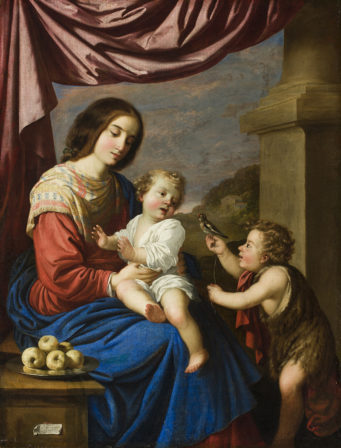
Francisco de Zubarán, Virgin and Child with Saint John, 1658. Oil on canvas. Gift of Anne R., Amy and Irene Putnam. 1935.22 San Diego Museum of Art
“Art & Empire: The Golden Age of Spain showcases the
broad scope of the Spanish empire and helps bring context to some of the
international treasures within the Museum’s permanent collection,” said
Roxana Velásquez, Maruja Baldwin Executive Director of The San Diego
Museum of Art. “Our renowned collection of Spanish art is on view
alongside important works from private collections and major
institutions around the world. This is an opportunity for San Diego and
its visitors to see works by the most influential Spanish artists,
including Diego Velázquez, whose work has transcended time and continues
to inspire new generations of artists.”
Juan Sánchez Cotán, Still life with Quince, Cabbage,
Melon, and Cucumber, ca. 1602 Oil on canvas. Gift of Anne R. and Amy
Putnam. 1945.43 San Diego Museum of Art
Artists featured in the exhibition include Diego Velázquez, Peter
Paul Rubens, Bartolomé Esteban Murillo, Francisco de Zurbarán, Jusepe de
Ribera, El Greco, Juan de Valdés Leal, Juan Sánchez Cotán, and many
more. This exhibition also marks the first time in the Museum’s history
that all five of the Spanish masters represented on the Museum’s
building façade—Velázquez, Murillo, Zurbarán, Ribera and El Greco—will
be shown together at the Museum.
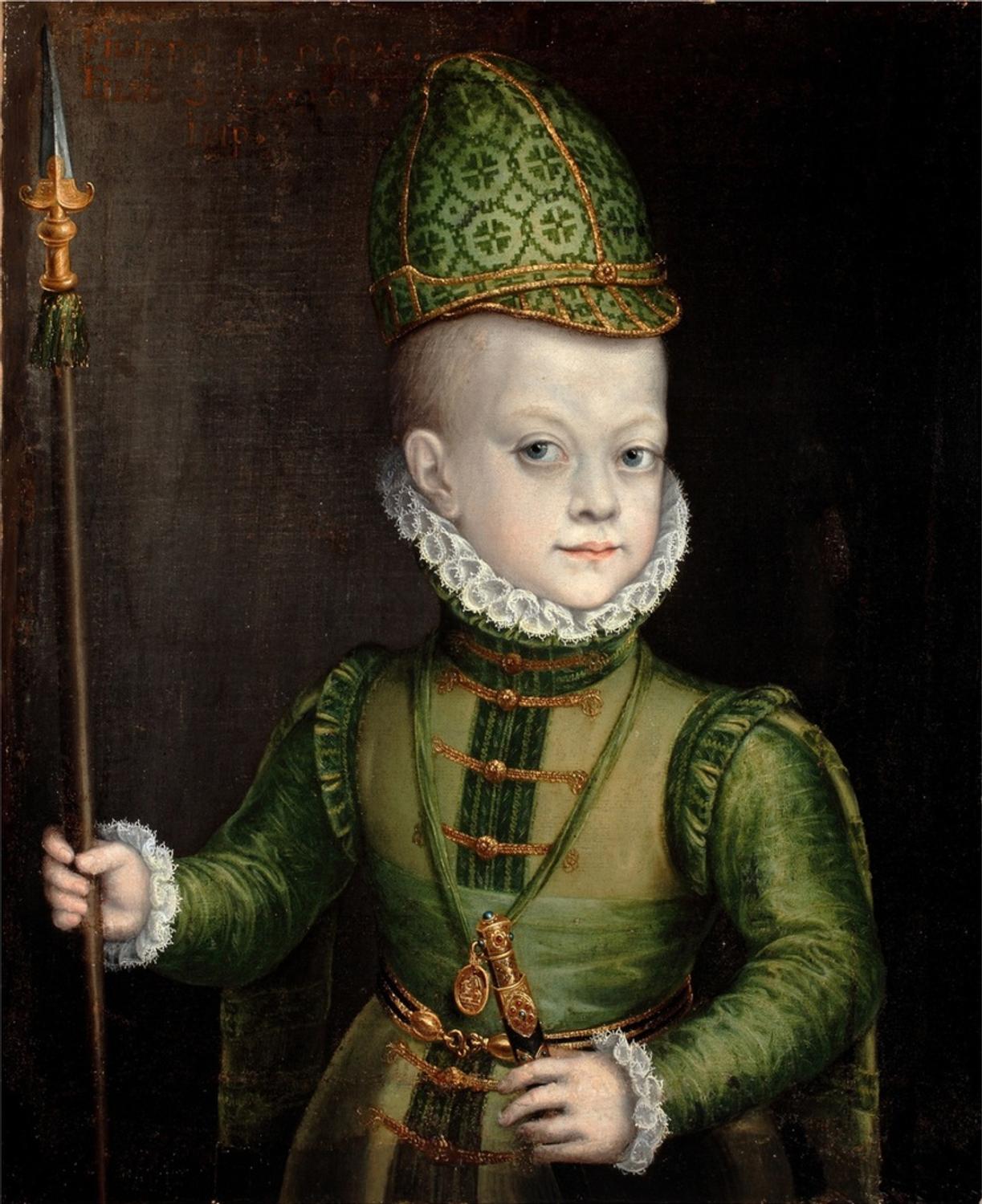
Sofonisba Anguissola, Portrait of a Spanish Prince
(probably Philip II), ca. 1573. Oil on canvas. Gift of Anne R. and
Amy Putnam. 1936.51. San Diego Museum of Art
Art & Empire: The Golden Age of Spain brings to life the
extraordinary moment when Spain’s visual arts, architecture,
literature, and music all reached unprecedented heights. More than 100
works of art are organized into five sections including The Courtly
Image: Portraiture in the Hispanic World; The Birth of Naturalism; Art
in the Service of Faith; Splendors of Daily Life; and Global Materials
and Trade, and represent more than 10 countries, including Belgium,
Italy, Mexico, Peru and the Philippines.
In addition to organizing the exhibition, Dr. Michael Brown, the
Museum’s Curator of European Art, is editor and contributing author of
the accompanying, fully illustrated publication, which features essays
by renowned art historians including Jonathan Brown, the preeminent
authority on Spanish art, as well as Benito Navarrete Prieto, Sofía
Sanabrais, and Jorge Rivas Pérez.
Sixteen Artists including René Magritte, Joan Miró, Oscar Domínguez, Max Ernst, James Ensor and Salvador Dalí
Launching 20th Century at Christie’s on 27 February 2019, The Art of the Surreal sale will follow the Impressionist & Modern Art Evening Sale. This year’s 18th edition of Christie’s annual The Art of the Surreal
auction includes Surrealist works spanning from 1890 to 1974, with 34
lots by 16 artists. The sale includes seven works by René Magritte, led
by Le lieu commun (1964, Estimate on Request), one of the
finest and largest examples of his iconic bowler-hatted men.
Never-before seen at auction, the work offers a unique view of the
wandering figure both full-face and hidden behind a column in an
ambiguous landscape of either impossible or multiple reality. Six works
by Max Ernst and four by Joan Miró are also offered, alongside a rare
discovery by Salvador Dalí, one of the experimental works of Joan Miró’s
‘dream’ paintings, and a rediscovered, large and enigmatic work by
Oscar Domínguez, unseen in public since its creation in 1934. The works
from the sale will be exhibited in London from 21 to 27 February 2019,
with 20th Century at Christie’s continuing until 7 March.
Olivier Camu, Deputy Chairman, Impressionist and Modern Art, Christie’s: “The 18th
edition of our annual themed sale promises to be exciting, with newly
discovered paintings by Dali and Dominguez, as well as Magritte’s
masterpiece Le lieu commun. It’s an honour to present this work
at auction for the first time. It is the most important and iconic
representation of Magritte’s bowler-hatted man to be auctioned since the
sale of Le fils de l’homme in 1998, which reached a phenomenal
price at Christie’s New York. Formerly in the collection of Gustave
Nellens, who received it from the artist, Le lieu commun is one
of the eight largest paintings Magritte did in this hyper-realistic
style of the bowler-hatted man, four of which are now in museums.”
René Magritte
René Magritte (1898-1967)Le monde poétique II
Estimate GBP 1,500,000 - GBP 2,500,000
(USD 1,938,000 - USD 3,230,000)
Lot 103
René Magritte (1898-1967)Moments musicaux
Estimate GBP 750,000 - GBP 1,250,000
(USD 969,000 - USD 1,615,000)
Lot 102
René Magritte (1898-1967)Le pain quotidien
Estimate GBP 2,000,000 - GBP 3,000,000
(USD 2,584,000 - USD 3,876,000)
Lot 105
René Magritte (1898-1967)Le lieu commun
Estimate on request
Lot 108
René Magritte (1898-1967)La belle captive
Estimate GBP 2,000,000 - GBP 3,000,000
(USD 2,584,000 - USD 3,876,000)
Lot 112
Led by Le lieu commun, six additional works by René Magritte will be offered for sale. In La belle captive (1931,
estimate: £2,000,000-3,000,000), René Magritte presents, for the very
first time, the image of a painted canvas standing on an easel,
depicting the exact same scene that its presence within the picture
seems to obscure. This was to become a familiar device for the rest of
his career.
In Composition on a Sea Shore (1935-36, estimate:
£2,000,000-3,000,000) three incongruous and impossible objects are
positioned amidst a sun-soaked beach: a sheet of corrugated metal
interspersed with spherical bells; a picture-within-a-picture; and an
amorphous, flesh-coloured column or pillar, an object that is completely
unique within the artist’s oeuvre. Floating amidst the clouds,
the body of a statuesque nude woman is framed by the jagged opening of a
darkened cave in Magritte’s Le pain quotidien (1942, estimate: £2,000,000-3,000,000). Never-before seen at auction, Le pain quotidien has remained in private hands since the time of its conception. Additional works include Le monde poétique II (1937, estimate: £1,500,000-2,500,000), Moments musicaux (1961, estimate: £750,000-1,250,000) and Les barricades mystérieuses (1960, estimate: £350,000-450,000).
Max Ernst
Max Ernst (1891-1976)Aux antipodes du paysage
Estimate GBP 400,000 - GBP 600,000
(USD 516,800 - USD 775,200)
Lot 121
Max Ernst (1891-1976)Ohne Titel (Muschelblumen)
Estimate GBP 260,000 - GBP 350,000
(USD 335,920 - USD 452,200)
Lot 127
Max Ernst (1891-1976)Projet pour le monument aux oiseaux
Estimate GBP 100,000 - GBP 200,000
(USD 129,200 - USD 258,400)
Lot 130
Max Ernst (1891-1976)Mer et soleil or Tremblement de terre
Estimate GBP 500,000 - GBP 800,000
(USD 646,000 - USD 1,033,600)
Lot 120
Bathed in the strange light of the cosmic sun wheel at the centre of the composition, the enigmatic Mer et soleil (1926,
estimate: £500,000-800,000) belongs to a series of works that Max Ernst
created in the late 1920s in which he explores spontaneous, unconscious
painterly effects and techniques in the construction of his
compositions. Painted in 1936, and previously owned by Doris Copley and
Dorothea Tanning, Aux antipodes du paysage (1936, estimate:
£400,000-600,000) is a powerful illustration of the constantly evolving
nature of Max Ernst’s Surrealist vision. The group is completed by three
early works, Projet pour le monument aux oiseaux (1927, estimate: £100,000-200,000), Ohne Titel (Muschelblumen) (1928, estimate: £260,000-350,000) and L’homme et la femme (circa 1929-30, estimate: £80,000-120,000), and an oil from 1962, Où naissent les cardinaux (1962, estimate: £700,000-1,000,000).
Salvador Dalí
Salvador Dalí (1904-1989)Sans titre
Estimate GBP 1,000,000 - GBP 1,500,000
(USD 1,292,000 - USD 1,938,000)
Lot 125
Recently discovered, Sans titre
(1932, estimate: £1,000,000-1,500,000) is a microscopically detailed
painting from 1932, which introduces one of Salvador Dalí’s most
frequently rendered obsessions of the early 1930s. It depicts a red
pole, possibly a staff or a fisherman’s mast, protruding from the small,
rectangular window of a Catalan fisherman’s shack similar to the one in
Port Lligat where, in 1930, Dalí and his new love Gala Eluard had
chosen to live and embark upon their love affair. Appearing as opposites
and yet unified, the pole and the window represent Dalí’s theory
surrounding the physical characteristics of objects, here conjoined in a
way that symbolises the sense of surprise and co-dependence that he
found with Gala.
Oscar Domínguez
Óscar Domínguez (1906-1958)Violette Nozières or Elle rêve
Estimate GBP 600,000 - GBP 900,000
(USD 775,200 - USD 1,162,800)
Lot 107
Oscar Domínguez’s absorbing and enigmatic painting Violette Nozières (Elle rêve)
(1934, estimate: £600,000-900,000) is an exciting discovery, which was
only previously known from a small black and white photograph. It was
purchased directly from the artist shortly after its creation and has
remained in the same family collection ever since. Among the artist’s
rare early surrealist masterpieces, the large composition is imbued with
the raw sexuality and violence so characteristic of Domínguez’s oeuvre,
combining elements of semi-automatism with precisely rendered details
and figures to create a powerfully fantastical, dream-like image, where
every element goes through a metamorphic process in front of our eyes.
At the heart of the composition, a majestic lion boldly stares down the
shadowy faceless figure of a soldier, who raises his arm as if to shoot
at the defenceless young woman that lies in the beast’s stomach. While
for the most part its symbolism remains determinedly elusive, Violette Nozières (Elle rêve) draws
inspiration from the notorious scandal of the same name, which had
gripped France throughout 1933 and 1934: Violette Nozière’s poisoning
of both her parents, followed by her attempt to disguise it as an
apparent double suicide. Filled with a seemingly endless array of
mysterious vignettes and symbols, connected through oblique visual
hints, Violette Nozières (Elle rêve) is a surrealist tour-de-force that captures the potency of Domínguez’s unique creative vision.
Joan Miró
Joan Miró (1893-1983)Peinture
Estimate GBP 1,200,000 - GBP 1,800,000
(USD 1,550,400 - USD 2,325,600)
Lot 126
Peinture
(1927, estimate: £1,200,000-1,800,000) is one of the final and most
experimental works of Joan Miró’s radical and much celebrated series of
‘oneiric’ or ‘dream’ paintings, which the artist began in Paris in 1925
at the height of his involvement with Surrealism. Personnage (1967,
estimate: £300,000-400,000) is part of a pivotal series of painted
bronze ‘Assemblage-Sculptures’ by the artist. In the late 1960s, Miró
wholeheartedly embraced sculpture in his continuing quest to expand the
limits of art, and, following an earlier suggestion by Alberto
Giacometti, in 1967 fused his sculpture with painting by adding colour
to these works.
Further artists representing the broad range and
influence of the movement include Yves Tanguy, Alberto Giacometti, André
Masson, Victor Brauner, Francis Picabia, Man Ray, Paul Delvaux, Antoni
Tàpies, Jean Arp and finally two artists that were precursors to the
movement, Giorgio de Chirico and James Ensor.
27.02 > 23.06.2019 - BOZAR, Centre for Fine Arts In co-production with the Royal Library of Belgium
The landscapes of Bruegel, a research project by Bas Smets
As part of the commemorative year around Pieter Bruegel the Elder, the
BOZAR spring season is dominated by the artistic productions of the
dazzling sixteenth century. With the double bill ‘The Age of Bruegel’, BOZAR presents two major exhibitions around the renaissance in the Low Countries: ‘Bernard van Orley’ and ‘Prints in the Age of Bruegel’.
Prints in the Age of Bruegel
zooms in on the art of printing; the revolutionary new medium
that conquered the world in the sixteenth century.Today, we think of
Pieter Bruegel mainly as a painter, but in his time he made his name
through engravings of his drawings. Bruegel was a true pioneer of the
graphic arts, though he was far from the first or only one: his graphic
work is merely the tip of the iceberg. There are many more jewels on
paper to be discovered in the shadow of this giant.
Prints in the Age of Bruegel
is a co-production with the Royal Library of Belgium. The exhibition
sketches a lively image of print production in the Southern Netherlands
during the era of Bruegel, with numerous etchings, woodcuts and
engravings by Bruegel and such contemporaries as Lucas van Leyden, Albrecht Dürer, Pieter Coecke van Aalst, Michiel Coxcie and others.
Featuring more than 90 works produced between 1963 and 2000, the
exhibition focuses on his graphic work and explores three major themes
of his printmaking oeuvre. Lawrence’s recording and recollection of
African-American and larger African diasporic histories are featured, as
well as his vivid observations of dynamic city life in Harlem, New York
City. Works in the exhibition include significant complete print
portfolios, such as the “Toussaint L’Ouverture” series, as well as “The
Legend of John Brown” series, amongst others.
History, Labor, Life: The Prints of Jacob Lawrence is
curated by Storm Janse van Rensburg, SCAD head curator of exhibitions.
The exhibition is organized by the SCAD Museum of Art and is made
possible with support from the Jacob and Gwendolyn Lawrence Foundation.
Life in the Age of Rembrandt: Dutch Masterpieces from the Dordrecht Museum,
on view at the
Columbus Museum of Art (CMA), is the result of an innovative
international partnership with Dordrecht Museum, The Netherlands.
Spanning more than three centuries,
Life in the Age of Rembrandt
features 17th-century art from the Golden Age of Dutch painting and
concludes with works of The Hague School
of the late 19th-century. This exclusive exhibition, shown only in
Columbus, Ohio, showcases some 90 works, including 40 masterworks, many
paired with a related object such as a print, a coin, Delft ware or
silver. All the works in the exhibition are on loan
from the Dordrecht Museum, The Netherlands.
Called the cradle of the Golden Age, the city of Dordrecht is
steeped in European Old World traditions, art and history and is the
oldest incorporated port city in Holland. The influence of the Golden
Age is still visible in Dordrecht’s many mansions, ancient
warehouses, canals, churches, city walls, harbors and busy merchant
streets. Dordrecht Museum is one of the oldest and most important fine
art museums in Holland. It
houses
six centuries of Dutch paintings and presents
a varied selection of temporary exhibitions each year as well as numerous programs and events for members and visitors.
The Dutch Golden Age (17th century) was a period of great wealth for
the Dutch Republic, including Dordrecht. As international trade
expanded, cities and citizens grew in wealth and prominence. Art and
science blossomed during this time as well.
The majority
of works in Life in the Age of Rembrandt
were executed in the 17th century or Northern Baroque period, during
which Dutch painting’s most
famous master Rembrandt was active. In Dordrecht and elsewhere,
17th-century Dutch art was a mirror of daily life in Holland. The
so-called "little masters" specialized in specific subjects such as
portraits, landscapes, still lifes and genre scenes or depictions
of everyday life.
These paintings were owned by members of Holland's prosperous middle
class, and rarely included overtly religious subjects, since the
dominant Calvinist faith in Holland prohibited images of Biblical
figures in churches. However, secular paintings were
filled with hidden religious or moralizing meanings.
Jacob Gerritsz Cuyp, Bed of Tulips, 1638,
Oil on panel
Collection of the Dordrecht Museum
The flowers in Bed of Tulips
by Jacob Cuyp,
for example, are a symbol of the vanity of physical beauty (because they
quickly wilted and died) and of material greed, since they sold for
exorbitant prices in the 17th century. Indeed,
the Dutch economy crashed when the tulip market collapsed in 1637, one
year before this painting was completed.
The Fish Market
(1627) by Jacob Gerritsz
Cuyp, Dordrecht’s first important painter, depicts a fish vendor and
two women in an open-air marketplace. The painting highlights the
importance of maritime commerce in Dordrecht, and carries a warning
against vice: fish-trading was commonly associated with
base desires, hence an undertone of sexual innuendo hangs over the
scene.
Two salt cellars representing a fish monger and a maiden will be
installed adjacent to the painting. Designed by Anthony de Vos, they are
an example of costly luxury items that will
accompany certain paintings in the exhibition. In other cases, more
common, everyday objects from the 17th-century such as ice skates, a
helmet or a baby’s high chair will be paired with paintings, bringing
the content to life for visitors.
Life in the Age of Rembrandtis
the first project stemming from an ongoing collaboration between
CMA and the Dordrecht Museum, The Netherlands. The goal of the
partnership is to celebrate the remarkable treasures of both museums
while broadening perspectives and cultivating a global view of
community.
Through multiple–year exchanges, CMA and the Dordrecht
Museum will build empathy and cultural understanding between people.
Dordrecht Museum will lend to CMA old master works and in turn, CMA will
lend to Dordrecht Museum a number of its outstanding American and
European modern works of art. Not only is each museum
sharing the strength of its permanent collection, but the exchange also
allows each to present artworks not well-represented in their
respective collections.
In 2020, Dordrecht Museum will present the
temporary exhibition
Pioneers of Modernism, which will feature, among other works, Mary Cassatt’s
Portrait of a Young Woman, c. 1898, on loan from the Columbus Museum of Art, Ohio.
Jan van Goyen
View of Dordrecht, 1651
Oil on panel
Collection of the Dordrecht Museum, purchased with support of Vereniging Rembrandt,
Mondriaan Stichting,Stichting Vrienden van de Dordtse Musea and many other
funds, corporate and private support 2008
Samuel van Hoogstraten
Masters of the Mint of Holland in Dordrecht, not dated
Oil on canvas
Collection of the Dordrecht Museum
Abraham Susenier
Still Life with Shells, 1659
Oil on canvas
Collection of the Dordrecht Museum, purchased with the support of a private sponsor from
Dordrecht 1992
Aelbert Cuyp
Horsemen Resting in a Landscape,
Date unknown
Oil on canvas
Collection of the Dordrecht Museum, purchased with support of Vereniging Rembrandt 1978
Aelbert Cuyp
Portrait of the 20-year-old Duck Sijctghen,
1647
Oil on panel
Collection of the Dordrecht Museum, purchased with support of Vereniging Rembrandt,
Mondriaan Stichting and Stichting Vrienden van het Dordrechts Museum 2004
Bartholomeus Assteyn
Still Life with Flowers, Shells and a Toad, 1631
Oil on panel
Collection of the Dordrecht Museum, loan from the Cultural Heritage Agency 1953
Samuel van Hoogstraten
Bird Still Life with Cat, 1669
Oil on canvas
Collection of the Dordrecht Museum
Abraham van Strij
The Drawing Lesson , Date unknown
Oil on panel
Collection of the Dordrecht Museum, purchased with support of Vereniging Rembrandt, particularly her Willem and Mary Reus-de Lange fund 2015
Rembrandt van Rijn
Self-Portrait with Saskia,
1636
Etching
Collection of the Dordrecht
Museum, loan from Teekengenootschap Pictura
Rembrandt van Rijn
Adoration of the Shepherds, 1654
Etching
Courtesy of the Dordrecht Museum, loan from
Teekengenootschap Pictura
Thomas Cole National Historic Site May 4-November 3, 2019
Hudson River Museum in Yonkers, New York November 21, 2019, to February 28, 2020
Thomas Cole’s Refrain: The Paintings of Catskill Creek
will open on May 4 in collaboration with Cornell University Press and
the Hudson River Museum, with related programming in partnership with
Scenic Hudson and Greene Land Trust.
The exhibition, curated by H.
Daniel Peck, John Guy Vassar, Jr., Professor Emeritus of English at
Vassar College, reveals new scholarship on Thomas Cole, scholarship
explored in Professor Peck’s forthcoming book of the same title,
published with Cornell University Press. Created during the
eighteen-year period between 1827 and 1845, which spans Thomas Cole’s
mature career, the artist's completed paintings of Catskill Creek
constitute the most sustained sequence of landscape paintings he ever
made.
The views in the paintings were all anchored along one short stretch
of Catskill Creek near the Village of Catskill, where Thomas Cole lived
and worked. The exhibition considers these paintings as a series for the
first time, unified by place as well as their stable composition and
recurring motifs, even as they exhibit variations reflecting the changes
in the artist’s life and times. Cole’s repeated attention to the
landscape of Catskill Creek signifies his deep attachment to it, and
illustrates his development of a profound sense of place. Cole’s view of
the Catskill Mountains that frames Catskill Creek can still be enjoyed
from the porch of the Main House at the Thomas Cole National Historic
Site today.
"The exhibition tells the story of Cole’s discovery of
Catskill Creek, with its Catskill Mountain background, and his ever
deepening attachment to it over the course of eighteen years. The
paintings contain mysteries— enigmatic figures, evocative human
structures, and symbolic landforms – that tell stories of their own,"
notes H. Daniel Peck, Exhibition Curator and John Guy Vassar, Jr.,
Professor Emeritus of English at Vassar College.
"This is a unique opportunity to immerse yourself in Cole’s stunning
paintings of Catskill Creek and to visit the very place along Catskill
Creek that Cole fell in love with nearly 200 years ago. The stretch of
land depicted in the paintings has been preserved as a public park that
is located just a few miles from the historic site," said Elizabeth Jacks, Executive Director of the Thomas Cole National Historic Site.
Exhibition Overview
The exhibition follows Cole’s Catskill Creek paintings from the 1820s
through the 1840s--almost the full course of his career--and includes
twelve original oil paintings by the artist. Represented, as well, are
paintings of the Catskill Creek scene by leading nineteenth-century
artists who were inspired by Cole: Asher B. Durand, Frederic Edwin
Church, and Charles Herbert Moore.
The exhibition features Thomas Cole
paintings from private collections that have rarely been seen in public:
Thomas Cole, View Near Catskill, 1828-29. Oil on wood panel, 24 1/4 x 33 3/4 in. Framed: 31 1/2 x 41 x 2 3/8 in. Private collection.
View Near Catskill, 1828-29,
and Settler’s Home in the Catskills,
1842,
as well as major works from the collections of the New-York
Historical Society, Yale University Art Gallery, The National Gallery of
Art, Albany Institute of History and Art, Olana State Historic Site,
the Frances Lehman Loeb Art Center at Vassar College, Detroit Institute
of Arts, and The Currier Museum of Art.
Thomas Cole’s Refrain: The Paintings of Catskill Creek will
be presented in the Thomas Cole Site’s reconstructed “New Studio,” a
building designed by Thomas Cole at his home in Catskill, New York.
After the debut at the Thomas Cole National Historic Site, the
exhibition will travel to the Hudson River Museum in Yonkers, New York,
where it will be on view from November 21, 2019, to February 28, 2020.
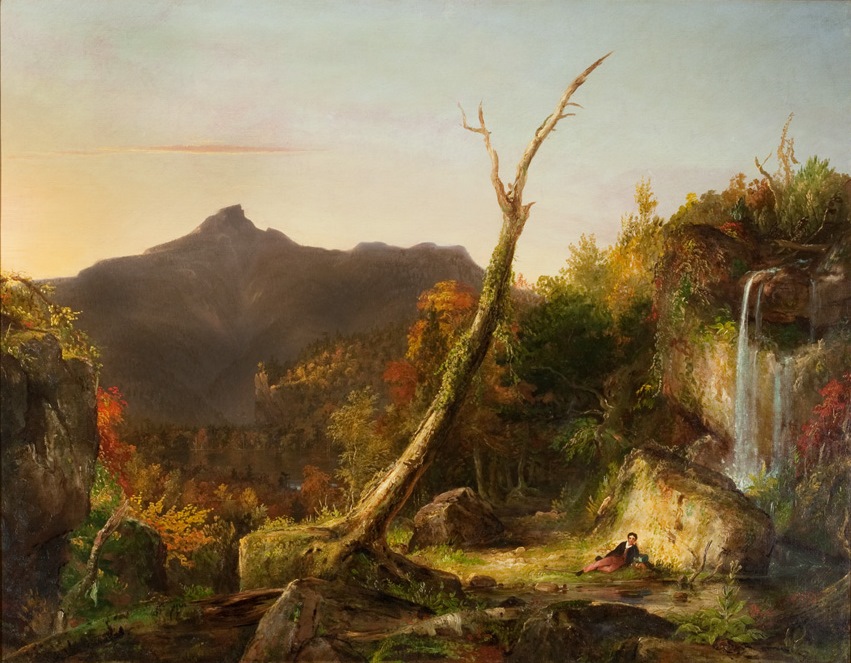
THOMAS COLE, North Mountain and Catskill Creek, 1838.
Oil on canvas, 26 7/16 x 36 7/16 in. Framed: 40 1/4 x 50 3/16 x 4 1Ž2
in. Yale University Art Gallery, Gift of Anne Osborn Prentice, 1981.56
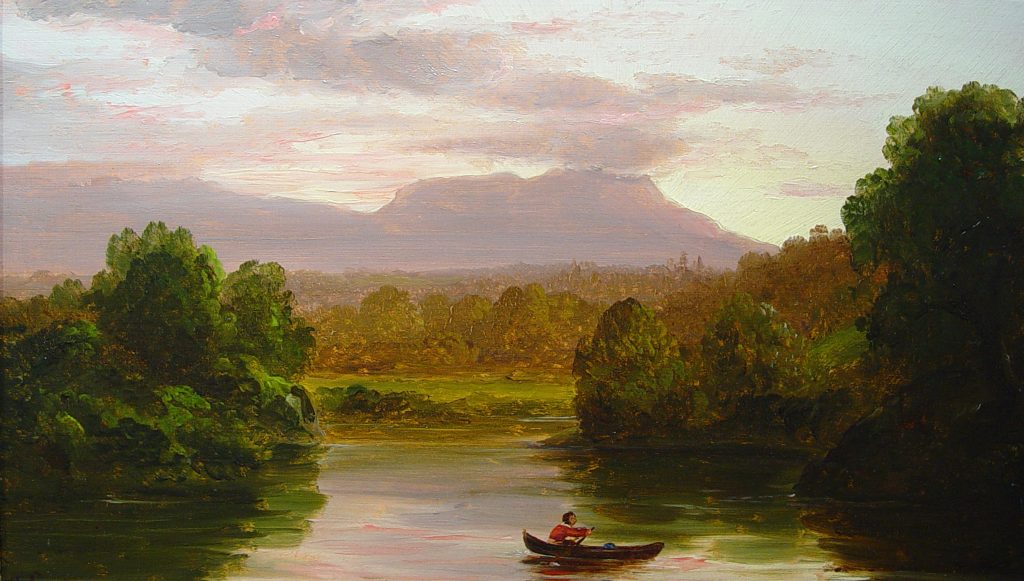
Thomas Cole, On Catskill Creek, Sunset, c.
1845-47. Oil on panel, 8 13/16 x 14 1/2 x 3/8 in. New-York Historical
Society, Collection of Arthur and Eileen Newman, Bequest of Eileen
Newman, 2015.33.8.
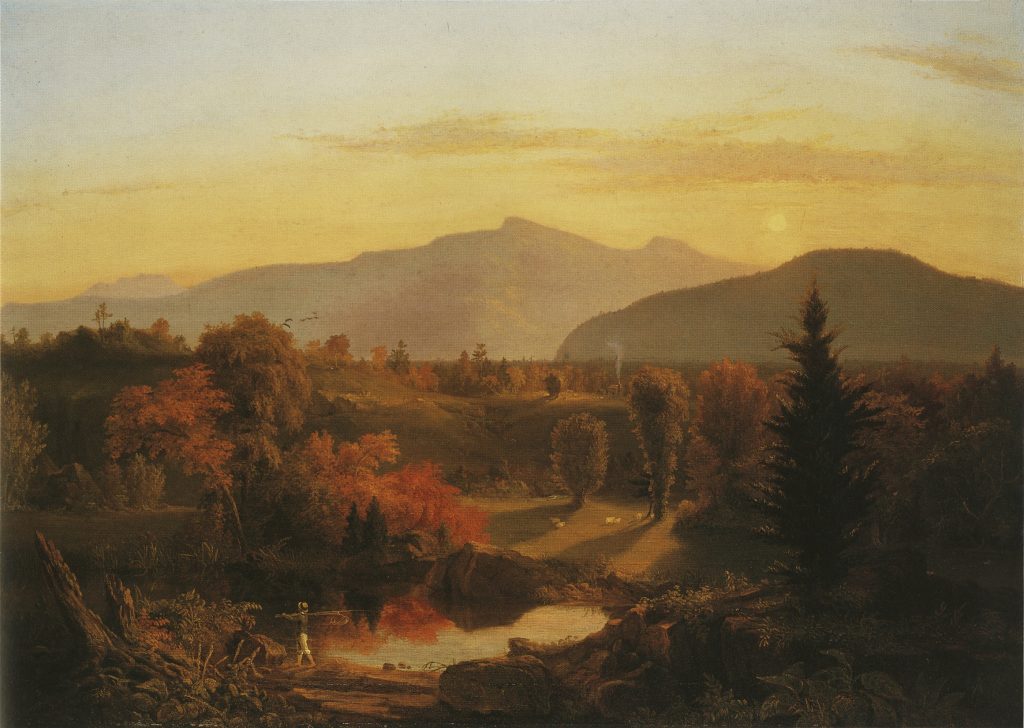
Thomas Cole, Autumn Landscape (View of Mount Chocorua), 1827-28. Oil on canvas, 38 5/8 x 48 1/2 in. The Jack Warner Foundation, Tuscaloosa, Alabama.
THOMAS COLE, Catskill Creek, New York, 1845. Oil on
canvas, 26 1Ž2 by 36 in. / Framed: 37 5/8 x 47 5/8 x 4 1/2 in.
New-York Historical Society, The Robert L. Stuart Collection, Gift of
his widow Mrs. Mary Stuart, S-157
Catalogue
The exhibition will be accompanied by a 186-page publication written
by H. Daniel Peck, John Guy Vassar, Jr., Professor Emeritus of English
at Vassar College, with forewords by Elizabeth Jacks, Executive Director
of the Thomas Cole National Historic Site, and Masha Turchinsky,
Director of the Hudson River Museum. Thomas Cole’s Refrain: The Paintings of Catskill Creek will
be published by Cornell University Press.
With new scholarship and
interpretations of both Cole’s major and little-known works, the
publication will also feature maps identifying the locations where Cole
sketched. Professor Peck is the author of books about writers Henry
David Thoreau and James Fenimore Cooper, and has published on painters
Asher B. Durand and Georgia O’Keeffe. His work on this project was
supported by an Andrew W. Mellon Emeritus Fellowship. The recipient of
several NEH and ACLS fellowships, Professor Peck has chaired the Modern
Language Association’s Division on Nineteenth-Century American
Literature, and has served as director of Vassar College’s American
Studies Program.
Thomas Cole, an internationally renowned artist, centered his art and
life in Catskill, New York. From his vantage point near the village,
he cast his eyes on the wonders of the Catskill Mountains and the
swiftly flowing Catskill Creek. These landscapes were sources of
enduring inspiration for him.
Over twenty years, Cole painted one
view of the Catskill Mountains at least ten times. Each work represents
the mountains from the perspective of a wide river bend near Catskill,
New York. No other scene commanded this much of the artist's attention.
Cole's Catskill Creek paintings, which include works central to American
nineteenth-century landscape art, are an integral series. In Thomas Cole's Refrain,
H. Daniel Peck explores the patterns of change and permanence in the
artist's depiction of a scene he knew first-hand. Peck shows how the
paintings express the artist's deep attachment to place and region while
illuminating his expansive imagination.
Thomas Cole's Refrain
shows how Cole's Catskill Creek paintings, while reflecting concepts
such as the stages of life, opened a more capacious vision of experience
than his narrative-driven series, such as The Voyage of Life.
Relying on rich visual evidence provided by paintings, topographic maps,
and contemporary photographs, Peck argues that human experience is
conveyed through Cole's embedding into a stable, recurring landscape key
motifs that tell stories of their own. The motifs include enigmatic
human figures, mysterious architectural forms, and particular trees and
plants. Peck finds significant continuities—personal and
conceptual—running throughout the Catskill Creek paintings, continuities
that cast new light on familiar works and bring significance to ones never before seen by many viewers.
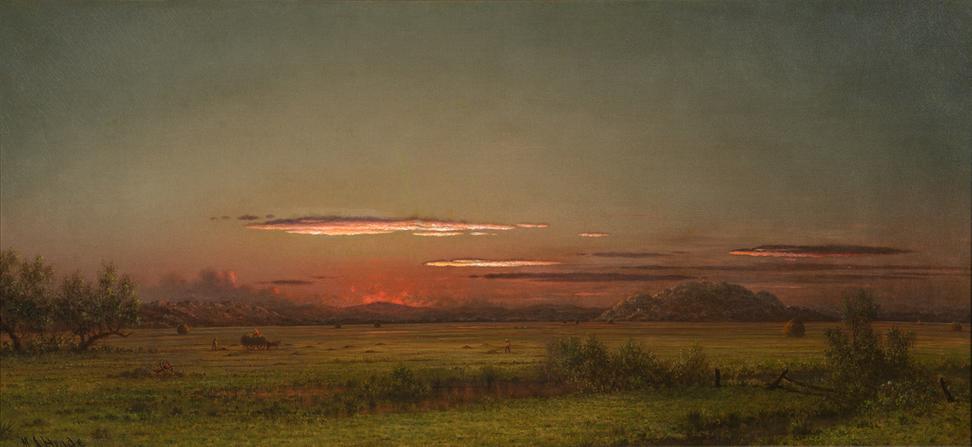
Martin Johnson Heade, New Jersey Salt Marsh, ca. 1875 -
1885, oil on canvas, 17 × 36 1/4 in. Brandywine River Museum of Art.
Richard M. Scaife Bequest, 2015
This spring the Brandywine River Museum of Art in Chadds Ford, Penn., will present American Beauty: Highlights from the Richard M. Scaife Bequest,
featuring the finest works from the bequest of Mr. Scaife—who left his
impressive art collection to the Brandywine and the Westmoreland Museum
of American Art following his death in 2014. Co-organized by the
Brandywine and Westmoreland, American Beauty features 50
paintings—a top selection of 25 from each museum’s holdings—celebrating
Scaife’s passion for the rich traditions of American art. The exhibition
will be on view March 9 through May 27, 2019 at the Brandywine.
A long-time trustee of the Brandywine—as well as a newspaper
publisher and philanthropist—Scaife was also a passionate collector of
American art. He bequeathed his entire art collection to the Brandywine
and Westmoreland, specifying that it be divided evenly between the
museums with each taking turns to make their selection. This exhibition
provides the first opportunity for the public to see the finest
paintings from the Scaife collection.
For the Brandywine, Scaife’s gift
added significant depth to its landscape holdings, introducing
extraordinary works by Martin Johnson Heade, John Frederick Kensett and
Albert Bierstadt, as well as American Impressionist paintings by
Theodore Robinson and Julian Alden Weir. Westmoreland’s collection was
similarly enriched, including a stunning landscape by George Inness
along with several marine paintings and elegant figurative works by
artists such as William Merritt Chase and Guy Pène du Bois. Together,
these paintings present a fascinating glimpse of one man’s vision and an
overview of the evolution of American art in the nineteenth and early
twentieth centuries.
“The Richard M. Scaife bequest was a watershed moment in the history
of the Brandywine River Museum of Art,” said Thomas Padon, The James H.
Duff Director of the Brandywine River Museum of Art. “The works of art
selected from Mr. Scaife’s collection bolstered and broadened the
Brandywine’s holdings and its connection to the American landscape
tradition.”
"We are delighted to be working in partnership with the Brandywine
for this exhibition,” commented Anne Kraybill, Richard M. Scaife
Director/CEO of The Westmoreland Museum of American Art. “We are very
thankful that Mr. Scaife left these works in trust to our museums to
preserve for future generations to enjoy."
During his lifetime, Scaife surrounded himself with works of art at
his two homes in Pittsburgh and Ligonier, Pennsylvania, as well as those
in Pebble Beach, California and Nantucket, Massachusetts. In California
and Massachusetts, he tended to collect the work of artists showing
scenes of these locales. This was especially the case in Nantucket where
he surrounded himself with nautical subject matter by both historical
and contemporary artists. A broader selection of American art could be
found at his two southwestern Pennsylvania homes, as well a handful of
regional artists. Examples from all four of his residences are featured
in this exhibition.
Mr. Scaife believed in art’s power to enrich our existence and its
ability to help us better understand the world and the issues facing us.
Through his bequest, these works of art, once enjoyed privately in
domestic settings, have become part of the public realm. As he wrote
toward the end of his life: “Beautiful art—paintings, music, literature,
whatever—can transform our moods, lighten our hearts, make us think or
change our minds, inspire us to be creative or live better lives.”
Theodore Robinson, Yacht Club Basin, Cos Cob Harbor,
1894, oil on wood panel, 10 × 13 1/2 in. Brandywine River Museum of
Art. Richard M. Scaife Bequest, 2015
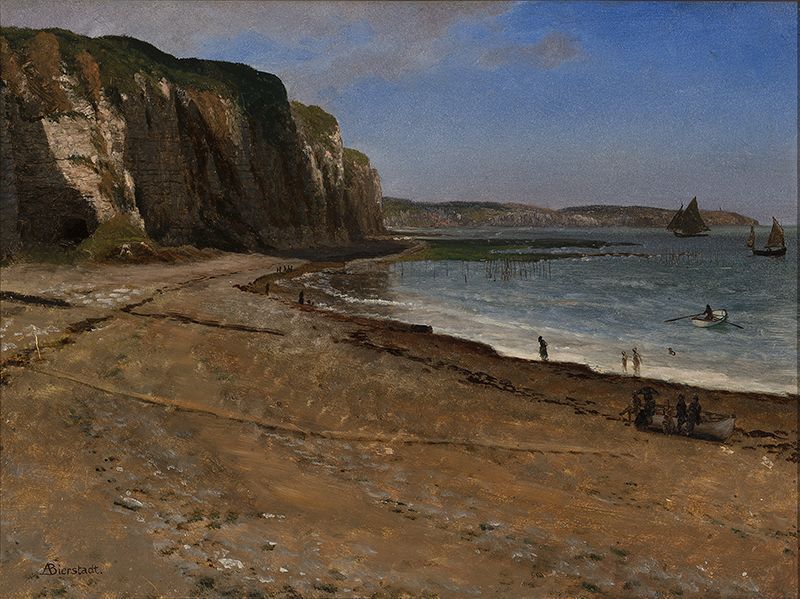
Albert Bierstadt (1830-1902), Coast of California, n.d., Oil on paper
mounted to canvas, 14 x 19 inches, Brandywine River Museum, Richard M.
Scaife Bequest, 2015, 2016.11.2
John La Farge, Fountain in Our Garden at Nikko, 1886, oil on wood panel,
11 3/4 × 9 3/4 in. Brandywine River Museum of Art. Richard M. Scaife
Bequest, 2015
George Inness, Moonrise, Alexandria Bay, 1891, oil on canvas, 30 ¼ x 45 ¼
in. Westmoreland Museum of American Art. Bequest of Richard M. Scaife,
2015
William Merritt Chase,
Interior, Oak Manor, 1899, oil on canvas, 27 x 27 in. Westmoreland
Museum of American Art. Bequest of Richard M. Scaife, 2015

.jpg?mode=max&width=200)
.jpg?mode=max&width=200)
.jpg?mode=max&width=200)
.jpg?mode=max&width=200)
.jpg?mode=max&width=200)

.jpg?mode=max&width=200)
.jpg?mode=max&width=200)
.jpg?mode=max&width=200)
.jpg?mode=max&width=200)
.jpg?mode=max&width=200)
.jpg?mode=max&width=200)
.jpg?mode=max&width=200)


.jpeg)